avatarDark Energy Articles

Free AI web copilot to create summaries, insights and extended knowledge, download it at here

2357

Abstract

atio" src="http://placehold.it/16x9"> <iframe class="" src="https://cdn.embedly.com/widgets/media.html?type=text%2Fhtml&amp;key=a19fcc184b9711e1b4764040d3dc5c07&amp;schema=twitter&amp;url=https%3A//twitter.com/Rainmaker1973/status/1625408693750595584%3Fs%3D20&amp;image=https%3A//i.embed.ly/1/image%3Furl%3Dhttps%253A%252F%252Fabs.twimg.com%252Ferrors%252Flogo46x38.png%26key%3Da19fcc184b9711e1b4764040d3dc5c07" allowfullscreen="" frameborder="0" height="281" width="500"> </div> </div> </figure></iframe></div></div></figure><h1 id="9e69">Leonardo da Vinci may have been the first to discover the workings of gravity</h1><p id="7730">However, it turns out that some aspects of gravity were understood by another scientist, many years before Newton and Galileo. Researchers at the California Institute of Technology have analyzed the lost records of Renaissance scholar Leonardo da Vinci and found that the Italian artist, architect and explorer analyzed the phenomenon of free fall.</p><p id="7a29">Several sketches by the scientist show triangles with scribbled sides. On one of them, a jar is drawn in the upper corner, from which sand, stones or drops of water are poured. The notes are dated 1480–1518</p><blockquote id="7d06"><p>“My attention was drawn to a note on which Leonardo wrote “Equatione di Moti” (Latin for “Equation of Motion”). I was intrigued by what the scientist meant by this phrase,” says Professor Mory Gharib, a biomedical engineer at the California Institute of Technology.</p></blockquote> <figure id="68d2"> <div> <div> <img class="ratio" src="http://placehold.it/16x9"> <iframe class="" src="https://cdn.embedly.com/widgets/media.html?type=text%2Fhtml&amp;key=a19fcc184b9711e1b4764040d3dc5c07&amp;schema=twitter&amp;url=https%3A//twitter.com/Gizmodo/status/1626350221864374272%3Fs%3D20&amp;image=https%3A//i.embed.ly/1/image%3Furl%3Dhttps%253A%252F%252Fabs.twimg.com%252Ferrors%252Flogo46x38.png%26key%3Da19fcc184b9711e1b4764040d3dc5c07" allowfullscreen="" frameborder="0" height="281" width="500"> </div> </div> </figure></iframe></div></div></figure><h1 id="f54a">Da Vinci depicted the movement on one of the lost notes</h1><p id="3e32">We know that Leonardo da Vinci was inte

Options

rested in the study of motion and forces acting on bodies. In 2017, Prof. Gharib analyzed with students the theories described by the Italian. It was then that he pointed out several of the several thousand surviving notes.</p><p id="a0ed">Prof. Gharib says that <b>Leonardo tried to prove that if a jug of water moves in a straight line, parallel to the ground, and flies out of it, the material does not fall at a uniform speed, but accelerates</b>. On the other hand, if the water or sand has already flown out of the vessel, and the pitcher does not affect it, these stop accelerating “vertically” and start “horizontally”, and therefore according to<b> the principle of gravity</b>. This movement is described precisely by the sides of an isosceles triangle.</p><p id="df42">The notes show that the Italian scientist was aware that water or sand would not fall at a constant speed. However, researchers at the California Institute of Technology have discovered that da Vinci erred in his calculations, which was most likely due to insufficient tools for calculating time.</p><blockquote id="52dc"><p>“We are not sure if Leonardo da Vinci conducted further experiments to clarify this issue. However, the very fact that he was dealing with it in the early 16th century shows how innovative his perception of reality was,” Prof. Gharib stresses.</p></blockquote><div id="a101" class="link-block"> <a href="https://readmedium.com/aliens-may-use-black-holes-as-quantum-computers-physicists-say-d93aaa888a7f"> <div> <div> <h2>Aliens may use black holes as quantum computers, physicists say</h2> <div><h3>Why have we still not discovered extraterrestrial civilizations? Perhaps we are not looking for what we need. Two…</h3></div> <div><p>medium.com</p></div> </div> <div> <div style="background-image: url(https://miro.readmedium.com/v2/resize:fit:320/1*-YUfLE-naxn81qvVqryjDA.jpeg)"></div> </div> </div> </a> </div><p id="361d"><b>Cool that you made it to the end of this article. I will be very pleased if you appreciate the effort of creating it and leave some claps here, or maybe even start following me. It would be nice if you also left a tip! Thank you!</b></p></article></body>

He was the first to understand the law of gravity. Many years before Newton and Galileo

Leonardo da Vinci’s lost notes contain the artist’s thoughts on gravity. Scientists claim that the Renaissance scholar was the first to understand the phenomenon of universal gravity.
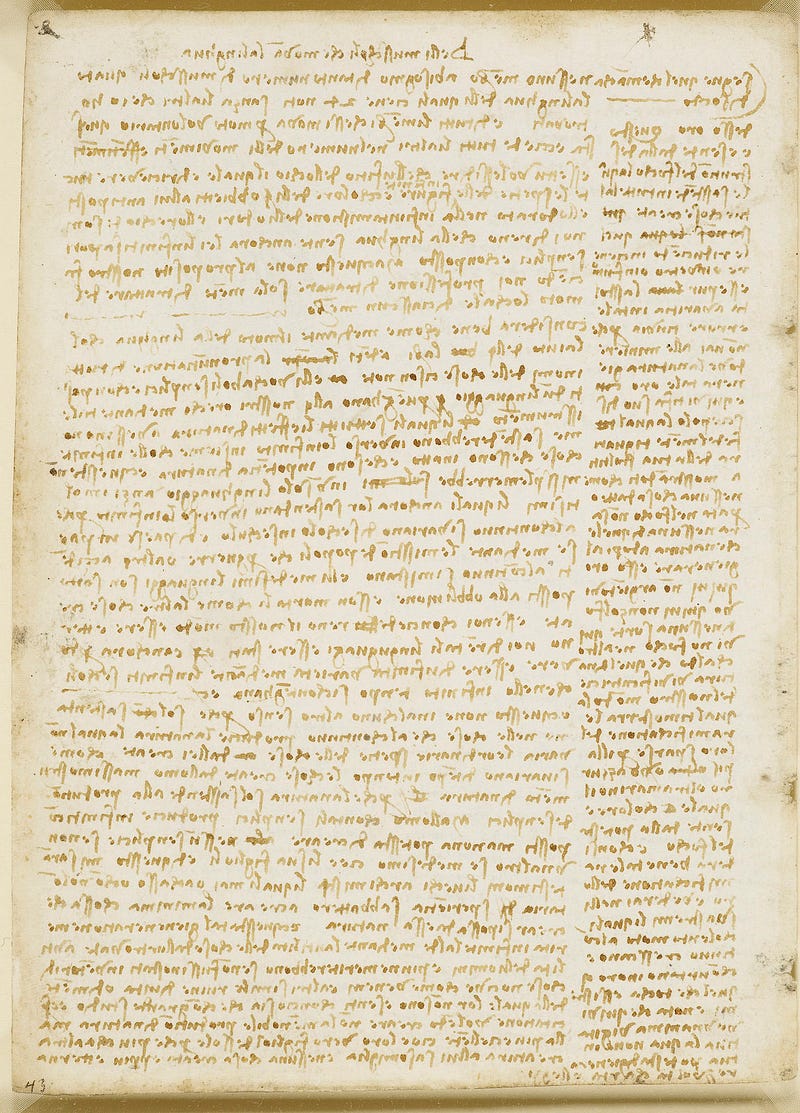
Leonardo da Vinci Notes — [Photo: Leonardo da Vinci, Public domain, via Wikimedia Commons]

Legend has it that Isaac Newton in 1687 understood what gravity was after an apple fell on his head. On July 5, he wrote the work “Mathematical Principles of Natural Philosophy,” in which he described the law of universal gravitation.

It reads as follows: “Between any pair of bodies having masses there appears an attractive force which acts on the line joining their centers, and its value is directly proportional to the product of their masses and inversely proportional to the square of the distance between their centers of gravity.”

It was not until Albert Einstein described exactly how gravity works

Newton, however, did not know how to explain the phenomenon and the law of gravity in practice. It was not until 1906–1915 that German scientist Albert Einstein developed the general theory of relativity, which combined the English scientist’s thoughts with the new mechanics. Einstein concluded that the force of gravity results from the local geometry of space-time. The concept, which states that all objects having mass or energy attract each other, revolutionized modern science.

Until now, however, it was believed that the first man to address the principles of gravity was Galileo Galilei. In 1602, he discovered that in a uniform gravitational field in the absence of other forces, all bodies fall with equal acceleration. This principle, of course, did not apply directly to gravity itself, but to motion.

Leonardo da Vinci may have been the first to discover the workings of gravity

However, it turns out that some aspects of gravity were understood by another scientist, many years before Newton and Galileo. Researchers at the California Institute of Technology have analyzed the lost records of Renaissance scholar Leonardo da Vinci and found that the Italian artist, architect and explorer analyzed the phenomenon of free fall.

Several sketches by the scientist show triangles with scribbled sides. On one of them, a jar is drawn in the upper corner, from which sand, stones or drops of water are poured. The notes are dated 1480–1518

“My attention was drawn to a note on which Leonardo wrote “Equatione di Moti” (Latin for “Equation of Motion”). I was intrigued by what the scientist meant by this phrase,” says Professor Mory Gharib, a biomedical engineer at the California Institute of Technology.

Da Vinci depicted the movement on one of the lost notes

We know that Leonardo da Vinci was interested in the study of motion and forces acting on bodies. In 2017, Prof. Gharib analyzed with students the theories described by the Italian. It was then that he pointed out several of the several thousand surviving notes.

Prof. Gharib says that Leonardo tried to prove that if a jug of water moves in a straight line, parallel to the ground, and flies out of it, the material does not fall at a uniform speed, but accelerates. On the other hand, if the water or sand has already flown out of the vessel, and the pitcher does not affect it, these stop accelerating “vertically” and start “horizontally”, and therefore according to the principle of gravity. This movement is described precisely by the sides of an isosceles triangle.

The notes show that the Italian scientist was aware that water or sand would not fall at a constant speed. However, researchers at the California Institute of Technology have discovered that da Vinci erred in his calculations, which was most likely due to insufficient tools for calculating time.

“We are not sure if Leonardo da Vinci conducted further experiments to clarify this issue. However, the very fact that he was dealing with it in the early 16th century shows how innovative his perception of reality was,” Prof. Gharib stresses.

Cool that you made it to the end of this article. I will be very pleased if you appreciate the effort of creating it and leave some claps here, or maybe even start following me. It would be nice if you also left a tip! Thank you!

History
Physics
Science
Life Lessons
Life
Recommended from ReadMedium