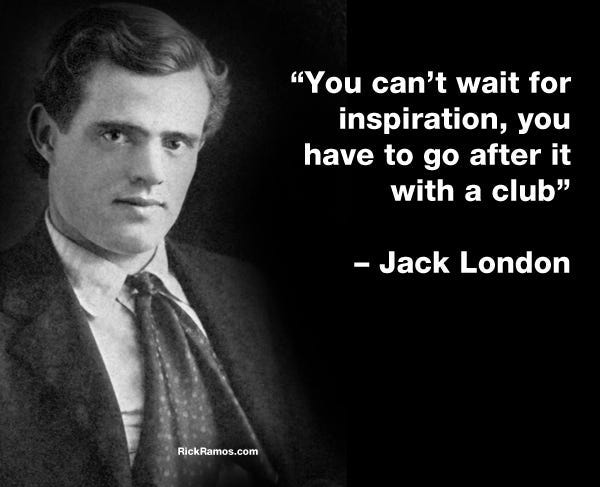
He Lived Hard, Died Young, and Was a Writer of World Experiences
Jack London has some lessons for us, but not all are good
I believe that when I am dead, I am dead. I think that with my death, I am just as much obliterated as the last mosquito you and I squashed.
Jack London (born John Griffith Chaney; January 12, 1876 — November 22, 1916). Though London died at 40, his cumulative life experiences far surpass those of most men who’ve lived twice as long, even at three times that span, most men could not pack in all the adventure and experience as Jack London had in those 40 years.
What comes to mind at the mention of Jack London? Most would say he was a great American fiction writer known for enduring works such as Call of the Wild, White Fang, and The Sea Wolf. And they’d be correct, but Jack London was so much more.
These dog stories, based at the same time and location as that of the Klondike Gold Rush, are essentially works of fiction. In truth, London could write such vivid accounts of these people and places because he was there to live them. He experienced the frozen, dreary, brutal landscape firsthand.
These stories are based on his real-life experiences in the North while actually on the quest for gold at age 21. Did London strike any gold? Perhaps not in the literal sense. But as the most prolific and highest-paid author at the time, with so many life experiences to draw from, London struck his gold.
Besides those stories from the north, which most people are familiar with, he wrote dozens of short stories and essays based on those journeys north from the San Francisco Bay area where he was born and raised. Some of these more well-known stories are An Odyssey of the North, To Build a Fire, Love of Life, The White Man’s Way, and The White Silence.
London migrated north to the Yukon and Alaskan territories with thousands of other eager gold-seekers and sailed the Pacific south seas.
He learned to sail at an early age. Working as a sailor and owning several sailboats throughout his life, Jack London was more at home at sea than on land.

At age 15, he purchased his first sailboat, the Razzle Dazzle, and made some quick, illegal cash as an oyster pirate on the Oakland estuary.
London joined the California Fish Patrol when he found out that he could make even better money working on the side of the law, hunting down and arresting oyster pirates.
As a game warden, he began hunting the same young men he once ran with to rob those precious oyster beds. It was easy money, as London knew precisely where to find these scallawags.
Later, Jack London signed on with the ship Sophia Sutherland and sailed across the Pacific to Japan. He’d also sail to Hawaii, the Solomon Islands, Samoa, Tonga, and Fiji.
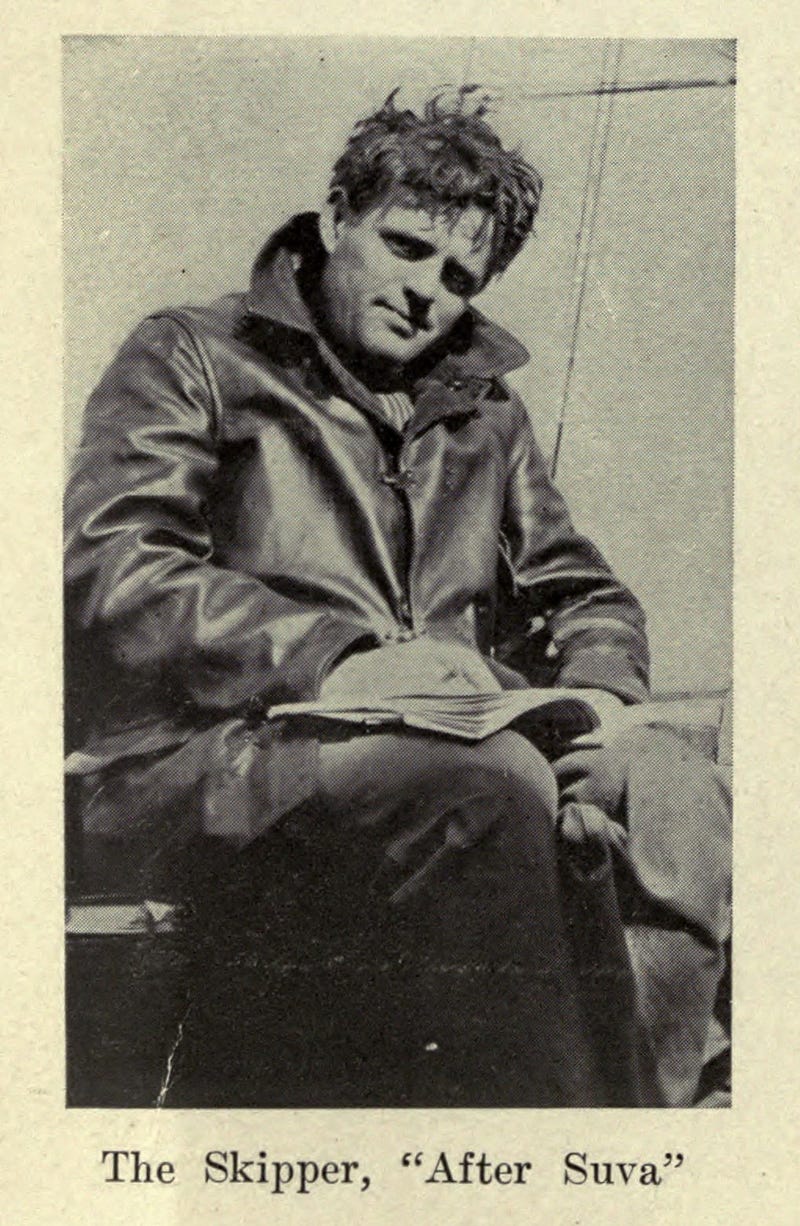
Some years later, he would build his own 55-foot vessel, the Snark, which he used to sail around the world. This he did with his second wife and soulmate, Charmian, who shared his love for travel, adventure, and all things exotic.
From those sailing exploits, London was inspired and penned several colorful works: South Sea Tales, Tales of the Fish Patrol, Cruise of the Dazzler, The Sea-Farmer, and Human Drift. And, of course, The Sea Wolf, which has been adapted for the screen at least as many times as Call of the Wild and White Fang.
The most recent iteration of White Fang is a 2018 animated feature-length Netflix Original voiced by Rashida Jones, Nick Offerman, and Paul Giamatti.
London’s life story would make for a compelling feature film or limited series. In 2009, I contacted Milo Shepard, a relative and trustee of Jack London’s estate, to query him regarding the prospect of writing a screenplay, Valley of the Moon, based on London’s life and times.
The answer at that time was a non-negotiable, no. I recall this answer being based on the estate’s dispute relating to the controversy surrounding London’s alleged suicide.
The cause of death was an overdose of morphine, which London regularly used. The dispute was whether the overdose was an act of suicide or an attempt for London to manage his chronic and severe pain.
At the time of his death, London was a raging alcoholic. He was also afflicted with dysentery, uremia, and a host of tropical diseases he and his wife, Charmian, contracted during their many travels abroad. London lived a whole life, but it was a hard life.
London was tenacious — he never quit, even after years and years of rejection. He continued to write for himself and pitch to the zines, newspapers, and publishing houses.
For anybody passionate about writing, many lessons can be gleaned from London’s examples.
Jack London’s writing was diverse
London provided publishers with various content, including adventure stories, political essays, scientific and sociological work, poetry, humor, and satire.
He worked as a war correspondent in the Russo-Japanese War of 1904, reporting directly to William Randolph Hearst. London also covered the great San Francisco earthquake of 1906.
Jack London wrote from his personal experiences.
In addition to London’s adventures seeking gold in Alaska and his travels at sea, he shoveled coal, worked at a cannery, was a hobo, rode the rails across the American continent, and hunted and skinned seals. He was a high-profile member of the Socialist Party and ran for the mayor of Oakland on that platform.
Though he lost the race for mayor, London remained an outspoken Socialist for the remainder of his days. All of these first-hand life experiences provided the backdrop for London’s stories.
Jack London was a disciplined and prolific content creator
London published more than 50 books during the last 16 years of his life. The experience of making writing a part of his daily routine was realized when London was in his early twenties.
He committed to practicing writing at least a thousand words a day. It didn’t matter to him if it was good or bad, just that he showed up, put in the time, and made his word quota.
Jack London was forward-thinking and an early adopter of ideas
After witnessing cruelty during the training and performances of circus animals, Jack London made it a mission to inform the public and increase awareness, encouraging the protest of such practices. He became one of the first activists for this cause.
London purchased a thousand-acre ranch in Sonoma County, California. He utilized farming methods that were very progressive for the time. Organic and sustainable crop methods were some practices that he learned from his travels in Asia, as well as his study of scientific design in agriculture.
London was a Renaissance man and a “Jack” of all trades. He is still a great model for those who aspire to write and take an occasional adventure to uncharted places.