
Having Sex With A Stranger — The Absurd Universal Concept of Arranged Marriage
If dating strangers is hard, try marrying one…
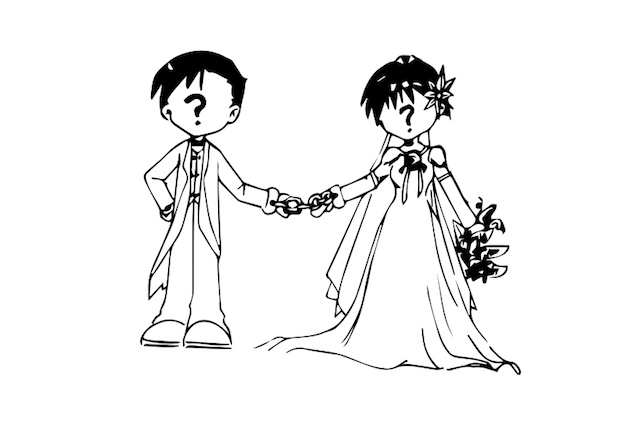
Marriage is probably the most widely accepted man-made social construct and is often referred to as a “cultural universal” by sociologists or anthropologists. A cultural universal is defined as:
“The anthropological name for something done, in some form or other, by every human culture around the world. This includes language, religion, music, art, war, families, gender roles, laws, taboos, personal names, etiquette, morals, etc.”
Many studies indicate that marriage might have been an evolutionary construct built by humans as they evolved from their primitive forms millions of years ago, and gradually became a more “social” animal.
One primary reason for the need for a formal bond or relationship traditionally between a man and a woman was child-rearing. In early times, when a female would give birth to a child, she would require a man to take care of other basic necessities such as hunting, sheltering, and safety, and so to give a child a more “secure” future, having a formal partner i.e. the “father” of the child seemed most logical.
And as the child-rearing need evolved with humans into other needs, the need for constant and stable companionship, family and lineage continuance, and many others, marriage stemmed itself as an integral part of human society.
In these early years, however, the partners who got into a “marriage” often chose each other. They might not have had the option of having bars and social networks (online and offline) to find a match, or the luxury of a Tinder to swipe right for a match, they did a fairly decent job and finding the right mating partner.
Fast forward to the more recent past, societies evolved into much more complicated structures with stricter rules and societal norms. Yet, marriage continued to pass the test of time and remained a central social construct universally, albeit, differing in traditions across cultures.
With these stricter societal norms, marriage gradually became often the only socially acceptable way that a man and a woman should mate — a euphemism for having sex, pushing the emotional, psychological, and other needs for companionship to a distant second priority.
In the more traditional societies and cultures, where excessive interaction between like-aged boys and girls after puberty or closer to adulthood wasn’t culturally and morally very acceptable, marriage shifted from being a natural selection process to a more manually curated process, often led by the parents of the prospective partners. This gave birth to the “arranged marriage.”
Arranged marriage is a type of marital union where the bride and groom are primarily selected by individuals other than the couple themselves, particularly by family members such as the parents.
While arranged marriages were common across cultures until the 18th century, some cultures, most often parts of the more modernized Western world, have evolved into a union based on courtship and active involvement of the actual couple.
Yet, according to a 2018 study by Statistic Brain, an annual 26,250,000 worldwide marriages were arranged — making its percentage 53.25% — still a majority vs. its counterpart i.e. the “love marriage.”
One of the leaders in the arranged marriage concept is the second most populous nation of the world — India. With a staggering 88.4% of unions still being arranged marriages, and its huge population, it clearly remains the world leader in the practice.
The world of arranged marriages is mysterious and complex and has significant differences in terms of how the married relationship evolves vs. a love marriage — where the couple has known each other for a while and fallen in “love” before they chose to marry. Let me highlight some of these significant differences.
Theoretical Compatibility vs. Practical Compatibility
In a love marriage, a couple would meet each other in some form — often via their networks of friends, workplace engagements, random bars or restaurants, or the modern world of online dating. They would then usually start dating and if it seems something for the long-term, they might officially get engaged turning the dating into courtship, before finally getting into wedlock.
Through all of this, there is a natural period of time that allows them to gauge compatibility on a variety of fronts — mental and emotional, physical, financial, cultural, and so on.
However, in an arranged marriage, the luxury of “practical” experimentation doesn’t exist. So, the compatibility is gauged on paper — i.e. in theory vs. in actual practice. Families and parents try to find suitable matches in “similar” families, in many cultures determined by castes, social status, financial status, and other such categories. In India, the following is a typical “classified ad” for finding a suitable partner:
“Wanted good-looking, educated, homely girl around 25 yrs of age, from respectable business family for a good looking North Indian Sharma boy / Graduate boy born Jul ’90 / 5'9” from a well-settled respectable family”
You could swap in other different permutations and combinations in the parts in italics but the core structure looks like this. The compatibility is clearly defined by certain characteristics:
- Physical appearance — Indians tend to have a fetish for “fair skin” meaning a lighter skin tone vs. dark — especially in the Northern parts of India. The word “slim” is often added to this preference, indicating the world-wide obsession with certain body-types.
- Age — In India, as in many other cultures, the girl’s “ideal” marriageable age is a few years earlier than a guy’s — so in today’s world anything from 20–28 would be a good age (from a social norm perspective) for a girl to get married, while for a guy it would be 25–32.
- Family Backgrounds— Social and Financial Status — Often, the “caste” of the family is still a huge consideration in India, divided based on an orthodox caste-system, as well as regional considerations given the wide disparity of cultures in various parts of India. Additionally, the similar financial and social status of families is a key criterion — often “business-owner” families prefer like-minded matches, while “service-oriented” families prefer their own kind.
- Marital Status — Divorce and remarriage in India and in many similar countries is still a bit of a taboo so it is important that matches are between couples with similar marital status — single (never married), widowed, separated/divorced, issueless / with child, etc.
Horoscopes and Astrology to the Rescue
Another part of the Indian culture, and of many eastern / Asian cultures is the belief in Astrology in some form.
To gauge compatibility between two near-strangers, their birth charts or horoscopes are drawn out using the art of astrology, and compatibility matching is run. In an Indian context, there are 36 specific traits that each person’s birth chart indicates, that can be matched with another. A match of more than 18 of these traits is considered a match — the higher the number, the better.
Believe it or not, astrologers, and not doctors, often in India predict if the couple would have success conceiving, or having a long, healthy life together. Horoscope matching, in many parts of India, and South Asia is a key consideration for determining the success of an arranged match.
Having Sex With a Stranger i.e. Your Spouse
While arranged marriages in the more economically and socially modernized parts of societies have evolved somewhat, and allow for a brief courtship period for the chosen couple, there are still many that are a lot more orthodox. In these parts, the bride and the groom only see each other once or twice in the presence of families and don’t spend any significant time together getting to know each other.
So, gauging physical or sexual compatibility is a far cry. In fact, in many cultures, and also religions, it is of course also still “prohibited” to have sex before marriage.
The result of this being the fact that you get married to a near-stranger, and end up in bed with them, with the obvious expectation to consummate your marriage on your wedding night.
If you thought kissing on a first date was a definite no, talk about having sex, and being almost obligated to do so since you’re now married, and almost “expected” to do so.
Learning to Grow Into Love, Than Falling Into It
In a love marriage, you fall in love and then decide to get into wedlock. The process is practically reversed in the case of an arranged marriage.
You’re put into wedlock, and are expected to fall in love as time passes — or what I call growing into love. The premise is simple — and often holds significant merit. If you are compatible with a person and spend enough time with them, you’re bound to get “used to” their company and the companionship will eventually lead to love blossoming.
This may not be as hard or complicated as it sounds — because the concept of dating is quite similar, only that there is an easier option of getting out of a relationship than a full-fledged divorce and social stigma attached to it.
Acquiring A New Set of Relationships With Strangers
When you haven’t really ever met your spouse, you can’t hope to have met their family and built a rapport or connection with all of them.
Yet, by law, you’re suddenly now living with a new set of relationships, which in your own world you had the chance to know for a good couple of decades. You now have a new set of father, mother, brother, sister, and so on, albeit in-law. Also, in most cultures even in the more advanced Western ones, it is the bride who marries into a groom’s house. This is apparent from the fact that the woman often takes the family name of the man, and goes to live with his family if he still lives with his parents, which is the case in India and many other Asian and African cultures.
Imagine going to live in a house with complete strangers, and calling them “mom” or “dad” and more than that treating them as such. There is a huge sea-change in what your life that happens, and you’re expected to adapt as a fish takes to water.
Despite all these daunting characteristics of an arranged marriage, it has seemingly stood the test of time and continues to seem to work — often better than love marriages.
One study done in 2012 shows the divorce rate of arranged marriages is less than 4 percent — as opposed to around 40 percent of marriages in the U.S. where partners chose who to marry of their own free will. There may be an element of the social stigma that holds back the more “orthodox” belief systems of cultures of those in an arranged marriage, yet even accounting for that, the difference there is glaring.
And from my own set of evidence, albeit small— both my parents and my sister have had a very successful arranged marriage — currently in their 39th and 10th years of marriage, respectively. I don’t know of many more couples that are more compatible than those two pairs — so clearly there is some method to the madness, which makes the completely absurd concept of an arranged marriage quite a success.
If you like my work, you can read more of it on Medium. You can use this referral link to subscribe to Medium, and a part of your subscription will go to my earnings. Or, find another writer you enjoy, and use their referral link — but consider using one if you choose to join! Happy reading!