
Have You Not Read any Books from Obama’s 2020 List?
Me neither — but that doesn’t mean we are ‘bad’ readers

Nearly every year, former US President, Barack Obama, releases his list of ‘favourites’ which feature films, TV and what this article is interested in — books. I usually glaze over these lists feeling a sense of guilt, and think to myself, why haven’t I read these books? What have I been doing all year?
But not this year.
It can be easy to look at peoples’ reading challenges and recommendation lists and feel a sense of guilt, especially when you regard yourself as a keen reader. However, like everything, it never pays to compare yourself to others. Reading, like sports, writing, careers and relationships, is not about competition — but what you get out of it.
Reading lists can be a source of inspiration as much as they can incite a feeling of uneasy guilt.
But we must approach them in the right way, by learning how to use them, what they are for and what we can gain from them as readers. But first of all, let’s start with what books are on Obama’s list.
What Are Obama’s Favourite Reads of 2020?
Firstly, yes, I regard myself as relatively knowledgeable when it comes to books. As a bookseller, it’s hard not to be attuned to the new titles coming out on a daily basis and have a knowledge of what’s popular.
Obviously, there are so many books out there, and it’s impossible to have a knowledge of everything and I’m not claiming I know all there is, but it did surprise me that I had only heard of 4/18 of these titles.
And additionally, I had read a grand total of zero. Here are the books that are listed:
- Homeland Elegies, Ayad Akhtar
- Jack, Marilynne Robinson
- Caste: The Origins of Our Discontents, Isabel Wilkerson
- The Splendid and the Vile: A Saga of Churchill, Family, and Defiance During the Blitz, Erik Larson
- Luster, Raven Leilani
- How Much of These Hills is Gold, C Pam Zhang
- Long Bright River, Liz Moore
- Memorial Drive, Natasha Trethewey
- Twilight of Democracy, Anne Applebaum
- Deacon King Kong, James McBride
- The Undocumented Americans, Karla Cornejo Villavicencio
- The Vanishing Half, Brit Bennett
- The Glass Hotel, Emily St John Mandel
- Hidden Valley Road: Inside the Mind of an American Family, Robert Kolker
- The Ministry for the Future, Kim Stanley Robinson
- Sharks in the Time of Saviors, Kawai Strong Washburn
- Missionaries, Phil Klay
Within this, is a mixture of non-fiction, history and contemporary fiction but all of the titles have certain themes in common. Most notably: race, culture, society and politics. It illustrates how multiple genres can give us an understanding of topics across the board.
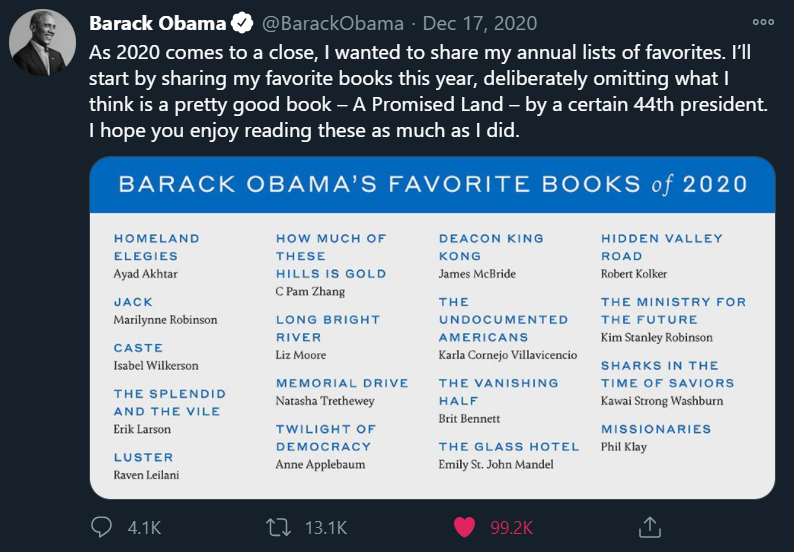
When I first saw this list on Obama’s Twitter just before Christmas, part of me felt ashamed and guilty that I couldn’t tick off a single title that I had read. But then the more I thought about it, the more I realised that was a ridiculous attitude to have.
This year, I’ve read widely and beyond my comfort zone. When I started to think about this, instead, I looked at this list as a form of inspiration and education, rather than guilt.
Why Reading Lists and Recommendations Have Value
As I started to plan out this piece, I looked up every book that Obama had listed and learned about each title. As a result, I’ve added a handful to my TBR list. As I did this, I realised my initial feelings of guilt were replaced by inspiration, as I looked towards reading these in the future.
Reading the recommendations of others provides us with a chance to open up our minds and encourages us to read beyond our comfort zones. I would never usually pick a book such as the Hidden Valley Road: Inside the Mind of an American Family, by Robert Kolker, but after reading about it I now would strongly consider it.
A lot of Obama’s recommendations go beyond the mainstream and bestseller’s list — which I love. The publishing world is so attuned to white authors and protagonists but this list shows how diverse reading can — and should — be.
Reading lists are valuable for new and experienced readers, but fundamentally, they provide you with a place to build from. With so many books out there, it can be hard to find something to read. But recommendations lists (of all kinds, not just Obama’s) give readers a source of inspiration to then go away and find those books, or similar, that they want to read.
They certainly have a place, when approached with the right mindset, but they should not be used as a point of comparison, or to make ourselves feel guilty that we are not ‘well enough’ read.
Reading Recommendations Will Always be Personal
Like anything we consume, what we read says a lot about us personally. The titles we love reading, will almost always, reflect our beliefs, interests, and passions. Often, our favourite books, end up becoming part of who we are as they have the ability to shape us as people.
And we can see this in this mere snapshot into Obama’s library and favourite reads. Most of the books mentioned, deal with the intersection of race, politics, gender, and class — regardless of whether they are fiction or non-fiction. Reading is a deeply personal experience, and we’re not always going to read the same books as everyone else, or, like them.
I’ve given recommendations to family and friends that have fallen flat. But I’ve also given people recommendations people have loved. You can never guarantee a person will love the same book as you, or for the same reasons — because reading is deeply personal.
That being said, if we read a recommendation list to find we haven’t heard of — or read a book on there, it doesn’t mean we are bad readers. In fact, we should view reading these lists as a window of opportunity.
After reading about the titles on Obama’s list, I started to realise the books we recommend to others, often touch as in unique ways that are to do with our own experience and connection with them. Thus, recommendations, are in part, always personal.
As readers, we will never be interested in the same issue, genre or topic, therefore, just because a famous individual recommends it, or anyone else, it doesn’t mean that we have to have read it or want to. It acts as a window into their interests and can be a source of inspiration for us — but importantly — it doesn’t have to be.
Reading Is Not about Quantity but Quality
Of course, we have no idea how many books Obama read in total in 2020 from this list. But importantly, it doesn’t matter. The amount of books we read is irrelevant if we don’t get anything out of them. Although seeing other peoples’ recommendations and reading challenges, can force us into thinking to be a reader it’s about how much we read — in fact it’s the opposite.
Social media and channels such as Goodreads promote the idea that more is always better. Although social media is valuable for sharing our favourite reads and having conversations about them, it can also force a point of comparison that is ultimately dangerous to readers. Additionally, the amount of books we read is due to personal to circumstance, time and enjoyment. We are not the same people and we don’t lead the same lifestyles — so we’re not all going to be able to read lots of books, even if we wanted to.
The focus should be on what you gain from a read, so start searching for books that you think will be most beneficial to you.
The Takeaway
- Quantity doesn’t mean everything and it doesn’t define your worth. If you read in any capacity you are a reader.
- First and foremost, find books that you will enjoy but gain inspiration from
- Reading isn’t about competition and it doesn’t mean you are a ‘bad’ reader if you haven’t read something
- Try and view recommendation lists as a source of inspiration and a way to expand your knowledge, rather than a point of comparison