avatarChelsea Rose

Free AI web copilot to create summaries, insights and extended knowledge, download it at here

2159

Abstract

y-woman-180951219/?no-ist">Leoti Blaker</a> boarded a crowded Fifth Avenue stagecoach at 23rd Street. As the coach jostled down the road, Leoti noticed that the man sitting next to her kept inching closer and closer.</p><p id="f5e3">Then, the man started to touch her. Seemingly accidentally at first, but then, purposefully. When the predatory man lifted his arm and draped it low across her back, Leoti had enough.</p><p id="1f11">Unfortunately for this pervert, Leoti Blaker was not a woman to mess with! In an act that should be heavily applauded, she removed her foot-long hat pin and stabbed into the creep’s arm, all the while maintaining a calm expression. It is said that the man screamed and scurried off the coach at the next stop.</p><p id="563f">Regarding this incident, Leoti noted to the <a href="https://www.smithsonianmag.com/history/hatpin-peril-terrorized-men-who-couldnt-handle-20th-century-woman-180951219/">New York World</a>,</p><p id="9504" type="7">“I’ve heard about Broadway mashers and ‘L’ mashers, but I didn’t know Fifth Avenue had a particular brand of its own…. If New York women will tolerate mashing, Kansas girls will not.”</p><p id="7d62">You may be wondering, just how large were these hatpins?</p><p id="4c9b">As hats became more decorative, the pins needed to fasten them grew longer and longer. It was not uncommon to see hats adorned with flowers, dead birds, <a href="https://www.history.com/news/how-women-defended-themselves-against-street-gropers-100-years-ago"><i>jewels, feathers</i></a>,<i> </i>and ten-inch-long hatpins.</p><p id="968c">The perfect length to threaten anyone up to no good.</p><p id="7348">However, Leoti was not the only one fighting back. Soon, similar accounts began to pop up in newspapers around the nation. A <a href="https://www.smithsonianmag.com/history/hatpin-peril-terrorized-men-who-couldnt-handle-20th-century-woman-180951219/">St. Louis schoolteacher</a> drove her would-be attacker away by slashing his face with her hatpin. Over in Chicago, <a href="https://chroniclingamerica.loc.gov/lccn/sn83045487/1916-03-21/ed-1/seq-6/#date1=1789&amp;index=0&amp;rows=20&amp;words=hatpin+mash

Options

er&searchType=basic&sequence=0&state=&date2=1943&proxtext=hatpin+masher&y=0&x=0&dateFilterType=yearRange&page=1">Mrs. Schultz</a> used her hatpin to fight off a Masher as he tried to put a chloroform rag over her nose.</p><p id="cbcc">The public lauded these women for taking a stand against Mashers, and hatpins became symbols of female empowerment.</p><p id="e8bc">Unfortunately, it probably comes as no surprise that women arming themselves against sexual harassers brought great upset to certain weak-minded, pathetic men.</p><p id="38d4">Ironically, those men started to argue publicly that the hatpins were a menace to society. Faced with the uncomfortable reality that women could now defend themselves, some males pushed lawmakers to ban hatpins and punish these “aggressive” women.</p><p id="2371"><i>In <a href="https://www.smithsonianmag.com/history/hatpin-peril-terrorized-men-who-couldnt-handle-20th-century-woman-180951219/">March 1910</a>,<b> </b></i>Chicago and other cities had passed laws limiting the length of hatpins. Chicago’s city council found themselves with a packed audience as they debated an ordinance that would ban hatpins longer than nine inches, with violators to be arrested and fined $50. The proceedings were acrimonious, to say the least.</p><p id="ef2f" type="7">“If women care to wear carrots and roosters on their heads, that is a matter for their own concern, but when it comes to wearing swords they must be stopped,” a supporter said. Cries of “Bravo!” from the men; hisses from the women.</p><p id="47ee">The furor over hatpins would continue until the onset of World War I, after which the nation had a new threat to worry about: the flapper.</p><p id="bbbc"><b><i>Thank you for reading.</i></b></p><p id="bc6c"><i>You can share your outstanding stories and inspire others. Just<b> click the below image</b> and be a <b>writer</b> for <a href="https://medium.com/the-masterpiece"><b>The Masterpiece</b></a><b>.</b></i></p><figure id="076c"><img src="https://cdn-images-1.readmedium.com/v2/resize:fit:800/0*kQxLuBcL48XJ6wya.png"><figcaption></figcaption></figure></article></body>

Have You Heard of the Hatpin Panic?

The creepy men who became the fashion police.

Source: Rene Asmussen via Pexels

Since the dawn of time, there have always been disgusting “men” who sexually harass and inappropriately touch women. Today we may call them catcallers, street harassers, but in the late 1800s and early 1900s, such vile creatures were bestowed the title of “Mashers.”

By the dawn of the century, women were steadily gaining more independence. They were walking and traveling alone from jobs, theatre shows, and dance halls. Some ladies were even showing their ankles!

But it was all too much for certain men. For whatever reason, a few of them found a woman’s newfound independence morally offensive. Worst, other men decided that these unchaperoned women were ripe for an unwanted grope, unwelcomed advance, or severe sexual harassment.

What were women to do in such situations?

Wear a hatpin.

More than just a fashion accessory, these long decorative pins turned out to be a great form of self-defense.
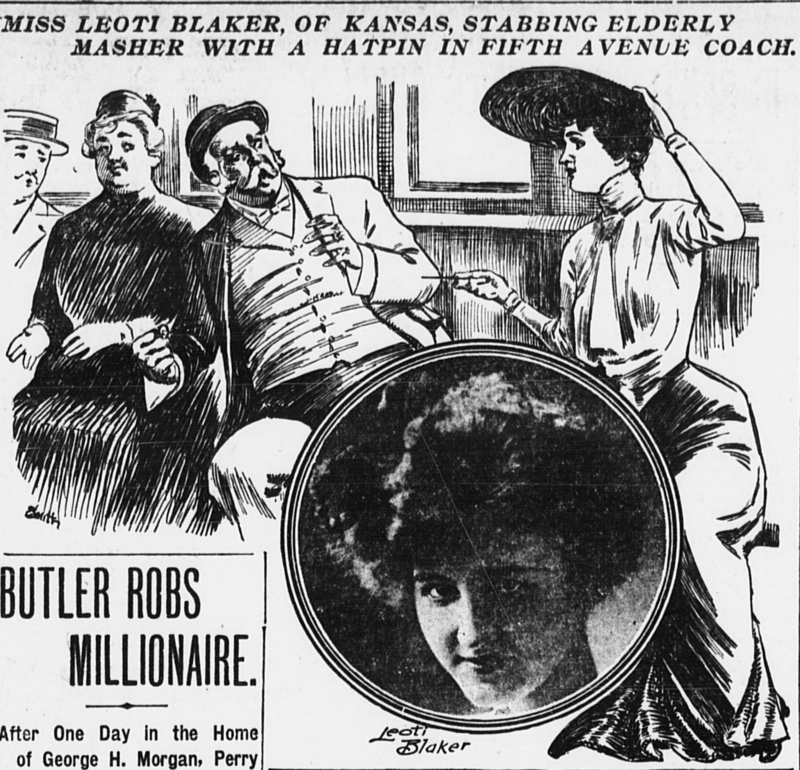
The Evening World, May 27, 1903. Chronicling America: Historic American Newspapers. Lib. of Congress (CC)

Thursday, May 28th, 1903. New York City. Kansan tourist Leoti Blaker boarded a crowded Fifth Avenue stagecoach at 23rd Street. As the coach jostled down the road, Leoti noticed that the man sitting next to her kept inching closer and closer.

Then, the man started to touch her. Seemingly accidentally at first, but then, purposefully. When the predatory man lifted his arm and draped it low across her back, Leoti had enough.

Unfortunately for this pervert, Leoti Blaker was not a woman to mess with! In an act that should be heavily applauded, she removed her foot-long hat pin and stabbed into the creep’s arm, all the while maintaining a calm expression. It is said that the man screamed and scurried off the coach at the next stop.

Regarding this incident, Leoti noted to the New York World,

“I’ve heard about Broadway mashers and ‘L’ mashers, but I didn’t know Fifth Avenue had a particular brand of its own…. If New York women will tolerate mashing, Kansas girls will not.”

You may be wondering, just how large were these hatpins?

As hats became more decorative, the pins needed to fasten them grew longer and longer. It was not uncommon to see hats adorned with flowers, dead birds, jewels, feathers, and ten-inch-long hatpins.

The perfect length to threaten anyone up to no good.

However, Leoti was not the only one fighting back. Soon, similar accounts began to pop up in newspapers around the nation. A St. Louis schoolteacher drove her would-be attacker away by slashing his face with her hatpin. Over in Chicago, Mrs. Schultz used her hatpin to fight off a Masher as he tried to put a chloroform rag over her nose.

The public lauded these women for taking a stand against Mashers, and hatpins became symbols of female empowerment.

Unfortunately, it probably comes as no surprise that women arming themselves against sexual harassers brought great upset to certain weak-minded, pathetic men.

Ironically, those men started to argue publicly that the hatpins were a menace to society. Faced with the uncomfortable reality that women could now defend themselves, some males pushed lawmakers to ban hatpins and punish these “aggressive” women.

In March 1910, Chicago and other cities had passed laws limiting the length of hatpins. Chicago’s city council found themselves with a packed audience as they debated an ordinance that would ban hatpins longer than nine inches, with violators to be arrested and fined $50. The proceedings were acrimonious, to say the least.

“If women care to wear carrots and roosters on their heads, that is a matter for their own concern, but when it comes to wearing swords they must be stopped,” a supporter said. Cries of “Bravo!” from the men; hisses from the women.

The furor over hatpins would continue until the onset of World War I, after which the nation had a new threat to worry about: the flapper.

Thank you for reading.

You can share your outstanding stories and inspire others. Just click the below image and be a writer for The Masterpiece.

Sexual Assault
History
Women
Fashion Trends
Fashion
Recommended from ReadMedium