
Have You Ever Wanted to Be Someone Else?
Surprisingly, being someone else helps navigate groups and enhance creativity
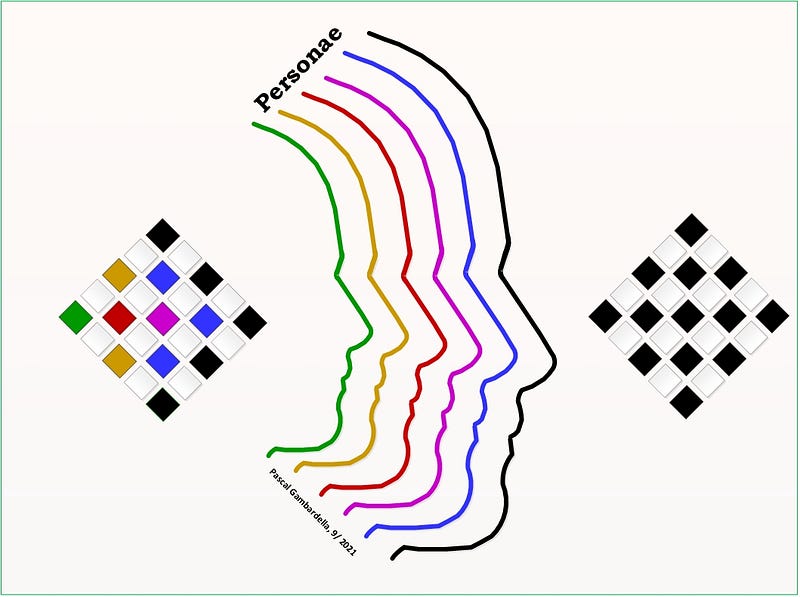
I wanted to be someone else.
As someone else, you adopt a new persona. That happened to me in high school when I adopted two personae, one temporary and the other lasted 16 years.
The first one was as an actor, performing in front of three thousand students. As a shy kid, I felt happy that the lights hid the audience. I played an old man and felt like one, especially in the scene where someone kicked my cane and I fell to the ground.
The more lasting one was when I adopted a scientific persona: detached and cerebral. It was a useful and became second nature to me, although it was lonely. I liked people and did not know it then.
I discovered being someone else can enhance creativity and help understand behavior. And, in my case, steer me from danger.
Do you take on a persona, whether for fun or as protective armor? Are some long lasting?
Think of being someone else as a tool. Let’s explore it.
Game of the Gatekeepers
We can connect being someone else with the Game of the Gatekeepers. The rules for this game, when known, tell how to enter a profession, organization, or social group. Adopting a new persona can help you navigate these rules.
The scientific persona served me well in school as I pursued a career as a physicist. It helped me play the gatekeeper game to get into graduate school.
Then, during my first year in graduate school, I hit a life-changing bump on the road. The US drafted me into the Army and sent me to war.
Unexpected Job
Despite having never taken a biology course, I became a US Army medic in 1969. I wondered if someone in the army confused the word physicist with physician. I arrived in Vietnam in January 1970, with a quarter of a duffel bag filled with books.
When I walked off the plane, I felt a blast of humid and sweet-smelling air. I thought, “now I am in real trouble.”
I traveled to my post at an isolated dispensary on the beach in Cam Ranh Bay. It had a larger population of flying roaches than people. While there, I treated injuries, assisted the doctor, and gave vaccinations. These were tedious activities. Preferring a world with options (and a little science), I was stuck in a boring one.
I wanted to do something scientific. While maintaining my scientific persona, I began hanging out in our small medical lab. And watching our only lab technician run tests.
After a while, I started helping him. Before he left the country, I knew enough to do his job. There was no one else to replace him. So, the job fell to me. Normally, becoming a lab technician required extensive training and a three-year commitment. I had neither.
I played by the rules of the game to become a physicist. The war put that game on hold. In contrast, to become a lab technician, I went outside the normal rules of the game.
Are the gatekeeper’s rules more flexible than one thinks?
Avoiding Danger
I was a medical lab technician at my next post in Di An. I was not there long. In mid-1970, there was a shortage of medics. The Army wanted to send some of us into battle. The alternative was to go to Long Binh and identify mosquitoes.
With my scientific persona in place, I argued that my two degrees in physics qualified me for the job. After all, didn’t I become a lab tech after a few months in Vietnam? I did not tell them I never took a biology course.
In July 1970, I went to Long Binh (remember the mosquitoes). A colleague there appeared to be suffering. He spent the first part of his tour in Vietnam in the field. I now think he had post-traumatic stress disorder. He was quiet and reluctant to share information. Did he feel the army would send him back to the field if they thought he was not an essential member of our team?
Do you have a persona that keeps you safe? Are you aware of when it no longer works?
A Way of Learning
In 1984, I worked with a NASA scientist. I helped him to study the region where the Earth’s magnetic field meets the solar wind. One day I was sitting in his office trying to understand what he was saying. He was mumbling something while bent over with his face towards the ground. Instead of coherent words, I heard gibberish.
I had taken a Neuro-Linguistic Programming (NLP) a year earlier. NLP had rapport techniques I thought could help me understand him. So, I started mirroring his hunched-over posture and breathing at the same rate as he did. What surprised me was that I understood what he was saying. I had entered his world.
One modeling technique is to step into someone’s experience to understand their view. Yet, it is more than mirroring their posture and breathing rate. You may also need to elicit their beliefs and strategies.
In their book, Expanding Your World, Modeling the Structure of Experience, Gordon and Dawes, say:
The most direct way to know whether or not an exemplar [of an ability we are modeling] is offering us relevant information is discovering how our own experience is affected by taking on those aspects of her experience.
For example, one of my karate friends is good at breaking boards using the side of his hand. As a former carpenter, one of his key belief’s is “wood is malleable and easily manipulated.” I thought, “what if I believed that?” That belief helped me to break boards for an exam, which was one rule to get an advanced belt in Tae Kwon Do.
Can you think of something you want to learn by stepping into another’s experience?
Enhancing Creativity
“Pretending you are someone else can make you more creative” is the title of an article by Susie Nelson. She described the work of Dumas and Dunbar. They showed that the creativity of a person is not a stable trait. It can change depending on the context and the perspective of the person. It can also change when a person takes the perspective of a particular stereotype.
Dumas and Dunbar used divergent thinking tasks as a proxy for measuring creativity. A person engages in divergent thinking when they create many ideas in a short period. People use various approaches when engaging in divergent thinking, including brainstorming and freewriting.
They compared how two groups and a control group performed when doing a divergent task. The groups were those taking an uninhibited stereotype perspective (e.g., eccentric poet). And those taking an inhibited stereotype perspective (e.g., rigid librarian). The first group performed best. The authors call this effect the “Creative Stereotype Effect.”
Nelson also discusses the work of Sarina Pillay, who takes the work of Dumas and Dunbar further. She says to be creative you should “believe you are somebody else.” In a column in the Harvard Business Review, Pillar says,
When in a creative deadlock, try this exercise of embodying a different identity. It will likely get you out of your own head and allow you to think from another person’s perspective.
Who will you be the next time you need to generate ideas?
The World of Being Someone Else
Being someone else is not so strange.
People write about how to be like someone else. That is what Gelb and Caldicott did in their book, Innovate Like Edison. And Dilts wrote a series of volumes called Strategies of Genius, where he examined the inner strategies of eight recognized geniuses, including Einstein and Mozart.
Children and adults engage in role-playing games like Dragons and Dungeons. One of my friends, with a PhD in psychology, is an active player. She takes the role of crotchety old witch.
The game lets people experiment with different personae. And they have to respond to challenges in the game as if they had that persona.
Storytellers do something similar with their characters. They refer to it as a narrative lens, which is about what the world looks like through the eyes of a character. That helps storytellers render a scene.
Some people like to think we have only one constant persona. I like to think we are continually growing and learning by exploring different persona.
What do you think?
Links to my articles and satires are on this mind map.


