
Have you ever thought why humans experience significant pain during childbirth while animals seem to handle it effortlessly?
Have you ever tried to explore the reason behind human back pain?
Does it have any connection to gravity?
Are we struggling to adapt to life on Earth despite thousands of years of existence on it?
Have you investigated why we need to cook our food when other animals can digest it raw?
Have you questioned why, despite our need for vitamin D, we tend to avoid prolonged sun exposure or find it challenging to tolerate?
Are you familiar with the theory suggesting that human ancestors committed crimes, resulting in their arrival on Earth, and that we are still facing consequences for those actions?
What if I share with you the idea that humans originated on another planet and descended to Earth millions of years ago?
Here is how:
Ellis Silver’s book, “Humans are Not from Earth,” challenges the conventional narrative of human origins.
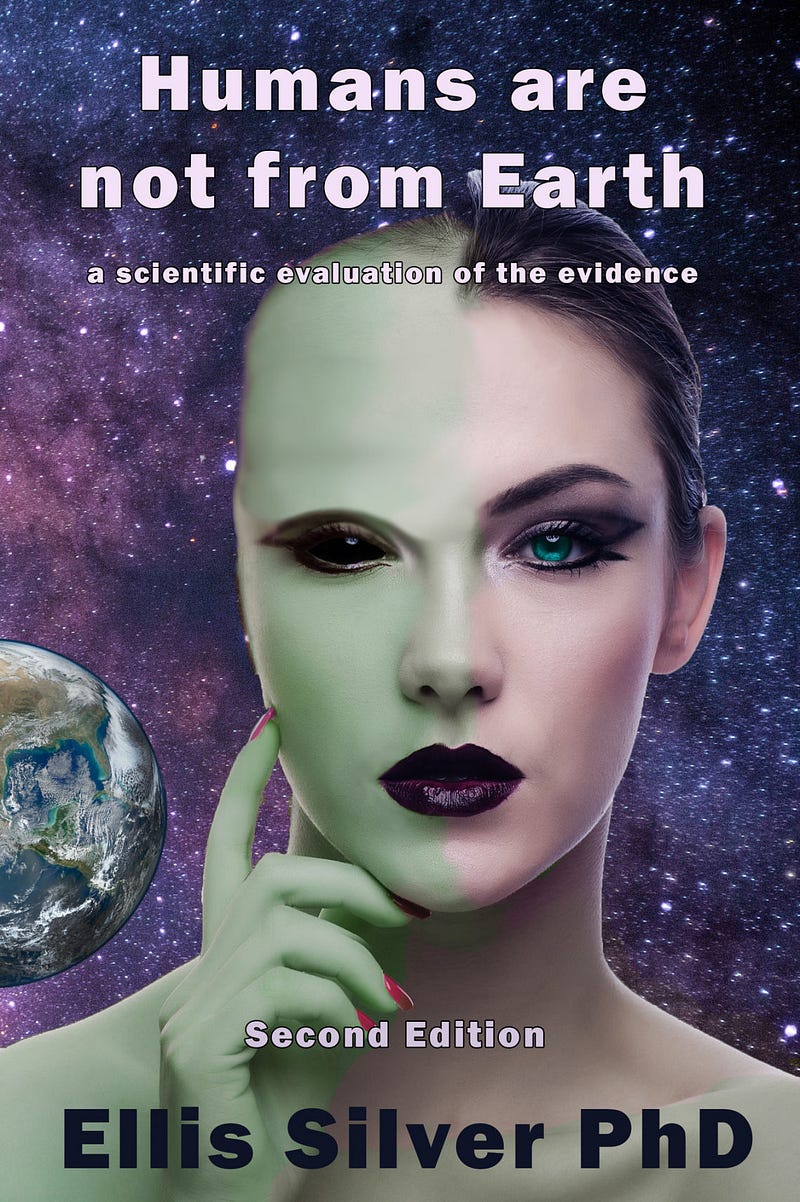
This provocative theory suggests that humans may have originated from another planet, and throughout the pages of his work, Silver explores various aspects of human biology and behaviour to support this controversial idea.
The Alien Adaptation Argument:
One of the central tenets of Silver’s theory revolves around the notion that humans are not well-adapted to life on Earth. This according to him is because humans were initially living on another planet.
He points to several aspects of human anatomy and physiology that, according to him, seem more suitable for a different planetary environment.
Skin Sensitivity:
Silver argues that human skin, which is sensitive to sunlight, is not well-suited for Earth’s conditions. He suggests that this sensitivity might indicate adaptation to a planet with a different light spectrum.
Lack of Natural Body Coverings:
The author highlights the relatively hairless nature of humans compared to other mammals on Earth. He speculates that this lack of body hair might be an adaptation to a planet with different climatic conditions.
Physiological Peculiarities:
Silver delves into various human physiological features that he believes might support the extraterrestrial origin theory.
Back Problems:
Human susceptibility to back pain is attributed by Silver to our upright posture, which he suggests is more common in extraterrestrial beings. It also seems that the human being is created to live somewhere with a different gravity and that might be one of the reasons for the back pain problems.
Sleep Patterns:
The writer looks at how humans sleep and thinks it doesn’t match Earth’s usual day and night cycle. They suggest that this difference might mean we’re used to a different schedule on another planet.
In simpler words, many people struggle to relax even after getting a few hours of sleep. This suggests that the human body might have some issues adjusting to life on this planet.
Unexplained Gaps in Evolution:
Silver raises questions about certain gaps in the evolutionary record, proposing that these gaps could be attributed to extraterrestrial intervention rather than natural evolutionary processes.
He challenges the standard model of human evolution, suggesting that Earth may have been visited by advanced beings who influenced our development.
Critiques and Controversies:
While Silver’s theory has garnered attention, it’s essential to note that it remains highly controversial within the scientific community.
Many scholars argue that his ideas lack robust empirical evidence and scientific rigour.
The mainstream view supports the theory of human evolution on Earth through natural processes over millions of years.
Conclusion:
Ellis Silver’s theory challenges our fundamental understanding of human origins. The provocative ideas presented in “Humans are Not from Earth” have sparked debates and discussions, pushing us to reevaluate long-held beliefs about our place in the cosmos.
However, until there is substantial empirical evidence supporting these claims, the mainstream scientific community remains skeptical.
In order to understand our origins, it’s crucial to balance curiosity with scientific rigor, acknowledging the vast body of evidence supporting the conventional model of human evolution on Earth.
Ellis Silver’s theory, while intriguing, stands as a reminder that scientific inquiry should be grounded in evidence and subject to rigorous scrutiny.
Thank you for reading the article!
I hope you enjoyed it.
If you enjoyed what you read, please consider tipping me. Swing by my Buy Me A Coffee page and send me a cup of ☕️ 😉 Your support means a lot to me. And the Coffee keep my brain up for further work.