avatarRené Junge

Free AI web copilot to create summaries, insights and extended knowledge, download it at here

4644

Abstract

The other explanation is that one assumes that before the Cambrian, the right conditions for the development of complex multicellular organisms did not exist. The reason for this could be either too low an oxygen content in the oceans, too high water temperatures or too high a calcium content in the water.</p><p id="76a6">It was only after these environmental conditions had changed that the way had been clear for these new forms of life.</p><h2 id="5753">First doubts: The Ediacaran fauna — has there not been a big bang of life?</h2><p id="2da1">As early as 1946, the geologist Reginald Claude Sprigg had found fossils of multicellular organisms from the Precambian in the Ediacaran Hills in Australia. These findings were re-evaluated much later when the Cambrian explosion had already solidified as a theory.</p><p id="aa18">It turned out that many of the multicellular organisms found there had not died out before the Cambrian explosion. They even existed for a long time parallel to the Cambrian species. A complete restart of the development of multicellular life can of course no longer be postulated on this basis.</p><p id="4094">The discovery of comparatively simple multicellular organisms from the Precambian allows at least the well-founded assumption that there might have been more highly developed multicellular organisms at that time. The fact alone that no fossils of immediate predecessor forms of the multicellular organisms from the Cambrian explosion could be found so far does not mean much.</p><p id="367b">The origin of fossils is by no means the rule, but the absolute exception. An enormous number of happy circumstances must come together for an organism to remain a fossil.</p><p id="1636">There are estimates that statistically only about three specimens of the entire world population living today become fossils.</p><p id="d04f">The thesis of the sudden eruption of life has thus received a severe crack.</p><h2 id="02c9">The truth lies in between — Revaluation of the Cambrian explosion</h2><p id="94c8">Today there is hardly a paleontologist or geologist left who would support the original form of the thesis about the Cambrian explosion.</p><p id="7468">Nevertheless, there is also no common sense about how this epoch is to be conclusively assessed. There are no fossils of intermediate forms of pre-Cambrian and Cambrian multicellular organisms.</p><p id="017c">However, to assume that they might have existed nevertheless is entirely justified. According to everything we believe to know today about the mechanisms of evolution, life always develops slowly and quite continuously. One form emerges from the other, and completely new things under the sun have not been created for millions of years.</p><p id="b5ad">The re-evaluation of what is known under the catchword of the Cambrian explosion began when pre-Cambrian multicellular organisms were discovered and evaluated for the first time and continue to this day.</p><p id="9c4d">Especially in the field of paleontology, one is strongly dependent on speculations and theories that are difficult to prove. Too little of what once existed is still preserved today, and very little of what has been preserved is likely to have been discovered.</p><p id="c1c9">The good news for all people interested in science is that exciting developments can be expected in this field in the future. Science does not proclaim absolute truths. It goes the way of progressive cognition.</p><p id="66a2"><b>Sources:</b></p><div id="618e" class="link-block"> <a href="https://en.wikipedia.org/wiki/Cambrian_explosion"> <div> <div> <h2>Cambrian explosion</h2> <div><h3>The Cambrian explosion or Cambrian radiation was an event approximately 541 million years ago in the Cambrian period…</h3></div> <div><p>en.wikipedia.org</p></div> </div> <div> <div style="background-image: url(https://miro.readmedium.com/v2/resize:fit:320/0*HSNDuV_M4Emry5BO)"></div> </div> </div> </a> </div><div id="b1ee" class="link-block"> <a href="https://www.nature.com/news/what-sparked-the-cambrian-explosion-1.19379"> <div> <div> <h2>What sparked the Cambrian explosion?</h2> <div><h3>A series of dark, craggy pinnacles rises 80 metres above the grassy plains of Namibia. The peaks call to mind something…</h3></div> <div><p>www.nature.com</p></div> </div> <div> <div style="background-i

Options

mage: url(https://miro.readmedium.com/v2/resize:fit:320/0*x3n7DuyMXhbGW4YB)"></div> </div> </div> </a> </div><div id="d0a8" class="link-block"> <a href="https://biologos.org/common-questions/does-the-cambrian-explosion-pose-a-challenge-to-evolution/"> <div> <div> <h2>Does the Cambrian Explosion pose a challenge to evolution? - Common-questions</h2> <div><h3>The term "Cambrian Explosion" refers to the appearance and rapid diversification of most major living animal body plans…</h3></div> <div><p>biologos.org</p></div> </div> <div> <div style="background-image: url(https://miro.readmedium.com/v2/resize:fit:320/0*U2Y6ulkCwcHnaKU8)"></div> </div> </div> </a> </div><div id="df2a" class="link-block"> <a href="https://www.nhm.ac.uk/discover/news/2019/february/the-cambrian-explosion-was-far-shorter-than-thought.html"> <div> <div> <h2>The Cambrian explosion was far shorter than we thought</h2> <div><h3>The Cambrian explosion happened more than 500 million years ago. It was when most of the major animal groups started to…</h3></div> <div><p>www.nhm.ac.uk</p></div> </div> <div> <div style="background-image: url(https://miro.readmedium.com/v2/resize:fit:320/0*CTp2P4l--i0uPK4H)"></div> </div> </div> </a> </div><div id="9343" class="link-block"> <a href="https://theconversation.com/uk/topics/cambrian-explosion-7159"> <div> <div> <h2>Cambrian explosion News, Research and Analysis - The Conversation</h2> <div><h3>The sudden appearance of a range of modern animals about half a billion years ago, during evolution's "big bang", has…</h3></div> <div><p>theconversation.com</p></div> </div> <div> <div style="background-image: url(https://miro.readmedium.com/v2/resize:fit:320/0*b7dH9VahCCu7uY6m)"></div> </div> </div> </a> </div><p id="b98c"><b>Read every story from René Junge (and thousands of other writers on Medium).</b></p><p id="9f07"><b>Your membership fee directly supports René Junge and other writers you read. You’ll also get full access to every story on Medium.</b></p><p id="bd3e"><b>Just click here and get tons of exiting and fresh content every day.</b></p><div id="54a6" class="link-block"> <a href="https://renjunge.medium.com/membership"> <div> <div> <h2>Join Medium with my referral link - René Junge</h2> <div><h3>As a Medium member, a portion of your membership fee goes to writers you read, and you get full access to every story…</h3></div> <div><p>renjunge.medium.com</p></div> </div> <div> <div style="background-image: url(https://miro.readmedium.com/v2/resize:fit:320/0*bAAXv_sbnPOwU5bK)"></div> </div> </div> </a> </div><p id="beb6"><b>Read also:</b></p><div id="f655" class="link-block"> <a href="https://readmedium.com/what-happens-when-the-earths-magnetic-field-reverses-its-polarity-9b06ccdb2dfa"> <div> <div> <h2>What happens when the Earth’s magnetic field reverses its polarity?</h2> <div><h3>Catastrophe or creeping change? When the Poles jump</h3></div> <div><p>medium.com</p></div> </div> <div> <div style="background-image: url(https://miro.readmedium.com/v2/resize:fit:320/0*d-XYhKehP_Z9zfPk)"></div> </div> </div> </a> </div><div id="699e" class="link-block"> <a href="https://readmedium.com/the-secret-of-the-supervolcanoes-8d27ac2d7538"> <div> <div> <h2>The Secret of the Supervolcanoes</h2> <div><h3>The destructive power of supervolcanoes is many times greater than that of ordinary volcanoes. They’re sleeping…</h3></div> <div><p>medium.com</p></div> </div> <div> <div style="background-image: url(https://miro.readmedium.com/v2/resize:fit:320/0*TBK74i3oIlXi7ni1)"></div> </div> </div> </a> </div></article></body>

Have You Ever Heard Of The Cambrian Explosion? It Is One Of The Most Fascinating Stories In History.

About 550 million years ago, almost all known animal strains suddenly appeared within only five to ten million years. How was that possible?
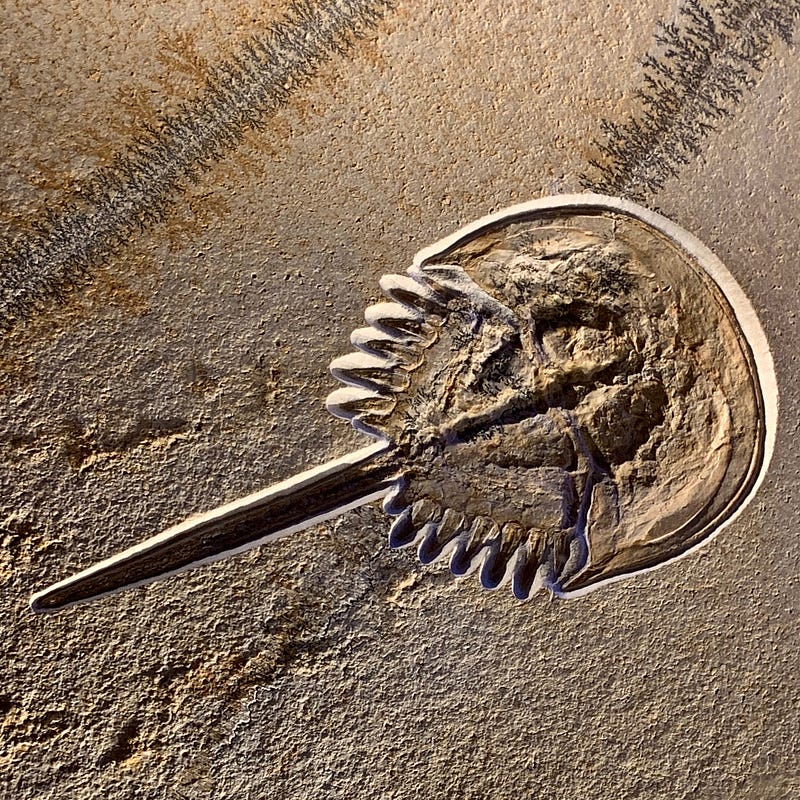
Photo by Christian Wagner on Unsplash

It was not until 1962 that a discovery made in 1909 was examined more closely. The results of this investigation caused a stir in the scientific world.

Apparently, 550 million years ago, something like a big bang of life had taken place. Where previously only unicellular organisms existed, in a period of only ten million years almost all known animal strains suddenly appeared in one fell swoop.

This event was given a name: The Cambrian explosion.

Archaeological Sensation Burgess Slate — Suddenly everything was full of breathtaking variety

In 1909, Charles Doolittle-Walcott made a discovery that would prove groundbreaking many years later. On the Burgess Pass in Yoho National Park, Canada, Walcott discovered a gigantic fossil deposit.

One year later, he began to explore these together with his sons. In the course of the excavations, which lasted fourteen years, Walcott and his helpers collected 65,000 fossil finds.

Until Walcott’s death in 1927, however, neither he nor the scientific community recognized the value of these finds. Walcott didn’t even think that he might have found something extraordinary.

Although he was a paleontologist, his ability to determine his finds was limited. He assigned all of them to the animal world known today, thus depriving himself of the opportunity to become a celebrated star of paleontology during his lifetime.

The scientific interest in his findings was naturally limited due to his false systematization. For a long time, no one thought it worthwhile to re-examine the collection.

It was not until 1962 that Alberto Simonetta subjected the collection to a new investigation. He concluded that the fossil organisms contained in Burgess slate could by no means be attributed to today’s animal forms.

Instead, the finds seemed to exhibit an incredible variety of unusual anatomical features.

It was Harry Blackmore Whittington who initiated the resumption of the excavations in 1966. These extended both to the site of the Burgess slate and to the Raymond quarry, which had been discovered a short distance away.

Walcott’s finds to date, supplemented by the newly added exhibits from the reopened excavations, finally resulted in an exciting picture: Apparently, since the period from which the fossils originated, not only all the basic plans of all the animal species still known today seemed to suddenly exist, but also an unmanageable number of building plans that had not developed further and had died out again.

The result was the image of an evolutionary big bang, in the course of which a greater diversity of species must have emerged apparently from nowhere and in an unbelievably short time on geological scales than we have on our planet today.

This epoch was finally baptized Cambrian. The so-called Cambrian explosion marked the beginning of this epoch. Accordingly, the time before that was called Precambium.

No fossil finds of complex multicellular organisms were known from the Precambian so that it had to be assumed that the Cambrian explosion was indeed a new start of evolution at express speed. Two different explanation methods were offered for the reasons of this rapid development.

One theory states that the first appearance of complicated multi-cells was itself the cause of their rapid differentiation.

The mere presence of only a few different species of multicellular organisms must suddenly have led to increased evolutionary pressure on them.

Species A was competing with species B. This competition made it necessary, on the one hand, to occupy new biological niches and, on the other hand, to defend oneself against suddenly existing enemies. So the Cambrian explosion would have driven itself forward.

The other explanation is that one assumes that before the Cambrian, the right conditions for the development of complex multicellular organisms did not exist. The reason for this could be either too low an oxygen content in the oceans, too high water temperatures or too high a calcium content in the water.

It was only after these environmental conditions had changed that the way had been clear for these new forms of life.

First doubts: The Ediacaran fauna — has there not been a big bang of life?

As early as 1946, the geologist Reginald Claude Sprigg had found fossils of multicellular organisms from the Precambian in the Ediacaran Hills in Australia. These findings were re-evaluated much later when the Cambrian explosion had already solidified as a theory.

It turned out that many of the multicellular organisms found there had not died out before the Cambrian explosion. They even existed for a long time parallel to the Cambrian species. A complete restart of the development of multicellular life can of course no longer be postulated on this basis.

The discovery of comparatively simple multicellular organisms from the Precambian allows at least the well-founded assumption that there might have been more highly developed multicellular organisms at that time. The fact alone that no fossils of immediate predecessor forms of the multicellular organisms from the Cambrian explosion could be found so far does not mean much.

The origin of fossils is by no means the rule, but the absolute exception. An enormous number of happy circumstances must come together for an organism to remain a fossil.

There are estimates that statistically only about three specimens of the entire world population living today become fossils.

The thesis of the sudden eruption of life has thus received a severe crack.

The truth lies in between — Revaluation of the Cambrian explosion

Today there is hardly a paleontologist or geologist left who would support the original form of the thesis about the Cambrian explosion.

Nevertheless, there is also no common sense about how this epoch is to be conclusively assessed. There are no fossils of intermediate forms of pre-Cambrian and Cambrian multicellular organisms.

However, to assume that they might have existed nevertheless is entirely justified. According to everything we believe to know today about the mechanisms of evolution, life always develops slowly and quite continuously. One form emerges from the other, and completely new things under the sun have not been created for millions of years.

The re-evaluation of what is known under the catchword of the Cambrian explosion began when pre-Cambrian multicellular organisms were discovered and evaluated for the first time and continue to this day.

Especially in the field of paleontology, one is strongly dependent on speculations and theories that are difficult to prove. Too little of what once existed is still preserved today, and very little of what has been preserved is likely to have been discovered.

The good news for all people interested in science is that exciting developments can be expected in this field in the future. Science does not proclaim absolute truths. It goes the way of progressive cognition.

Sources:

Read every story from René Junge (and thousands of other writers on Medium).

Your membership fee directly supports René Junge and other writers you read. You’ll also get full access to every story on Medium.

Just click here and get tons of exiting and fresh content every day.

Read also:

Science
Fossils
History
Knowledge
Nature
Recommended from ReadMedium