
Have You Avoided Getting Scammed?
You’ve got to develop your bullshit detectors!
First things first: How I distinguish The Good Guys from The Bad Guys
In my experience, Bad Guys are fairly easy to spot. They belong to an international brotherhood in which they all follow the same rules, more or less:
1. Bad Guys are most prevalent where they have easy access to their favorite prey: foreign tourists. Therefore, it is most likely that they will be congregating in touristy areas, rather than neighborhoods where the locals live and hang out.
2. A Bad Guy is very frequently the first to say hello. He wants to capture your attention before you make the first move. He will offer his help before you ask for it. Furthermore, he will not only be polite, but excessively polite: the Eddie Haskell Syndrome.
Your own cultural awareness can help you to spot two red flags just by this act of speaking to you:
[a] In many societies where these guys operate, it is not common for strangers to speak to each other.
[b] In many societies where these guys operate, men do not associate in public with women who are not part of their family. So, for the women out there, this is something you should know about.
3. Once engaged in conversation, the Bad Guy is very interested in knowing where you are staying. He’s looking for the name of your hotel. The worst response is that you are staying in the home of nationals of the country where you are visiting and that you are referring to them as your friends.
An alternative along these lines is having a strange guy approach you and tell you that he works in the hotel where you are staying and that he remembers you from there.
4. The Bad Guy wants you to know as soon as possible that you are now friends, brothers, or are otherwise in some kind of close relationship for which you have an entirely different definition. Now that you are in this relationship, he will lose no time in telling you that you can trust him. If you hesitate, he may even ask you, “Don’t you trust me?”
Then he works towards fortifying his position to look like a Good Guy by warning you that there are Bad Guys in the area, and that you should be very careful. He will explain to you that it is a good thing you befriended him, and not one of the Bad Guys instead.
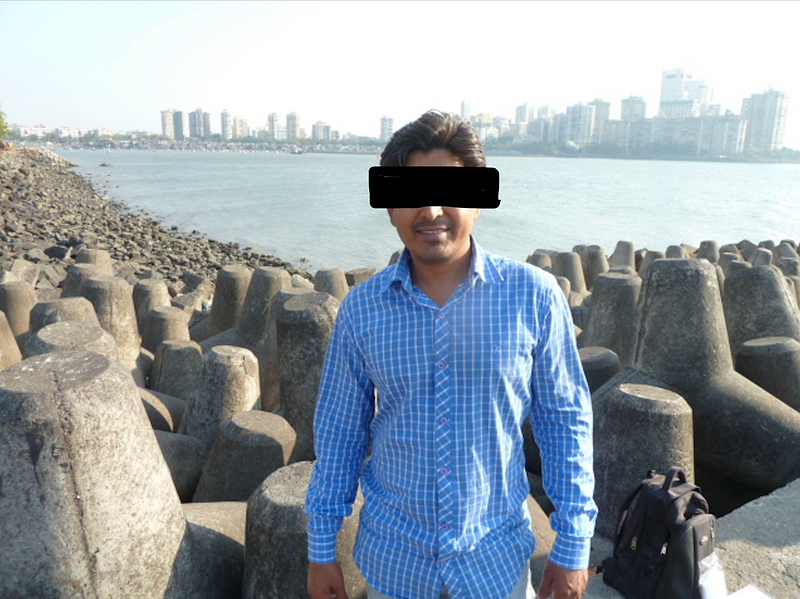
5. If you suspect that you are talking with a Bad Guy, you can check on his status by asking if you may take his picture. In many circumstances, Bad Guys will not want you to have their picture. Of course, there are many reasons why a person may not want his picture taken; just because he doesn’t want you to take it doesn’t mean that he is a Bad Guy, but this is a red flag, indicating that you need to pay closer attention.
Not only that, but there are very definitely Bad Guys who will allow you to take their photo, as you can see from the photos that I have provided here in this piece.
6. The Bad Guy will decline giving you any other information that can lead to your ability to trace him. This may include his place of work, home, or mobile phone number. He will have multiple reasons for not giving you any of these. Conversely, the chances that you have found a Good Guy are increased if he accompanies you to his place of work or his home.
Now, then, onward to the stories of two Bad Guys: one who scammed me and one who tried, but didn’t get where he wanted to go.
Mumbai, Inda: Mayur
I met Mayur as I was walking along the streets of Mumbai. He informed me that he was a guide. After we chatted for a while, he mentioned that two French guys had hired him for a day tour and that if I joined them, I could share the cost among the three of us.
When the French guys didn’t show up for a coffee meeting with Mayur, I went with him to their hotel and found them checking out, looking for a new hotel. They decided to flake on the tour. Mayur said that he could do the tour with just me, and that I could still pay my one-third price of the original total.
I agreed.
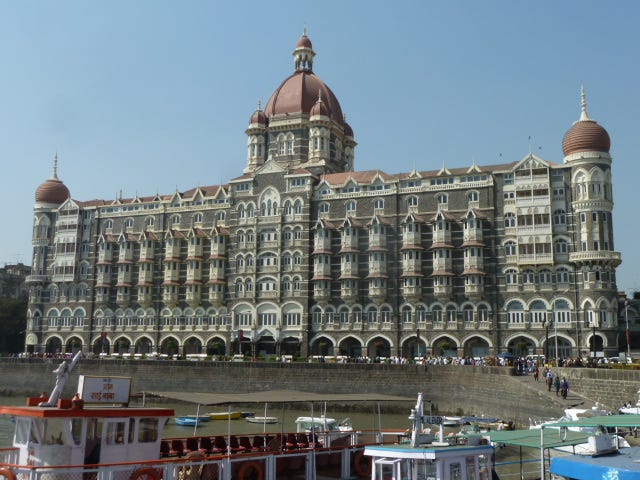
The first stop was the Taj Mahal Palace Hotel, which has high security since it was the object of a terrorist attack in 2008. It is beautiful and has hosted many famous people, some of whose photos were on display inside.
Mayur did not drive but had a driver to take us around.
We rode around the Sassoon Dock, where the huge fishing industry has an imposing presence. Yes, lots of fish smell!
We stopped between the University of Mumbai, which has some beautiful buildings (but the campus is closed to the public) and a grassy area called The Oval, which was filled with people playing cricket, a sports obsession in India.
At Hutatma Chowk there are several monuments. We found some people doing dance numbers for either a Bollywood film or something to do with India’s Got Talent.
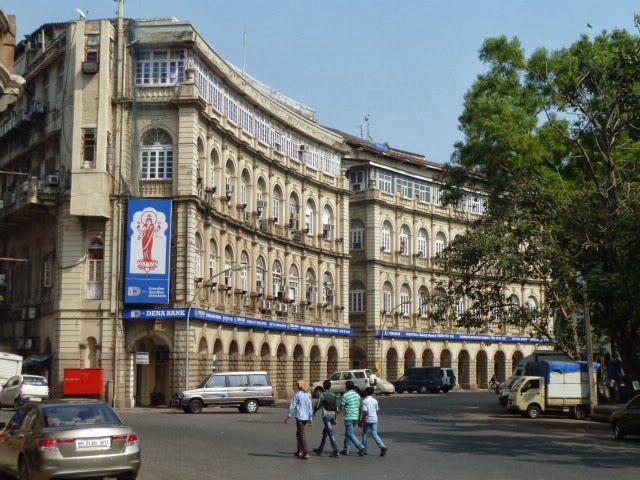
I left the scheduling in Mayur’s hands, since he is the local and the person who knows what there is to see. He took me on an itinerary that included St. Thomas Cathedral, Horniman Circle, the old Mahatma Jyotiba Phule Market, the Chor Bajar, Mani Bhavan [the building where Gandhi lived from 1917–1934], and Malabar Hill, with some of the most expensive housing in Mumbai, as well as Kamla Nehru Park and the Hanging Garden.
After the parks, we stopped at a Jain temple where we walked around for a bit. There was a wedding going on and I got some overhead shots from the second story, where there was a gallery going around the four sides of the main worship room.
From there, we walked the perimeter of Banganga Tank, which I later determined, in retrospect, was “the scene of the crime.”
On the walk around the tank, which Mayur referred to as a lake, we stopped to chat with several children who were playing in the area.
By the time we were finished at Banganga Tank, it was after 16:00 and we had not eaten a proper lunch — just lots of snacks such as samosas, peanuts, pineapple, cucumber, and figs at various small stands and markets along the way. India is great that way: there is never a shortage of tasty and cheap snacks wherever you go.
At the end of the meal I reached into my pants pocket to get money to pay the bill and, much to my shock, my money clip with cash and credit cards was not in my pocket.
Where could it have gone?
Not even forty-five minutes earlier I had stopped with Mayur at a drink stand to buy a bottle of club soda, so I knew I had it then. Nobody there had come near me to pick my pocket. Mayur said he saw me put it back into my pocket.
Total mystery.
We drove back up the hill to retrace our steps. I had taken a notebook out of that same pocket when we got into the car after walking around the water tank. Could it have fallen when I got that little notebook?
Nobody up there knew anything about it.
I needed to get back to the computer in my room so that I could use Skype in order to cancel my stolen credit cards and ATM card. I had had three credit cards in my pocket and one in my room; in retrospect, it should have been two and two, but it was too late for that.
I was traveling with a reserve ATM card. Mayur and the driver took me to my place, where I got the reserve ATM card. We drove to a bank, I got some cash for them, and they took me back so I could start making the calls.
On my first call, I learned that somebody had already tried to use one of my cards to get a cash advance, but the bank recognized the transaction as being fraudulent; they denied the transaction.
One replacement credit card could only be sent to my home address, so I had to forget about that. I was able to arrange for a replacement credit card to be mailed to me before I left Mumbai.
After I took care of business, I thought back to that one-hour window between the time I knew I had my money clip and the time that I found it missing. I came to the conclusion that Mayur was responsible for setting me up to have my pocket picked. I think his accomplice was one of the children we stopped to talk to at the Banganga Tank.
I am aware that this is not an argument that could hold up in court in any way. My conclusion is from my gut, so there is never anything I would be able to prove.
Furthermore, I made the mistake of letting on that I had a second set of cards in my room! I should have told Mayur that I was sorry to have had my pocket picked, and that he and the taxi driver would now not be able to get paid.
Tunis, Tunisia: Ahmed
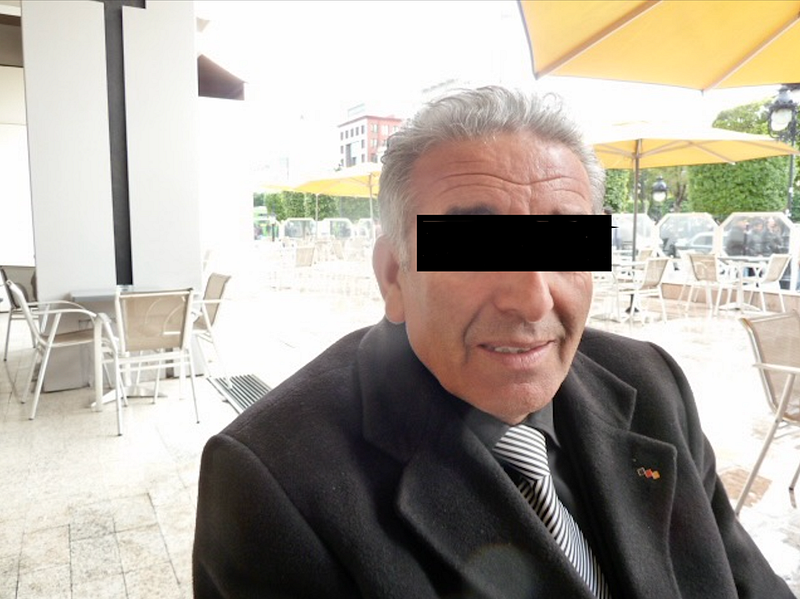
As I wandered the streets of Tunis, I made eye contact with a gentleman who approached me and introduced himself as Ahmed. We walked around a little bit and I told him I was going to get some lablabi for lunch. In fact, I already had a restaurant in mind because I had eaten there before. He wanted to steer me towards one that he knew, which was fine.
Ahmed didn’t eat anything. He said he didn’t like lablabi. He chatted with the restaurant owner while I ate.
During our conversation, Ahmed not only said that he worked at the Bardo Museum as a security guard, but he took out some sort of paperwork, ostensibly as a means of proving to me that he worked there. [As if I would care or question that.]
During our time together, Ahmed showed me a couple of papers that I was unable to read because they were in Arabic. One was supposedly the paper informing him of his current vacation time, which ends on Monday, and the other was an ID card, supposedly from the Bardo Museum.
This immediately raised my suspicion: Who, in a casual conversation with a stranger, needs to show proof of employment? It made no sense to me.
He told me he was 52, single, living with his mother, and it didn’t take long for him to come out to me as being gay. Maybe he considered the fact that I, as a solitary man traveling, could be gay, so this could have been part of a ploy to establish closeness in some way.
Once I had eaten my lunch and we left the restaurant, he said he wanted to get a coffee or a beer. I said that that was fine with me, but I didn’t want either one, as the lablabi was quite filling. I said I would just sit there while he had whatever it was that he wanted. I had my camera with me and asked if I could take his photo, to which he agreed.
Outdoor cafes are very much part of the culture in Tunisia. I imagine they are more enjoyable in warmer weather. But despite temperatures around 15C/55F, they are always populated, and I have yet to see an outdoor heater that tends to be popular in other countries.
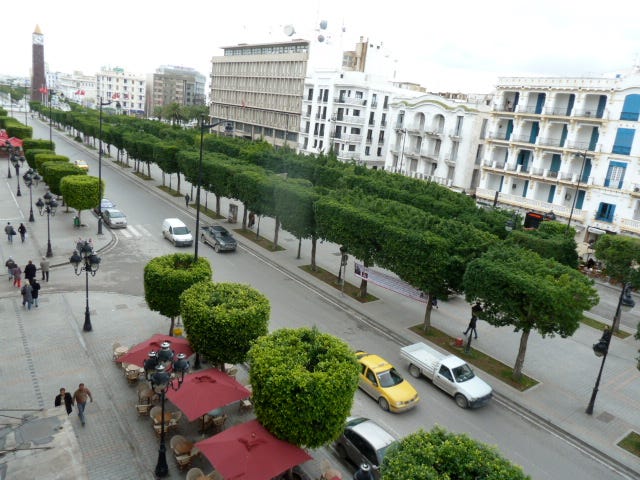
Ahmed took me to a bar that had an outdoor seating area. As soon as we walked in, I found that the smoke was overwhelming. I told him that I couldn’t stay indoors because of the smoke: we had to sit outside. I then learned that while it is legal to serve and drink alcohol, it would have to be inside the establishment, as it cannot be served or consumed in the area on the sidewalk.
He told me that I should be careful of young Tunisian guys, as they were looking to rob tourists.
He also asked if we could exchange phone numbers, and we did.
He had a beer, then another, then ordered a plate of cheese cubes. When his third beer was delivered, the bill came along with it. He looked at me, said it was 11.5 dinars, and asked if that was all right with me.
Oh, so that’s his game!?!?!?!?
I was a lot quicker with Ahmed than I had been with Mayur: I said there was no need to check the price with me, since he was the one drinking and eating.
I told him I hadn’t realized that that was he was up to. I simply stood up, wished him a good day, and left him sitting there at the table.
In all, no harm was done: just a fascinating experience. If stuff like this didn’t happen, I wouldn’t have as much to write about, would I?
How about you?
Have strangers tried to take you into their confidence as a means of entrapping you in some sort of way?


