
Have Regrets? To Move Forward, Look Backward
The prevailing wisdom says to ignore your regrets. Science calls bullshit. Embracing your regrets can be the path to your best life.

Perhaps you didn’t take that chance to travel. Or you were too shy to speak up at that one crucial moment. Or you didn’t take enough creative risks in your career. Or you never mended bridges with someone you loved…and now it’s too late.
It’s natural to look back and question some of our life choices. Why did we choose so poorly, decide so wrongly, or act like such a complete fool?
Ashamed and humiliated, we push those negative emotions to the backs of our minds. “No regrets!” we proclaim cheerfully. Why invite pain when we can avoid it? Forget the past; seize the future!
To that way of thinking, author Daniel H. Pink has one word: “Bullshit.”
In his book The Power of Regret: How Looking Backward Moves Us Forward, Pink says that reviewing our past — even the less-than-stellar moments — can help us make better decisions, be more creative, and live more meaningful and fulfilling lives — benefits proven through more than 50 years of scientific research.
Regret is “healthy and universal, an integral part of being human,” Pink writes. “It clarifies. It instructs. Done right, it needn’t drag us down; it can lift us up.”
The two paths to regret
Pink dove deep into the science of regret, undertaking two research projects. The World Regret Survey is a collection of 16,000 regrets of people living in 105 countries around the world. The American Regret Project is a public opinion survey of more than 4,000 Americans about the times in their lives they wish they could have skipped.
Pink found regret is surprisingly common. A whopping 82 percent of Americans said they at least occasionally look back and wish they’d done things differently. By some estimates, regret is one of the most common human emotions.
There are two ways to feel regret, Pink says — through action or inaction. Action-related regrets, while painful in the short term, can help us learn from our mistakes. We take our lumps and move on.
But regrets related to inaction — the words left unsaid, the chance not taken, the opportunity unrealized — tend to keep us “stuck” — especially as we age.
Inaction leaves the results to our imaginations, Pink explains. So it’s not difficult for our brains to conjure up stories such as “I should have married Steve instead of Mike,” or “I should have become an artist instead of an engineer.”
These types of “I should have’s” are nothing but fantasies. There’s no crystal ball showing whether life as an artist would have been terrific or terrible, or whether Steve would have been a dream husband… or a complete cad.
The flavors of regret
To avoid fantasizing about outcomes or getting “stuck” in your regrets, Pink recommends bringing them into the light of day. Start by reviewing the following types of regrets Pink identified through his research, and take note of any that may apply:
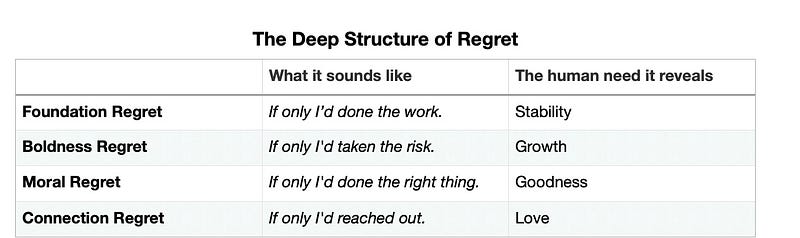
Foundation regrets — These include things you should have done but didn’t. Maybe you failed to eat right or exercise, save money for retirement, or take your education seriously.
The consequences of “non-choices” like these aren’t immediately apparent. But over time, the effects accumulate and can morph into strong negative feelings.
“When such decisions eventually cause the platform of our lives to wobble and our fortunes to not live up to our hopes,” Pink says, “regret follows.”
For Tina Turner — the Queen of Rock ’n Roll who passed away this past March — ignoring her health caused her remorse. Although she died of natural causes, Turner had long battled high blood pressure and kidney failure. In her final months, Turner said she regretted “letting it get to the point where it was about life or death.”
Boldness regrets — With boldness regrets, you chose to play it safe. You stayed in a dead-end job. You passed on an opportunity to study abroad. You didn’t approach that attractive person.
A 47-year-old Utah woman told the American Regret Project: “I regret not traveling more when I was younger — before I had a mortgage and child and ‘real job’ and all the responsibilities of being an adult. Because now, I don’t feel like I have the freedom to do it.”
“At the heart of all boldness regrets is the thwarted possibility of growth,” says Pink. “The failure to become the person — happier, braver, more evolved — one could have been.”
Moral regrets — If you have moral regrets, you did the wrong thing. You cheated on a test. You swindled a business partner. You deceived a spouse. Bottom line: You took the low road.
In his book, Pink shares the story of a 37-year-old man who said, “I regret bullying a few different kids in my grade growing up. When I think back on it, I cringe and I can’t help but wish for a chance to go back and change it.”
Connection regrets — The most common type of regret relates to relationships — family, friends, and romantic partners. This often surfaces when people drift apart or become estranged.
Palliative care specialist Bronnie Ware, author of The Top Five Regrets of the Dying, hears connection regrets frequently from end-of-life patients who prioritized their careers.
“All of the men I nursed deeply regretted spending so much of their lives on the treadmill of a work existence,” Ware writes. “This came from every male patient that I nursed. They missed their children’s youth and their partner’s companionship.”
What your regrets reveal
When reviewing your regrets, Pink suggests thinking of a photographic negative. Just as a negative shows the inverse of an image, regrets operate as a photographic negative of the good life.
“If we know what people regret the most,” Pink says, “we can reverse that image to reveal what they value the most.”
What human need are you lacking? The Deep Structure of Regret may provide insights:
How to do regret right
Once you’ve identified your regrets and the corresponding human needs, Pink recommends a three-part strategy:
- Look inward — Treat yourself with kindness and compassion. Know your past mistakes don’t define you.
- Look outward — Share your regrets, either through journaling or by talking to a trusted friend or therapist. Sharing your emotions is a form of unburdening yourself.
- Move forward — Ask yourself what lessons you can draw from your experience, and how you can apply them going forward. Can you apologize, make amends, or tweak your life’s course?
A caveat: While mild regrets may be useful for driving new action or gaining new insights, obsessing over past mistakes can lead to depression and anxiety.
Be sure to avoid rumination. The word itself is derived from bovine digestion — the way cows eat food, regurgitate it, chew it again, swallow…and repeat.
Ruminating can have the same over-chewed, unproductive effect. If you find yourself stuck in negative recurring thoughts, seek professional help.
Takeaway: Regrets make us human
In his book, Pink tells the story of Cheryl Johnson, who regretted losing touch with her close friend Jen. The feelings nagged at Cheryl so much that one morning she pushed past her awkwardness and sent Jen an email.
Although they hadn’t communicated for 25 years, Jen replied within hours, and the two decided to reconnect.
“I finally got to say to her that I knew I made a mistake, and how much I regretted losing so many years that could have been spent watching our lives unfold together,” Cheryl said.
Jen’s response? “But we still have a lot of years left.”
If we think about regret like this — looking backward to move forward, taking charge of what we can control, and putting aside what we cannot — the effect can be liberating.
“After a few years immersed in the science and experience of our most misunderstood emotion, I’ve discovered about myself what I’ve discovered about others,” Pink writes. “Regret makes us human. Regret makes me better. Regret gives me hope.”
Thanks for reading! Your support makes my writing possible. You can sign up for emails when I publish on Medium, or join Medium to directly support me and gain full access to all Medium stories.


