
Have a Heart, Be Grateful, and Observe Handicap Restrictions
If you’ve got functional mobility, use it.
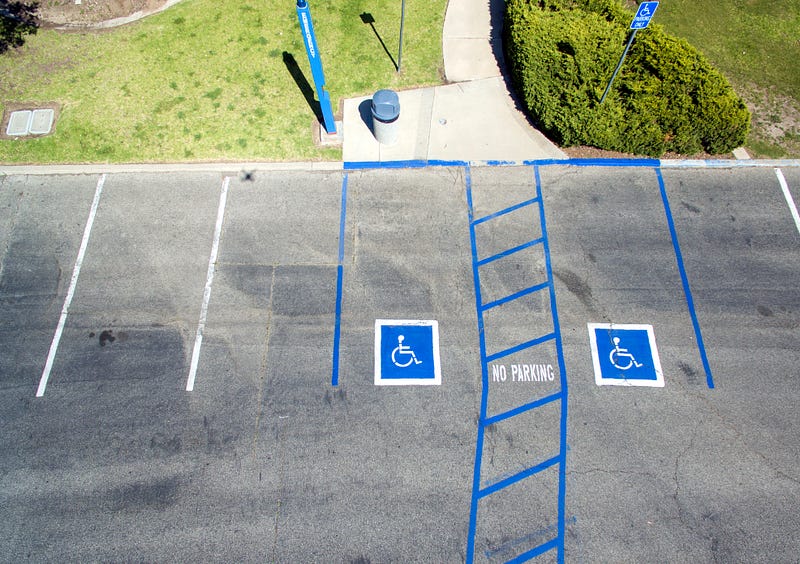
Handicap spots, bathrooms, and accommodations are for those with limited mobility. It can be for an obvious impediment or something that you can’t detect with your eyes. People with bad backs, seizure disorders, or undergoing chemotherapy are three examples.
You can’t see what’s wrong. But that doesn’t mean something isn’t.
Observing and obeying handicap signs is the law, and you are subject to fines if you neglect to do so. But observing them is also a sign of common courtesy.
Take into account someone you care for or that you may need handicap accommodations sometime in your life. These accommodations make it possible for those with limitations to participate in activities like the rest of us. And it’s their world, too.
Here are a few examples of where you’ll find handicapped accommodations.
Parking
You’re driving around and around, and there are no spaces. But there are several empty handicap spots, and you just can’t imagine that at least one won’t be used.
I feel your pain. You’re late. You’re frustrated and there are no other spots available. Every place you look has a handicap placard. In reality, there is one handicapped parking spot for every 25 or 2 percent for lots with 501–1,000k spaces.
Or maybe the spaces are tucked away on the back of the lot, and walking across a parking lot in the winter or the blazing heat is not pleasant. Personally, I’ve experienced this. But if you’ve got two good legs, don’t even consider using a handicap spot.
You never know what not having a spot might mean to someone who doesn’t have two good legs.
It isn’t very empathetic and it’s against the law. California calls it “fraud” and you will be fined $250 — $2,500.
How do your legs feel now?
Bathroom
Unless you can’t wait, and maybe you can’t, don’t use the handicap-accessible stall in public bathrooms.
It’s extra-large for wheelchairs, is equipped with bars to allow the person in the wheelchair to get out and onto the toilet, and the toilet paper is within arms’ reach.
This last item doesn’t sound like a big deal, but we all need to be able to reach the toilet paper.
It’s the last stall in the bathroom, so look to see what else might be open.
Public Transportation
This one is a matter of patience. And kindness.
Subway systems are equipped with cars that “kneel” and extend a ramp to allow wheelchairs. There is then a spot for that wheelchair on the bus or train.
Either leave these spots open or move out of them to make room for someone in a wheelchair.
Seats are reserved for anyone with a physical limitation. Give your seat to anyone who has a cane, walking device, or has mobility issues. Or any a person who is holding a child.
It also takes people with disabilities a bit longer to board a train or bus. When a disabled person is on the platform or sidewalk, the driver needs to exit to engage the ramp and assist the passenger. It’s a slight delay, but you’ll see people rolling their eyes and sighing due to the inconvenience.
Try putting yourself in that wheelchair. Smile at that person, no matter how you feel. Your standing there on your own two feet.
And a smile is a little thing that goes a long way.
Entertainment Venues
Movie theatres, theatres with live shows, and other entertainment venues have areas designated as handicapped.
And no, it is not alright to use them if it is empty.
Think of it as using something with someone else’s name on it. If there’s a name card on a table and that person doesn’t show up, do you pretend to be them and sit there?
Probably not. And it’s even more apparent if you don’t have a physical handicap.
We, the non-disabled, at least for the time being, are not entitled to use handicap designated spaces, services, etc., just because it’s more convenient for us.
If you can get around and walk longer distances, do so. The day might come when you are not so lucky.
And you’ll need that handicap space to be available!