
Have a Happy New Financial Year in 2019!

Could 2019 be the year you become debt-free?
Could 2019 be the year you start to build up an emergency fund?
Could 2019 be the year you start saving seriously for a deposit on a home or early retirement?
The answer to all these questions is a resounding “yes!”
If you decide what you want to achieve, make plans for doing so, and carry them out, you will improve your finances in 2019, even if you end 2018 deep in debt, with no savings, or a low income.
You can improve your finances even if you think there’s no point in trying because you’ve tried before but haven’t succeeded. Don’t be defined by your past mistakes or temporary failures. The future can be different but you do need to take action to make it different.
You may move forward slowly at first and you’ll definitely encounter setbacks on the way, but you could achieve much more than you ever imagined, if you keep to your plans.
Here are five things you can do to improve your finances in 2019.
Decide on Your Financial Goals
What do you want to improve and achieve as far as your finances are concerned?
Do you want to:
· reduce your debts and then pay them all off?
· save money for the deposit on a home, unexpected expenses, a vacation or other reasons?
· boost your income?
· reduce your expenses?
· plan for an early retirement?
Write down each financial goal as it comes into your mind.
Once you’ve finished, divide your goals into:
· Those that are achievable in 2019
· Longer term goals.
Setting financial goals means that you clarify your intentions both in the short and longer term.
Deciding exactly what you want to achieve is the first step toward achieving it.
You’ll be more motivated to achieve your goals and less likely to give up on them if you’ve recorded them on paper or electronically.
Set Up or Update Your Monthly Budget for 2019
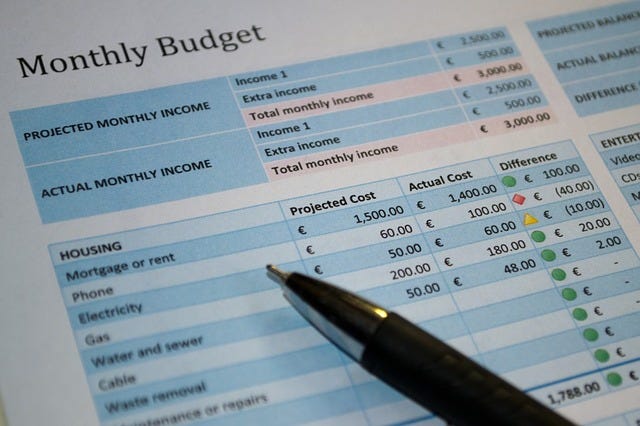
If you already follow a monthly budget, update it for 2019 and see if there are any areas of expenditure that you can reduce or even eliminate altogether.
If you haven’t yet set up a monthly budget, do so for 2019. Search for a monthly budget template and choose one with an eye-catching, colourful design so that you’ll enjoy filling it in.
Essentially, a budget should consist of:
· Total income
· Expenses
· Savings
Keep your budget as simple as possible. You don’t have to break your expenses down into a lot of categories, unless you want to find out exactly where all your money is going.
If you already have good control over your discretionary spending, just add a “personal spending” category in which you place all your outgoings on non-essential items.
Make a Debt Payment Plan
If you have debts, your priority should be to set up a plan to reduce and pay off these debts as quickly as possible.
Start by listing all the debts you have. Include:
· Each credit card
· Student loan
· Car loan
· Personal loan(s)
· Payday loan
· Money owed to friends and family members
· Mortgage
· Rent arrears
Write the total amount you owe and the interest rate next to each debt.
Then, prioritize the repayment of your debts, starting from the debt you’d like to pay off first to the one you’ll pay off last.
You might want to pay off the lowest amount you owe first, so that you feel a sense of achievement that will encourage you to repay your other debts.
One sensible course of action is to pay off the debt with the highest rate of interest first, even if it takes you some time. If you put all your extra money into paying off a credit card or loan with a high interest rate, you’ll be paying off the balance rather than letting the debt get higher and higher through the continuing addition of interest.
At the same time, see if you can reduce the interest rate on your other debts. You may, for example, be able to transfer your credit card balance to a new credit card that offers zero percent interest for a limited period.
On the other hand, if one of your debts, such as a car loan, carries a penalty for early repayment, make it your lowest priority debt.
Look at your monthly budget and decide how much money you can devote to paying off your debts. Remember that, as well as paying extra money toward your top priority debt, you’ll also have to meet the minimum or usual monthly payments on your other debts.
At the same time, see if you can increase your income and/or reduce your expenses, in order to generate or save extra money that will be put toward debt repayment. If, for example, you receive a bonus or tax refund, that can be used to pay off part or all of your top priority debt immediately.
If you continue to do this, you’ll either reduce your debts significantly or be debt-free by the end of 2019.
Start Saving Regularly
Even if you have debts to pay off, it’s still a good idea to get into the habit of saving money regularly. If you build up an emergency fund, even a small emergency fund, you’ll be able to pay for unexpected expenses without using your credit card or taking out a loan.
If you don’t have any debts but little, if any, savings, now is the perfect time to start saving regularly.
Decide to save a certain percentage of your income each month in 2019. It could be as little as 0.5 percent or as much as 50 percent or more. You may choose a high proportion of your income if you’re aiming to retire early.
Set up an automatic transfer from your checking account to your savings account on payday each month and then forget about it.
Regard the money you save each month as a bill that has been paid. If you think that you’ll feel tempted to dip into your savings, open a savings account at a different bank or a restricted access account. This will make it more difficult to withdraw money from your savings.
Simplify the Management of Your Finances
It can be difficult and time-consuming to keep track of your finances if you have many different accounts held in different places.
A personal finance app that allows you to see your true financial picture at a glance will simplify the management of your finances and save you a lot of time.
Gokong, for example, allows you to see the current total of all your bankable and non-bankable assets. This makes it very easy to keep track of your finances on a daily basis.
When the Going Gets Tough, Carry On
Don’t give up when the going gets tough. If you can’t afford to put extra money toward paying off your top-priority debt because you had to pay for a car repair this month, don’t worry. Just allocate that money to the debt next month.
Try to be as consistent as possible with your saving, but, if you need to reduce the amount you save one month because you’ve had an unexpected dental bill, don’t stop saving altogether. Just go back to saving your regular amount next month.
Everyone is challenged by unexpected events at different times in their lives.
The key is to continue with your financial goals, even when things are tough.
This way, you’ll achieve those goals, even if it takes longer than you expected.
You can improve your finances in 2019. With these plans in place, you’ll enjoy a happy and prosperous year.