
A Funny Thing Happened on the Way to the Wedding
One weekend, six weddings, and how a love torn apart by hate survived 40 years of separation and the pandemic
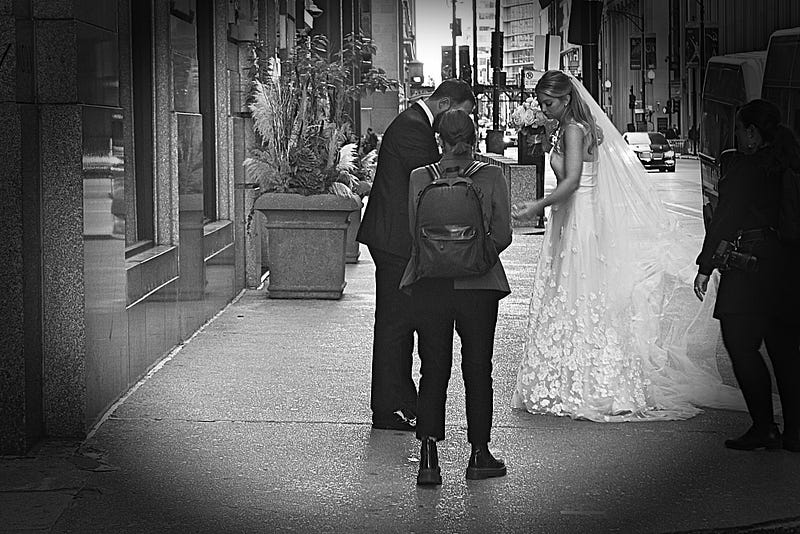
A young woman in a wedding dress is a mystical trigger. She is not only herself but an embodiment of dreams and aspirations that extend beyond her immediate union with her beloved. The dress itself, though often costly, is usually worn in public only once. A sign that the bride’s time of elevated participation in something greater than herself will never be repeated in quite the same way.
In October of this year, I flew to Illinois for the wedding of a favorite niece. To get there, I took an at-home COVID test and sent the negative result to the coordinator at least 72 hours before the event. I entered a lengthy queue of traveling mask-wearers in the Atlanta airport and boarded a plane for Chicago, where I checked into the exclusive private club where my niece was staying.
It was my first trip out of Atlanta since the pandemic began. And I conducted myself like Miranda at the end of The Tempest. “O brave new world that has such people in it!” Everyone looked beautiful to me. I talked incessantly to anyone who would listen.
If scarcity teaches value, being among my fellow humans in such large numbers again made me appreciate them as if they’d all just sprung to life from the mind of Zeus. Each person regardless of size, shape, gender, or race seemed a veritable miracle to me. I felt happy, inspired, lucky to be alive.
The courage to love
During the ceremony the following day, I remembered that a wedding is a rite of passage for the bride and groom. One that invites everyone in attendance to contemplate their own efforts to join with another in a holy sacrament. Be those efforts successful, aspirational, or failed — you cannot witness the exchange of vows without also recalling that it takes courage to love. I watched as my niece and newly acquired nephew stepped boldly into a ring only 60 percent of couples survive.
I don’t cry at events like this. But I did feel a certain fullness of heart as I remembered one other thing. Every earthly wedding has a spiritual counterpart that can only be experienced within, the stakes of which are measured by one’s capacity to embrace them.
Deja vu
After nearly two years of pandemic confinement, I couldn’t wait to drink in as much of Chicago’s exuberant cultural life as possible. The next day, I made it to the Art Institute to catch the André Kertész Postcards from Paris exhibit and the Impressionist paintings I never seem to get enough of. Masks required. Touchless ticketing. A long walk through the Asian Art gallery to the museum’s Modern Wing. Heart-stopping beauty everywhere I turned.
Afterward, I walked through the city snapping black-and-white photographs on the streets, hoping that one or two of them might be worth holding onto. About a block away from where I was staying, I looked up to see a woman dressed entirely in white stepping out of a black car. Here was another veiled young bride about to exchange vows with a man she hoped would turn out to be everything she needed him to be.
They certainly looked beautiful together. And as the wind blew through the high-rise canyon of downtown Chicago, I snapped away. This was not my wedding party. But I took this other bride’s last fussy minutes before the ceremony as a gift intended entirely for me. After all, I had a Nikon around my neck.
Having just left André Kertész, it was Henri Cartier-Bresson’s decisive moment that influenced me now. The image would not last unless I captured it.
I love instants like this. The candid unposed photos will never be as finished as the ones the bride paid for. But that brief sidewalk pageant excited something inside me I cannot explain. I felt kissed.
As You Like It
In keeping with my usual gluttonous consumption of Chicago culture, I had intended to see Othello at the Court Theatre, followed by Desdemona, Toni Morrison’s take on Shakespeare’s tragic heroine. But both plays were sold out. And I was glad.
My niece’s wedding and the family reunion that accompanied it had heightened my spirits and extended the loving sense of belonging I’d experienced since leaving Atlanta.
Why dampen that feeling with a play about a faithful wife who gets murdered by a jealous husband? Why sink further into that miasma with a look at how the white wife fares during an afterlife encounter with Black women?
There are many good reasons to answer Yes to those questions. One of them is Shakespeare. The other is Toni Morrison. But not on this night, dear literary masters. Some other time. The Universe had ordained it.
The Shakespeare-Beatles mashup
So I wound up seeing a clever adaptation of As You Like It at the Chicago Shakespeare Theater instead. Masks and proof of vaccination equired. In this version, the banished Rosalind dresses as a man just as she does in other versions. But in this play, all the songs are by the Beatles. And the melancholy Jaques who roams the forest reciting verse is a woman.
An idea like this would either fall flat on its face or send the audience into spasms of exultation. Fortunately, the latter proved to be true the night I was there. Standing ovations all around.
I had forgotten that As You Like It ends with four weddings, the path of each foretold by the quality of their beginnings. Which is true, I suppose, of all relationships. And come to think of it, just about everything we attempt to do.
But in this version, three of the brides are Black who wind up with white husbands. I wondered watching this production if Atlanta’s dismantled Georgia Shakespeare productions might have survived had its managers been brave enough to attempt casting like this.
Torn apart by hate — reunited by love 40 years later
Shortly after I returned to Atlanta, I chanced upon a trending story in my Twitter feed about a young mixed-race couple in the UK who fell in love as teenagers. She was white, he was Black, and both sets of parents were against it. In the end, it was the girl’s father who convinced the boy to forget his daughter by threatening to use his influence to have the boy expelled.
After two failed marriages for her and a failed relationship for him, the two eventually found each again other via Facebook but remained separated by pandemic travel restrictions and the distance between the Bahamas and England. Now in their 60s, they can begin again the love that was taken from them in their youth.
As I read this story, I thought about my own family. How like a delegation from the United Nations we all looked at my niece’s wedding. Black, white, brown, and many shades in between.
On the New Orleans side of my tribe, the races have been intermarrying for generations. If the larger world has taken its time to overcome racial hatred, we seem to have moved faster than the deliberate speed mandated by the Supreme Court in 1954.
Now my niece has continued that tradition. During the dining and dancing that followed her wedding, no one cared that the groom’s family is white and that ours is mostly Black. What mattered for the newlyweds and for the rest of us is the song we heard at the end of that Beatles-inspired As You Like It in Chicago.
All you need is love All you need is love All you need is love Love is all you need.
©2021 Andrew Jazprose Hill
Thanks for reading.