
Hath No Fury Than A Medici Scorned
The fall and rise of Catherine de Medici — the merchant's daughter

In 1527, the city of Florence was one heck of a mess.
The Florentines wanted the ruling family, the Medici, canceled, including the Medici upstart, Pope Clement VII (Giulio de Medici), and all his clan. To punctuate their hatred, citizens tore through the streets, destroying the art that had once made Florence the epicenter of culture and beauty.
The angry mob even hurled a bench through a window and broke the arm off of Michelangelo's David's. We can thank the painter and architect, Vasari, for saving the arm. He hid David's arm until things calmed down and then reattached it.
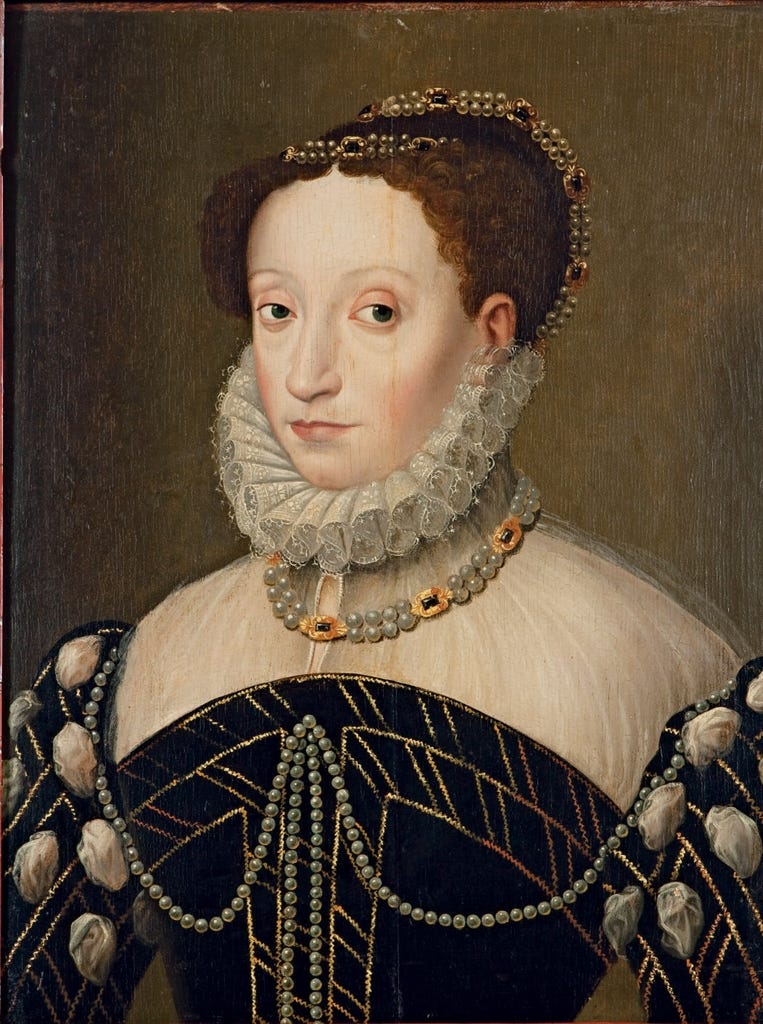
During the melee, the thirteen-year-old Duchess of Florence, Catherine de Medici, rode through the streets of Florence on a donkey with the screams of an angry mob calling for her death.
Catherine had few friends or family to protect her from her terrible fate. Her mother, Madelaine de la Tour d'Auvergne, a French Bourbon Princess, had died giving birth to her. Her father, Lorenzo II de Medici, the Duke of Urbino, had died from syphilis weeks after Catherine's birth.
Now, Catherine represented everything the Florentines had come to hate in the power-hungry banking family. Her bulging eyes and thick cheeks didn't help. Most contemporary sightings reported that Catherine looked every inch a Medici (which was not a compliment).
If Florentines could destroy David, what would stop them from killing this unattractive heiress to the Medici fortune?
There were certainly some creative suggestions as to what to do with her.
A. Strip her naked and expose her on the city walls as target practice. B. Place her in a brothel to spoil her marriage value. C. Lock her up in a convent.
Fortunately for Catherine, the citizens went with option C, but Catherine never knew if they would come storming into the convent to enact plan A or B. To protect her chastity, she cut off all her hair and donned a nun's habit, daring the people to hurt a bride of Christ. Catherine intended to survive even if it meant a life of seclusion.
Yet, just a few months earlier, the Florentine people had called her "Duchessina" (little duchess) and loved and respected her. We can imagine a thirteen-year-old girl not fully understanding why her people had loved her one minute and then hated her the next. Such a precipitous fall from grace cemented Catherine's chariness and colored her later political decisions.
Rome…A Bigger Mess
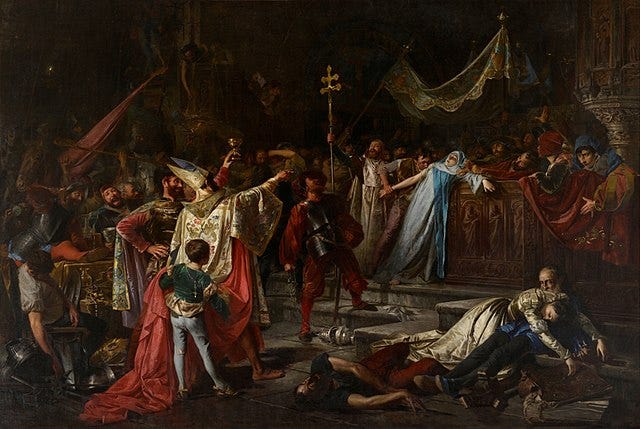
Months earlier, Catherine's cousin Giulio de Medici (Pope Clement VII) had some uninvited guests — Spanish and German troops under Charles V. The main forces consisted of 13,000 German reiters, and these brutes were not attacking Rome for religious redemption. They mostly wanted booty. Instead of being paid, they worked out an agreement where they agreed to sack Rome if no limit was set to their pillaging.
And pillage they did.
They helped themselves to Rome's goodies like hyperactive kids on a sugar high. It was said that their commander, von Frundsberg, wore around his neck a gold chain with the sole purpose of strangling the Pope.
They even dressed an ass up in papal vestments to further amuse themselves and ordered a priest to feed it the consecrated Host. I don't find it very funny, but the Germans found it hilarious. When the priest refused, they hacked him to pieces. (Hmmm…still not funny.)
But Frundsberg didn't get to use his gold chain because Clement escaped disguised as a servant with a long beard and tattered hat. It wouldn't have fooled me, but barbarians are not too smart when busy pilfering.
So with his papal robes dragging behind him, Clement hid out at the Castel St. Angelo while the holy city took a good beating.
Coincidently, during this time, English legates came to see the Pope about Henry VIII's divorce from Catherine of Aragon. They found Clement sitting on a straw pallet with his gouty leg propped up, vowing never to shave again. Henry sure picked a crappy time to ask for a favor. (Perhaps that is why he didn't get his divorce dispensation.)
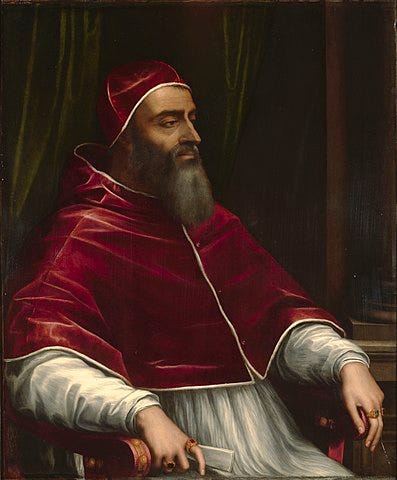

So let's recap. We have a gouty Pope sitting on a straw throne, needing a shave. His palace in Rome is in tatters. His people have been murdered and raped. And now Florence (his hometown) is revolting and trying to drive out his Medici relatives.
I am not defending the guy, but he was probably having a bad week.
Clement felt betrayed by the Florentine revolt and intended to put it down swiftly and cruelly. Machiavelli didn't dedicate The Prince to Clement's brother, Lorenzo II, for nothing. Clement's mission to put down the Florentine revolt reflected a Medici family mantra — "do evil if necessitated."
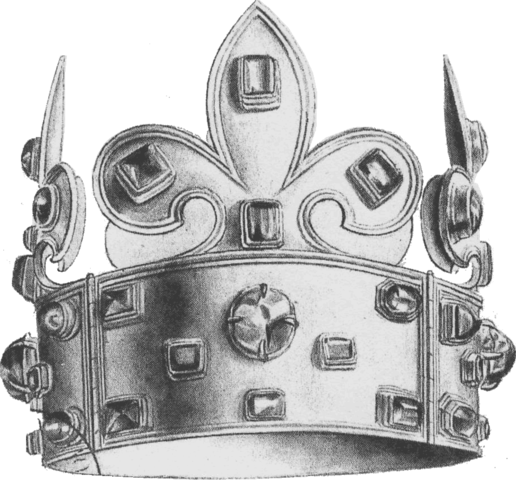

In an act of marketing genius, Clement then made a secret agreement with Charles V to end the destruction in Rome in exchange for placing the crown of Charlemagne on Charles' head. This gave Charles serious religious prestige and cost Clement nothing.
But how do you put a revolt down with no army?
No worries. Clement employed the same barbarians that had sacked Rome just months earlier to put down the Florence revolt. The German historian Leopold Von Ranke described it best when he wrote, "With astonishment did men behold Clement launch upon his native city the very army by which the horrors of the Sack of Rome had been perpetrated before his eyes." (1)
You have to be a little leery of a pope who finds barbarians employment. Yet whether his tactics were justified, Clement was triumphant.
He then came to Florence to return his prize to Rome — his young cousin, Catherine de Medici.
The Pope's Booty
Catherine was not of royal blood, but she did have a dowry big enough to tempt any prince. Consequently, Clement went about looking for a suitable groom. Several suitors were proposed, including:
A. The Duke of Richmond (Henry VIII's illegitimate son) B. King James V of Scotland C. Prince of Orange D. Duke of Milan
Anyone might have made a fine husband, but Clement had higher aspirations for Catherine. Knowing that France could use some spare gold, Clement waved the carrot of Catherine's dowry in front of King Francis I.
Francis bit, and Catherine was married to his second son, Henri II. Francis was not just hungry for Catherine's dowry. She also fit into his grand scheme of taking a chunk of Italy here and there, and the wily Clement VII did nothing to disabuse Francis that border expansion was not possible. (Over every Italian's dead body, was it possible.)
Thus, the young Catherine de Medici traded up that donkey for a white palfrey and made her royal entrance into France wearing enough bling to blind a person. Interestingly, Catherine wore a pair of priceless pearl earrings that she later gave to Mary Queen of Scots. These pearls ended up as part of Elizabeth I's crown jewels after she ordered the execution of Mary Queen of Scots.
Catherine also brought a sense of style to the court by employing the most talented Florentine seamstresses to make her dresses.
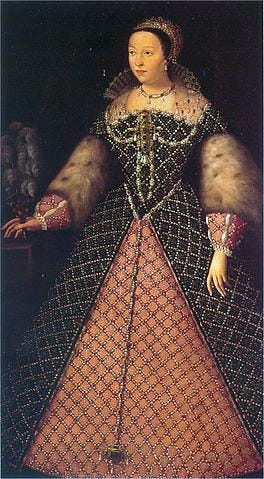

And jeweled dresses were not the only trend she brought to France. She also made the following popular:
1. The first forms of ice cream — or sorbet. 2. The fork — That one didn't catch on until later. 3. Handkerchiefs — but they were more like decorative squares and not the snot rags that we think of today. 4. Little persons — They were called "dwarfs" in Catherine's day. 5. A train of bears — Cause everyone needs a few bears in your royal procession. 6. Underwear — the ladies of the court were going commando until Catherine came along. 7. Seers and soothsayers — Catherine was buddies with Nostradamus and the Ruggieri Brothers. 8. The side-saddle — Invented later in her reign to show off her legs. 9. The folding fan — To hide her smirk. 10. Tobacco — Made popular later in her reign. She ground it up to treat headaches, but unfortunately, the rest of the court found other uses for it. (That means lung cancer for the kids at home!)
You would think a woman that shows up with fortune tellers, bears, and ice cream might impress a guy, but Henri seemed indifferent to his father's choice of bride. Perhaps he thought the "merchant's daughter" was not high enough on the royal food chain for him. Or perhaps her lack of beauty did not appeal to him. We will never know.
What is certain is Henri was Francis's least favorite son, and relations between the two were never the stuff of Hallmark cards. Henri most likely blamed his father for selling him short in the marriage market and probably saw his marriage alliance as proof of his father's lack of affection for him.
Catherine already had a rough start.
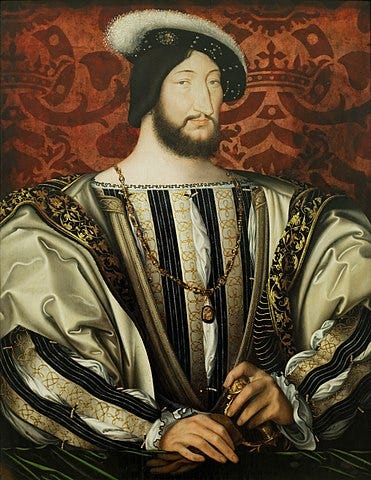

King Francis I — mentor or sleazy voyeur?
If Henri showed little affection for his new bride, at least Francis seemed happy with his choice. He liked Catherine so much that he even stayed in the newlywed's chamber to make sure that he "saw valor in the joust."(2) We can only imagine how Catherine felt about her father-in-law sticking around for her first moments as a newlywed. Yuck.
Even worse, Pope Clement VII checked in on the two honeymooners the following morning to ensure that the deed was done. He left satisfied.
In truth, Francis probably would have made a better husband for Catherine than his son. They shared a love of dance, poetry, art, and beautiful people. Catherine knew how to please and Francis…liked to be pleased. Catherine quickly ingratiated herself into Francis's harem, called the Petite Bande — a group of beautiful ladies that surrounded Francis everywhere he went.
But Catherine was that girl who stood out amongst Francis's bevy of dimwitted groupies. She stayed side by side with Frances in the hunt and took her falls without a complaint. She knew all the latest dances. She knew all the hot artists. (Vasari adored her.) She made Francis laugh. Heck… she even knew how to use a fork.
Catherine had that little something extra we call charisma. And it must have been refreshing for Francis to have a true Renaissance woman in his court when he had chosen so many of his companions by beauty alone. In turn, Francis became a mentor to Catherine, and we can see many of her later political decisions influenced by these early years.
Catherine had a chance of making a place for herself at court, winning the love of her people, and being remembered as a true Renaissance queen.
But then her uncle, Pope Clement VII, had to go and wreck everything.
When in Rome… don't drink the water.
Catherine de Medici tried to make a fresh start in the French court, but her happiness would be short-lived. On September 25, 1534, her cousin and benefactor, Pope Clement VII wrecked everything by dropping dead. The official report was that he died of a "gastric disease," but rumors quickly spread that he was poisoned.
Foul play was certainly probable considering that many Popes before Clement had succumbed to an unenviable death. Poisoning became so common that a popular saying of the time was, "He who drinks of the water in the Vatican will die soon." Assassinations were secretly carried out by the "Council of Ten" or "Terrible Ten" — a covert and highly autonomous Venetian police force that answered to no one.
Still, we can only speculate on what caused Clement's death. Some sources claim that Clement died after accidentally eating death cap mushrooms. This is highly unlikely given that the highly potent death cap mushrooms (even in small amounts) kill within a matter of days. Clement's illness lasted over five months.
More likely, his wine was flavored with a bit of "eternity powder" — a lethal mixture of henbane, water hemlock, or mandragora. Eternity powder was usually administered in small doses over several months resulting in a slow death that looked like…gastric problems.

Naked and afraid
If Catherine had shed any tears for her uncle, then she would have had few people to grieve with her. Florence mourned Clement's death by raiding and vandalizing his tomb. People did have reason to be angry. Clement had left behind a legacy of higher taxes and inflated grain prices.
Most damaging for Catherine, Clement also left behind her unpaid dowry. Francis was now stuck with an unpopular, Italian daughter-in-law without a cent to her name, prompting him to remark, "the girl has come to me stark naked."(3)
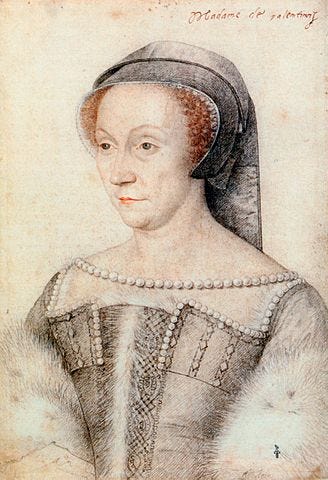
Three years after the marriage, Catherine was also failing at her sole purpose as wife to Henri II — she had yet to become pregnant. During this time, Henri began his affair with his older mistress, Diane de Poitiers.
A damsel in distress
Time for another recap. Catherine is stuck in France with no money, no benefactor, and no little Henri's running around. Her husband has taken some cougar as a mistress, and her uncle has died without paying her dowry. (But she does have fabulous underwear and dancing bears.)
How could Francis secure the Valois line if Catherine did not become pregnant? The logical solution would be to replace his daughter-in-law with a more fertile and politically advantageous bride.
The Guise brothers began campaigning for Louise of Guise as the replacement wife. Years earlier in England, Henry VIII had kicked Queen Catherine of Aragon to the curb and swapped her for Anne Boleyn. What was to stop Francis from doing the same to Catherine?
Catherine knew her situation was doomed, so she went to Francis, begging him to at least let her serve the new queen as a lady-in-waiting. Luckily, Francis was a big softy for a damsel in distress and didn't have the heart to kick her to the curb.
So Catherine stayed put and set herself the task of becoming pregnant.

A bitter pill to swallow
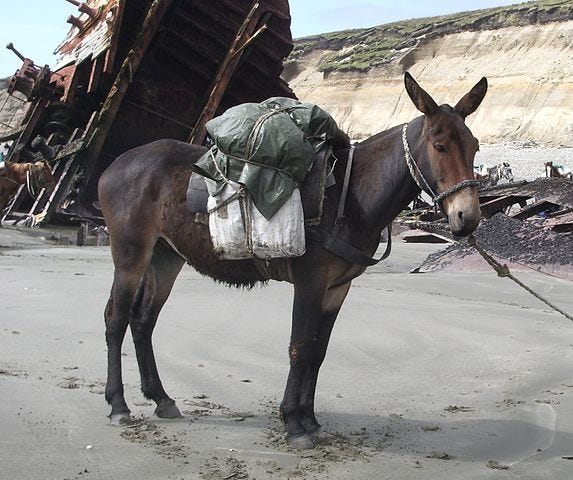
Getting pregnant in the sixteenth century could get dicey. First, Catherine applied poultices of ground-up stag antler and cow dung — a guaranteed remedy for infertility. When that didn't work, she tried drinking large quantities of mule's urine.
Catherine even drilled holes in her chamber's floor so that she could spy on her husband and his enigmatic mistress, Diane de Poitiers. Unfortunately, the peep show taught Catherine little regarding fertility and much more than she needed to know about her husband's passion for his mistress.
After ten years of trying everything imaginable…time was running out.
The fertility doctors comes a knockin'
Finally, the sixteenth-century version of a fertility doctor named Doctor Fernel was brought in, and he diagnosed a slight irregularity in the couple's reproductive organs. He prescribed a cure to which Henri and Catherine followed.
I wish I could tell you more about this cure, but history doesn't know what voodoo magic he used. All we know is that it worked fabulously. After ten years of cow dung and sex education, Catherine gave birth to Francis II on January 19, 1544.
Over the following years, she would give birth to nine more children, survive the Saint Batholomew's Massacre and the Hugenot's machinations.
Not too shabby for a mere "merchant's daughter."
Sources and further reading:
(1) Strage, 16. (2) Guy, 44. (3) Knecht, 28.
Strage, Mark. Women of Power: The Life and Times of Catherine Dé Medici. United States, Harcourt Brace Jovanovich, 1976. Frieda, Leonie. Catherine de Medici Pb. The United Kingdom, HarperCollins, 2006. Knecht, R J. Catherine de’Medici. Boston, Taylor & Francis, 1894. Guy, John. Queen of Scots: The True Life of Mary Stuart. United States, Houghton Mifflin Harcourt, 2014.