
Haters Are Worth Your Time. Here’s How to Pick Apart Their Nasty Comments and Baseless Arguments
You’ll not only feel better but could also gain a new follower.

Fluff article.
I editorially suggest you take this article down.
Can you imagine if someone said that about your thoughts, feelings, and opinions? I can — because it was directed at my writing.
As a freelance writer, you have to get used to degrading and hostile comments. It comes with the territory.
Random people will despise your hard work. They’ll fundamentally disagree with what you have to say — and they’ll let you know about it. This person is commonly known as a hater, and believe it or not — you will have haters.
They’ll stink up the comment sections of your most prized articles. They’ll attack your intelligence, integrity, and anything else they can get their hands on. The more you write, the more they have access to.
And you will take it personally.
At least, you will at first.
You’ll want to fire back. You’ll want to pepper in more expletives than Samuel L. Jackson spits out in any given scene. You’ll wish you could get your hands on the internet troll that’s spewing baseless personal attacks.
As tantalizing as the low road is, it only makes matters worse. The high road is far more rewarding — and I’ll show you exactly how to take it.
First, let’s walk through why you shouldn’t fight fire with fire.
Why you shouldn’t fight fire with fire
For starters, most haters want to push your buttons. Some people just like to poke the bear. By matching their nastiness, you’re giving them what they want. Don’t give them the pleasure.
Second, if someone is willing to stoop to crapping on your article, they aren’t going to back down if you fire back at them. It’s obviously not a face-to-face encounter, so the keyboard and screen give them a lot of confidence and protection.
Call me a pacifist if you want, but it’s not worth your time and energy. A written back-and-forth argument takes a lot of time. Think about the number of minutes it would steal from your day if you constantly monitored a war of digital words. Beyond the time factor, it’s an absolutely exhausting emotional exercise. It’s like accidentally leaving your headlights on all night — you’re needlessly draining your car battery when that energy could be put to better use elsewhere.
Instead, I’ll share two methods for handling negative feedback — because, if haters get to you, I still think it’s worth responding. They used to bother me, but I practiced the first method and it made me feel a lot better.
Once you adjust to mean comments and baseless arguments, you can graduate to the second method.
How to handle a hater if you’re sensitive to negative feedback
It’s a simple three-step process, but it’s easier said than done. With time and repetition, you’ll master it. And I highly recommend that you do because people aren’t going to stop being asshats online anytime soon.
While you’re new to writing, or, another way to gauge this, if negative feedback still makes your stomach sink, here’s the process:
Step #1: Take a deep breath. Breathing exercises are effective destressers — this will help you recenter yourself and think clearly.
Step #2: Count to 10. This will help you refrain from responding while you’re fired up. Otherwise, you’ll exacerbate the problem with an emotion-infused counterattack.
Step #3: Politely and professionally defuse the situation. You don’t have to sound passive or spineless to accomplish this — and you might even convert a hater into a follower.
How? Logic is your weapon.
First, and you’re going to look at me sideways, genuinely thank them for reading. They took the time to read your content and respond — show that you appreciate this. It’s a simple tactic, one that they’re probably not expecting. More often than not, this will catch them off guard.
Second, remember that the comment is coming from someone with a different perspective. They think differently — recognize and acknowledge that in your response. Try to see your work from their point of view.
Third, determine the legitimacy of their argument. The hater may have attacked the angle you took or a specific assumption you used. Maybe their grievance is baseless. Maybe they’re partially right. The accuracy of their claims will determine how you approach your response.
- If they’re partially right, acknowledge this. We’re human — if you made a mistake, it’s okay to admit it.
- If they fundamentally disagree with a controversial subject (e.g. politics), acknowledge that it’s okay to disagree and that you respect their opinion.
- If they’re outright wrong, point out the flaws in their argument without directly calling them flaws. (I’ll show you an example in the next section.)
- If it’s just blatant ad hominem, thank them for reading and express your disappointment in their opinion, but that you respect their right to have one. (Even if you don’t, you give them no ammunition and leave them with nothing to antagonize you over.)
It’s a logical process that will help you sidestep any frustration or fury. By taking the high road, they only look worse if they double down on their initial remarks. You also have a much better chance of convincing them they’re either in the wrong or overstepping a boundary.
An example of how I dealt with negative feedback
One of my proudest unheralded stats as a writer is the number of potential arguments I’ve dispelled. I’ll give you an example.
For context, the following response was to a story I wrote about cutting my monthly expenses by 32%. About nine months earlier, I had transitioned from corporate banking to freelance writing full-time; in turn, I needed to drastically cut my spending habits because my income took a massive hit. Within that story, I referenced a guilty pleasure of mine that was costing me a sizable chunk of change: smoothies.
That’s not so bad, Carter — how much were you spending on smoothies?
In a four-month stretch, I spent $302 on smoothies. Yeah, I know. That’s a lot.
Although this was only a small aspect of my story, I lost all of my credibility in the eyes of one particular reader, who was so taken aback by this subplot that he left a scathing comment.
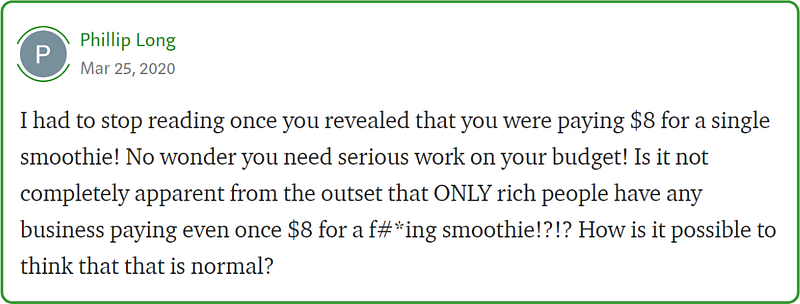
Phillip clearly disapproved of my guilty pleasure. Although Phillip doesn’t explicitly say it, he pretty much questions my common sense.
As you can imagine, I didn’t like reading it. My heart sank a little. A flare of anger sparked inside of me. But emotion-based arguments don’t end well for anyone involved. So, I kept my cool and responded according to the aforementioned steps. (Although I didn’t thank him for reading, I came up with that tactic later.)
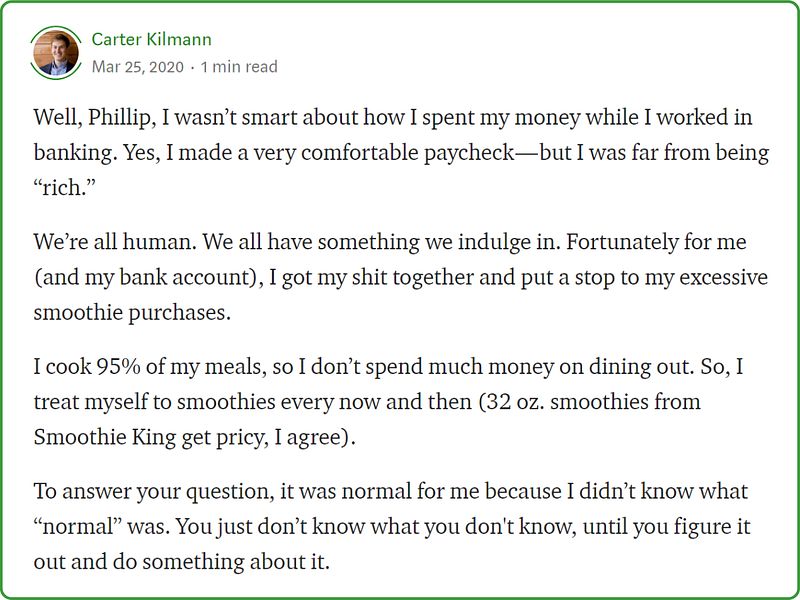
Let’s dissect my comment. I opened my retort by agreeing with the sentiment of his argument; he was partially right, my spending habits were ill-advised. In my response, I addressed each of his grievances, misassumptions, and questions, countering with logic-based answers.
Argument #1: Only rich people can afford $8 smoothies. This point was two-pronged: (a) I spend ridiculous amounts on smoothies, so I’m not qualified to give financial advice and (b) to do so, I must be “rich” so my budgeting solutions aren’t applicable to the masses anyway.
My response:
- I acknowledged that I made a good living, but I disagreed with the “rich” label.
- I recognized that people are human and, thus, error-prone with a tendency to indulge in guilty pleasures.
- I shared my rationale at the time — how I managed to convince myself it was okay to spend so much money on smoothies.
Argument #2: How could I think regularly spending $8 on smoothies was normal? This point questioned my common sense.
My response:
- I took a step back and suggested an alternative way to look at it. “Normal” is subjective.
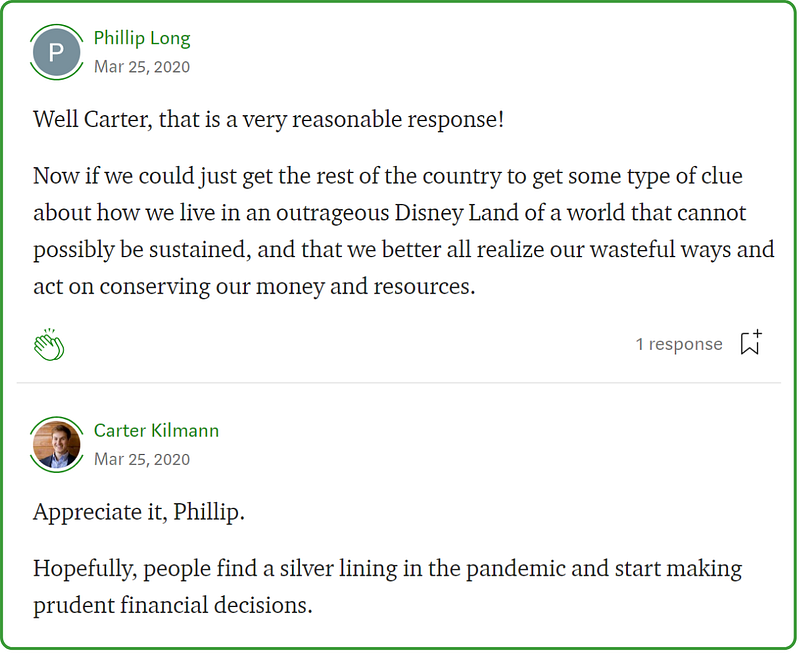
His response lifted the weight from my conscience. Although he went on to share a pretty cynical outlook on the general well-being of our country, he acknowledged that my response was reasonable.
He even came back to share that he also loves smoothies.
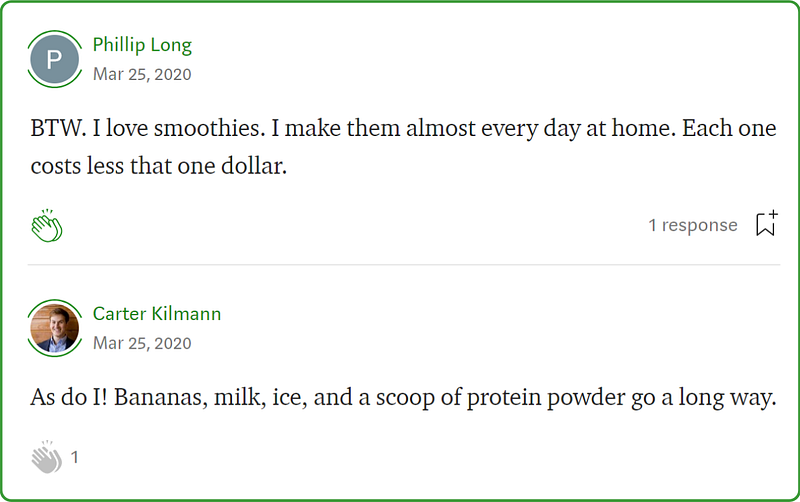
Immediately, I felt better. My initial feelings of self-defeat washed away. Plus, if anyone else shared Philip’s initial perspective, they’d see our discussion and feel less inclined to share negative feedback (hopefully).
Since this encounter, I’ve dealt with countless haters. I employed this approach for a while, but I eventually felt mostly immune to the negative feedback — it’s never fun to read, but it gets easier to handle with time.
How to handle a hater once you’re mostly immune to negative feedback
It takes a long time to reach a point where you don’t care what people think — even just a little. Negative feedback can still sting after years of writing. However, it doesn’t have as lasting of an impact. It’s much simpler to brush it off. Once you reach, this point, here’s how the process flows:
Step #1: Take a deep breath. Sigh at the audacity of some people.
Step #2: Determine if it’s worth your time — most likely, it isn’t.
Step #3: Forget about it.
That’s it.
You’ll reach a point where convincing strangers that they’re wrong doesn’t matter anymore.
Haters are a good thing
Writing is personal. It’s an outward expression of our inner-self. So, when someone trashes our writing, it feels like a personal attack.
It’s important to remember something: it’s not. They might intend it to be, but they don’t know you. You’re more than an opinion on global warming or a story about a bad relationship. Your thoughts, stories, opinions, feelings, etc. are just slivers of who you are. A hater in the comments doesn’t change that.
Ironically, I think haters are a good thing. They’re an indicator that you did something right. If enough people see your work that you’ve attracted people that strongly disagree with you, there’s a good chance your reach has expanded.
So, embrace the haters and keep doing what you’re doing.
What’s it like to write for a living? Let me show you.


