Has Culture Really Stopped Evolving?
And is Big Data to blame?


In a recent article in the New York Times, cultural critic Jason Farago argues that cultural output — films, music, art, etc. — stopped making progress at the end of the last century. Now, Farago doesn’t actually define “progress” in his essay, but it’s clear from his writing that he means something like the movement, over time, of cultural output through different, recognizable styles.
On your drive home, you can turn on the decade-by-decade stations of Sirius XM: the ’50s, 60s, 70s, 80s, and 90s will each sound distinct, but all the millennial nostalgia of the 2000s station cannot disguise that “We Belong Together” and “Irreplaceable” do not yet sound retro.
Farago’s thesis seems to be that culture stopped making progress because, by the 2000s, we had all basically immersed ourselves in a digital world where past and present coexisted. Space may go with the flow of time, but cyberspace exists beyond time. The artifacts there simply “float,” untethered to a specific time and place. Moreover, contemporary audiences just don’t seem to care as much about novelty as past ones did.
Farago’s conclusion is that this new stasis isn’t necessarily a bad thing. Past epochs of high cultural achievement have also been characterized by stasis, and novelty for novelty’s sake can create problems (more on that later), but ultimately, I felt Farago spent a lot of time embellishing his thesis without actually supporting it or considering any interesting arguments against it.
So in this article, I want to throw a more critical glance at the idea that culture has stopped making progress since the turn of the century. First, I want to ask whether “progress” is even the right word for what Farago is talking about. Then, I’ll offer an explanation for why art may merely appear not to be making progress from our current vantage point. Finally, I’ll look at some alternative explanations for the cultural stasis Farago claims to observe.
Consensus versus Progress
Farago’s essay reminded me of The Structure of Scientific Revolutions by Thomas Kuhn. In that book, Kuhn argued that science progresses through paradigms. Here’s how it works:
In the pre-paradigmatic stage, people disagree on what it is they’re studying and how to study it. Then, someone or some group of people come up with a framework or theory — what Kuhn calls a “paradigm” — that works both as a lens through which to interpret what they see and as a set of problems to solve. The paradigm supplies the language necessary to formulate hypotheses and suggests experiments to solve them.
If the new paradigm offers more hope of finding answers to questions people care about, it will gain adherents, and other ways of looking at the problem will die out. Soon, most practicing scientists are using the dominant paradigm, during a period Kuhn calls “normal science.”
But over time, the success of the paradigm means that scientists can develop more sophisticated technology for carrying out observations and can ask subtler questions in their experiments. As they do so, they find more and more that the data they observe fail to conform with the expectations supplied by their paradigm. This is called the period of “crisis.”
Eventually, the crisis is resolved when a new theory comes along that can reconcile all the old data and the new anomalies. If the new theory gains enough adherents to displace the old, a “paradigm shift” occurs.
Kuhn poses an interesting question at the end of his book, though: “Why should the enterprise sketched above move steadily ahead in ways that, say, art, political theory, or philosophy does not?”
That’s very interesting! Farago wonders why art has stopped making progress, but Kuhn seems to be saying that it never did to begin with, at least not in the sense that science does. But not so fast. Kuhn’s analysis actually goes deeper.
Viewed from within any single community… whether of scientists or of non-scientists, the result of successful creative work is progress. How could it possibly be anything else?
The theologian who articulates dogma or the philosopher who refines the Kantian imperatives contributes to progress, if only to that of the group who shares his premises…. If we doubt, as many do, that non-scientific fields make progress, that cannot be because individual schools make none. Rather, it must be because there are always competing schools, each of which constantly questions the very foundations of the others.
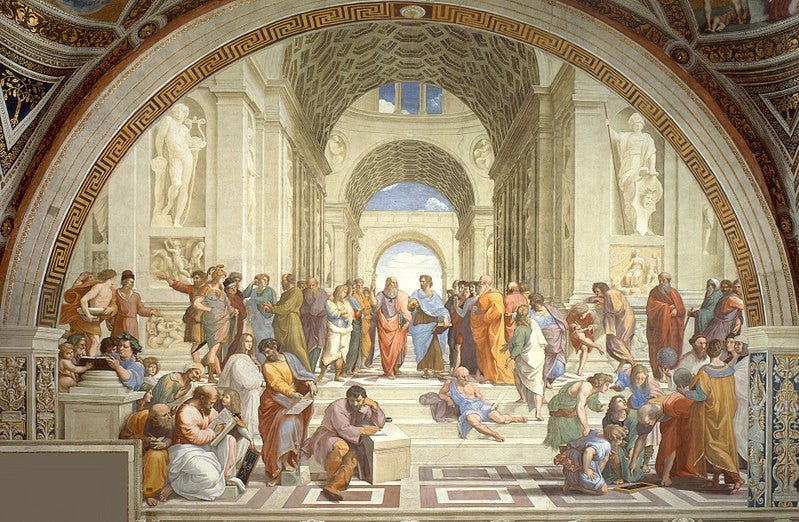

Science provides us (pardon the pun) with a paradigmatic example of progress. We can point to objective evidence of progress whenever we use a tool or perform some action that wasn’t possible — maybe wasn’t even thinkable — for our ancestors. And in the history of science, progress is generally accompanied by consensus on a paradigm.
But progress and consensus aren’t the same thing, as Kuhn shows. You can make progress in the arts even if you don’t have a consensus about what art is for, what its proper subject matter should be, and what forms it should take.
The way Farago talks about progress in the arts, and the examples he gives, make me think that he’s really talking about consensus, not progress. He’s saying that for the last few centuries, artists and audiences tended to coalesce on certain forms and subjects that dominated discrete spans of time. But since the 2000s that pattern has been broken.
Fair enough. He may be on to something there. It’s not that culture hasn’t progressed, but that no one can agree on where exactly the progress is happening, and what it means.
Revisionist history?
When I’m not listening to NPR, I usually have the car radio set to the “oldies” station that plays mostly songs from the 80s and 90s. But one frustration I have with this station is that, despite the wealth of great music that came out of those decades, they only seem to play a small sliver of it before they start repeating themselves.
For example, U2 produced a lot of great stuff in the 80s, but I can’t remember the last time I heard “With or Without You” or “Sunday Bloody Sunday” on the radio. But in just the last year I think I’ve heard “Sweet Dreams,” “Karma Chameleon,” “Don’t Stop Believin’,” and “Livin’ on a Prayer” a dozen times.
And that observation makes me suspicious of Farago’s thesis. Maybe there is no consensus among musicians, writers, and artists today over what forms and styles are most worth exploring, but are we really sure such a consensus existed thirty years ago? Or do we just think that because we’re only looking at a small fraction of the cultural output of a given era?
U2 doesn’t sound very 80s if by “very 80s” I mean the kind of synth-pop or power ballads that characterized the music of the Eurythmics, Culture Club, Journey, or Bon Jovi. So maybe that’s why it doesn’t get played much by the 80s station?


And maybe that’s true of movies too. We like to think there’s a genre of “80s movies,” but what we really mean is some loose constellation of films by John Hughes, Wes Craven, John McTiernen, James Cameron, and John Carpenter (a lot of Johns!).
But if we expanded our scope beyond what the filter of time and memory has left in the 80s bucket, would we be so sure the era really had the “feel” that we associate with it? And who knows? Maybe twenty or thirty years hence, future generations will filter out much of what we’re producing now and come up with a sound or an aesthetic that “defined” the 2020s.
On the other hand…
Still, part of me thinks Farago was on to something, even if he didn’t make the same arguments I would have made in his place. I think you can make a fairly strong case, not that culture hasn’t progressed, but that we have failed to find the kind of consensus that seemed to coalesce around cultural output in previous eras.
Consider that the 2000s coincided with the massive expansion of the internet and platforms for creating and sharing artistic works. Basically, the Information Age democratized content creation. No longer were audiences restricted to seeing, hearing, or reading only what the gatekeepers at major record labels, publishing houses, and movie studios decided they should.
Those gatekeepers had largely gone to the same schools, had the same training, and moved in the same social circles. It’s not surprising that they would agree on a style they liked. And being the conservative, profit-driven enterprises that they are, they naturally would hew to formulas that worked.
Another reason artists, writers, and musicians aren’t forming any kind of consensus may be that the Information Age has just given them such a vast back catalog of inspiration to work with. They can sample and riff on so many old sources now that they don’t need to engage their contemporaries as much. The upshot is that they’re picking up the threads of past artistic debates even as they’re not settling on any consensus about their own moment in art history.
Farago kind of makes this point when he talks about our “digital tools” and “algorithmic recommendation engines” producing “such chronological confusion that progress itself makes no sense.” But that can only be half the story. If the same technology didn’t also isolate us from one another, you would expect artistic communities to still be able to take that “chronological confusion” and make something recognizably 2020s.

At this point in his article, Farago begins a long digression on Amy Winehouse’s 2006 album “Back to Black”. It’s interesting, but I wish he had lingered on those “algorithmic recommendation engines.” If anything can explain why cultural forms keep circling back on themselves, they can.
The science of art
Why do I say that? Because as much as we may not want to hear it, as much as we may want to believe that art appreciation is a spiritual or transcendent experience, the truth is that we now know quite a lot about the psychology of aesthetic experiences.
For example, we have known for a long time that symmetrical faces are perceived as more attractive than asymmetrical ones. But when we drill down and ask why, we learn about a great deal more than just attractiveness. We discover general principles that explain the very concepts of “interestingness” and “beauty,” not just in the realm of physical objects but also in music and literature as well.
In the most general terms, the key idea is this: among a set of comparable objects or ideas, the most beautiful one will be the one that our minds can encode with the least amount of effort. That’s why symmetrical faces are more beautiful than asymmetrical ones. It’s why “brevity is the soul of wit.” It’s why we adhere to the principle of parsimony (aka Occam’s Razor) and find simple but highly explanatory theories “elegant.”
We like writing that’s “tight.” We enjoy paintings that display “organic unity,” that is, a thematic unification of diverse elements like colors, textures, forms, space, lines, shapes, and so on.
But ease of encoding isn’t the whole story. We also like novelty. We want these easily encodable patterns to violate our expectations, but not too much. Just enough to grab our attention, but not so much that we lose the plot. Good music employs complex but still recognizable rhythms, and melodic phrases that tease us with different possibilities for how a particular melodic tension will be resolved.
The characters in our stories emerge from what psychologists and anthropologists call our “intuitive ontology.” Think of your intuitive ontology as an implicit theory of the kinds of things that exist in the world. Those kinds of things might include PERSON, ANIMAL, NATURAL OBJECT, TOOL, etc.
This implicit theory has been honed by millions of years of evolution, and it creates a set of basic categories that then get fleshed out into sub-categories and sub-sub-categories on the basis of your individual experience (language turbocharges this process). Each category (and sub-category etc.) stores information about that category, so if I recognize x as a cheetah, for example, then I can infer x is a carnivore and that it can run very fast.
Now, anthropologists have found that, all around the world, stories involving anthropomorphized animals are far more common than stories involving anthropomorphized tools. Why? Simply because PERSON and ANIMAL are two basic categories that share lots of inferences in common, but PERSON and TOOL do not. Therefore, the narrative possibilities for stories involving talking animals are far greater than for talking tools. Our listeners or readers have to do much less work to understand the motivations of a talking animal, and they get more enjoyment from guessing its next moves than in the case of a talking tool.
Here’s the point: given a digital environment in which our attention has become the scarcest, most valuable commodity, and given powerful machine learning algorithms that can study millions and millions of human cultural artifacts, shouldn’t we expect data-driven methods to home in on artistic forms that are designed to maximize attention while minimizing the cost of production?
This is the question I really wish Farago had asked. If indeed culture has stalled, then I think Big Data is the most likely culprit. Never before in human history has it been so easy to “hack” our attention by quantifying our aesthetic preferences and mass-producing content designed to appeal to them.

Conclusion
I suspect the rumors of culture’s death are greatly exaggerated. Still, I think Farago is right to be concerned about the apparent lack of novelty in contemporary cultural output. And it’s not at all crazy to imagine that the Information Revolution has played some role in that development or that algorithms and machine learning may accelerate this process.
In the novel Infinite Jest by David Foster Wallace, the various plots revolve around a film of the same name, also called “The Entertainment.” The film is so compelling, so engrossing, that its “victims” can do nothing other than watch it until they die. In another of his novels — The Pale King — a character has an existential crisis when a voice on the TV tells him, “You’re watching As The World Turns.”
Maybe this is the greatest danger to cultural evolution: the power of computation and the logic of capitalism will induce us to turn art into a science. The gravitational attraction of our data-driven entertainment will become so great that it collapses into a black hole from which our attention can never escape.
But then I remember: all art is made for an audience. It is of the essence of all cultural output that it participates in an endless dialogue. I can’t help but feel that if we really did start to slide in toward solipsism’s event horizon, the need to share and connect would pull us back.