
Haruki Murakami’s Kafka On The Shore is spellbinding!
A hypnotic experience!
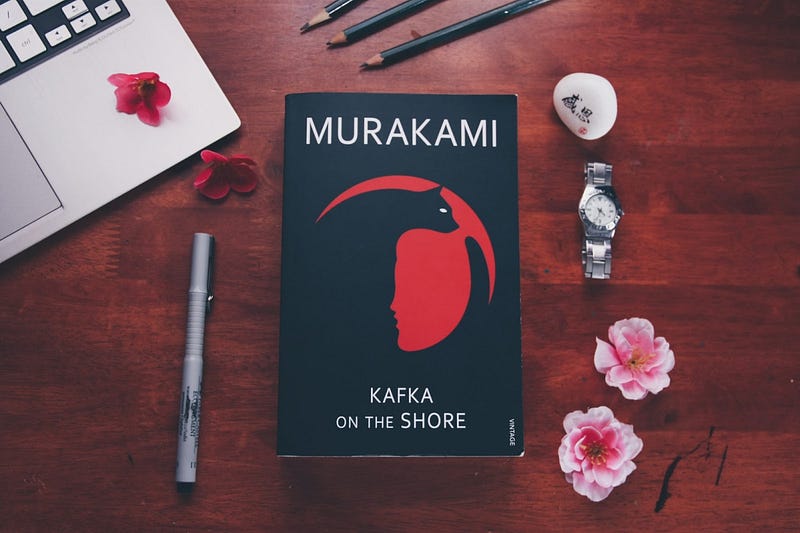
An old man with uncanny abilities who can talk to cats, rain leeches from the sky, and is guided by fate. A 15-year old runaway who falls in love with his mother because of his dad’s prophecy. Kafka on the Shore is a novel offering two unique stories but interrelated ones.
The fact that Haruki Murakami is a fan of Franz Kafka is not hidden. He has used the name, “Kafka” in this book. Also, he has written a short story “Samsa In Love” which was inspired by the novel, “Metamorphosis” by Franz Kafka. This fanboy journey of Murakami is beautiful and pure.
The book starts with an unnamed character who runs away from his home and his father’s dark prophecy. In search of his sister and mother, he finds his solace private library in Takamatsu. Running from the Oedipal curse, he becomes skeptical of every woman he meets — always thinking that any woman he meets can be his sister or mother.
Going through the transformative journey, he starts falling in love with Miss Saeki, who runs the library. Miss Saeki is a 50-year old woman but Kafka falls in love with 15-year old Miss Saeki that comes to his room at night. Slowly and steadily, he falls in love with 50-year old Miss Saeki and comes up with a theory that she can be his mom. The dark prophecy by his father starts turning true.
It’s hard to tell the difference between sea and sky, between voyager and sea. Between reality and the workings of the heart.
The second protagonist, Mr. Nakata lost his memory and ability to read when he was in school. His unique ability to talk to cats takes him to “Johnnie Walker”, who captures the soul of cats and asks Nakata to kill him. After the murder, Nakata loses the ability to talk but his ability to forecast developed. Raining leeches, raining fishes from the sky, or forecasting thunderstorms were very normal of him. Guided by fate, Mr. Nakata goes to Takamatsu to find an Entrance Stone.
It might sound strange to put it this way, but it seemed like the real Nakata had gone off somewhere, leaving behind for a time the fleshy container.
After that, Murakami magic is sprinkled over the pages and how the plots interrelate is just magical. I think Murakami must have got a “Nobel Prize for Literature” till now. The way he blends his character, subplots, music, sex, animals, and settings into one plot is fantastic. If creating “magical realistic” stories is art, then he is the Picasso of it. With his book, a reader is not looking for ending like a superhero kind or a happy-happy one but a story that blows the mind.
It’s like Tolstoy said. Happiness is an allegory, unhappiness a story. — KONTS
My Take
I have been reading Haruki Murakami’s works for a few years now. My love for his books has grown as I read. more of his work. From Killing Commendatore, Men Without Women, Sputnik Sweetheart, to Norwegian Woods, the author has been playing with music, love, and creatures all around. But with Kafka on the Shore, I think every nitty-gritty has all come together in a straight line, which makes this book — a beautiful unforgettable experience.
Kafka on the Shore is a mental blast. It keeps you hooked all the time. It is one of the books which you don’t want to stop reading. It is the kind in which there is no last chapter of the day.
Basically, Kafka on the Shore is an attention seeker. Always seeking attention of the readers!
Peace!


