
Reading Harry Potter in Tehran
Sickened by the thought of war in this tranquil land
The news from Iran and Iraq is not good. Don Trump, as ever seeking someone to blame for his problems, is hell-bent on attacking Iran. I’m not sure he even knows where the place is, let alone been there or met any of its people. I’ve visited Tehran four times now, and travelled reasonably extensively around Iran, so I speak with a little more authority on this subject than the leader of a superpower.
I remember flying over Iran on my first round-the-world trip. I looked out of the window of my Boeing 747 jumbo on the way to Heathrow, and it all looked rather bleak. Endless brown desert.
Desert full of fanatical Arabs. That’s the way the country seems to be viewed. As it was by me in those days. I wondered why we were flying over it at all. Wasn’t it dangerous?
The road to Tehran
As it happened, a dozen years later and I found myself going to Iran for work. I have a job in the travel industry and Iran is getting into tourism in a big way. There is a bright new airport, sleek modern hotels are springing up all through the country, and tour groups from Russia, China, and the European nations are everywhere.
The lady handling the arrangements for the first trip confided that she went along on the tours, and laughed away my doubts. “No, it’s a lot of fun. You have to wear a headscarf, sure, but nobody believes in it apart from the government. The people are friendly, and the scenery is fabulous.”
I sent my passport off for a visa, hunted up some books on Iran, and studied the restrictions. Hair to be covered in public, no bare arms, certainly no bare legs, a modest shirt or coat to cover the hips, and don’t even think about alcohol or a casual fling with another traveller.
I wrapped my hair in a scarf as our plane approached Tehran, and rather nervously huddled with the rest of the tour group as we went through customs and immigration. Our bags weren’t searched, we weren’t interrogated, in fact, it was about as threatening as any other arrivals hall.
Our local tour guide was a woman. Short, middle-aged, and ferocious towards officious guards and police. A real powerhouse. She would wade into the middle of the most chaotic Tehran traffic, hold up her hand, and everything came to a halt while we tourists scampered across.
Tehran’s traffic, I have to say, beats anything I have ever seen elsewhere. The cost of fuel is minuscule: a few cents a litre, the sturdy locally-produced cars are cheap, and the city is big enough that you either take the subway or drive. Most people drive, it seems, and they have their own traffic code.
I said to one taxi driver, as I looked out at everybody hurtling past with no apparent regard for traffic regulations, let alone personal safety, “Iran must have the best drivers in the world!”
He hooted with laughter, but I knew that I wouldn’t even make it around the block in one piece if I were to try.
Snapshots
There’s nowhere near enough room to describe all my impressions, but I can maybe give an idea with a few of the highlights.
The people are friendly. Not just friendly, they go out of their way to be hospitable. If any one of we Westerners had any trouble with our headscarves, a dozen Persian ladies would appear out of nowhere to help get things sorted.
Far from being all-concealing veils, the locals wear their scarves as far back as possible, usually balanced over a bun. The younger the woman, the more hair visible. Faces are rarely covered. The scarves are fashion items, brightly-coloured, patterned, in silk and carefully chosen to accessorise the outfit.
Most Iranians are young. After the devastating Iran-Iraq war, there was a formal policy to encourage children to replace those lost. As a result, Iran has a massive population bulge below 40. These Iranians have modern views, are well educated, and have never known anything but the current regime.
And they are about as religious as Australians, I discovered. Meaning, not much. They might attend mosque for important ceremonies, but for them Friday (the Islamic Sabbath day) is a day of relaxation, not religion.
There may be religious laws in place, but as a woman, I was impressed with the ability of the young people to get around them. Scarves are worn way back on the head, sleeves stop at the elbow, and jeans are skin-tight.
Our guide pointed out that public displays of affection are increasingly common. Where once unmarried couples were rarely seen, nowadays they go walking in public parks, occasionally even holding hands.
We visited a hip modern cafe in Tehran. Apart from the lack of alcohol, it could have been any similar establishment in Melbourne or Sydney. Young, well-off Iranians, enjoying each other’s company, with contemporary music, and decorations as international as any in Europe’s capitals. There was even a wall of Route 66 memorabilia, which I appreciated.
A gulf of ignorance
Traffic aside, Tehran buzzes. Walking the main streets at night is an experience. People are out strolling, celebrating (or lamenting) a sports result, browsing the bazaar, shopping well into the evening, and enjoying lavish meals. Or a snack from a street vendor.
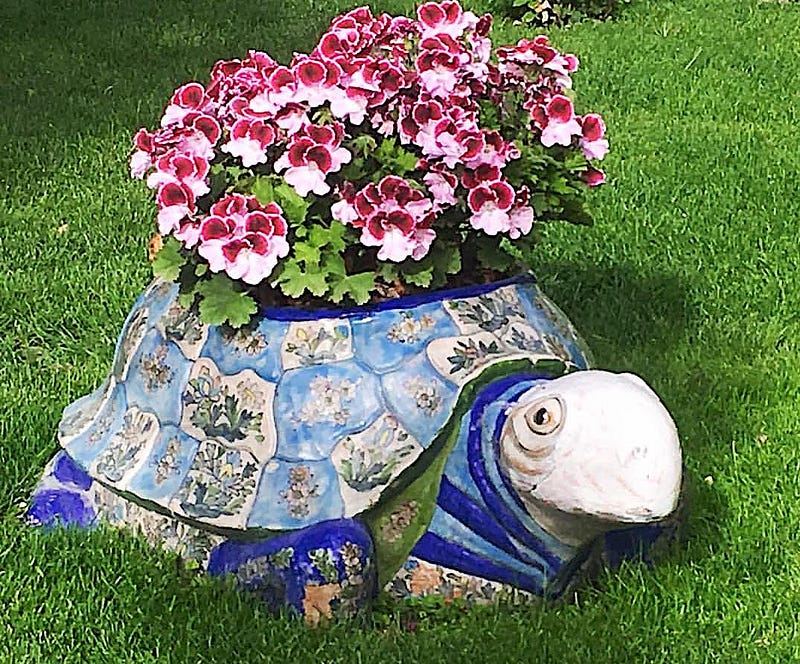
Public art is everywhere, often whimsical and clever. There seemed to be a pattern going on. If it moves, watch out! If it stays still, decorate it!
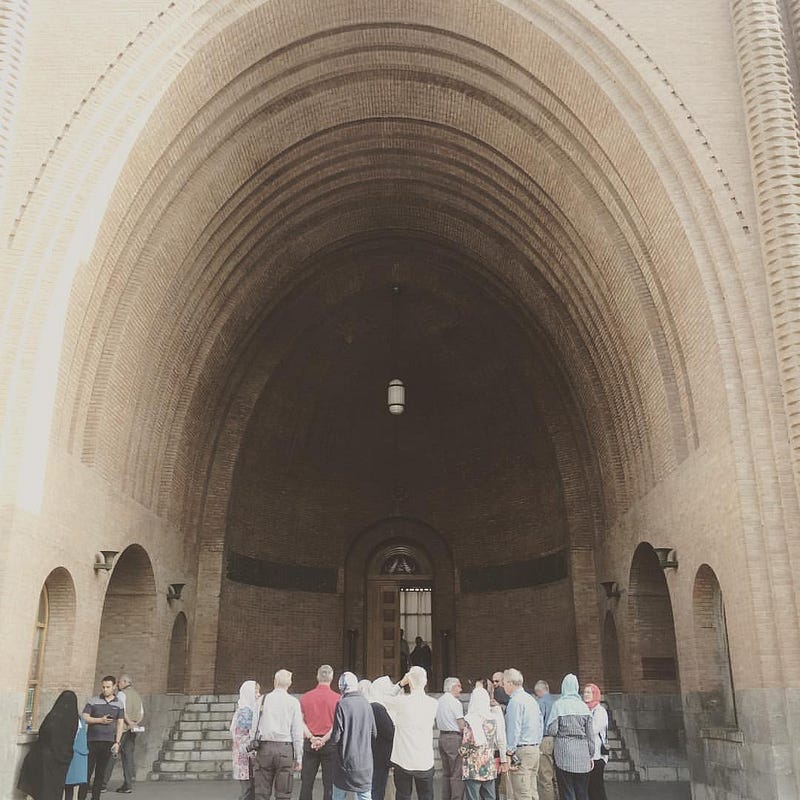
In the Iranian national museum, our guide stood before a huge map of the country with a long pointer, like about twice her diminutive height. “Iranians are Persians,” she declared, pointing to the body of water dividing Iran from the Arabian peninsula. “See this? That’s the Persian Gulf, not the Arabian Gulf. We are not Arabs!”
I hadn’t known this. I thought the Islamic population of the Middle East were Arabs. Not so, it turns out. The Persian Empire may have folded, but Persians live on, a people of proud and ancient lineage.
The museum itself was crammed full of exquisite artifacts from ages past. Some of the carvings from Persepolis, the ancient capital, were jaw-dropping in their elegance and detail. The proud king, the visiting emissaries, the soldiers-at-arms. All perfect in their uniforms, decorations and varied postures and features.
Long before Greece or Rome, civilisation had flourished here, and with it, architects, artists, scholars. We saw an arrowhead cast in the shape of a flying duck, a mirror beneath revealing that even the webbed feet had been included. Here were ancient artworks, cuneiform writing, everyday objects of skill and whimsy.
Beside the Ancient museum, there was a museum of Islamic art. Ceramics, glassware, woven fabric, all exquisite in their design and execution. You would not believe the amount of effort that went into getting the colours of a tile to line the interior of a mosque until you had it pointed out that each tile was made up of slivers and shards of pottery glazed and fired at precisely the right temperature for each different pigment in the pattern, and later perfectly fitted together to make a design.
There was a gallery of modern art, featuring exhibitions of work by internationally renowned artists, as well as art by Persians, as good as any in the world. I have seen some of the great galleries, and here in Tehran was a collection that could stand proudly on the world stage.
Not just desert
From Tehran a range of snow-capped mountains dominates the northern horizon, the city’s suburbs climbing their flanks.
These peaks rise to nearly 6,000 metres, giving the capital a dramatic setting. On the other side of these mountains, sub-tropical forests cover the land down to the shores of the Caspian Sea.
We visited mountain villages, remote monasteries, agricultural districts under crops from horizon to horizon. And yes, quite a lot of rubbish land, unpopulated save for the flocks of sheep, each accompanied by a picturesque shepherd and a couple of rangy dogs.
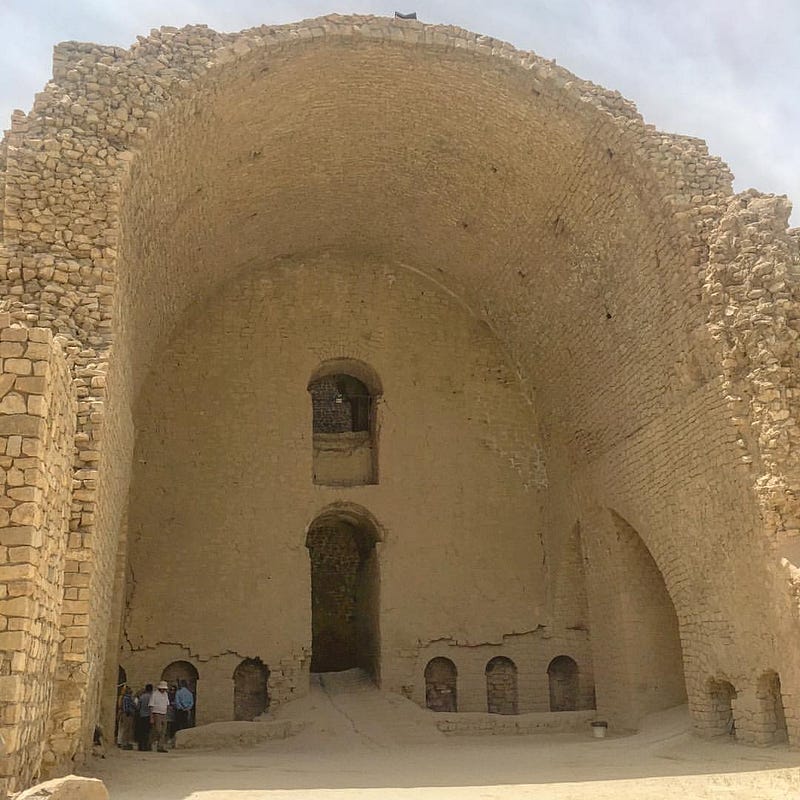
Not a particularly damp land, but there are rivers and lakes here and there. We took a trip down to a mediaeval fortress south of Shiraz, and the land was rolling, green, well-watered, as good as you could find anywhere on Earth, bands of nomads — horses long since swapped out for battered pickup trucks — on the move with the change of seasons.
Everywhere, history
The old places may not be as spectacular or as famous as (say) Egypt, but the long history of the Persian Empire is visible everywhere.
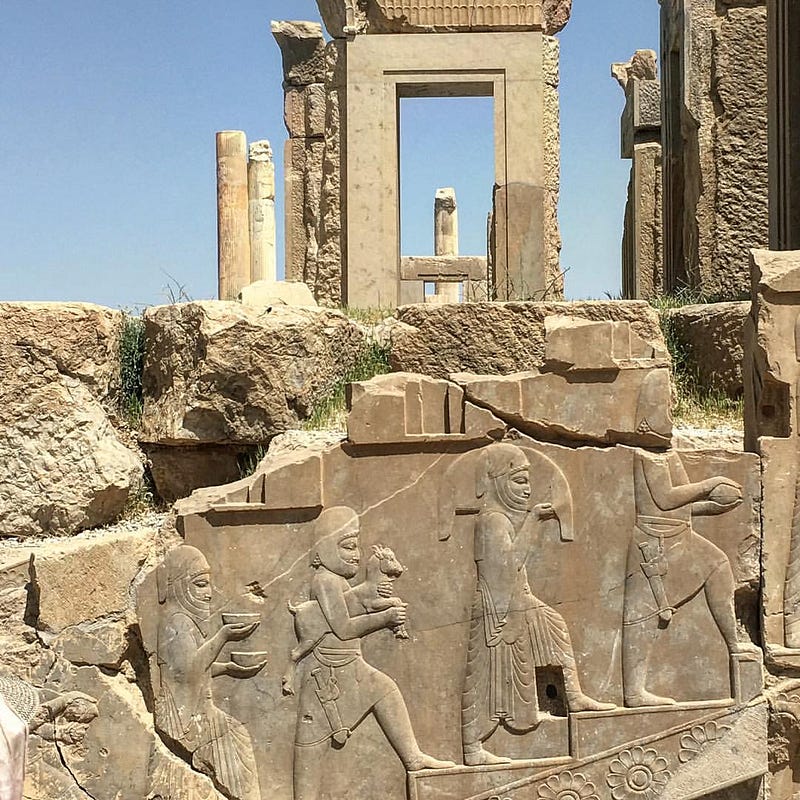
Sprawling Persepolis with its tall columns, majestic terraces and staircases, and exquisite carvings, is a showstopper, but beside these 2,500-year-old ruins are the frames and tattered canvas of the tent city the last Shah built to house dignitaries for the lavish party he threw shortly before the Persian people threw him out.
At nearby Pasargad the tomb of Cyrus the Great stands beside the ruins of another mighty palace. Empty of the treasure that once accompanied the great king, but otherwise looking much as it did when Alexander the Great stood here at the head of a triumphant Greek army.
Imperial tombs, splendid rock carvings, ancient castles. The land is full of them. In the north, the highways — six and eight-lane motorways every bit as good as the American Interstates — follow the path of the Old Silk Road.
Everywhere, mosques
After a while, each tour group discovers ABM syndrome. Every day, every new city, there’s Another Bloody Mosque.
I have to say that some of them were divine in every sense of the word. Surrounded by gardens, decorated to within an inch of their lives, exquisite architecture, each fresh one was a delight.
The two grand mosques on the central square in Isfahan were amongst the most impressive buildings I’ve ever seen. Islam itself may not be my cup of Earl Grey, but by crikey they build some glorious temples.
Some, we women were given temporary chadors to put over our already modest clothes. Naturally, once we donned the floral prints, we all lined up while the men took our photographs. Fair enough. I’ve been told in no uncertain terms to adjust my clothing in Salisbury Cathedral, and the same respect applies in any religious place.
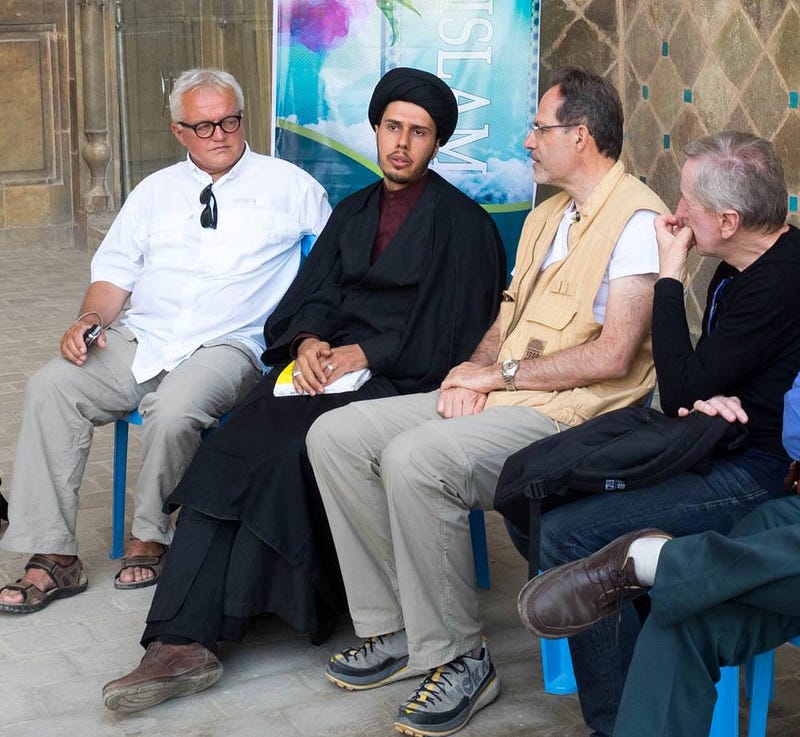
Sometimes there would be a “duty cleric” to talk about Islam with the tourists. It’s nothing like the cut and dried Christianity of the West. In Iran, the imams are taught to question everything, and there will be a dozen different interpretations of Koranic verses for every half-dozen clerics.
Every city has a grand “Friday mosque”, there are less impressive suburban mosques, and alongside the motorways, there would be tiny mosques serving the truck drivers, which our guide assured us were called “mosquitoes”.
But far from being a uniformly Islamic nation, most Iranians have little interest in religion, and the most devout seem to be the Christian, Jewish, Zoroastrian and other minorities. Armenian churches actually serve wine at Mass, and attendances are high.
To be honest, I got the feeling that the Persians still resent the Arabian incursion of centuries ago, and would prefer to go back to Zoroastrianism, or nothing at all.
Everywhere, schoolgirls
It seemed that at every site of importance, beginning with the museums of Tehran, huge tourist coaches arrived to unload tour groups. America may shun Iran, but the rest of the world is pouring tourist dollars — and Euro, and pounds — into the economy.
Besides the tourists, chattering, smiling, and taking endless social media snaps, school groups of colourfully uniformed girls discovered their nation’s history. And every group followed the same pattern.
First, the boldest would approach a Western tourist, asking for a selfie. Her friends would follow, attaching themselves to the female members of the group. Blondes were in high demand, and the Iranian equivalent of Facebook must feature hundreds if not thousands of photos of me and assorted grinning kids.
They all learn English, and we would exchange names, discuss the weather, count up to ten in each other’s language, and generally have a great time.
Eventually their teachers would come up and herd their charges away, their stern expressions at odds with their twinkling eyes.
There are schoolboys as well, but they gazed on we women from a safe distance lest they be corrupted, and would gravely shake hands and discuss football with the men.
After my first trip, I brought along some little Australian presents. Toy koalas, flags, trinkets like that. But there were never enough to go around, and my supplies were soon exhausted.
And oh, the food!
Perhaps we as tourists dined well, but I heard from those who had visited Iranian friends that the banquets they had been served put the hotel buffets to shame.
Iranians eat healthy, with a good mix of meats, carbs, and vegetables. Barley soup was served at every meal, always slightly different, always delicious. Kebabs were likewise universal, as was saffron rice. Salads full of pomegranate and tomatoes were heavenly.
But there was a certain sameness to the tourist meals, and we soon learnt that if a local dish was offered, to jump at it. Lamb shank hotpot was one I remember with fondness, the meat succulent and juicy and tender, cooked in divine gravy.
Nobody goes hungry in Iran. Food is plentiful, and the bazaar stalls a riot of colour in their fruit, vegetable, spice, and sweets displays. Nuts and dried fruits were cheap and delicious, and mixed bags were bought at stops to be shared around the coach.
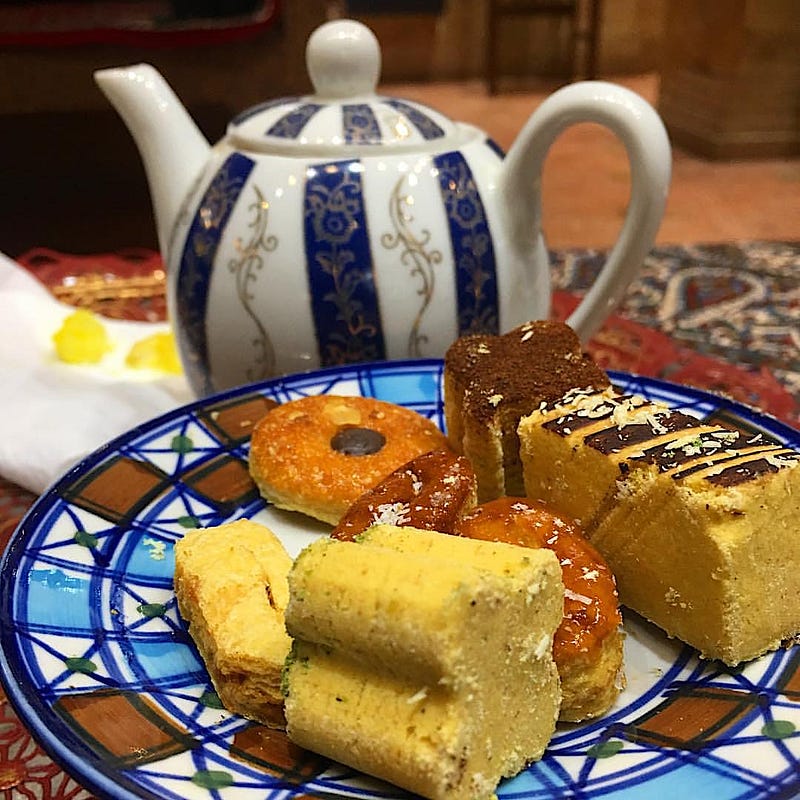
To be Iranian is to have a sweet tooth, I think. We dined on an amazing array of desserts and pastries.
They do tea well. Coffee, not so much. The chic cafes in Tehran had baristas, but in the provinces, not so much, and when we found the occasional rare bird, their idea of a latte or flat white was disappointing.
Oh yeah, Harry Potter
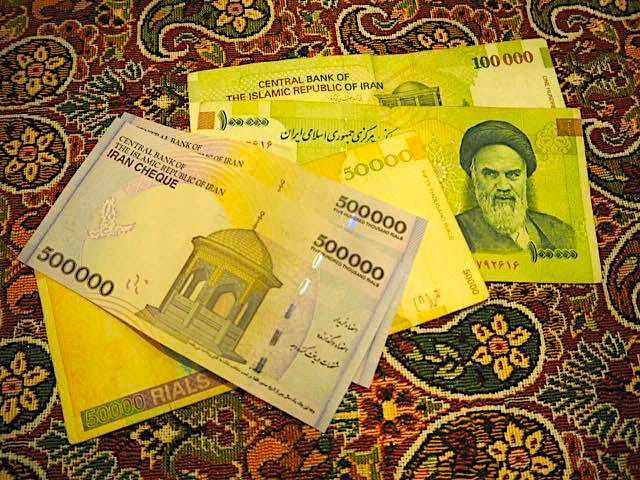
The effects of the various sanction regimes have impacted the poor in Iran most of all. Not that we saw any beggars or people living on the streets, but inflation has bumped the values on the currency up to ridiculous levels. Hand over half a million, you expect a house and car, not a book or two.
There are autotellers everywhere, but not linked to the world’s financial systems. We were advised to bring in dollars or Euro and get them changed. 30 000 Iranian Rials to the dollar. Coins are virtually non-existent, but then again, they are vanishing everywhere in the world. (Apart from America, where worthless copper pennies are plentiful.)
In Isfahan we were taken to the showrooms of carpet merchants and the painters of miniatures on camel bones. Exquisite craftwork, but the prices needed more than even a few million in notes. Every merchant had a friend in Dubai or somewhere who would accept credit cards over the phone and indicate whether the transaction had gone through.
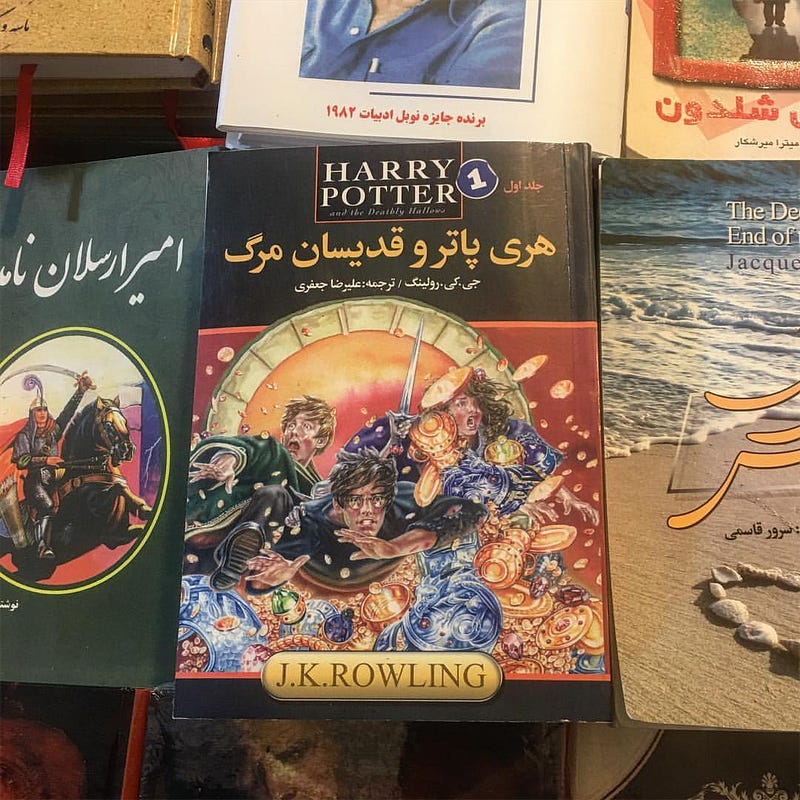
Western culture is popular. Apart from Harry Potter, the sort of airport thriller bestsellers have all been translated and put into new covers. Children have Disney backpacks and lunchboxes. The local car industry turns out licenced copies of Peugeots. Everyone under a certain age speaks English, if not German and Russian as well.
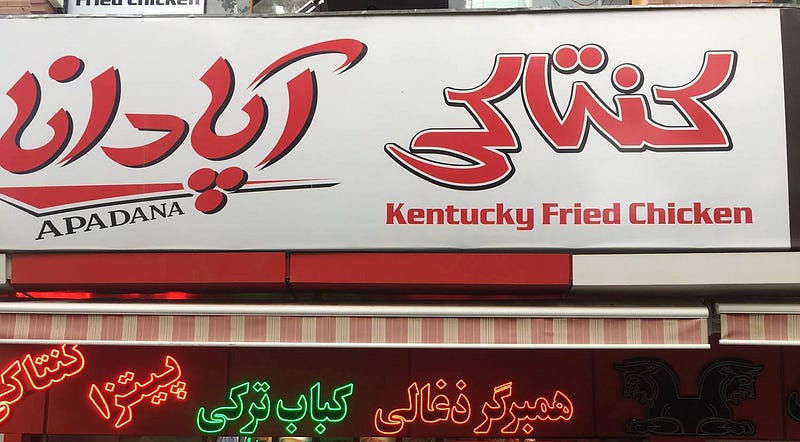
I found “Kentucky Fried Chicken” which was kind of like the real thing. KFC in the West doesn’t put quite as much emphasis on salad, but the chicken itself was excellent.
Everyone has a cellphone. Facebook might be forbidden — as well as anything to do with alcohol, apparently, as I discovered when I tried to select next month’s wine club delivery — but there are local equivalents of every social media platform.
And it seems that alcohol is available, just not openly displayed. You can — I am told — download an app, make an order, and a car will arrive with your selection of wine and whisky and beer in the boot. Actual bootleggers. Don’t get caught in public with it, and don’t try to drive or walk drunk.
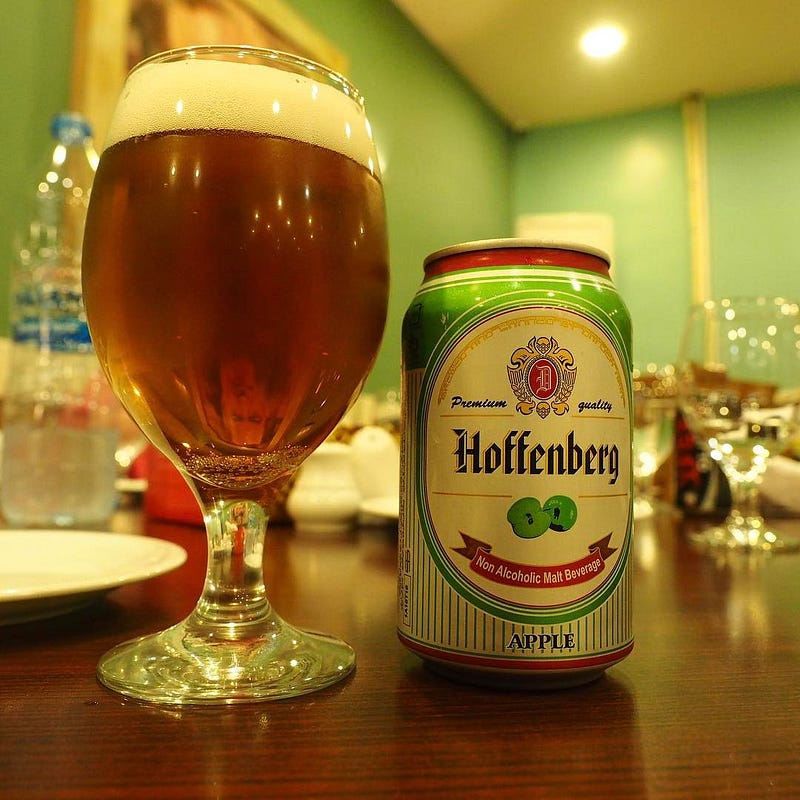
Non-alcoholic beer is popular, especially with Western tourists. Fruit beers are available. Apple, peach, pineapple beer. Weird, but wonderful.
Some of it is almost identical to the real thing. Imported from the Netherlands, the packaging and presentation is spot on, and the taste and mouth feel superb. Apart from the lack of alcohol, of course, but hey, it’s only a couple of weeks, dry out!
I’d go back in a heartbeat
The land is beautiful, the people the friendliest on the planet, and the culture amazing. Exploring Persepolis in our free half-hour after the official tour was nowhere near enough, not for this keen photographer. I’d love to be there at dawn.
In Yazd I met a solo traveller from Australia. She had left her husband behind and was having a ball. She was by no means the only one. It isn’t as free and easy as some places, but so long as you comply with the never onerous rules, it’s not much different from backpacking around Greece or Spain.
America is missing an opportunity through ingrained official bloody-mindedness. If they showed any kindness at all to Iran, the people would ditch their theocratic rulers and rejoin the West in a matter of months. Hardliners might chant “Death to America!” (an overly dramatic phrasing, it seems; taxi-drivers chant “Death to Traffic” if they are racing you to the airport) but the generally young and well-educated Iranians are keen to open up to the wider world.
I suspect that China with its “Belt and Road” initiative to rebuild the Silk Road, and Russia not far over the border will end up having more influence than the West, and that is a shame for all of us, I think.
After all, here are the roots of our civilisation.
I love Iran. Simple as that.
Britni
Britni Pepper writes for Kindle Direct Publishing. She runs a blog where she reviews erotica, and rambles on about this and that. She may be reached on Twitter and Facebook.