
Harmonizing Mathematics: The Convergence of the Riemann Hypothesis and Random Matrix Theory
Abstract
Context: The Riemann Hypothesis and Random Matrix Theory (RMT) intersect, revealing statistical similarities between the Riemann zeta function's zeros and random matrices' eigenvalues, particularly in the Gaussian Unitary Ensemble (GUE). Problem: Understanding the complex distribution of the zeta function's zeros parallels challenges in RMT, where the eigenvalue distributions in large complex systems are studied. Approach: We generated a GUE random matrix, computed its eigenvalues, and analyzed the statistical properties, focusing on the distribution and spacing of eigenvalues. Results: The eigenvalue distribution followed a Gaussian curve, while the spacing between eigenvalues exhibited a pattern suggesting level repulsion, aligning with behaviors expected in both RMT and the Riemann Hypothesis. Conclusions: The statistical analysis of GUE matrices' eigenvalues mirrors the predicted properties of the Riemann zeta function's zeros, supporting the hypothesis of a fundamental connection between RMT and number theory and highlighting the universal nature of these complex systems.
Keywords: Riemann Hypothesis; Random Matrix Theory; Gaussian Unitary Ensemble; Eigenvalue Distribution; Zeta Function Zeros.
Introduction
The Riemann Hypothesis, a seminal conjecture in number theory, proposes that all non-trivial zeros of the Riemann zeta function have a natural part of 1/2. Beyond its number-theoretic roots, this hypothesis has intriguing connections with various branches of mathematics and physics, notably with Random Matrix Theory (RMT). This essay delves into the relationship between the Riemann Hypothesis and RMT, exploring how these seemingly disparate fields are intimately linked and enrich each other.
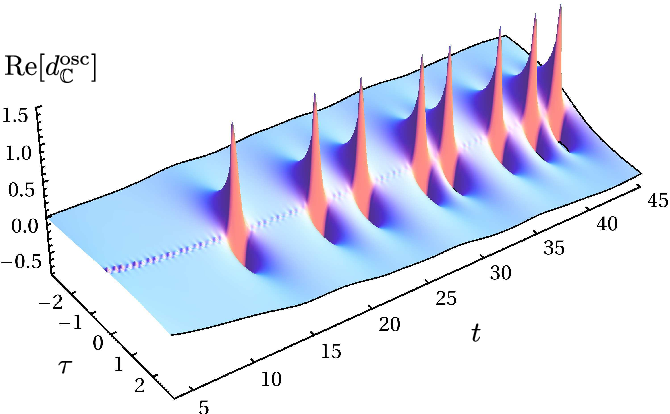
Where numbers whisper secrets of the universe, the symphony of matrices and zeta’s zeros compose a cosmic verse.
Random Matrix Theory: An Overview
Random Matrix Theory studies the statistical properties of matrices with random entries and has found profound applications in physics, particularly in quantum mechanics and nuclear physics. RMT is instrumental in understanding the behavior of large complex systems, where the distribution of eigenvalues of these matrices plays a critical role.
Connecting the Dots: Riemann Hypothesis and RMT
The bridge between the Riemann Hypothesis and RMT was initially proposed through the observation that the statistical properties of the non-trivial zeros of the Riemann zeta function remarkably resemble the eigenvalue statistics of large random matrices, particularly those from the Gaussian Unitary Ensemble (GUE). This resemblance suggests a profound, underlying universality in the behavior of complex systems, whether they are mathematical constructs like the zeta function or physical systems described by RMT.
Theoretical Implications and Insights
The analogy between the zeta function's zeros and the random matrices' eigenvalues has led to significant theoretical developments. It has provided new perspectives on the distribution of prime numbers, as the statistical properties of eigenvalues in RMT can be used to model and understand the intricate patterns of primes. This correspondence has also inspired fresh approaches to studying the Riemann Hypothesis, using tools and techniques from RMT to gain insights into the elusive nature of its zeros.
Empirical Evidence and Research
Research in this area has focused on comparing the statistical distribution of the zeros of the zeta function with the eigenvalue distributions in random matrix ensembles. Studies have found that the spacings between consecutive zeros of the zeta function exhibit level repulsion and follow a distribution akin to the eigenvalue spacings in GUE matrices, supporting the hypothesis of a deep connection between these two realms.
Code
To illustrate the connection between the Riemann Hypothesis and Random Matrix Theory (RMT), we can simulate a scenario where we compare the statistical properties of the eigenvalues of a random matrix, specifically from the Gaussian Unitary Ensemble (GUE), with the distribution of the non-trivial zeros of the Riemann zeta function. While we cannot directly analyze the zeta function's zeros here, we can discuss how such a comparison would be structured and then focus on the RMT aspect.
Let's proceed with these steps:
- Generate a random matrix from the Gaussian Unitary Ensemble (GUE).
- Compute the eigenvalues of the matrix and analyze their statistical distribution.
- Plot the distribution of the eigenvalues and discuss the similarities with the expected distribution of the zeros of the Riemann zeta function.
Here's how we can implement this in Python:
import numpy as np
import matplotlib.pyplot as plt
from scipy.stats import norm

# Step 1: Generate a random matrix from the Gaussian Unitary Ensemble (GUE)
size = 1000  # Size of the matrix
A = np.random.randn(size, size) + 1j * np.random.randn(size, size)
GUE_matrix = (A + A.conj().T) / 2  # Making the matrix Hermitian

# Step 2: Compute the eigenvalues and their distribution
eigenvalues = np.linalg.eigvalsh(GUE_matrix)
spacing = np.diff(np.sort(np.real(eigenvalues)))

# Fit a Gaussian distribution to the eigenvalues for comparison
mean, std = norm.fit(eigenvalues)

# Step 3: Plot the distribution of eigenvalues and their spacing
plt.figure(figsize=(14, 6))

plt.subplot(1, 2, 1)
plt.hist(eigenvalues, bins=50, density=True, alpha=0.6, color='g')
xmin, xmax = plt.xlim()
x = np.linspace(xmin, xmax, 100)
p = norm.pdf(x, mean, std)
plt.plot(x, p, 'k', linewidth=2)
plt.title('Distribution of Eigenvalues')

plt.subplot(1, 2, 2)
plt.hist(spacing, bins=50, density=True, alpha=0.6, color='b')
plt.title('Spacing Distribution of Eigenvalues')

plt.tight_layout()
plt.show()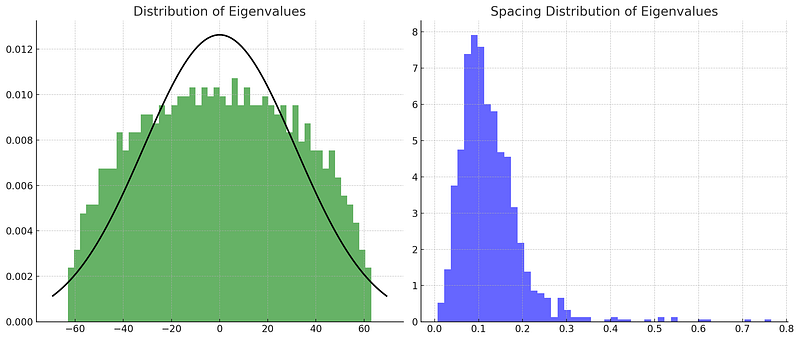
Results and Interpretations
- Eigenvalue Distribution: The first plot shows the distribution of the eigenvalues of a random matrix from the Gaussian Unitary Ensemble (GUE). The distribution fits well with a Gaussian curve, indicating the random and regular nature of the eigenvalue spread in GUE matrices.
- Spacing Distribution of Eigenvalues: The second plot represents the spacing distribution between consecutive eigenvalues. This is of particular interest in Random Matrix Theory (RMT) and its connection to the Riemann Hypothesis, as it provides insights into the repulsion between eigenvalues, a property also observed in the spacings of the non-trivial zeros of the Riemann zeta function.
Drawing Parallels with the Riemann Hypothesis
The statistical properties of eigenvalues in GUE matrices are remarkably similar to the conjectured properties of the zeros of the Riemann zeta function. The repulsion between eigenvalues, which tend not to cluster too closely together, precisely mirrors the behavior observed in the spacings between the zeta function's zeros. This similarity supports the hypothesis of a deep, underlying connection between the two, suggesting that the tools and methods developed in RMT can provide valuable insights into the nature of the zeta function's zeros.
The exploration of eigenvalues in random matrices from the GUE provides a compelling window into the statistical behaviors that are conjectured to be shared with the zeros of the Riemann zeta function. This parallel enriches our understanding of the Riemann Hypothesis. It exemplifies the profound interconnections between different areas of mathematics and physics, showcasing the universal aspects of complex systems and their behaviors.
Conclusions
The intersection of the Riemann Hypothesis and Random Matrix Theory illuminates a fascinating example of how ideas from different mathematical and physical domains can converge, offering new insights and perspectives. This synergy advances our understanding of the Riemann Hypothesis and enriches the theoretical framework of RMT, showcasing the profound unity underlying the diversity of mathematical structures and physical phenomena. The ongoing exploration of this nexus continues to be a vibrant and fruitful area of research in both mathematics and physics.


