
Hard work was necessary to achieve your goals.
Kareem Abdul-Jabbar on work ethic. (The Commonplace Book Project)
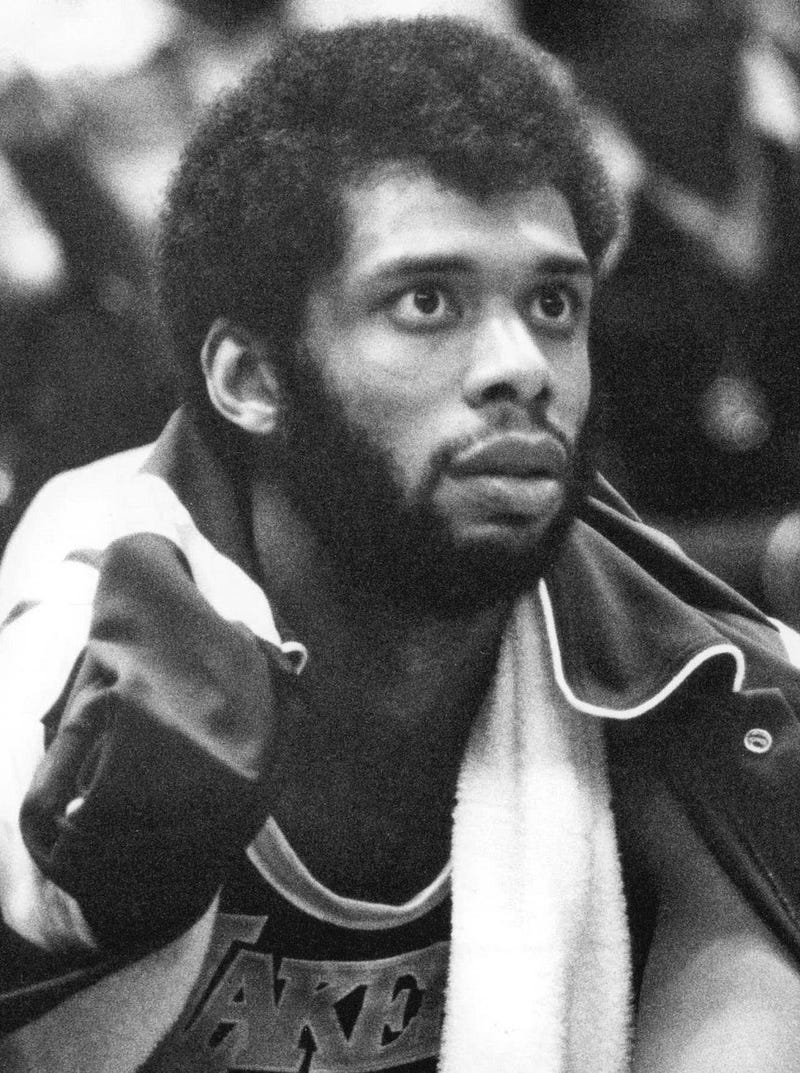
“My mother always emphasized that hard work was necessary to achieve your goals, while my father proved the value of repetition in mastering a skill.” — Kareem Abdul-Jabbar, Coach Wooden and Me
When I was a ten-years-old, in 1981, my dad did some work for Jerry Buss. I’m not 100 percent sure now what that work was, probably something to do with sports memorabilia, but it had one incredible perk. Amazing tickets to see the Lakers play at the The Forum.
I will never forget standing against a metal railing, leaning over it with my heart in my throat, watching Kareem Abdul-Jabbar play.
Abdul-Jabbar, physically at least, was born for basketball. According to his Wikipedia page: “He was unusually large and tall from a young age. At birth he weighed 12 lb 11 oz and was 22 1⁄2 inches long, and by the age of nine he was already 5 ft 8 in tall. By the eighth grade (age 13–14) he had grown to 6 ft 8 in tall and could already slam dunk a basketball on a regulation 10 ft hoop.He would eventually reach his full height of 7 ft 2 in when he entered the NBA at the age of 22.”
He was a standout high school player and then played for UCLA. College basketball banned dunking for almost ten years starting in 1967 as a direct response to Abdul-Jabbar’s (then Lew Alcindor) use of the shot.
His signature, though, was the Skyhook. It’s impressive on video, but when I was a little white girl watching from the stands, it was awe inspiring in person.
My dad owned a baseball card shop at that time and that summer I went to conventions with him. My sister and I brought a bottle of Windex and a roll of paper towels and we made a killing cleaning cases for venders or running to the concession stand to buy them hotdogs.
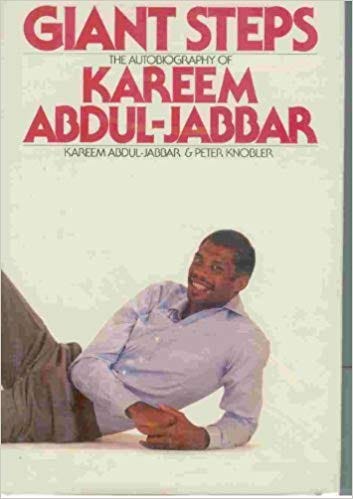
I found a used copy of Abdul-Jabbar’s autobiography at one of those conventions. Giant Steps was one of the first grown up books I ever read, and the first book of any kind I bought myself. It made an impression on me. I started swimming that year and for a long time my biggest goal was to be in the Olympics.
What I learned from Kareem Abdul-Jabbar was that practice mattered. It’s a lesson that’s stuck with me. Practice matters for sports, of course, but it matters for so much more. In the quote at the top of this post, he’s referring to his father’s music practice.
I also spent hours and hours at our driveway basketball hoop perfecting my Skyhook.
Abdul-Jabbar valued education. He was born with a set of natural attributes — size, athletic ability, even just being male — that gave him a leg up on the whole NBA thing. But it’s his work ethic and his commitment to practice that made him a legend.
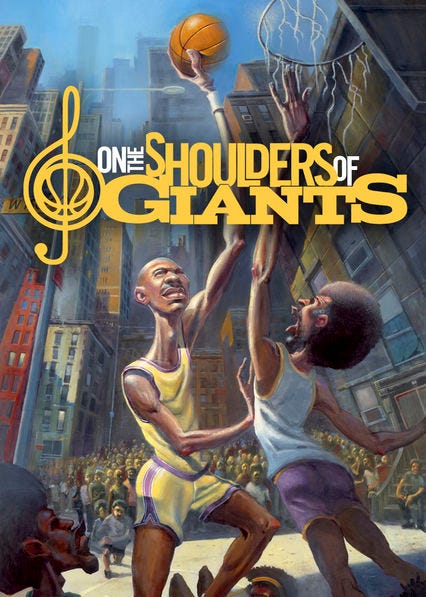
I wanted to watch a movie based on a Maya Angelou book tonight, but wound up watching On the Shoulders of Giants, Kareem’s look at the Harlem Renaissance — the first black professional basketball team. (Maya Angelou recites Langston Hughes’ poem Harlem Sweeties.)
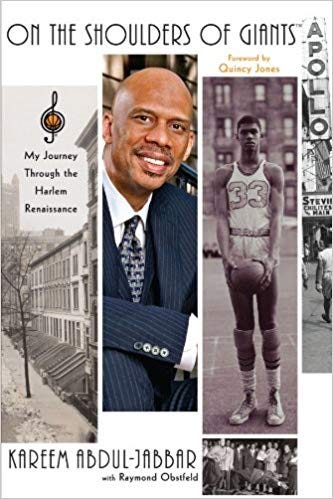
Abdul-Jabbar is 71 now, and he’s been a bestselling author for longer than he was a professional basketball player. I’ve added his book, On the Shoulders of Giants: My Journey Through the Harlem Renaissance , to my reading list.
I really enjoyed this interview with Abdul-Jabbar in Smithsonian Magazine.
Today’s poem:
Harlem Hopscotch by Maya Angelou
One foot down, then hop! It’s hot. Good things for the ones that’s got. Another jump, now to the left. Everybody for hisself.
In the air, now both feet down. Since you black, don’t stick around. Food is gone, the rent is due, Curse and cry and then jump two.
All the people out of work, Hold for three, then twist and jerk. Cross the line, they count you out. That’s what hopping’s all about.
Both feet flat, the game is done. They think I lost. I think I won.
Shaunta Grimes is a writer and teacher. She is an out-of-place Nevadan living in Northwestern PA with her husband, three superstar kids, two dementia patients, a good friend, Alfred the cat, and a yellow rescue dog named Maybelline Scout. She’s on Twitter @shauntagrimes and is the author of Viral Nation and Rebel Nation and the upcoming novel The Astonishing Maybe. She is the original Ninja Writer.


