
Happy July 4th: or as I Remember It, Higgs Boson Discovery Day
The story of discovery from the perspective of a physicist in training.
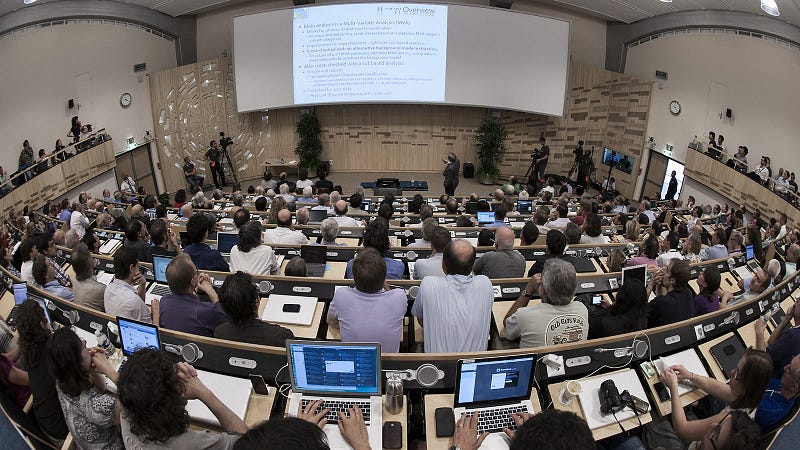
I can still vividly recall the events of July 4th, 2012. The alarm clock woke me up around 3 a.m. I was slightly groggy, but I quickly collected myself, remembering the significance of the moment.
I was still a graduate student at Princeton at the time. There was a celebration “party” event that I decided not to attend (given that it was a 40-minute commute for me)—as I would later find out, I might have missed a chance to be in a few frames of the acclaimed documentary Particle Fever.
In the darkness of my room, I quietly turned on my laptop, trying not to wake anyone else up. I quickly tuned in to the live-stream of the announcement, happening across the Atlantic Ocean at the European Organization for Nuclear Research (CERN). A crowd of physicists and journalists had been waiting at the auditorium for hours. Then, the presentation started.
The Birth of a New Particle
Slide-by-slide, the leaders from each of the experiments (ATLAS and CMS) went through the technical details of the analyses. They presented their findings with great technical care and caveats. For example, they refrained from saying “The Higgs Boson,” and instead used the phrase “a Higgs-like Boson.” Any occasional slip-ups seemed to evoke a chuckle from the audience. It almost felt like a typical physics seminar, without much fanfare involved. But then the summary figures emerged:
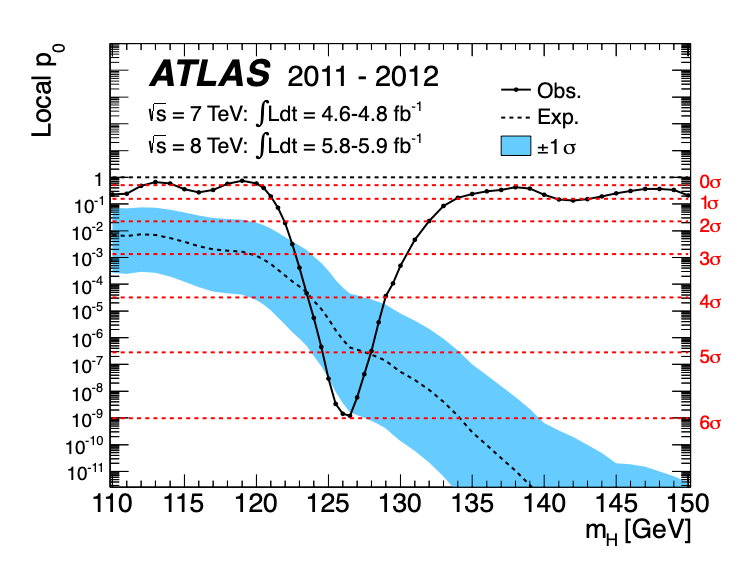
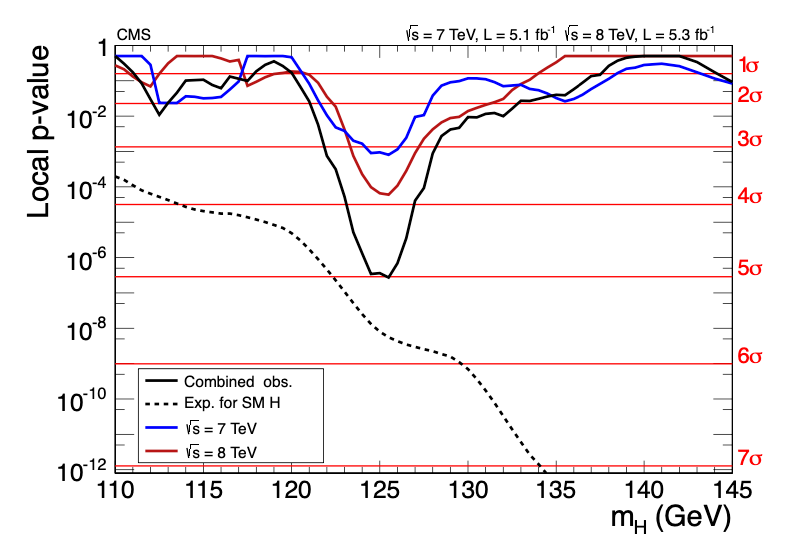
Like every physicist, my eyes immediately zoomed in to the apex of the bump-like figure (the black lines at around 125 GeV). The key thing to look for was whether not the black lines (observation) touched the 5-sigma line. By statistically combining the data from various analyses, we saw that the fabled 5-sigma significance value was independently obtained for each of the experiments. This meant that there was a less than 1-in-a-million chance for the signal to have been a random fluke (not once, but twice for two experiments). Even before the presentation ended, thunderous applause spontaneously erupted following the 5-sigma announcement, triggered by a seemingly unspoken collective understanding.
The next day, my social media feed was filled with colleagues’ and friends’ stories: from folks unable to get a seat at the CERN auditorium because it was overpacked, to others theorizing about whether it really was the Higgs Boson or not.
Of course, none of us were all that surprised. Rumors from our colleagues had spread well before the event. The real surprise lied in whether the combination of multiple analyses would be carried out, and whether a formal claim of discovery would be made.
But in the end, there it was. After decades of searches, we witnessed the birth of a new particle, “the Higgs-Like Boson,” which would later be confirmed to be the Higgs Boson we expected.
The Significance of the Significance
For many, the discovery might not have meant much. However, for the young scientist in training that I was, it was an affirmation of my commitment to particle physics. This was science in the making, and many had waited decades to see it come to fruition. I was lucky enough to be amongst colleagues who actively participated in the search. I thought to myself, “what better time to be a researcher in particle physics?!”
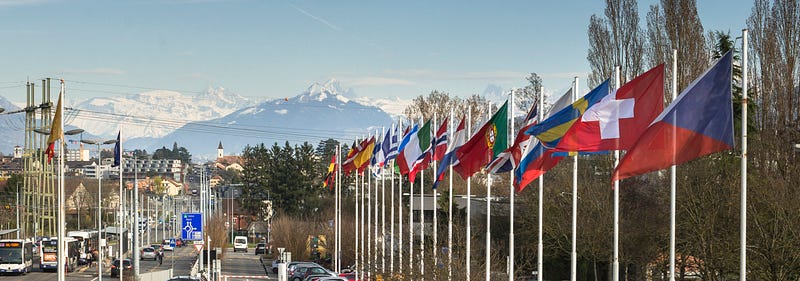
Indeed, it was more than a scientific achievement; it was a triumph of human collaboration. Scientists and engineers from dozens of countries working together—Iranians and Israelis, Chinese and Americans—all focused on advancing our understanding of the world. I held fond memories from my undergraduate years visiting CERN as a summer research student. In that magical place, cultural and political differences seemed to be set aside. Success was determined by merit and the scientific process, arguably some of the loftiest ideals for human endeavors.
Since that day, I invested much of my time in the areas of theoretical physics that surrounded the Higgs Boson’s discovery—phenomenology and collider physics. Eventually this would lead me to a post-doctoral research position at the University of California, Berkeley. Particle physics was blossoming, and it seemed like another discovery was just around the corner. What were we going to find next? Supersymmetry? Extra Dimensions? Or that the Higgs was composed of something even more fundamental? The field was buzzing with excitement.
From Discovery to Humility
As time passed, the hope of discovering something new diminished (though there were plenty of anomalies here and there). Slowly but surely, more and more data confirmed how the newly discovered boson behaves exactly as predicted by our beloved Standard Model. It became a new entry to the Particle Data Group’s handbook, cementing its status amongst other previously discovered particles such as the W/Z bosons and the Top quark.
It seemed as though collider physics, the sub-field that I had come to cherish, was becoming less fashionable. As more data accumulated, I was faced with a slow trickle of disappointment. Eventually, the statistics pointed to a humbling reality: The time it would take to uncover any new discoveries—if they exist at all—would likely be measured in decades, not years.
Faced with this reality, I had to re-orient my research directions. I gradually moved toward Dark Matter physics, where alternative experiments may shed light on the darkest mysteries of our Universe (the missing 80% of all matter). And eventually, I would end up leaving academia and pursuing data science in industry. But that’s a story for another time.
A Retrospective…
I look back on my academic career in physics with fondness. There was excitement—from the discovery of the Higgs Boson to the first detection of gravitational waves. There was banality and frustration—from the daily grind of running simulations and calculations to the tedious back-and-forth with scientific publishers. Through it all, I was extremely fortunate to have been part of this scientific endeavor. Even though I ended up in industry, I would not hesitate to follow the same path again if given the opportunity.
Perhaps it has finally dawned on me what it means to do science. I now see what Professor Higgs meant when he said he never imagined he would one day see the discovery of the Higgs Boson. Unfortunately, scientific breakthroughs don’t just happen overnight. I hope that, one day in the coming decades, I’ll have another opportunity to tune in at 3 a.m., and I’ll listen to another announcement on how decades of effort culminated into a brand new revelation. I would take great pride in knowing that I was part of the community, and that I participated in the collective pursuit of human knowledge.
That is, of course, if we get through this pandemic.