
🐍 🎂 Happy Birthday Python! You 32yo Bada**!
Python is with us for 32 years. Check out some interesting facts, stories and a birthday poem for Python’s birthday!
🐣 21 Messages Of The Revalation
32 years ago, on 20th February 1991 Python made it’s first appearance. Let’s look how far the programming language created Guido van Rossum went.
The first Python source code was published by Guido on the very day on the Usenet alt.sources newsgroup.
For the younger audience Usenet is a precursor of Telegram. It’s free and decentralized like Mastodon, and allows people to exchange text messages on thousands of newsgroups.
The alt.sources is one of such newsgroups specifically created to publish interesting snippets of code. Guido’s post was one of hundreds. I wonder if Usenet readers noticed at that time, that very post will mark an important day in the history of programming and technology.
This is how Guido described his creation:
This is Python, an extensible interpreted programming language that Xcombines remarkable power with very clear syntax.
Python can be used instead of shell, Awk or Perl scripts, to write prototypes of real applications, or as an extension language of large systems, you name it.
The announcement of Python 0.9.1 was split into 21 Usenet messages and released after two years since Guido started to develop it.
Now, it’s everywhere. Let’s look at some notable accomplishments of the PY!
🔭 Python Gives Us AI, Car Autpilots And Earliest Photos Of The Universe
To say Python is everywhere is too little. GPT-2, and most likely GPT-3 is written in Python. You know, the AI chatbot everyone is talking about.
Also, the OpenPilot relies heavily on Python. It is an open source autopilot for a range of cars.
NASA relies on Python apps to process and handle data from James Webb telescope giving us the unique chance to see how the Universe looked like just after The Big Bang.
Python is used for cloud computing, data science, backend services, education, and everything that needs code.
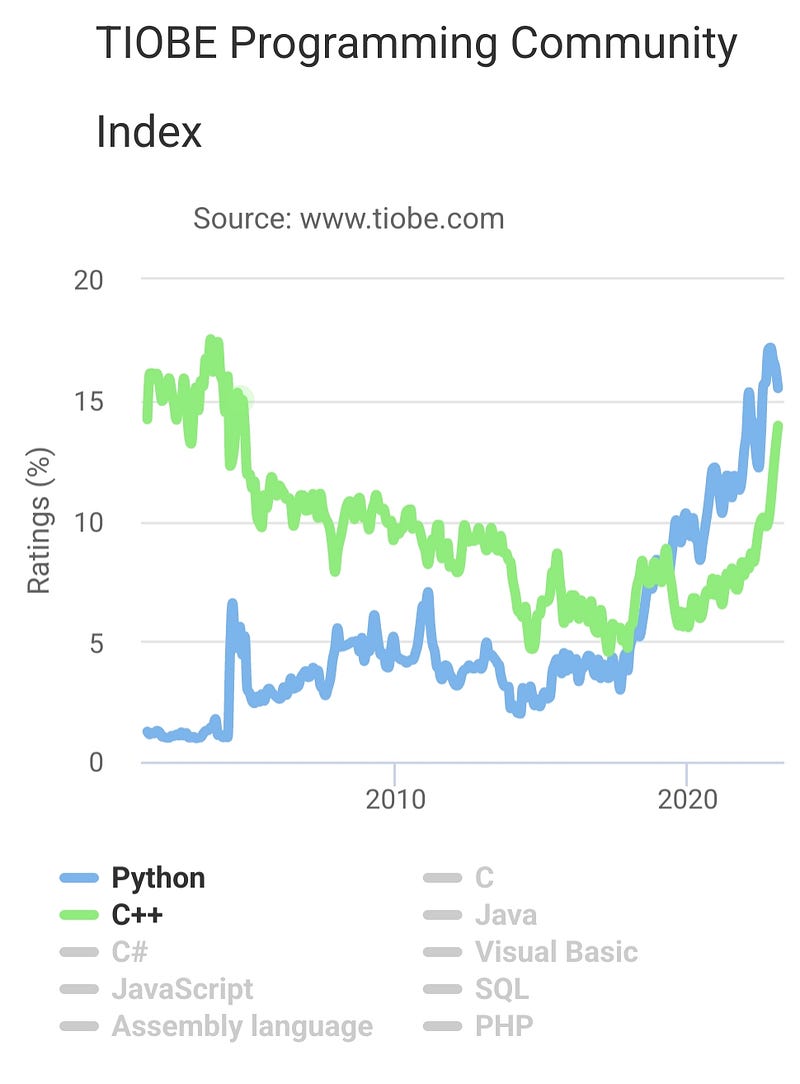
The TIOBE ranking indicates that Python is the most popular language since around 2021, and from the top languages, it shares the rapid growth only with C++.
To sum it up, 32 birthday is a moment when we can recognize that Python became the most important programming language on Earth and beyond.
💡 Python Is An Impossible Invention
You may think that Python is a new invention, but when we will put it on the historical timeline it almost feels like it was made in ancient times.
Digital cameras had 2MB of memory, you had to use a cassette player if you wanted to listen to the music on the go, to have a phone call you had to find a phone booth, and the major sources of information were radio, television and newspapers.
The world changed rapidly during these 32 years not only in terms of technology, but also our lives changed:
- We have increased photovoltaic energy production from almost zero to around 20% of world’s consumption
- The life expectancy increased by 9 years ( from 64 to 73 years )
- Poverty decreased by 23 percent points
It means that in 1991 there was impossible to imagine how the future will look like and that a newly invented programming language will become an important part of it.
Now, Python is everywhere proving the motivation and hard work of Guido and everyone involved during the years into Python development paid off greatly.
We know how Python was born, how popular it is, and the long road it made to the success.
But how people reacted to the new programming language?
🤗 Python Won Because It’s Good For Its Users
Robert A. McLachlan was one of the people who recognized a novelty in the Guido’s approach to programming. As he wrote in January of 1992:
Novel features include strict type checking and source-level debugging of compiled code. Unusual attention has been paid to the compiler’s user interface.
It set Python straight apart from other programming languages at that time. Programming was a mistery job done by few. No one really cared about the user experience of developers.
Check out Python Cheat Sheet Cards I’ve Just Released!
You could use a set of educational purpose language that made your life easier, but later you landed in “real” programming languages that spat ambiguous errors and expected you to know exactly what you are doing.
Python was different because it married the educational and professional coding. The history as we know it prooved it was the right approach.
For years professional developers thought about Python only as an educational language. It gave it time to incubate and attract people who shied away from the voodoo programming and considered a language as a tool to build neural networks, prototypes and data processing systems. A language that helped to get the job done.
But enough with this seriousness. It is a birthday! I’ve prepared some thing special!
🎂 Python Birthday Wishes
It’s 2023 and I am sure that Python will drive the world in the new era of weak AI. Since that said, I asked a Python child to write a birthday poem about its father:
On this day, we celebrate The Python's birthday, so great! It's been around for quite some time And still manages to stay in its prime
It's not a snake, but a coding tool That makes our lives a little less cruel With its syntax, we write with ease And create programs as we please
So let's blow out the candles, with a smile And enjoy this day, in true Python style Happy Birthday to our dear friend May its code never come to an end!
Happy Birthday Python 🎉🎉🎉 thank you Guido for creating Python and congrats to everyone who was / is involved in the development and success of Python!
I am curious how you discovered Python. Do you have any interesting story? Share it in the comment section!
If you like the article clap, like, share, subscribe and follow for more! I am writing about interesting things around Python and software engineering.
Would you like to be up-to-date with software engineering? Already over 2500 people subscribe to Tom Smykowski’s articles. Now you can join them too. For just $5 a month, you will get access to not only his but also ALL ARTICLES on Medium and let Tom Smykowski write more interesting stories because of a small commission! Become a member now!


