
Self-Development
Admit It. You’re Happy When You’re Alone
There’s a difference between being lonely and being alone
I love solitude. I like it when friends visit, but I’m also glad when they leave. Sometimes when an acquaintance says, “Oh my god, we should catch up soon!” I secretly think, Please, let’s not.
Can you relate?
It’s not like I don’t want to be around people. I can mingle and schmooze, but three hours is the max time I can socialize at full energy. After that, I get limp and mushy like a forgotten banana in the kitchen.
What can I say? I’m happy when I’m alone.
I was that child who drew triceratops and pterodactyls in her bedroom and spent hours reading Nancy Drew.
In my 20s, while building a career, partying, dating, and nurturing “friends for life,” I discovered the thrill of solo travel. After exploring 40+ countries alone, I don’t feel weird at all relishing a fancy dinner, an opera, or a two-bedroom Airbnb all to myself.
Now married and in my 30s, I still regularly go on many “table for one” trips. My husband is pleased when his wife comes back happy, full of stories and new adventures.
Whether you’re an introvert, a guardian of personal space, or a lover of home cocooning, you’ll get it when I say this: Solitude is bliss.
It’s a liberating feeling to be alone, do whatever you want, and not worry about pressures, opinions, or judgment. It feels great when you can choose when to socialize and with whom, and not feel guilty when you want to be left alone.
But why is solitude often scoffed at? Why is it always associated with loneliness?
Solitude is NOT loneliness
If you love me-time too much, you’re seen as different, asocial, or lonely.
If you live solo and adore having your own flat and bathroom, neighbors send you homemade soup because surely you cry every night in an empty bed.
If you are single by choice, family and friends worry about you growing old and dying alone.
Loners, who rarely crave company, sometimes cave into social pressure and doubt their own joy: Is it okay that I’m happiest alone? Is something wrong with me?
Why do we hear more about the risks, fears, and dangers of being alone?
Don’t get me wrong — they are real. Science says so; the pandemic proved so. We must take them seriously.
But that’s one part of the conversation.
Can we talk more about the positive impact of solitude? About the opportunities to flourish and thrive when all you have is your skin and soul?
Truth is, you can be with an arena of people and be sad. And you can be really happy and solitary.
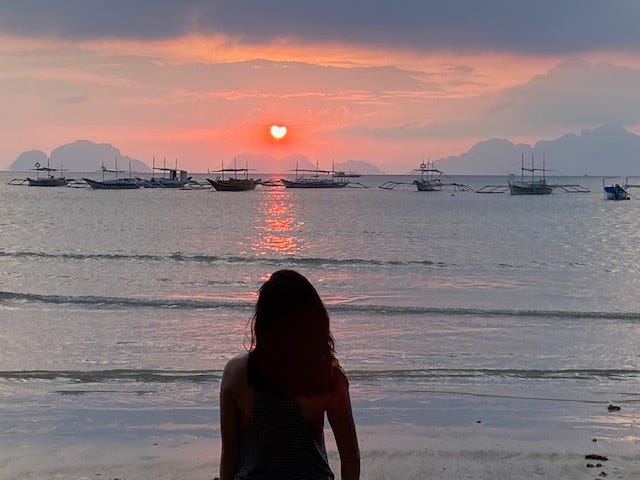
It’s not easy for everyone to understand why some people delight in aloneness.
For instance, my sweet French mother-in-law feels sorry for me when my husband is away on work trips. She often calls to say bonjour but I know she only wants to make sure I don’t get sad.
When I’m traveling solo, it’s not uncommon for a stranger to pity me and ask, “But where’s your husband?”
What they don’t know is I find a deep kind of joy in solitude. To me, it’s a sacred space for rest, reflection, and creativity. (It’s also cool to sing your heart out in an empty house.)
People who choose and want to be alone are very different from those who are forced into isolation.
Looking back, I realized that my introversion has influenced key decisions in my life:
- marrying someone who also appreciates solitude
- quitting office life so I can work remotely…for good
- nurturing only a handful of lifelong friends (who will cry at my funeral!)
- choosing island and country life over large-city bustle
Some of my most memorable experiences were my years of living on a quiet tropical beach, on a Normandy farm with no neighbors, and in a tiny French village. I don’t want to live in Manila, Kuala Lumpur, and Paris again.
Four Conditions of Productive Solitude
In his piece On Solitude, Withdrawal, and Social Isolation, Kenneth H. Rubin, human development expert at the University of Maryland, writes about conditions or “ifs.”
Solitary experience can be productive IF:
- one spends time voluntarily
You must want and choose to be alone.
2. one can join a social group when one wants to
You’re more comfortable on your own when you have family, friends, and a community waiting for you.
3. one can regulate emotions (such as social fears and anger) effectively
Too much thinking can leave you vulnerable. So let me rephrase #3 as a note to myself: Learn to deal with your own sh*t, Jenny. If you can’t, just be around people.
4. one can initiate and maintain positive relationships with significant others
It’s important to keep a few strong ties: your “ride or die,” “person in case of emergency,” or friends who have your back no matter what.
How to Use Alone Time to Be Better and Happier
I believe solitude is a broad spectrum and anyone — regardless of where you are in life — can access its positive benefits.
Some people crave being alone from time to time. Others do half and half. And there are those who choose it as a permanent way of life, such as a recluse or hermit.
Here are some ideas that I have personally used to approach and enjoy solitude:
A Few Days: For the Weekend Recharger
Unplug
Yes, I mean really disconnect. And no two-hour FaceTime chats.
Did you know that 66% of U.S. adults have nomophobia, the fear of having no working mobile phone? A study suggests that turning off your phone one hour a day can help boost your sleep, sex life, and productivity.
Rest and recharge
Meditate, take long baths, or spend time in nature. Research says that spending 30 minutes or more in green outdoors during the week can help manage symptoms of high blood pressure and depression.
Indulge in a guilty pleasure
I know I said no screen time but sometimes, all I want is a two-hour chick flick and a pint of vanilla ice cream with pecan.
A Few Weeks or Months: For the Occasional Recluse
Work on a project or learn a skill
I have a penchant for 30- to 90-day challenges. I’ve done it for learning French, practicing meditation, and writing every day.
You don’t need to spend 52 days alone in the desert like Matthew McConaughey to write a memoir. Sometimes locking your office door with a “Do Not Disturb” sign will do.
Try to live somewhere new
When I quit my cubicle job in 2015, I moved to a tiny, remote island in the Philippines. I wanted to experience what it was like to live on the beach and not wear shoes for months. It was a big lifestyle change — from spending hours in business meetings to pondering life by the sea.
Go on a ‘bestiemoon’
Have you heard of this growing vacation trend (almost 1 million views on TikTok)? Girlfriends visit romantic destinations instead of waiting for their dream honeymoon. I like this idea but with my favorite people.
For example, while I travel solo most of the time, I also go on bonding trips with a loved one. My husband and I walked and hiked 373 miles across France for five weeks. Recently, I went to Morocco, Portugal, and Spain with my sister.
Spending time with your favorite person is like having the best of both worlds: solitude + connection.
A Few Years to a Lifetime: For the Deliberate Hermit
Okay, I had never shut myself off from society but if — by some twist of fate — I become a recluse (I doubt it!), I imagine I would have these:
Indestructible conviction
Solitude can do bizarre things to the mind. So if I’ve chosen a solitary existence, it would be because I’ve thought long and hard about it and 100% believe it is for my highest good.
A wealth of survival skills
I expect to live in a self-sustaining Earth ship, grow my own food, and defend myself like a warrior princess.
A will and a legacy
I may have chosen perpetual seclusion, but it doesn’t mean I’d be a burden to my family and community when I die.
Final Thoughts
Solitude is a powerful tool that can help us recharge, reflect, heal, and be free.
Remember:
- Solitude is not loneliness. Just because you’re super cozy with yourself doesn’t mean you’re averse to connections and love.
- Being alone is only productive if you: want it, can be social when you want, can manage your own emotions, and are willing to keep important relationships.
- Stay alone but do not stay lonely. If the lack of company negatively affects your well-being, stop. Mingle or seek help.
Paul Tillich, a German-American philosopher, wrote in Eternal Now (1963), chapter 1, Loneliness and Solitude:
“Our language has wisely sensed these two sides of man’s being alone. It has created the word “loneliness” to express the pain of being alone. And it has created the word “solitude” to express the glory of being alone.”
Perhaps, like me, there were times in the past when you felt the need to explain yourself to others — why you love doing things solo. Maybe you also experienced both the pain and glory of being alone.
If solitude feels right for you, I hope you embrace it. I hope it moves and changes you in a way that you never have to apologize for it.
And if someone doubts your choice (including yourself), I hope you can gladly say: I’m happy being alone.


