Happy 100th B-Day Jack Kerouac
Tribute to an American Literary Icon
Don’t use the telephone. People are never ready to answer it. Use poetry.
— Jack Kerouac from Scattered Poems
Who was Jack Kerouac and why is he important?
(March 12, 1922 — October 21, 1969) was an American novelist and poet. He is considered a literary iconoclast and, alongside William S. Burroughs and Allen Ginsberg, a pioneer of the Beat Generation. Kerouac is recognized for his method of spontaneous prose. Thematically, his work covers topics such as Catholic spirituality, jazz, promiscuity, Buddhism, drugs, poverty, and travel.
Kerouac wrote 14 books, 14 books of poetry, 8 volumes of posthumous fiction, and many letters, journals, and interviews.
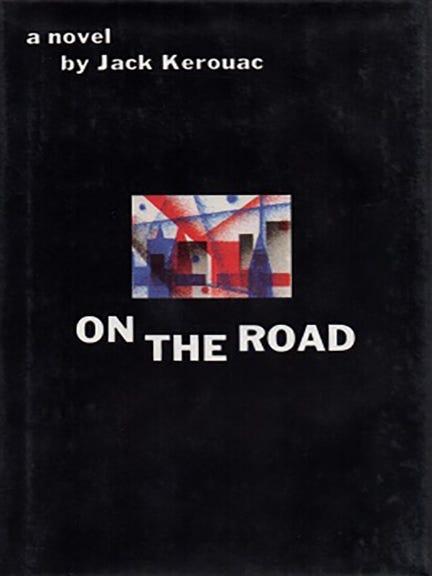
His most well-known novel “On the Road” has become a classic text in American literary counterculture. Set in the aftermath of the Second World War, Sal Paradise’s account of his travels across America has become emblematic of the struggle to retain the freedom of the American dream in a more sober historical moment.

Kerouac’s novel “On the Road” started as a series of notebooks that became “the scroll” — a continuous, 120-foot scroll of tracing paper sheets cut to size and taped together.
Written in a 20-day, Benzedrine-fueled writing style he called “Self Ultimacy.” In a deep trance, he’d written with chaotic speed, channeling spontaneous prose that jibed with the ethos of “first thought best thought.”
It is a story about 2 Catholic buddies roaming late 50s America in search of God. They embarked on a journey through post-Whitman America to FIND that America and to FIND the inherent goodness in American man.
“On the Road” was nominated to be in the top 100 books of the 20th Century. It was rejected for 6 years until Viking Press in 1957 published the manuscript.
Viking reports that “On the Road” has sold over 3 million copies, and is selling over 60,000 copies a year. It was translated into over 25 languages.
As if writing a letter to a friend in a form that reflected the improvisational fluidity of jazz. “On the Road” revolutionized modern literature.
“On the Road” holds a great deal of historical significance, showing an underbelly of American culture full of sex, drugs, and lost youth. A culture that received little public attention during the 1940s and ‘50s.
The story epitomized to the world what became known as “the Beat generation.” It made Kerouac one of the most controversial and best-known writers of his time.
One message of the book is that everybody is naturally dishonest and morally deceitful. Morals are defined by one’s religion, the laws of the country, or some combination of the two.
It signals the novel’s hunger for a new experience. For a way out of the conformist pieties of post-World War II America, and also Kerouac’s desire to stare down the mortality that he feared. In some sense, this is the key to all his writing. The idea was that by mythologizing his life and that of his friends he was somehow placing them all outside of time. — David L. Ulin, Los Angeles Times Book Critic
Time is a key element in “On the Road.”
Kerouac the next 100 years
Time was not always friendly to the writings of Jack Kerouac. When I attended an MFA in the late 90s. Faculty and students alike, thought his spirited encounters with women to be dated and sexist.
I caught wind of Kerouac’s Beat trilogy, “On the Road,” “The Dharma Bums,” and “Desolation Angels” when I was 15 years old. I didn’t just read them I became them. Light a match to the gasoline of a wild young man’s imagination. I hitchhiked across America too. Asking the same questions Kerouac did and tried to duplicate the live-as-you-go lifestyle.
Kerouac’s surrealist and improvisational prose and poetry left a profound mark on my writing. As a teen coming of age in the Vietnam War and Civil Rights era, Kerouac’s adventures provided a beacon of light in an ocean of lies.
Kerouac also served as an introduction to Zen that I will always be grateful for too.
Today, literary centers like City Lights Booksellers & Publishers continue to celebrate Kerouac.
One day I will find the right words, and they will be simple. Live, travel, adventure, bless, and don’t be sorry. There was nowhere to go but everywhere, so just keep on rolling under the stars. I like too many things and get all confused and hung-up running from one falling star to another till I drop.— Jack Kerouac
Other writing by the Author