

Happiness Is Loving The Boring Days
Out of all the great TED talks that exist, Barry Schwartz’s is easily the best. He talks about what he calls The Paradox of Choice. I’ve gone back to it countless times for countless reasons, but my favorite part is when he shows this comic:
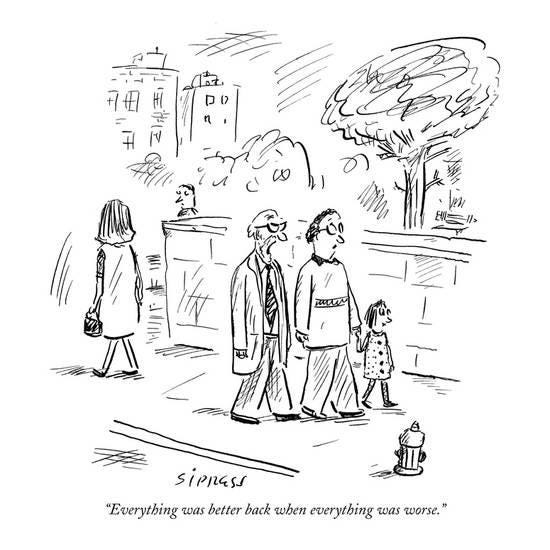
Ask anyone how they feel about their life from ten years ago, and they’ll likely tell you that “those were simpler times.” Less to worry about, more to enjoy. Somehow, everything was easier. Today, it’s all complicated. Always.
“Everything was better back when everything was worse.”
It’s more than a good chuckle. So simple, yet so instinctively true. But why does our gut want to agree so badly when we hear this? Barry explains:
“The reason that everything was better back when everything was worse is that when everything was worse, it was actually possible for people to have experiences that were a pleasant surprise.
Nowadays, the world we live in — we affluent, industrialized citizens, with perfection the expectation — the best you can ever hope for is that stuff is as good as you expect it to be.
You will never be pleasantly surprised, because your expectations, my expectations, have gone through the roof.
The secret to happiness — this is what you all came for — the secret to happiness is:
Low expectations.”
I turned 28 a few days ago. I thought about what lessons I’ve learned so far in life. Barry’s is one that’s stuck with me throughout the years. What’s changed since I first heard it, however, is how I’m trying to live it. There’s a twist to it.
“Low expectations” sounds daunting. Shouldn’t we hope for good things? Optimism being a self-fulfilling prophecy and all.
Sure, it helps to dampen your excitement before any event whose outcome you don’t control, like a presentation, job interview, or publishing an article, but if you demand so little of life that you don’t even attempt any of these, you’ll soon walk around with a perma-long face. Most of us aren’t saints, so wanting literally nothing isn’t a practical everyday solution.
Avoiding misery, however, is. That’s what I’ve made my happiness about.
Long-term, everyday happiness lies in not being miserable.
Each day when I’m not sick, not stressed, there’s no drama, and I don’t have to do a lot of things I don’t like, is a good day. We think we need to accomplish our biggest goals to find happiness, but the truth is having a life with enough room to obsess about and chase them is more than enough. And yet, when we use this freedom to obsess, we often forget taking care of the basics.
Am I healthy? Is something psychological causing problems with the physical? Do I have a fit mind and a fit body? Or is one breaking the other?
Am I living below my means? Or slowly veering off track? Is paying the bills becoming a hassle? Or does it work out okay if I don’t splurge too much?
Do I enjoy my work? Am I spending my workday with good people? Or do I dread getting out of the house? Am I commuting 2 hours into a toxic place?
As long as you’re healthy, like your work, have a few friends, and money kind of works out, there’s quite little you really should be worried about. If one of these implodes, however, you should raise all hell to get back to your baseline.
It’s the same idea, just flipped on its head. Sure, low expectations are great when you’re buying a pair of jeans but, when it comes to the big stuff in life, you’re better off cultivating a high aversion to misery.
Once you’ve achieved your own little standard, you can settle into your base camp of being healthy, calm, and not having to do stuff you don’t like. From there, you can explore, try, learn, fail — all in hopes of higher things.
I think that’s how you really win. By remembering you’re a finalist long before the end game has begun. Wanting to do more, better, greater is honorable, and achieving big goals always gets you a burst of endorphins. But they’re not everyday occurrences. And so they can’t serve your day-to-day happiness.
If you live to 82, that’s 30,000 days. 27,000 will be boring. Life is about learning to love those days. Happiness is enjoying the little things.


