
Life in Spain
Happiness is a 2€ Glass of Spanish Wine
Good things happen when the best things in life are (almost) free
In January, my wife and I moved to Spain. And so far, we love it.
But when people ask us, “Why did you move to Spain?” we never really know what to say.
Sometimes we mention our love for the Camino de Santiago. Other times we talk about the delicious Spanish food or how much we like living in a walkable city.
The answers vary — and they’re all true. But none of that stuff is the main reason we love living in Spain so much.
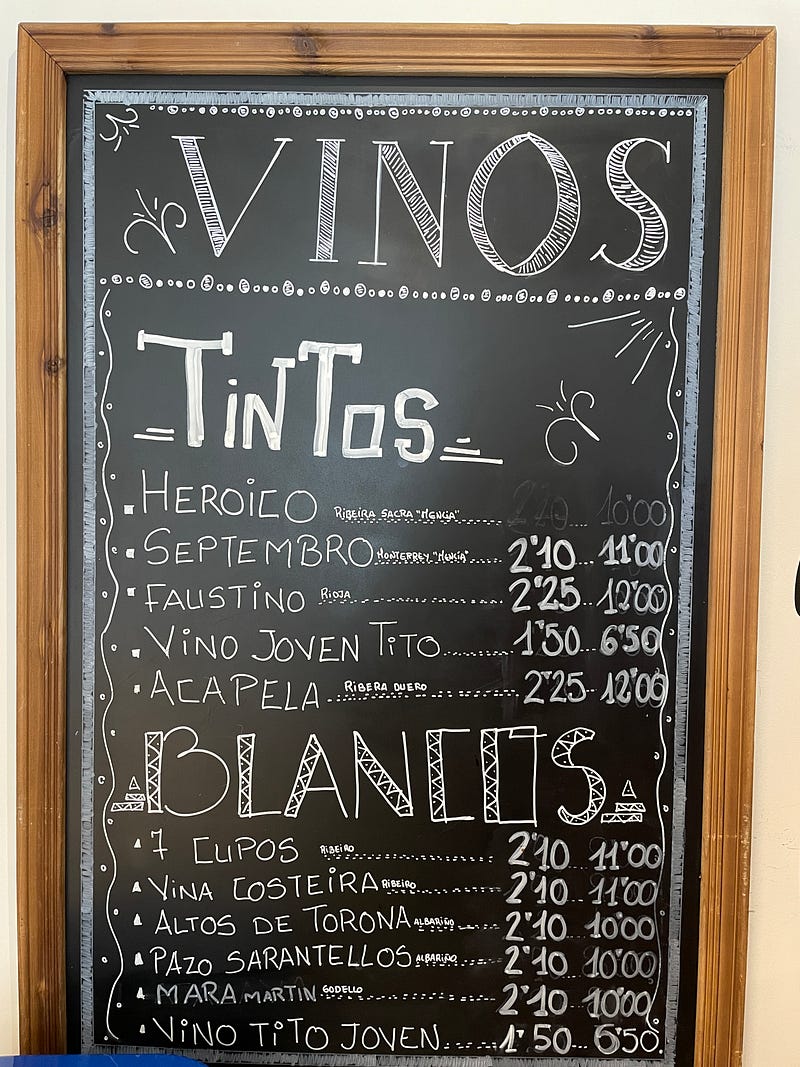
The actual reason we love Spain is because it’s so much easier to afford the “good things in life” — like a nice glass of wine.
And that matters a lot more than you think.
You shouldn’t have to be rich to enjoy life
Don’t get me wrong. Spain has plenty of expensive wine.
If you want to drop €150 on a fancy bottle of Rioja, you can. And I’m sure it’s great.
But you don’t have to spend a fortune to have a nice night out with your friends. Because in Spain, a great glass of wine, tasty tapas, and (hopefully) some good conversation are seen as fundamental rights — not just something for wealthy people to enjoy.
And that simple, almost invisible equality is a big part of what makes Spain such a great place to live.
Why Americans can’t have nice things
We’ve been lucky enough to host several friends and family from the States. And during their stay, every single person has been blown away by how cheap the (very good) wine is.
Because of course, they are. Look at the prices on this wine menu from a very chic cafe in town.
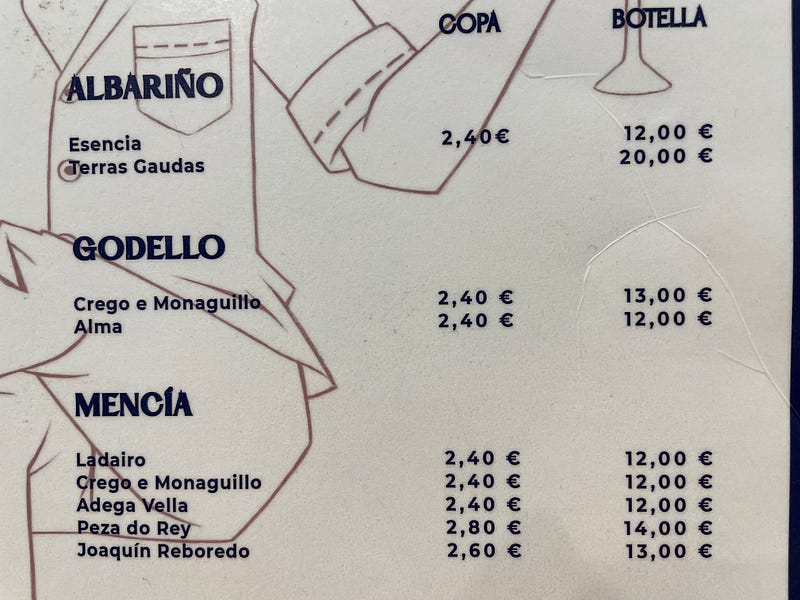
Those are all great local wines, and none of them cost more than €3 a glass. (And this is one of the nicer places in town).
But even though our guests usually rave about how tasty and affordable the food and wine are in Spain, a funny thing inevitably happens when we start talking about the price of things like this in Spain.
Everybody wants to raise the price. Every single person.
“They could charge so much more for this. People would still pay.”
“Why don’t they round up from €2.30 to €3 or even €4?”
“You would never see prices like this in the States.”
I agree.
You don’t see prices like this in the US. And that’s the problem.
Without fail, our American visitors — who are enjoying the lively atmosphere on our local tapas street — complain that the bars and restaurants aren’t charging more for their wine.
It’s almost like they can’t understand how a restaurant can stay in business if they charge fair prices for wine instead of a massive markup.
It’s like we’re conditioned to getting ripped off.
And when we see hard evidence that it doesn’t have to be like that, we can’t process it. We’re too used to the status quo where the good things in life are perpetually out of reach.
But it doesn’t have to be that way.
Our local Spanish friends told us that if bars in Spain raised the price of wine — even by a few euros — many Spanish people wouldn’t be able to afford it, at least not very often.
And that’s unacceptable.
Because in Spain, going out for a glass of wine with friends is considered a fundamental right for everyone. Not just wealthy people.
Another friend explained it like this:
“When things are going well, you go out and celebrate with friends. When things are going poorly, you go out and complain with friends.”
Regularly going out for a tapas and a drink is how Spanish people build relationships, lower stress, and participate in their communities.
And we’ve seen firsthand how essential that is to a functioning society.
People over profit
I’ve heard plenty of Americans and even other Europeans say that “Spain isn’t great at business.” And while I think it’s a gross generalization built on a misunderstanding of siesta culture, I have to agree.
Spanish businesses aren’t as productive or profitable as the U.S. or other European nations.
And that’s why we love living here.
Visit Spain and you’ll quickly see that most businesses aren’t built to maximize profits. Shops in town sometimes randomly close for weeks so the employees or owners can take a vacation or just get some “rest” (descanso).
Almost nothing is open on Sunday.
Waiters will let you sit at a table sipping coffee forever.
We waited 10 minutes to buy beef at the butcher shop the other day because the woman in front of us was chatting with the people who worked there.
And I’m 100% fine with that.
Because when it’s my turn at the counter, no one behind me will be tapping their foot while I ask questions and practice my Spanish.
What happens when life is affordable
Spain isn’t perfect.
Obviously.
They have intense political divisions, massive youth unemployment, and a bunch of other societal problems I’m only beginning to understand.
But the social life here is firmly rooted in public spaces for the simple reason that most people here can afford to go out regularly — even if it’s just for a quick glass of wine and a chat.
And that access to “the good life” leads to lively conversations between neighbors, a bustling city center at all times of the day, and a stronger sense of community than I’ve felt in years.
So while it might seem silly, I know what I’ll say the next time someone asks us, “Why did you move to Spain?”
I’ll tell them that in Spain, you can get a great glass of wine for €2 just about anywhere.
And that seems pretty great to me.
Shawn Forno is a very left-handed travel writer with 15+ years of experience writing for Lonely Planet, Matt D’Avella, and Tortuga Backpacks. Sign up for his newsletter or check out his YouTube channel, Days We Spend, for videos about travel, packing, and life in Spain.


