
Halibut: A Holy Fish With a Story to Tell
Secrets of the word revealed
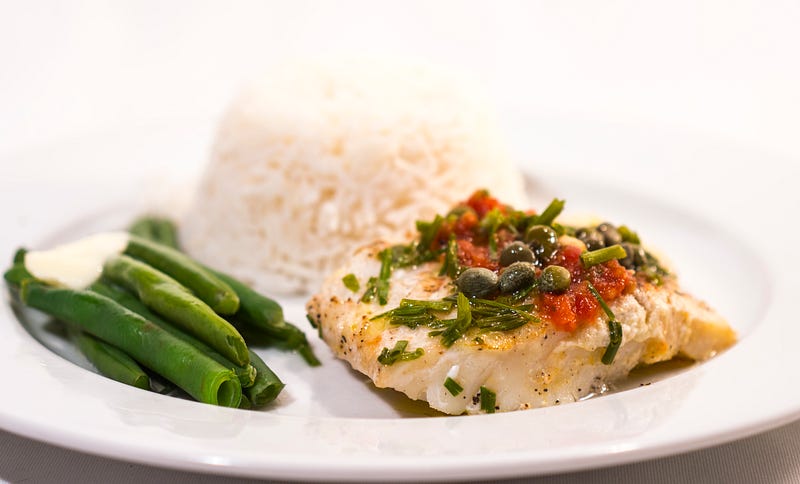
Halibut has been a revered fish for centuries. In fact, this reverence contributed to its name.
The first part of the word, hali-, means holy and comes from the Middle English hali or holi, as noted in The American Heritage Dictionary. Other sources have the early spelling as haly, but because English spelling was often variable before the printing press, this seems to be a largely insignificant difference.
What is significant is that the several varieties of the large flatfish known as halibut were highly valued as food on Catholic holy days when eating meat was forbidden.
Still, of all the fish and shellfish available for meatless days, only halibut took on a holy name in the English language.
The second part of the word, -but, comes from the Middle Dutch butte, meaning flatfish.
So there you have it. From holy flatfish, we get halibut.
The Dictionary of Etymology recognizes the year 1396 as the first recorded use of the word halibut in English.
A Deep Dive for a Holy Fish
For word nerds and those who’d like a deeper understanding, read on.
The forerunners of holy mentioned above drew from the Old English hālig, which appeared around 725. Hālig, or holy, has similar cognates (related words) in other early Germanic languages, including Old Frisian, Old Saxon, Middle Dutch, Old High German, Old Icelandic, and Gothic.
The Dictionary of Etymology gives some support to an early definition of holy as “that must be preserved whole or intact.” Such a meaning then strongly implies a tight connection between holy and whole (hāl in Old English).
Although we should be cautious about applying old definitions to modern words, a holy-whole tie-in may give spiritual seekers much to ponder.
Knowing that the second part of halibut comes from the Middle Dutch butte is good enough for many people, but for a word nerd, new questions arise. And so we go deeper.
If we are going to squeeze out the knowledge of English etymology, we often need to look at proto-Indo-European, the foundation of a wide swath of European and Asian languages from India to Ireland.
We say this basic language is assumed because we have no written record. But that makes it no less real. Just think of astronomy, which often relies on an assembling observable facts to provide convincing evidence of the unseen.

On to butte — and a few questions.
Is that Middle Dutch word for flatfish related to the English word (same spelling) for a flat-topped hill? And what about the butt end of whatever, including buttocks? And is halibut the only flatfish name to incorporate some form of butte?
The answers are simple. All these uses are from the same root in Indo-European, and linguists have determined that root is bhau-. The link isn’t obvious at first glance, but bhau- is the basis, at least in part, of many modern words, including halibut, baste, buttock, buttress, rebut and button.
In the realm of fish, turbot came into English from an Old Swedish-like Scandinavian source that used but for flatfish, similar to the butte of Middle Dutch used in halibut.
However, the explanation for turbot isn’t quite such a straight line. First, the complete Old Swedish word was törnbut (thorn + flatfish, in reference to the thorn-like spine). Second, the word detoured through Old French as turbut and tourbut, then later as just turbut, before becoming turbot in English about 1300.
If you read this far and the story of the once-simple word halibut fired up a few brain cells, then the language articles in the link below may interest you as well.
After reading those, you can button your shirt, sit on your buttocks in a house on a butte, and eat some tasty halibut.