
Hadrian’s Wall: A Paradoxical Union of Romans and Britons at the Northern Border
It was meant to be proof of the end of Roman expansion and a way to separate the empire from the barbarians who threatened it. It was built by legionaries and was the longest structure on European territory. Hadrian’s Wall guarded the northern borders of the Roman Empire for nearly 300 years.
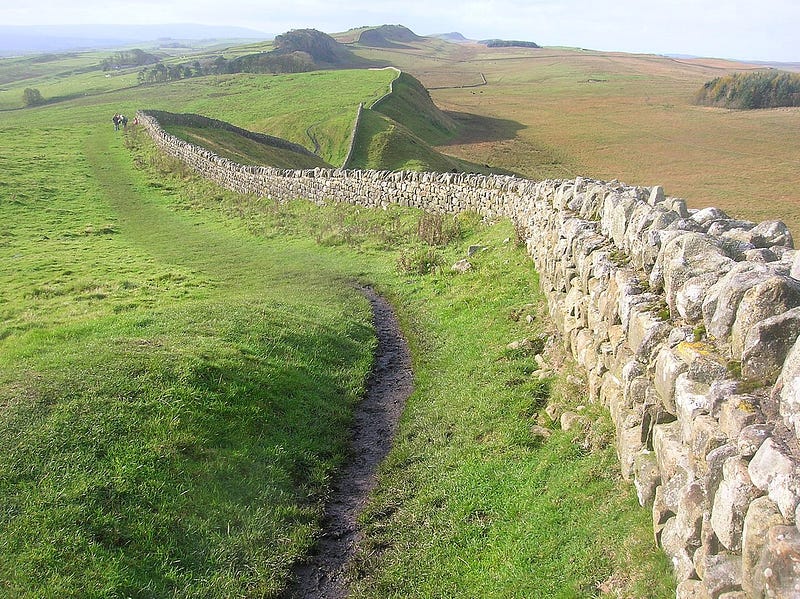
It is an astonishing engineering achievement. Built of 25 million hewn stones, it cut England in half. It demarcated the northern part of the empire, the southern edge of which reached into Africa. But it was not just a wall, but a complex of forts and fortresses. For the northern tribes, who did not know the technique of building with stone, it was an expression of the power of the invader, whose tentacles extended across Europe.
Who was the emperor Hadrian?
It is not known whether the rampart would have been built if another emperor had sat on the Roman throne. Hadrian, before he ascended the throne, became known as a consummate politician, a lover of art and architecture. It was thanks to him that the Roman Pantheon, destroyed in a fire, was rebuilt. It was also on his initiative that the monumental family tomb, now known as the Castle of Saint Angelo, was built in the Eternal City. But Hadrian was characterized by something else — an aversion to war and a deep understanding that the borders of the empire cannot be moved indefinitely. Instead, these borders must be secured.
In 121 AD, the emperor traveled to occupied Gaul and Germania. Seeing how the legionaries were fortifying their positions with wooden palisades, he decided that cordoning off with a wall would be the best way to establish and strengthen the borders of the empire. Historians say that it was then that the idea dawned on him to separate Roman territory in the Isles from that occupied by native tribes, primarily the warlike Caledonians.
The conquest of Britain by the Romans
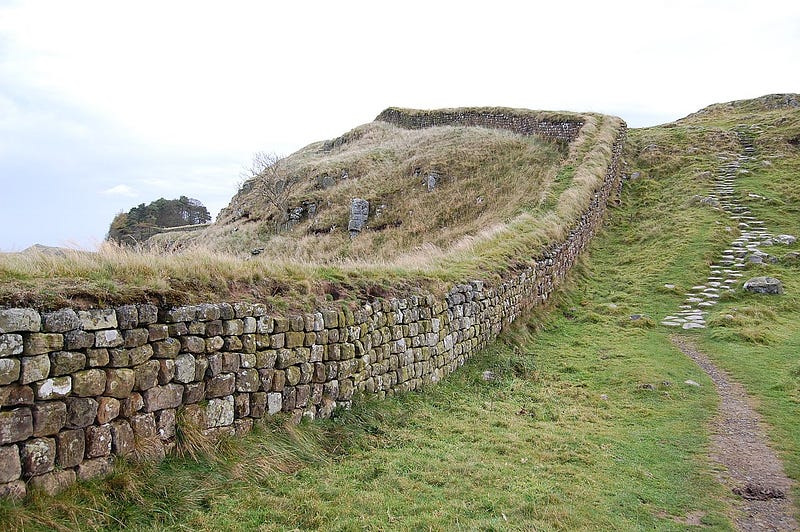
The Romans ventured into Britain back in the time of Julius Caesar. But it was Claudius’ legions that incorporated the southern areas of the Island into the empire. The conquest of the north was undertaken by one of Emperor Vespasian’s most outstanding commanders, namely Julius Agricola. He launched an offensive in 78, and consolidated the conquered territories by building a network of forts.
It was these fortifications erected by Agricola’s soldiers that later became the basis for the construction of Hadrian’s Bulwark and the further north Antonine Bulwark. The latter was built after the next emperor, Antoninus Pius, rejected Hadrian’s peaceful policies. Antoninus’ Wall was less monumental than Hadrian’s Wall and stretched only 63 km.
Construction of Hadrian’s Wall
The construction of the wall was started by Emperor Hadrian himself. Near the mouth of the River Tyne, he ordered the erection of two altars in honor of the gods Neptune and Oceanus. This was an overt reference to the actions of Alexander the Great, who was to worship the same gods in the far East — on the Hydaspes River. The next step was the erection of Hadrian’s Bridge. It was to mark one end of the new boundary line. Only after this work was completed was the erection of the wall begun. A wall that stretched more than 120 km between the Irish Sea and the North Sea.
There are many indications that Hadrian not only commissioned the construction of the wall, but designed it himself. The first design called for the construction of a stone wall 10 Roman feet, or three meters wide, from the River Tyne westward for 72 km to the River Irthing. The wall was to be 72 kilometers long and transition into a rampart 20 Roman feet (6 meters) wide west of Irthing to the mouth of the Solway.
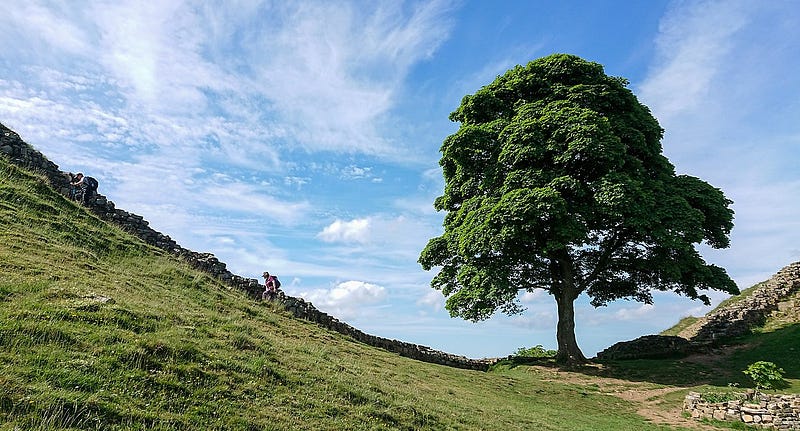
Fortifications of Hadrian’s Wall
The wall was also protected by fortified gates, called mile castles. Most of the unearthed mile castles housed a single building. Presumably it was a barracks block for about 8 men.
Hadrian made several changes to the original plan, including lowering the wall and adding more forts. The work proceeded remarkably smoothly. This was possible thanks to the work of soldiers from as many as three Roman legions. Such a legion usually consisted of about four to six thousand soldiers. Among them were engineers and excellent specialists in stone processing.
Why was Hadrian’s Wall built?
Historians consider the reasons for the construction of the wall. They question whether it was intended only as a way to fence off the Caledonians. It is speculated that it may have been used to collect fees from merchants traversing the Island and to regulate the flow of population.
Interestingly, the wall quite quickly became a place that united the native population and the legionaries rather than dividing them. Above all, it was an excellent place for trade, since the legionaries, who received regular pay, were among the few people at the time with money. Whole families lived just by tilling the fields for the legionaries. Stalls, taverns and, of course, brothels appeared. Baths, so important in Roman culture, were also built.
Construction of the wall took more than six years. The work was a good way to maintain discipline among the soldiers. Hadrian had no plans for further conquests, but wanted to keep the army in combat readiness.
Hadrian’s wall after the fall of Rome
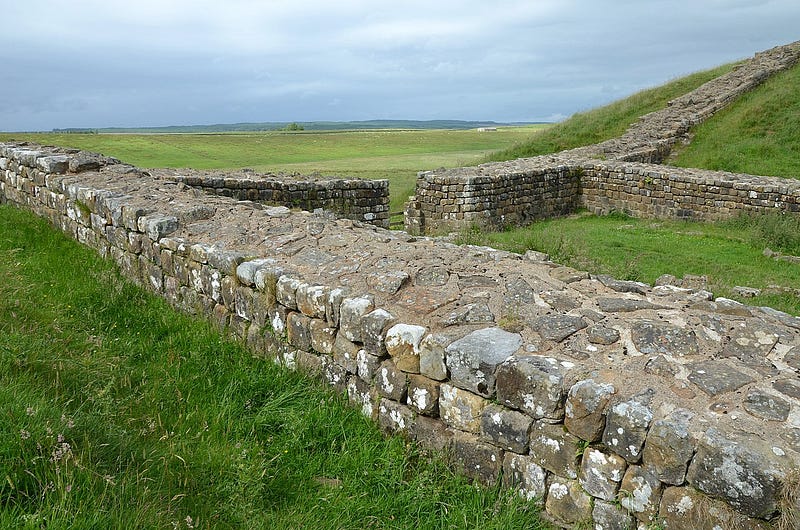
But as time went on, the British legions had less and less in common with Rome and more and more with Britain. Legionaries were recruited from among the natives. Many of them started families, and forts turned into villages. Money from Rome also stopped flowing, and the wall itself was deteriorating. And finally, 281 years after Hadrian’s Wall was completed, the Romans left Britain.
Fragments of the wall still exist today and are one of the Islands’ tourist attractions. And stones hewn by Roman legionaries can be found in many English churches and other landmark stone buildings in the region.
Interestingly, Hadrian’s Wall is often an inspiration for artists. It was the wall that inspired George R. R. Martin when he wrote “Game of Thrones.”
Cool that you made it to the end of this article. I will be very pleased if you appreciate the effort of creating it and leave some claps here, or maybe even start following me. It would be nice if you also left a tip! Thank you!


,_next_to_Hadrian%E2%80%99s_Wall_UK.jpg)
.jpg)