
Guilty Until Guilty
Why Racism in America is So Rampant and Hard to Eradicate
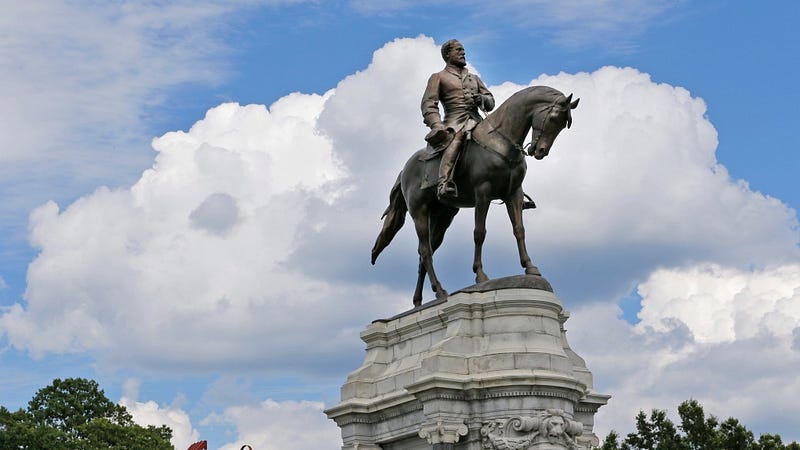
As the protests against police brutality and racism after the death of George Floyd turned violent with riots, property destruction, and looting, the fight against racism has taken an interesting turn. Some are screaming for LAW & ORDER, while some prefer to deflect the conversation away from police brutality with stuff like this: ‘there’s more black-on-black crime than police brutality’, as if that makes the latter acceptable. There is no correlation of police brutality and racial profiling with black-on-black crime. If that comparison is valid, then a court of law should also accept a serial killer’s defence that ‘more people die in accidents than I kill’ and thus let him walk free. However, that is not the main point of this topic. Let us discuss crime among black Americans.
First some data.* ¹ ²
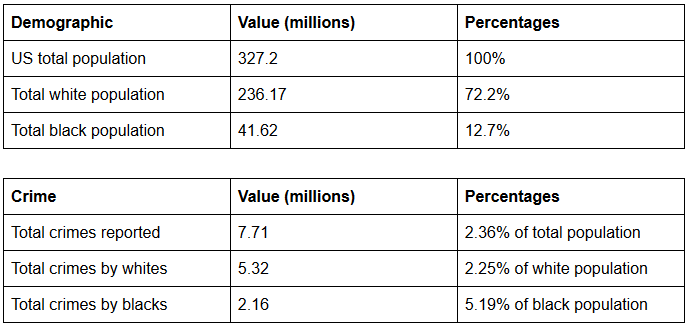
From the Criminal Victimization, 2018 report from Bureau of Justice statistics³: “Sixty-two percent of violent incidents committed against white victims were perceived to be committed by white offenders, the same portion (62%) of the total U.S. population (age 12 or older) represented by white persons (table 15). Among black victims, the percentage of violent incidents perceived to be committed by black offenders (70%) was 5.8 times higher than the representation of black persons in the population (12%).”
The data shows the number of black offenders is almost double that of white offenders, and that there is a lot more black-on-black crime in America. But before you think to use this data to further label blacks criminals, let me ask you another question:
Why is there more crime among black Americans?
You don’t need a degree in sociology to see that the biggest factor is systemic racial discrimination inherent to American governance. Racial profiling, housing segregation, gentrification, economic inequality, lack of opportunity, reduced access to education, and a tougher stance on crime with disproportionate enforcement by a majority white police force⁴ ⁵ ⁶ have led to the formation of a self-sustaining cycle.
Blacks were abducted and brought to America as slaves. They lived for generations as slaves. It took a civil war to get laws marking them as slaves repealed. But it was not enough. A change of laws does not automatically lead to a change of culture, or a change of heart. Blacks, begrudgingly granted freedom, were left to find their own path. They were seen in a positive light only through the lens of slavery, otherwise despised and ostracized. They were shunned, separated, and treated worse than animals. There was anger against them for disturbing the status quo — to undermine the supremacy of the white man. Time and again, as seen in history, there was violence against them, and attempts to legally restrict them where possible.
Yes, the whites were angry, for wasn’t their established and comfortable way of life destroyed? But how long can you expect the other side, the oppressed black minority, to suffer in silence and accept what was being done to them as a people? Rage was building up among the blacks as well. How were children of slaves — once without the right to education — with limited freedoms and access, supposed to cope with the bitterness of discrimination while struggling to put food on the table — once the wages of slavery — when no jobs were available because of the colour of their skin? Where could these segregated black kids vent their frustrations at the unfairness of their world, except in their own neighbourhoods? Yet, what did the whites see in this behaviour and label it as? Why were black kids labelled ‘juvenile delinquents’ while white kids were likely to be let off because ‘boys will be boys’? Why were black children taught by mostly black teachers, while juries of black accused were mostly white? Weren’t white jurors likely to judge former slaves more harshly? Weren’t economically disadvantaged blacks less likely to be able to afford bail and good representation? Weren’t the children of this generation of blacks more likely to have witnessed more violence growing up? In the meantime, laws continued to be added by white legislators that limited the freedoms of blacks and encouraged further discrimination (See endnote E2 for examples), while not enough was being done to repeal existing racist laws. Treatment of blacks had not noticeably improved, rage was still building up, increased crime led to increased police force monitoring black communities, and that gave birth to the belief that blacks are likelier to be criminals, thus police would be more likely to require the use of deadly force to protect themselves and others — leading to a spiralling cycle of hatred and distrust. In the meantime, groups wishing for the good ol’ days of white supremacy were doing things like holding rallies and erecting statues of confederate leaders.⁷
Every once in a while, a death of a black person led to uproar and inevitably to violence. Amadou Diallo, Tamir Rice, Ahmaud Arbery, George Floyd, among many others, became martyrs for the cause of black lives. Diallo was brutally shot by police in 1999. There were protests. George Floyd was murdered by police in 2020. There were protests. There were multiple protests in those two decades fighting discrimination. What has really changed in those 21 years in terms of equality for blacks? Evidently, not much. Every time, with every short-lived protest, history has repeated without much change to show for it. So what would you expect to change this time around?
The demonstrations for racial equality that began in the aftermath of the Floyd killing ended up becoming something else entirely. Currently, violent protests (and sometimes even peaceful ones) are being met with violence. Conversation is now turning to how blacks are destroying their own neighbourhoods. There is a clearly divisive and racist rhetoric in messaging from the literally and figuratively named White House. The discussion about whether black lives matter has been diverted into arguments about keeping confederate statues as symbols of American history and greatness. Taking down confederate statues has been added to the list of crimes by whites offended by these acts [E1]. This translates to ‘removal of symbols of slavery is a crime’, which isn’t far removed from considering asking for racial equality a crime [E2]. And if you don’t like it, you can go back where you came from, thank you very much. [E3], [E4]
The fundamental point about the black lives matter movement seems to have been forgotten or wholly ignored. It is quite appalling that in the twenty-first century there is any doubt or a need to discuss which lives matter.
Statistically speaking, yes, there is a higher incidence of crime among blacks in America. But that seems to be the result of a system of governance by white Americans that has evolved to assume by default that blacks are inferior people and criminals. Blacks end up having less education, lesser opportunity, and virtually no benefit of doubt in a system where they are labelled guilty until they are forced to become guilty. The fight for racial equality will not end with rioting and the destruction of property by a minority community. It is not America that differentiates, but Americans**. Racism is not a physical object but an idea. It is not a part of our genetic encoding, but learned behaviour. Rioting will not result in lasting change, only lasting damage. The solution is not in removing offending statues, but offending statutes. Racism will not go away till the idea of racism is destroyed from the system that feeds off it. The question is, not individually but collectively, how can white Americans who have established this repressive system and are getting away with it be motivated to tear it down?
Endnotes
*Data is from 2018 and 2016, where the most complete data is available.
**Racism is everywhere in the world. The intent is not to single out America, it has been used as a case study.
[E1] The topic of removal of confederate statues and symbols seems to have been subverted by parties interested in distracting the public from the main point. The point is that statues are not a record of history (that’s what museums and books are for) but an aggrandizement of accomplishments and beliefs held by the subject of that statue. By saying that removing confederate statues is a crime, you suggest that the nation believes in preserving the idea of slavery that the confederacy fought for. Statues are also art. Offensive art should not be displayed in public. In truth, this topic is complex because it is debatable what should be considered offensive. You will always find some individual or group that is offended by pretty much anything, but that does not necessarily mean you should not do it, else nothing at all would ever get done.
[E2] Legally, crime is simply the breaking of a law or regulation passed by the government or courts. Throughout the history of American legislation, there have been laws that were introduced to specifically limit the freedoms of non-white races. Notable laws include the Racial Integrity Act⁸, Anti-miscegenation laws⁹, and the landmark Dred Scott v Sandford case where blacks lost the legal right to vote¹⁰.
[E3] American blacks were born in America, and grew up in America, so what meaning does the statement ‘go back where you came from’ have for them? There is no country for black men? And juxtaposed to saying they should accept their lot in life or move out, is the dialogue about them destroying their own neighbourhoods. But is that even true? They do not seem to own much of anything¹¹, and tend to get driven out from areas they occupy.¹² (I am not suggesting gentrification is a conscious process, but is relevant to this conversation because of its impact on non-white communities.)
[E4] ‘Go back where you came from’ is particularly rich coming from European whites (particularly British, Dutch, and French) who invaded and overran the new world (including North America) just a few hundred years ago, driving out native people through aggression, genocide, and disease.¹³
References
¹ Table 43a, Criminal Justice Information Services Division, https://ucr.fbi.gov/crime-in-the-u.s/2018/crime-in-the-u.s.-2018/topic-pages/persons-arrested ² US Census data, https://data.census.gov/ ³ Criminal Victimization, 2018, Bureau of Justice Statistics, https://www.bjs.gov/index.cfm?ty=pbdetail&iid=6686 ⁴ Race and Crime in the US, Wikipedia, https://en.wikipedia.org/wiki/Race_and_crime_in_the_United_States ⁵ Local Police departments, Personnel, 2016, https://www.bjs.gov/index.cfm?ty=pbdetail&iid=6706 ⁶ Federal Law Enforcement Officers, 2016 — Statistical Tables, https://www.bjs.gov/index.cfm?ty=pbdetail&iid=6708 ⁷ List of Confederate statues and monuments, Wikipedia, https://en.wikipedia.org/wiki/List_of_Confederate_monuments_and_memorials ⁸ Racial Integrity Act, 1924, https://en.wikipedia.org/wiki/Racial_Integrity_Act_of_1924 ⁹ Anti-miscegenation laws, https://en.wikipedia.org/wiki/Anti-miscegenation_laws_in_the_United_States ¹⁰ Dred Scot v Sandford, https://en.wikipedia.org/wiki/Dred_Scott_v._Sandford ¹¹ Racial Economic Inequality, https://inequality.org/facts/racial-inequality/ ¹² Gentrification in America, https://www.governing.com/gov-data/census/gentrification-in-cities-governing-report.html ¹³ Guns, Germs, and Steel, by Jared Diamond, https://en.wikipedia.org/wiki/Guns,_Germs,_and_Steel