
Guilt and Victimhood in Christian Symbolic Grammar
Regimes of Fragmenting
The traumatic event is a root and amplifier of all psychic disorders. Trauma stays with those who experienced it independently of their desires or conscious and unconscious attitudes, it cannot be repressed and if it is, its consequences become far worst than the initial situation. Trauma can stay in either or both of the two following modes — that of victimhood and that of guilt. The former is incumbent on one who deems his trauma to be caused by a certain other who is to be blamed for it. The latter is incumbent on one who perceives herself to be a cause of other’s suffering thus deeming herself to be guilty and in need of atonement and redemption. These are the two essential modes of rendering moral responsibility for the events of the past — one either blames other and becomes victimized, or blames himself and becomes guilty. All psychic disorders develop in both of these modes, as a result of bending the membrane of the past by lying. When one percieves traumatic events of the past to be her fault, one is bend on assessing the past inadequately and being unable to adequately function in the world one is faced with right now. When one sees his traumas to be caused by another’s fault, one is bend on permanently revisiting the past to restore “justice” and perceiving himself to be wrongly oppressed. Traumas facilitate and accelerate the development of psychic disorders because they “fade out” certain domains of reality (be it past memories or present environment) for the consciousness thus causing it to either dissociate from reality (dissociation) or distort and deform it (schyzophrenia). Traumas engender the consciousness to avoid certain triggering phenomena thus contorting and crippling its capacity to be synchronized with and adapted to the reality of the present moment, which is the most famous symptom of a psychic disorder. When one is bent on avoiding a certain strata of reality, one is more likely to lie about this reality or himself, thus twisting and disfiguring the fabric of reality (schyzophrenia) or the wholeness of one’s psyche (dissociation). In the following example of the European migration crisis, same process are happening on the societal level.
Discussion around the Migration Crisis was compromised by the censorship of a certain strata of facts, e.g. crimes commited by refugees, especially in Germany. This blackout of various topics may speak of underdevelopment of the societal sense-making apparatus (collective consciousness), incapable of addressing certain layers of reality. Very often this impossibility of addressing the problem is not related to its novelty, but is, on the contrary, connected with the traumas of the past, with the former interactions with the problem at hand that have left tedious memories. Such triggers provoke a reaction that is inadequate to the current state of the problem, but which, in fact, is adequate to the phenomenological experience of the respondent. The discrepancy between phenomenological experience and actual reality leads to the development of a splitting mechanism and construction of an alternative fantasy structure designed to rationally account for the differences between experience and reality that cannot be ignored but, at the same time, cannot be addressed consciously. It is this mechanism that politicians, specialists, and ordinary citizens use when they interpret certain facts and events according to their own ideas and wishes — this deceitful forgery is carried out unconsciously. To a certain extent, it is inevitable, because each person inevitably uses his own interpretive schema, his own system of beliefs, but in our case it is a pathological exacerbation of this condition, where societal discourse becomes a hostage to bi-polar, schismatic conflicts , where the debate is not about the interpretation of certain facts, and not even about which facts to take into account at all, but with regard to whether the discussion is due to happen in the first place. The importance of the discussion itself is questioned. The lack of common articulated values makes the discussion impossible. In psychiatry, this disorder is defined as schizophrenia (from the Greek σχίζω — “split” and φρήν — “mind”) — an endogenous progressive (procedural) psychotic disorder characterized by a deterioration of perception of reality. In 2002, the term “schizophrenia” in Japan was changed from Seishin-Bunretsu-Byō 精神分裂 病 to Tōgō-shitchō-shō 統 合 失調 症 (integration disorder). One who suffers from the integration disorder constructs her own reality with laws other than the laws of the outside world — this reality draws the patient ever deeper, in advanced stages, turning his life into a dream. In the process of studying the trends of European fragmentation, we noticed a substantive resemblance to the processes of disintegration of individuals diagnosed with schizophrenia. (The structure of conscious development of society (sense-making apparatus) at the proposed levels of abstraction is identical to the similar systems of adaptation of an individual). In the context of the existential crisis in the European community (imbued with its own immunity and nervous systems), contradictions become more acute and the autoimmune system begins to split itself. Signals that are in normal condition are accepted as valuable information, begin to be ignored or deemed dangerous. Consciousness is absorbed by the illusion of control and in order to preserve illusion, it begins to change its understanding of the surrounding reality. In the state of integration disorder (the Japanese definition demonstrates better the societal character of European fragmentation), the community is incapable of synthesizing contradictory sentiments and their logoscentric manifestations in the synergistic symbiosis of the adaptive search of the truth. The sensory device loses the ability to perceive information at its face value, becoming an engrossed instrument, guided by the beliefs of a polytheistic mind, fragmented by agents of influence, consciously and unconsciously. Thence, the recent Brexit referendum, animated by the fear of increasing migration and anti-immigration rhetoric, has shown how European internal demons, “projected onto immigrants, produce affective states that can affect social reality in a stronger way than economic facts” [Kulicka 2018].
The core symptoms of the integration disorder are 1. Failure to close contact with others due to the impossibility of articulated broadcasting of one’s experience and feelings; 2. Decalibrated communication between one and her environment; perceiving of reality through a very distorted cognitive scheme, which leads to the construction of a fantasy world; 3. The discrepancy between the perception of such a person and the that of other people precipitates the sense of supremacy and conspiracy; 4. Reducing interest in the surrounding world and novelty; stimuli that have not been incorporated and deliberately identified are ignored, denied, or inadequately rationalized (streamlined). Many scientists consider the so-called “double messages” as the cause of the integration disorder. In childhood, it happens that the two contradictory messages are sent to a child— one verbally (explicitly), and the other is a non-verbal way (implicitly). In other words, at the articulated level one signal is sent, but at the level of tonality, gestures, and behavior, another is being sent simultaneously. “I say one thing, but I carry out another ethos with my own acts. I strongly punish the lie, while I constantly lie myself. I wish you the best, but make you suffer.” The child is not able to accuse adults of contradicting signals, explicit and implicit, conscious and unconscious, articulated and hidden, because he does not function on a required for that level of abstract thinking. Swinging the child’s psyche is often caused by both parents — when one contradicts another. Many consider the concept of binary messages as a key for the development of schizophrenia, schizoid accentuation, and narcissism. It leads to a dredging into an introspective imagination, intellectual constructions, and to the impossibility of building relationships with other people. Patient’s meaning of life shifts from the self-sacrifice for the good of the others, to the perpetual self-preservation and increasing need for security. Speaking about society, one can immediately reminisce the sentiments of preserving and protecting European civilization (sometimes with the emphasis on white race) and, on the other end of the political spectrum, the demands of the “safe spaces”. Proceeding from the concept of integration disorder, the situation in East Germany appears to be particularly tragic, as the articulated discourse was radically un-relatable to the actual experience of its citizens. Hence, the effectiveness of fear-mongering (intimidation) in East Germany is not surprising. We hypothesise that there exists a structural congruence (equivalency) between the integration disorder pf the mind and the fragmentation of societal collective cognition apparatus. We suggest that this situation may be defined as an integration disorder of society. In an integration disorder, the parties of the conflict are doomed to lie — otherwise, the coherent structure of reality that they are axiomatically sticking to will be questioned. Scilicet, when an objective assessment of the facts threatens the ideology and sentiments of certain subjects, they begin to ignore these facts or even use “alternative facts”.
Thus functions the complementary cycle which facilitates formation of the alternative reality — trap of the lies of the past, in which people become hostages to their ideology. One of the options of dealing with such a trap is demonstrated by the populists who are not afraid to be caught on a lie and simply lie “without shame” by postulating that “truth is anything that is inside of you” (gutteral definition of truth). They can be conceptualized as a visceral response to the structural weaknesses of the establishment and gnarled reality. Although populists respond to the reality’s distortion only with its further distortion, their positive contribution to the discourse is to highlight ignored problems and scorned points of view (yet again, the way in which they do it inevitably brings lots of anxiety). Paradoxically, both sides (censors and populists) tend to be right in what they claim, but mistaken in what they deny; while society tends to be incapable of synthesizing both “messages” due to underdeveloped symbolic stage (just as a child is not able to see the paradox in the messages of her parents due to the lack of her cognitive skills). Construction of the “alternative reality” occurs via the deformation of the cognitive scheme (sense-making apparatus), now used as an instrument in the struggle to confirm one party’s vision of reality, and not as an instrument of exploration of objective reality. This attitude to the truth was described in the work “Truth Regime” by French scholar M. Foucault [Foucault 1983].
Regimes of Mending
Regime of mending (defragmentation) is a modality in which a given society faces its historical traumas. Negative events of the historical past are traced in collective memory as tragedies (injuries) and can be addressed either in the modality of guilt or that of victimhood. The essential segment of the public discourse — concerning historical facts and what happens contemporaneously — is perceived and navigated precisely through the prism of a particular narrated mode of awareness (i.e. mythos). The first type of modality (victimized) is more primitive, because it does not require a lot of time and resources to propagate it —it is more scalable — people themselves remember well their misfortunes and those who cause them. The second type of modality (guilty) occurs only in societies with a developed culture of sin and advanced, refined mechanisms of social consciousness — mechanisms that contribute to the promotion of sentiments and insights of conscience (sense-making apparatus, that is philosophers, artists , scientists, etc.) There are four cardinal modes of mending (defragmentation): (1) Denial (Guilt) (2) Repentance (Guilt) (3) Fixation (Victimhood) (4) Forgiveness (Victimhood)
Modes 1st and 4th potentially lead to the evolution of logoscentric discourse (treatment of integration disorder and subsequent embodiment of truthful word); modes 2nd and 3rd lead worsten the integration disorder by furthering the split of reality via fantasized constructions. In the context of the historical development of Europe, the integration disorder means a regression in the form of fragmentation: rejection of the project of European unification, of the Christian dictum “to take upon oneself all the sins of mankind,” and of the moral evolution in the fairway of sacrificial love and truth. In this segment we attempted to outline the structures of development (and degradation) of social awareness, public discourse, traumatic impulses and categories, impartial modes of perception and the mechanisms of schizophrenic rationalization of the schism between reality and its articulation in words.
(1) Guilt: Mode of Denial. To deny one’s guilt is a natural impulse: a selected few concentrate on their feeling of guilt, while most of us tend to forget one’s wrongdoings. Yet, despite being repressed deep in the psyche, guilt lingers and lurks, awaiting a proper trigger to actualize its traumatic and unaddressed anxieties. It is possible to demonstrate this apophatic regime on the example of certain Europeans, who, instead of reflecting on colonialism and its contribution to the European prosperity, suffer unconscious projection and begin to see refugees as dangerous neo-colonialists and themselves as victims. This attitude is a direct manifestation of the integration disorder: the creation of fantasies that prevent Europeans from turning to the situation in wholeness of its complexity (recalling the role of the West in the declension of countries — donors of refugees and migrants). The apophatic regime distorts the process of creating truth from chaotic, dubious facts and contributes to the split between reality and human awareness of it, thus bolstering destructive projections of the past to the reality of the present.
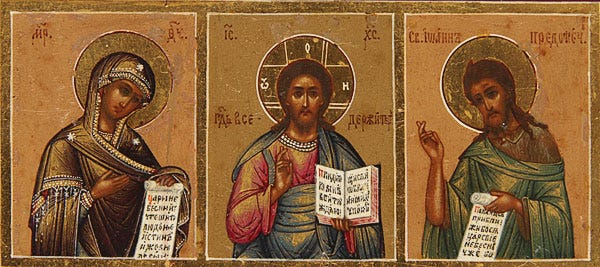
(2) Guilt: Mode of Repentance implies repentant (R), forgiver (F), and the subject of repentance (S) and is unsuccessful (deprived of redemption) if the relations between R and F are profane in terms of identity characteristics. If R has a typological identity to F, the interaction between the categories of identity will become hostage to the problem of complexity, since one is always defined, technically, by what one is not, that is, A is A because there exist x=not-A. P. Florensky solves the problem in the following way: “instead of the empty, dead and formal self-identity A=A, by virtue of which A should independently, self-affirmingly, selfishly reject any non-A, we obtain a meaningful, complete, real self-identity A, immanently self-denying yet in this self-denial radically affirming itself. If, in the first case, A is A (A=A) due to the exclusion of all else (and of itself in its specificity!), now A is A due to the assertion itself as non-A, as a result of assimilation and absorption of all that is different.” Define non-A as B. For the sake of the absence of a simple identity “A=A”, so that the real equity is “A is A, since A is not-A”, it is necessary that B itself is possible and at the same time both B and not-B, the latter, that is, non-B, will be denoted as B. Together with B, the circle may close, because in its “otherness”, in “not-B”, A is allowed space to find itself as A” [Florensky 1914, my translation]. Trinitarian relations, formulated in this fashion by priest Florensky, illuminate the exigency we are faced with, that of a “third party” dilemma — quintessential need for a transcendental object of repentance, the Forgiver in lieu de forgiver. Wee all know that once we are forgiven by the party on whom we inflicted suffering, our guilt does not magically disappear, it lingers on, because our sin is not defined and exhausted by what it had brought to the victim, our sin is (to say the least) defined by our conscience. The entirety of one’s guilt is attainable only through the “eyes” (and example) of the Ideal (and not through the mirror of the existing object of repentance who has been hurt, since it is ultimatelly indentical with us in its createdness and transience). Especially at the societal level, repentance requires an ultimate witness who is able to assume all the blame and sins on himself, witness that stands beyond the logical and mathematical relations of identity; witness that was embodied by Jesus Christ. Here is the essence of Christian repentance. Societies that have not developed this sense of repentance are often at pain of atoning guilt (Asian fixation on revenge is one of its crucial consequences). In order to understand the process of Christian atonement one must study its conceptions delineated by St Gregory of Nyssa, St Maximus the Confessor, St Mark of Ephesus, Jean Elluin, and fr. Pavel Florensky. Jean Elluin defended the theory of so-called “Surgical hell”, where sinner’s personality does not mixt with his sins: thanks to the purifying “surgical” fire, all the man’s poison burns down, and he can “be cleansed to join the common harmony”, the theory quite parallel to the “fiery baptism” in the eschatology of St. Gregory of Nyssa and the concept of purgatory. Purgatory as a “Surgical hell” repels sins and revives the atoned sinner to eternal life via otherwordly purification, “where the fire of His love can finally burn everything that burdens us”, is encountered in many contemporary Catholic authors because of a desire to humanize the medieval idea of purgatory, thus giving the traditional Western doctrine an Eastern Christian optimistic interpretation in the spirit of the doctrine of “fiery baptism”. St Maximus distinguishes between two “restorations”: the restoration of the existence of nature to the whole world and every creature through the universal resurrection, and the restoration of man according to the divine plan (λόγος of being). Roughly speaking, Christian atonement is possible by the way of the praxeological embodiment of the Word in action, while the presence of only a “lower-case” word just makes repentance infinite and vain. According to the priest Pavel Florensky, the idea of purifying fire runs as a red thread through the New Covenant. When Pharisees and Sadducees come to John the Baptist, he points out the need for repentance for the sake of avoiding “future wrath” and threatens them with some kind of fire (A). John also threatens with the double-edged sword — for repentance must follow a new purification process — “I baptize you in the water of repentance, but He who follows me is stronger than me … He will baptize you with the spirit of saints and fire (B), his shovel (as an instrument of separation and purification) has the same meaning as the sword in his hand, and He will cleanse the filth and gather the wheat into a barn, and burn the straw with unquenchable fire” (B) [Mt. 3:11] [Florensky, 1914]. The turturing flames of (fire A) and (fire B) burn that in the Self which is incompatible with being in God, while the unquenchable fire (B) completes the purification by separating the logoï of a creature from all its ephemeral, non-divine, and non-natural stratas. In our view, the absence of this “surgical” split of the penitent from the content of repentance is a dire problem of Protestantism. If, in the Catholic Setting, the locus of redemption is situated within the ecclesial authority, individualistic Protestant remains hostage to internal reflections on sin, notwithstanding the radical irony of the fact that this very mechanism of rational pondering is the very subject that brings the state of sin in the first place. It is difficult to get out of this recurrent reflections in the circle of sola fidei and sola gratia. Come what may, the possibility of redemption lies in the triple antinomy of Repentance — Fire of Purification — Forgiveness. A prominent Christian illustration of this process is embodied in the figure of St John the Baptis, depicted in the Eastern iconography as one who preaches repentance and atonement, redeemed by (1) the fire of suffering, (2) the fire of repentance, and (3) the healing by the Word (in this case, in its epitome of Truth). Thence in the phenomenological dimension, the gift of forgiveness comes from the “third party” — outside of the victim-perpetrator relations.
(3) Victimhood: Mode of Fixation. There is an agitation brochure drawn by the Polish anti-immigrant party KUKIZ’15 on which one may decipher the following: “Year 2044. A group of Warsaw dwellers uses sewers to the city center, “depicts Warsaw occupied by Muslims. On the streets and sidewalks we see armed Muslim soldiers guarding the security of Muslim men walking down the street and cheerfully chat-ting and Muslim women shopping. Poles are forced to use sewers to move around the city”. This paranoid vision of the future projects the traumatic events of 1944 Warsaw Uprising against Nazi occupiers, when the Poles had to move via the sewer system to save themselves from Nazi executions. The cartoon shows a reversal of the victim-perpetrator scheme, filtered by the memory of the past. Muslims are seen as occupiers (historically played by the Nazis) who come to conquer and annihilate the Poles. Old scripts are resuscitated to create a phantasmic figure of a colonizer, that replaces the real, suffering human beings (refugees) and absolves Poland from the moral obligation to help. In this mode, society equivocates the cause of their trauma with its perpetrators, projecting the images of metaphysical evil on specific secular forces — be it an empire, people, religion, et cetera. In this mode, xenophobia and chauvinism are born, as the consequences of the irrepressible action of unhealed “mutilations” popping into the public consciousness in the form of projected “symbols of evil”. In a sense, such a trigger mechanism for identifying the painful affection with its stimulus is evolutionarily justifiable, but in a situation with the historically predicated identitarian fluctuation — a society that identifies a certain object of reality with the source of absolute evil makes a big mistake, forgetting about the fluctuating diversity of evil’s embodiments. In Eden there is always a serpent of evil, a permanent representative of chaos in the territory of order; but it can not be reliably categorized and placed in a specific pouch, nor can it be called a certain permanent name, since its location is always uncertain. That is why the identification of evil with a certain object of reality (adversary) is an extremely counterproductive strategy. Instead, it is mandatory to accept the trauma— and suffering that comes with it — as a gift of purification and as an opportunity to accomplish the greatest of acts — the act of forgiveness. If you identify someone as a guilty perpetrator, you yourself will become the primary victim of this hate since the emotional burden of it will beset and plague your nervous system and cognition, so it will be in your interest to get rid of this unhealthy victimized attitude towards the past (since the past is gone and you have to live in the present) by forgiving your tormentor.
(4) Victimhood: Mode of Forgiveness. Forgiveness comes from the intimation of purity and leads to a conscious purity, to the purity in the example. Forgiveness is a return to a symbolic divinity, to freedom from dark temptations — projections and fixations. The mode of forgiveness is the most difficult since people are radically disinterested in the voluntary defiance of the victim status, especially in the modern world, in which so many perpetrators are ready to make sacrifices to calm down their feelings of guilt (see the example of the post-WW2 Germany). L. Kostenko has articulated the dilemma of forgiveness in her novel “Notes of Ukrainian Madman”: “Through the memory of the two neighboring nations, the unrepentant blood was again exposed. I did not know anything about Volyn massacre. I jumped on it like on a grenade… Negotiations are continuing, debates are heavy and violent. Poles blame Ukrainians for ethnic cleansing (but that was not ethnic cleansing, that was a war within another war!), and demand honor for the Polish victims in Volyn (but there were also Ukrainian victims!) — But Polish victims were more! (Who then counted them? Poles killed Ukrainians, Poles Ukrainians — this is the historical truth. It must be acknowledged and repented.) — But why us and now if it was 60 years ago! — I’m already debating with myself. — What is our fault?, why should we ask for forgiveness?! I had no idea about it until now, so why am I asked to repent?… And suddenly I realized. It is the very essense of the Christian forgiveness that it is the innocent who are asking for it. Those who were guilty couldn’t have been forgiven therefore they didn’t ask for it [here Kostenko is obviously off the track — D.R.]. It is us who must do it, for the sake of the honor of our nation, for the sake of reconciliation with other nations, and for the sake of the memory of the innocent. It is the only way out. Forgive and ask forgiveness. And only then, as said by Jacek Kuron, one can “leave the past to God” (Kostenko, p 301–302). In the relationship between the victim and the perpetrator, there is always ambivalence — the course of history constantly changes the identities of the two. The only possibility of overcoming the trap of fragmentation lies in the unilateral readiness to be the subject of true repentance (which paves the way for the Word) and the chaste (unblemished) forgiveness (in which the Word is born in flesh) — in the rejection of the distortion of reality for the sake of revenge, or for the sake of escaping from revenge. But there is no escape from guilt, because there is no lie that shan’t be cleansed by the truth, as there is no purification via vengeance, for its ardor inevitably burns the avenger — inescapably, the one who flees the fire of Truth (i.e. does not confess) will rot in the tomb of slander; and the one who freezes past by accusing instead of forgiving will be shattered and devoured by the flow of time (Derrida’s l’avenir). Only by participating in the process of Logos (mercy of forgiveness and justice of repentance), one enters the state (perpetual Kingdom of God) where sustainable adaptation to the veering reality takes place: where order is created out of chaos, and where fragmented parts are assembled anew.
Conclusion. Recovery of sustainable discourse involves the struggle against temptations to distort reality, whether for the sake of revenge or fleeing from it. By participating in the adaptive process of Logos, societal sense-making apparatus synchronizes the high world of abstract articulation (ideas, theories, symbols) with the phenomenological world of real experience (facts, practices, feelings). The requital for this everlasting struggle includes nothing less than the resurrection of life, inasmuch as sincerely facing what you least want to address is the only way — if not to survive in an inexorably changing world — but cert hope that what will come out of your sacrifice for the sake of Truth and Love will be the very cause of its redemption despite suffering and death which it required. Dictum “what you need most will be found where you least want to look” or, in words of medieval alchemists, “in sterquilinas invenatur” (Lat. will be found in the mud), is most grotesquely demonstrated in the Bible (Numbers 12:4–9; John 3:14–15). Because of the grumbling and neglect of the Jews to the grace of God’s manna and His care of the in the wilderness all the years of Moses’ wandering, the Lord sends fire serpents as a jundgement and so many of people die. As they recognized their sin they came to Moses and asked him to pray for healing. God told Moses to pull one serpent on the pole, so that people would look at the source of their suffering, but with hope. Everyone who was scared to look was killed. In the Gospel, Jesus returns to this story, weirdly comparing himself with the serpent — “just as those who looked with faith at the serpent in the wilderness were healed, so those who look with faith at the Son of Man will have eternal life.” Thus, audacious confession of the most terrible sins is the first condition of successful mending. The second half is represented in Christian imagery as a place where merficul forgiveness cleanses from anger. In this place, where repentance ends deceitful avoidance and mercy ends hateful fixation, Virgin Mary gives birth to Logos. The only alternative to this converging communion in Christ is further fragmentation (rationalistically disjunctive or poetically conjunctive) is represented in the figure of devil (Greek Διαβάλλειν: blame, divide, split), in whom that what was united by truth and love is shattered by accusation and set asunder by lie.
Summary.
1. Integration disorder is caused by the splitting of experience and its articulation (by lying); 2. Lie, as resort to the impossibility of the objective addressing of a certain layer of phenomenological reality on its own conditions, is facilitated by the outmodedness of the symbolic language (semantics) in comparison to the state of reality; 3. This backwardness is a consequence of the late incorporation of emotionally and morally tense experiences (e.g. nazism, fascism, communism, WW2, colonialism, racism, et cetera). A society with a “spoiled” sense-making apparatus (i.e. science, media, intelligence, experts) is identical to a schizophrenic who lives in a fantasy world; 4. The past must be integrated into the plastic dimension of the present (dimension where past can be used as a plastic object of cognition); this can be understood as dimension of “ghosts” instead of complete obliviousness or/and embodied presence (in the unconscious actions of people); 5. Metamodernism provides a toolkit for this incorporation through the dictum of both-and and absolutizing responsibility; 6. Incorporation of victim’s experience and/or experience of guilt, takes place in certain phases (repentance and/or forgiveness). Until these phases are surmounted, it is impossible to overcome the integration disorder; 7. Synthesis of contradictions in experience (and of experience and its articulation) can be achieved thanks to the evolution of the logocentric realization of reality, through the synergic union of truth and morality. It is the only mode of functioning that can successfully adapt individual and society to a constantly changing environment, specially in the long run.