
The Complete Guide to Music for Productivity
Get into flow by using science to choose the right tunes for the task

In the last decade, the role of music in our lives has grown dramatically. When someone asks me what music I listen to, it’s hard to give just one answer anymore.
I have all kinds of playlists for different parts of my life. I like hip-hop to get me pumped up for a workout, electronic when I’m working, light jazz in the background when I’m eating dinner with family, R&B for getting in touch with my emotional side, and the list goes on.
The common thread across all these contexts is that I use music to help regulate how I’m feeling. It nudges my mental state to something more appropriate for the occasion. Whether I’m in a bad mood or a good mood, tired or energetic, emotional or logical, music helps me adapt to the situation.
I think about what state I want to be in, and find the right music to get me there. It’s kind of like having a superpower.
In most cases, people have good intuition for choosing music. There is one exception, though — when they’re trying to be productive. While many people discover that music is a great companion for working, there is usually no method to the madness.
It’s hit or miss. There are days when it’s the perfect playlist and you’re working for hours on end. But then the same playlist is inexplicably irritating and distracting the next day, when you’re working on a slightly different task. What gives?
Music is a powerful way to regulate your mental state. Even elite athletes regularly use music for getting themselves primed for peak physical performance. Surely, we can use the same principles to enable peak mental performance.
In this guide, we’re going to dive deep into the science behind how music helps us stay productive at work. By the end, you will have the tools to pair your tasks with the right music and reliably get into the zone.
Specifically, we aim to answer four questions:
- Why does music help you concentrate?
- How can music be distracting?
- What makes good background music?
- What apps or services are out there?
If you’re just looking for the actionable takeaways, they are conveniently summarized at the bottom of this article for you.
A Crash Course on the Neuroscience of Music
Mood
Arousal
When Does Music Become Distracting?
What is attention?
Distraction type 1: Interference-by-process
Distraction type 2: Attentional captureMusical Factors to Consider
Tempo
Familiarity
Preference
GenreWhat Apps or Services Are out There?
Traditional music services
Algorithmic music servicesKey TakeawaysA Crash Course on the Neuroscience of Music
The most widespread scientific myth about music is the Mozart Effect. A high-profile 1993 study found that listening to classical music supposedly increased people’s intelligence, which attracted a lot of attention in education and public policy. As of 2017, most people still hold this outdated view.
The arousal-and-mood hypothesis gives us a better explanation. It makes the case that there is nothing special about music — it’s just one example of a stimulus that affects people’s mood and arousal, which is known to influence cognitive performance. Caffeine is another common example that indirectly helps us think more clearly, by elevating mood and alertness (more on the science of caffeine).
Let’s break down the terms:
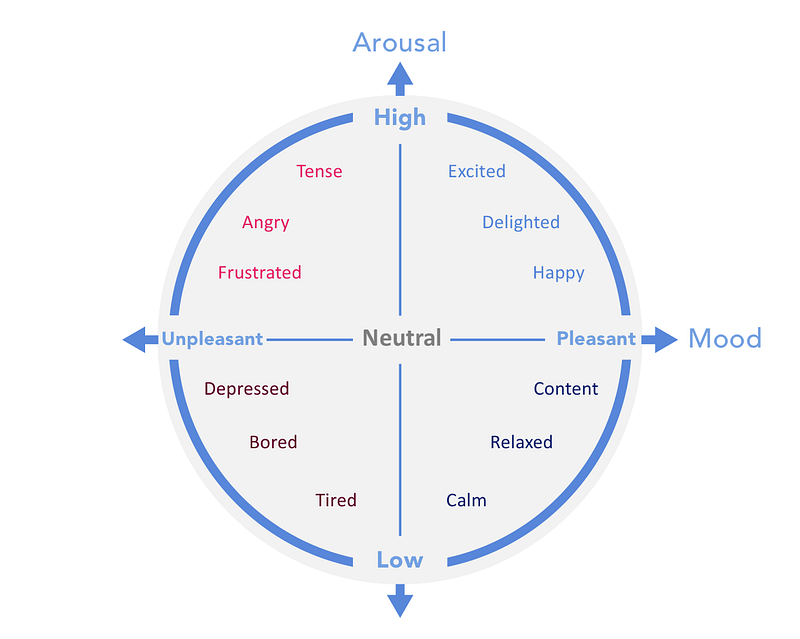
- Mood refers to the quality of the feelings or emotions; it can be pleasant (e.g. contentment, excitement, calmness) or unpleasant (e.g. frustration, boredom, anxiety). Note: a pleasant mood can result from both happy and sad music.
- Arousal relates to the intensity of the emotional response or your overall physiological activation (e.g. alertness, vigor, wakefulness).
For our purposes, the space of possible mental states is visualized below.
Now that we’ve seen the whole space of mental states, let’s simplify things.
Imagine that music tunes the mood and arousal levers in your brain (see below). Generally speaking, the optimal state for cognitive performance is moderate arousal and pleasant mood — the green zones are where we want to be.

You might be wondering, how exactly does music regulate our mood and arousal?
Mood
It’s still largely unknown why, across all cultures, an abstract stimulus like music feels pleasurable and has such a strong influence on our emotional state. Studies have shown that music can stimulate the brain’s emotional and reward circuits. The enjoyment we feel from listening to music is dependent on the release of the neurotransmitter dopamine, which underlies most other pleasurable things in our lives.
This is surprising because these dopamine-dependent neural systems are only activated naturally by stimuli with clear survival benefits (e.g. food, reproduction) or artificially activated by drugs of abuse.
Arousal
Music properties also influence the brain stem, which is responsible for automatic functions like breathing, muscle tension, heart rate, and blood pressure. Evolutionarily speaking, the brain stem is one of the oldest parts of the brain and might misinterpret music for important survival signals heard in nature. Simple musical properties like tempo (or speed) might stimulate reflex-like responses in the brainstem — slower music is associated with a decrease in heart rate, respiration, and blood pressure (and vice versa for faster music).
When Does Music Become Distracting?
So far, we’ve learned that music will increase performance on cognitive tasks to the extent that the listener's state of arousal and mood are improved by the music. There is one caveat: We’re assuming that music is playing in the background and you aren’t paying attention to it.
This isn’t always true though — the boost in performance is easily lost if the music saps our attentional resources away. To prevent this, it’s important to understand our attentional systems and how background music interacts with them.
What is attention?
Attention is commonly described as a spotlight that we can direct towards things we want to attend to, the subject of our moment-to-moment awareness. You can imagine a little person sitting in your head, swiveling the spotlight of your attention.

We effectively have two attentional systems: voluntary and involuntary. Not only do we have the ability to voluntarily direct our attention towards things we care about, but our attention is also subject to involuntary distraction from our environment (e.g. push notifications from our phones). In other words, the person in your head sometimes loses control of the spotlight when something surprising enters your awareness.
It follows that there are two main ways background music could potentially distract you instead of helping you concentrate: interference-by-process and attentional capture.
Distraction type 1: Interference-by-process
The first type of distraction is called interference-by-process, where the music is inadvertently competing for the same mental resources as the task you are trying to focus on. This is related to the voluntary attentional system and is task-specific.
A simple example is trying to read while listening to lyrical music: your brain is automatically processing the lyrics in the song you are listening to, which leaves less mental bandwidth for understanding the words that you are reading. As a general rule, you should avoid listening to lyrical music when working on tasks that require any kind of verbal processing (reading, writing, listening, etc.).
Distraction type 2: Attentional capture
The second kind of distraction is called attentional capture, which is produced when a sound causes disengagement of attention away from the task. This is driven by the involuntary attentional system, which is always scanning for novelty in the environment — for stimuli that seem surprising or important.
This can occur either as a result of the content of the sound (e.g. when you hear a catchy lyric) or the context of the sound (e.g. a fast-paced song has a sudden slow segment).
Most music is made to be entertaining and features elements that are meant to grab our attention, including drastic changes in tempo, frequency, and so on. While this is part of what makes music great, it’s not ideal for when you’re trying to focus.
This means that you should try to avoid most kinds of drastic change when choosing your music — for each work session, stick with one genre, queue songs that are similar in tempo, and stay clear of frequent jumps in frequency.
At the same time, you don’t want something that is so dull and monotonous that it’s not even enjoyable to listen to. If you go too far in this direction, your mind will involuntarily start to wander in search of novelty in the form of distractions.
There is a delicate balance. Effective background music is non-invasive and provides pleasurable feelings. Without overtly drawing our attention away, it occupies our mind with just enough novelty to satisfy the involuntary attentional system.
Dean Burnett makes a great analogy:
“It’s much like giving small children a new toy to play with while you’re trying to get some work done without them disturbing you.”
To recap, there is a trade-off between the aesthetic quality of the music and its distractibility. Consider how much attentional capture you could tolerate for the task you’re doing:
- Light/repetitive work (e.g. data entry): Distracting elements won’t matter as much as maintaining optimal mood and arousal, so music made purely for entertainment is usually fine.
- Creative tasks (e.g. brainstorming): You don’t mind breaking focus once in a while and it actually might facilitate the creative process.
- Learning/studying (e.g. reading): Distractions are not ideal and a moderate degree of concentration is needed.
- Deep work (e.g. logical problem solving): Requires intense concentration and distractions are costly, so try to choose more predictable music that’s least likely to disengage you.
Musical Factors to Consider
Now that we’ve covered the ways music can hurt our productivity, let’s explore the different factors that you may consider when choosing music for work, in order of importance.
For each factor, we’re going to think in terms of how it affects the mood and arousal levers.
Tempo
As we’ve covered before, tempo is an important musical property that might stimulate reflex-like responses in the brainstem — slower music is associated with a decrease in heart rate, respiration, and blood pressure (and vice versa for faster music).
It is very tightly linked with our arousal levels and can help us modulate our alertness and energy levels.
- If you are feeling drowsy and want to be more alert, consider uptempo music in the range of 100–160 BPM (beats per minute).
- If, instead, you’re feeling anxious, stressed, or overstimulated, it’s best to listen to downtempo music in the range of 50–80 BPM.
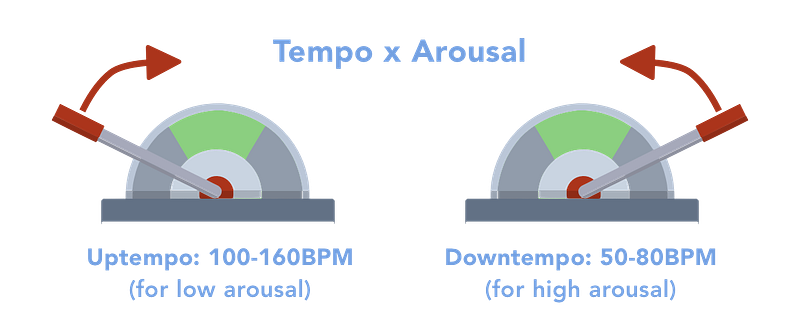
Both uptempo and downtempo will keep you concentrated in different contexts; it’s just a matter of what flavor of focus you’re looking for — calming or invigorating.
Here are my two personal favorite playlists for managing arousal levels. Pure Focus is more uptempo, whereas Deep Focus is more downtempo.
Familiarity
Familiarity with music is an important factor for emotional engagement.
A prominent study has shown that familiar music triggered more activity in emotion-related brain regions compared to unfamiliar music. It’s easy to imagine that familiar music can indirectly help your concentration by putting you in a more pleasant mood.
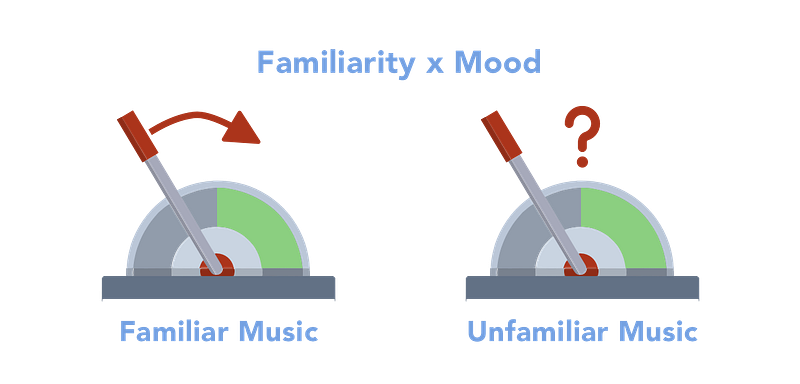
Unfamiliar music can be great in certain contexts as well, but it won’t impact your emotions as much. Also, note that unfamiliar music with lyrics is more likely to be distracting because of its novelty.
Preference
Unlike familiarity, there is disagreement on whether musical preference makes a difference in emotional engagement. This is surprising because most people choose to listen to music they prefer.
The same study from above failed to show that musical preference was an important factor in determining the emotional involvement of listeners. They pointed out that most research in this area doesn’t differentiate between familiarity and preference, so many of the findings may be due to familiarity rather than preference.
On the other hand, a small behavioral study found that participants scored lower on a reading comprehension test while listening to music they did not prefer compared to silence. However, they failed to find any difference between preferred music and silence. There were only 24 participants in the study, so it’s conclusions are only suggestive.
Conflicting findings could stem from the fact that musical preference is highly subjective. Each person has their own unique taste that’s influenced by their past music listening history, their friends, their environment, their personality, and so on.
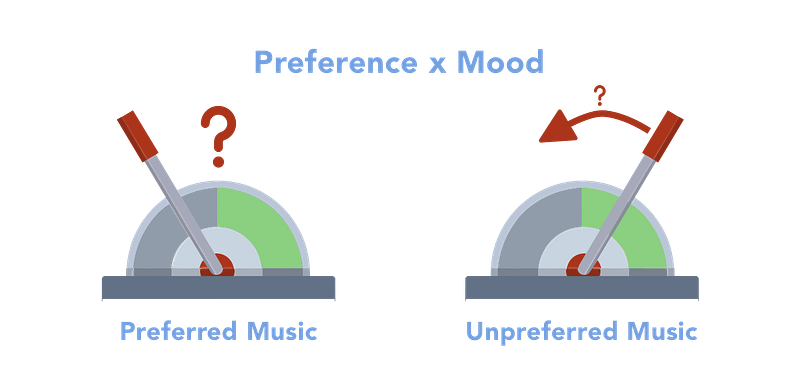
While the research isn’t definitive, listening to music that you like is probably a safe bet, but it might be less important than familiarity.
Genre
Musical genre is not very important on its own. The “Mozart effect” myth puts classical music on a pedestal, but there’s really no genre that’s unequivocally better for productivity than others. This confusion arises from the fact that the average song within a certain genre might be more or less distracting as background music.
Pop is typically full of catchy lyrics that might steal your attention away. In contrast, jazz is often heard in lounges and tends to more naturally blend into the background. But both genres have many songs that can help you concentrate, depending on the context.
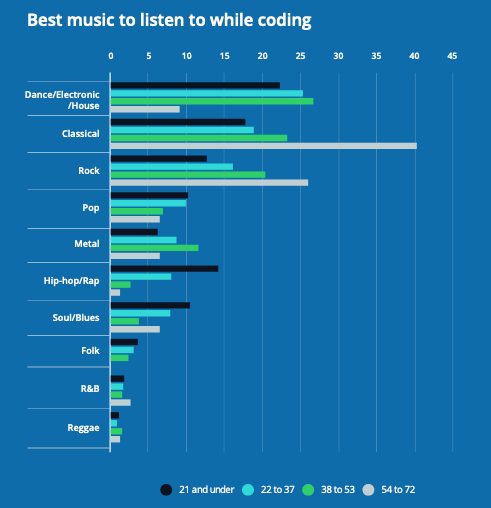
It really comes down to personal preference. In the tech industry, developers often turn to electronic music, but there is a ton of variability across genre and age.
What Apps or Services Are out There?
This guide is meant to be helpful no matter what app or service you use for listening to music.
However, a new class of algorithmic music services is making it much easier for people to choose the best music for the task.
Traditional music services
I personally use Spotify (paid) because there are hundreds of high-quality focus playlists to choose from, but other streaming services work just as well. If you’re looking for something free, YouTube has plenty of 24/7 streams that curate focus music in many different genres.
When you’re choosing playlists or streams, remember the ways in which music can distract you and avoid them. For example, don’t try to use the free version of Spotify, because the ads are horrendous for focus. Similarly, a continuous stream on YouTube is far better than videos that switch often.
If you feel yourself getting overly distracted by music, try working in silence or with ambient noise (e.g. rain, wind, coffee shop noises). There are literally hundreds of apps that do this for free — my favorite is A Soft Murmur.
Algorithmic music services
At this point, you have all the heuristics you need to pair your tasks with the right music and reliably get into the zone. But it certainly isn’t easy.
There is clearly a lot of overhead in this process. It involves assessing your current and future mental state, choosing an appropriate playlist, and adjusting the playlist every so often.
Algorithmic music services such as Endel and Brain.fm help us drastically reduce the effort involved — it can be as simple as choosing the type of task you’re working on and the rest is taken care of.
Endel (paid) is an algorithmically-generated, adaptive sound environment to help you focus, relax, and sleep. The core algorithm is based on the circadian rhythm, and it adapts to a number of personal inputs in real-time, including weather, time, heart-rate, and motion. For more details on the science behind Endel and whether it’s effective for productivity, check out my deep dive.
Brain.fm (paid) creates their own music using a combination of human-made musical content and an algorithmic system. This music is designed with scientific findings in mind and is optimized for its effects on our behavior. Specifically, their technology relies on brainwave entrainment. If you’re curious, I wrote a longer article on the science and effectiveness of Brain.fm.
To give my brief opinion, the science is promising, but both services currently lack concrete evidence to show that their technology is significantly better than listening to a free stream on YouTube or a Spotify focus playlist.
They are really helpful for people that don’t have the time or background to choose appropriate music, but I’m confident that you can achieve similar results on your own after reading this guide.
Key Takeaways
The research on using music for productivity is promising and is pointing in some interesting directions, but note that many findings are still preliminary and inconclusive.
Truthfully, everyone should figure out what works for them when it comes to music, but there are some heuristics for thinking about what music you should listen to.
There is nothing special about music — it’s just one example of a stimulus (like caffeine) that affects people’s mood and arousal, and which is known to influence cognitive performance.
- Mood refers to the quality of the feelings or emotions; it can be pleasant (e.g. contentment, excitement, calmness) or unpleasant (e.g. frustration, boredom, anxiety). Note: a pleasant mood can result from both happy and sad music.
- Arousal relates to the intensity of the emotional response or your overall physiological activation (e.g. alertness, vigor, wakefulness).
The optimal state for cognitive performance in most cases is moderate arousal and pleasant mood.

Music helps you modulate these two levers depending on the context:
- Tempo (arousal): Uptempo music (100–160 BPM) helps raise arousal while downtempo music (50–80 BPM) helps lower arousal.
- Familiarity (mood): Familiarity with music is an important factor for emotional engagement and can put you in a more pleasant mood.
- Preference (mood): Music you don’t like might put you in a worse mood, but the research is not conclusive.
- Genre: Not important on its own.
There are two ways that music can be distracting:
- Interference-by-process: The music is inadvertently competing for the same mental resources as the task — avoid lyrical music when working with words in any way (e.g. reading, writing, listening).
- Attentional capture: The music causes disengagement of attention away from the task — avoid most kinds of drastic change when choosing your music (e.g. frequent jumps in tempo, frequency, genre).
Consider how much distraction you could tolerate for the task you’re doing:
- Light/repetitive work (e.g. data entry): Distracting elements won’t matter as much as maintaining optimal mood and arousal, so music made purely for entertainment is usually fine.
- Creative tasks (e.g. brainstorming): You don’t mind breaking focus once in a while and it actually might facilitate the creative process.
- Learning/studying (e.g. reading): Distractions are not ideal and a moderate degree of concentration is needed.
- Deep work (e.g. logical problem solving): Requires intense concentration and distractions are costly, so try to choose more predictable music that’s least likely to disengage you.
Remember that effective background music is non-invasive and provides pleasurable feelings. It occupies our mind with just enough novelty to satisfy the involuntary attentional system, without drawing our attention away.
Regarding which apps or services to use:
- Top music streaming services like Spotify (paid) or Apple Music (paid) have many high-quality focus playlists to choose from.
- For something free, YouTube has plenty of 24/7 focus streams.
- If music is distracting, try working in silence or with ambient noise (e.g. rain, wind, coffee shop noises) — my favorite free option is A Soft Murmur.
Algorithmic music services such as Endel and Brain.fm (both paid) help us drastically reduce the effort involved in selecting music for productivity — it can be as simple as choosing the type of task you’re working on and the rest is taken care of.
Endel and Brain.fm are really helpful for people that don’t have the time or background to choose appropriate music, but I’m confident that you can achieve similar results on your own after reading this guide.


