
Guardians of the Galaxy: MCU Mini Feminist Reviews
As an action movie lover and feminist, I feel strongly about the representation of feminist themes in big box-office narratives. Feminist themes make better, fresher narratives and incorporate emotional intelligence (the part that makes viewers actually think and feel). Not only is it important to represent progressive themes, but box-office hits have a bigger responsibility to do so. Their impact on social culture is huge.
Guardians of the Galaxy has been a huge hit in the Marvel Universe, not only because of its intergalactic action or punchy one-liners, but because the Guardians are the first true team of the MCU outside of the Avengers (who mostly all have their own individual movies).
Friendship hasn’t been adequately represented in Marvel movies thus far. True friendship and emotion are feminist qualities because they make us consider human qualities that we all share.
Guardians of the Galaxy
Guardians is easily one of my favorite Marvel movies. It’s quirky, clever, and still somehow makes you think and feel, as any good movie should.
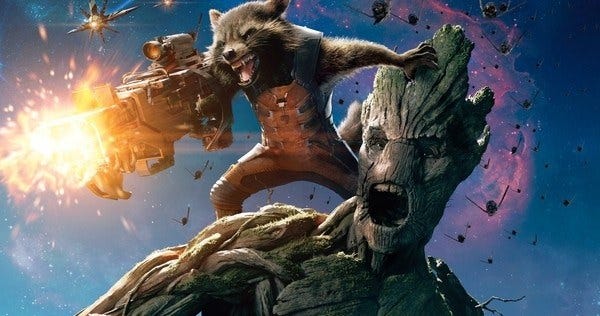
Friendship is a big theme for the Guardians. Rocket and Groot were a team before the Guardians banded together, but otherwise, all of them were angry, distrustful, cocky, and didn’t appear to have any true friendships. Friendship is a rare (and feminist) theme for action movies, at least to the extent where we feel a truly sensitive and emotional connection between characters.
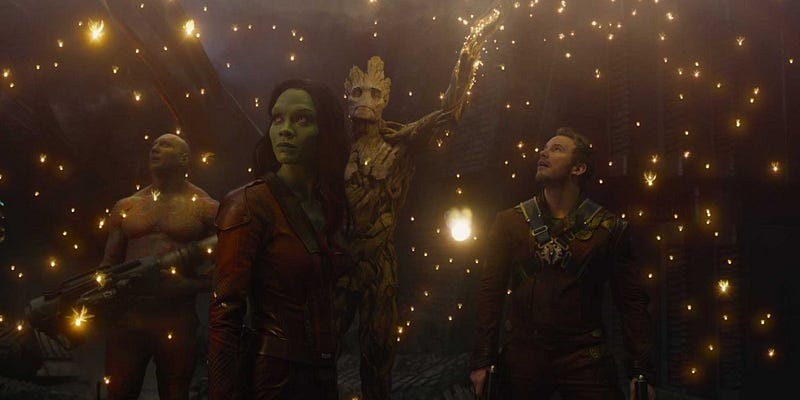
Over the course of the movie, the characters shift from trying to kill/capture one another to being friends and teammates. It comes up in dialogue now and then, and it’s almost cheesy, but at the same time, it wouldn’t make sense for them to NOT mention the radical shift in these characters’ outlooks. At the end, it’s apparent the Guardians have somewhat learned how to work together, trust one another, and genuinely care for one another.
Gamora is the main female character, who uses her skills to betray her (adopted) father, Thanos, to save the Galaxy. She’s not a love interest who just decided to do a thing for a guy, but she’s essentially the one who led the Guardians to protect the Power Stone. So, without her, the Galaxy would probably have been destroyed.
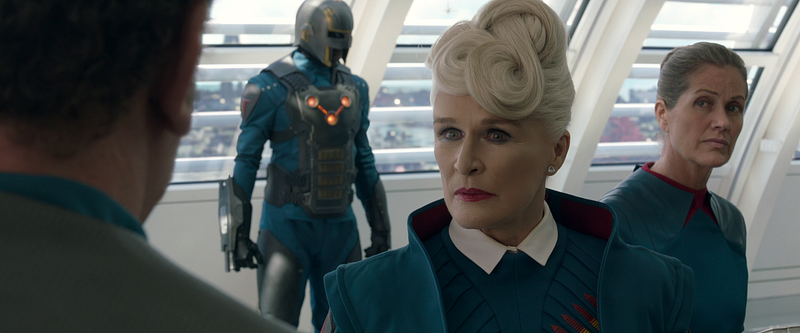
And another BADASS LADY ALERT: Nova Prime, played by Glenn Close. Not only is she the leader of the Nova Corp, but she’s also older than typical female leads. Ageism plays a part in keeping female characters young and it’s still rare to see a woman of age take important roles. And though she’s still smoking hot, she doesn’t appear to care about her own appearance. She’s too busy leading one of the biggest armies in the universe like a BOSS.
Rocket is one of the unexpectedly emotional characters. Rocket gets very upset when they are drinking on Knowwhere, and Quill has to stop him from blasting Drax. upset for being called rodent, not taken seriously, and says he didn’t ask to be experimented on. Since Rocket is easily the toughest-talking and most-joke-cracking Guardian, this especially took some viewers aback, causing us instead, to think about the consequences of bullying (however much they seem to be in good humor) and see that even the toughest-acting characters have emotions.
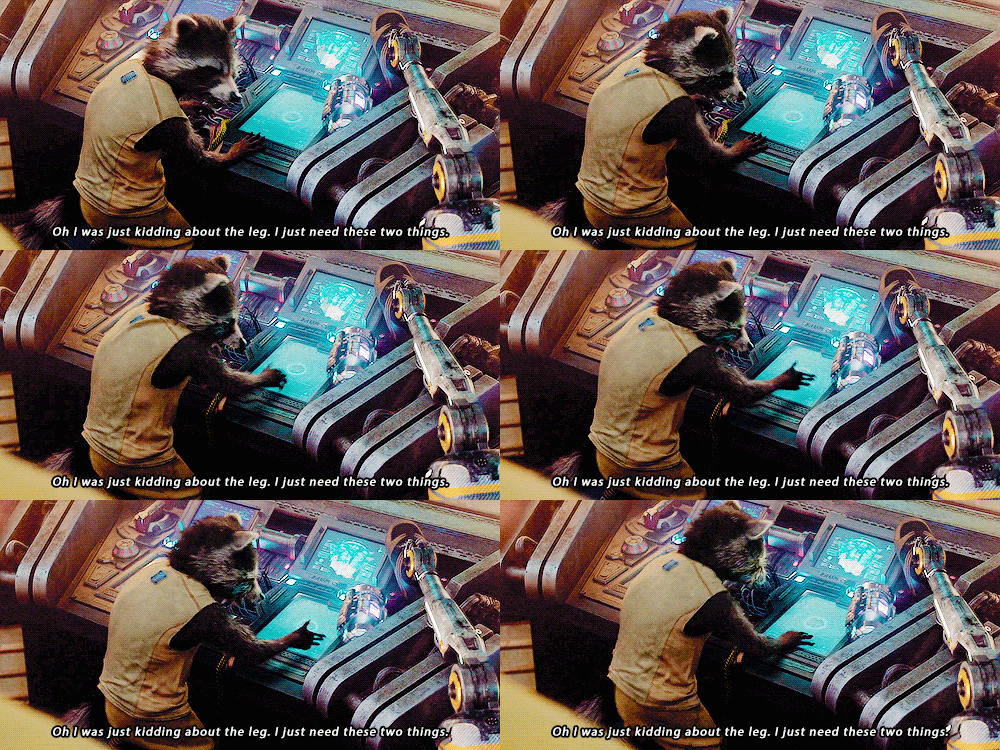
For whatever good qualities he has, Rocket’s obsession with prosthetic body parts is extremely ableist. Rocket isn’t always the nicest character, but when Quill brings him a man’s prosthetic leg, presumably for parts to enable their escape, he says he doesn’t need it, and laughs, saying he just thought it’d be funny. Quill is upset because he had to transfer money to the guy in exchange for the leg, but no one ever mentions that the poor guy now doesn’t have a leg because Rocket thought it’d be funny. Just as Rocket doesn’t find it funny to be called “Rodent,” it’s not funny to make fun of disabled people.
Another downside: Drax’s lost wife and child is a tired theme that basically uses women/children as plot devices to allow a man to follow a greater purpose. We see it a lot in action movies. That being said, Drax’s pain is believable and palpable without having to flashback to a tragic scene of them dying, which would make this even worse.
Though there are great feminist themes in GotG, it definitely has a way to go. Any on-screen action team needs more than one female member to feel like more than a token representation. Yes, men are often more action/physically oriented, but obviously it doesn’t completely exclude women. We need more than a sprinkling of women characters in a film. Take any action flick and add up women with lines, then add up the number of men with lines. You’ll see what I mean.
Feminist Rating: 5/10
Guardians of the Galaxy Vol. 2
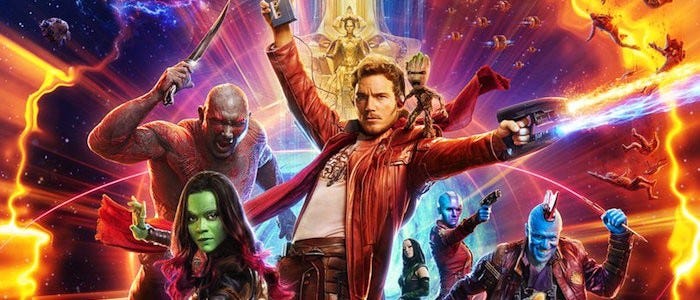
While there’s nothing quite like the original, Vol. 2 gives GotG a run for its money in more ways than one.
This movie is very much about family and friendship: emotional feminist themes. At the start of the movie, Peter Quill’s true father, Ego, shows up, asking Quill to return to his home planet with him. Quill is torn, unsure if this is his real father. He, Gamora, and Drax accompany Kurt Russell (i.e. real dad) to his home planet. Meanwhile, Rocket and Baby Groot stay with Nebula (a hostage at the moment) and repair the ship (wrecked at the moment).
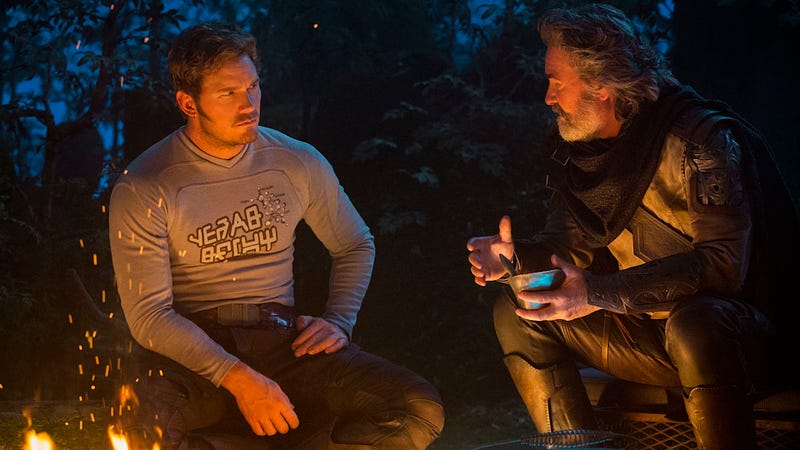
Right away, this movie is more emotional than the last. Quill badly wants a relationship with his true father, and when he shows up and brings him to a fantastical planet, it seems too good to be true.
Then, we see more into Gamora and Nebula’s relationship. Though both make attempts to kill one another, it’s clear each has reservations about their unrealized relationship. Nebula feels Gamora never looked out for her and was the reason Thanos tortured Nebula mercilessly. But, as Nebula says after she fails to kill Gamora yet again, she just wanted a sister who cared about her.
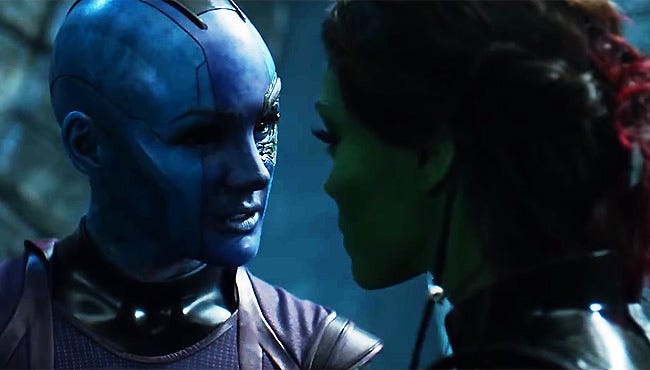
Obv this relationship is dysfunctional and 100% Thanos’ fault, so the traumas of both their past make this movie poignant for both characters. Though neither fully come to terms with their relationship in this movie, they go as far as to stop trying to kill one another to help Quill save the galaxy.
We also get a better look at Yondu, who obviously cares about Quill, however, tries to save face with his band of ruthless Ravagers.
When **spoiler!** Yondu sacrifices himself at the end of the movie, it’s not only felt by Quill, who realizes Yondu saved him from Ego as a child (and never *truly* thought about feeding him to the Ravagers), but also Rocket, who develops an unlikely friendship with him over the course of the film.
On top of all that, Quill realizes Ego actually planted the tumor in his mother, essentially killing her so that Quill would be free to fulfill his destiny as a celestial being. That heartbreaking realization adds to the emotional punch.
All of these emotional backstories and relationships add to making this a feminist movie. The characters’ motives are not all straightforward, we consider friendships and complicated emotions, and we see some characters swallow their pride to reveal those emotions.
This movie is feminist not only because it beautifully develops already-strong relationships and emotional themes, but because the female characters are given agency in their own stories.
Nebula escapes to find Gamora (**still intending to kill her**) and ultimately changes her plans to help save the galaxy (**though she says it’s because she needs the Guardians to give her a ride off the planet**). Regardless, she plays an integral part just as the rest of the Guardians in destroying Ego and escaping…all of her own accord.
Another fantastic female character is Mantis, Ego’s slave entrusted with helping him sleep. Mantis is an empath and is able to feel and impress emotions on others. That can mean making an all-powerful being go to “sleep,” or wake up. She incapacitates Ego for a while when the Guardians are busy trying to destroy his planet.
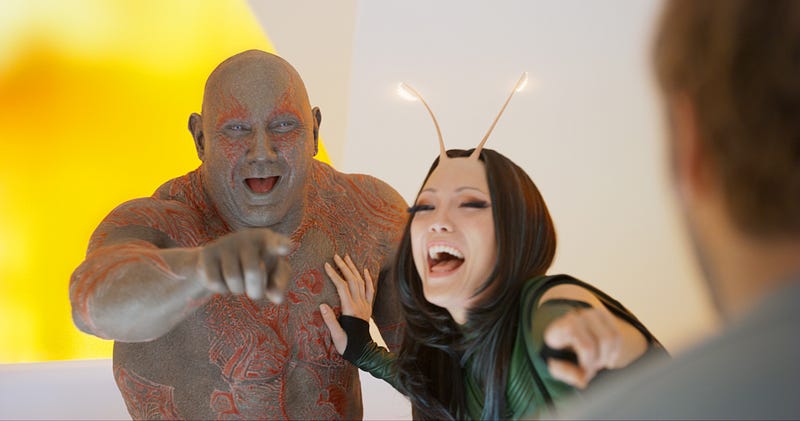
Even though Drax is cruel to her and often calls Mantis “ugly,” Mantis still develops a friendship with him, seemingly believing the best in everyone, and indicating that being “beautiful” does not dictate her worth. Though Mantis’ powers are limited in a physical battle, she still wields a lot of power as well as the emotional insight that the Guardians sorely need.
Feminist Rating 7/10
Next week: Doctor Strange, Spiderman: Homecoming: MCU Mini Feminist Reviews