
Growth Is on the Other Side of Scary Experiences
Chasing your dreams requires stepping through scary doors.
Pulling into the parking lot, I take a slot directly in front of huge plate-glass windows, put the car in gear, set the parking brake, and shut the car off in one smooth motion. I pick up my purse and bag, and I freeze, still in the driver’s seat.
My palms sweat as I stare at the massive mirror-tinted window in front of me. On it, two-dimensional guys in white ghees toss each other around while bright red stick-on letters advertise “Kung-Fu” lessons. Cryptic Chinese symbols tumble down the right-hand side of the window next to a giant Yin-Yang.
A couple of guys carrying ratty gym bags walk up to the door, chatting as they go in.
It all looks so… testosterone-laden.
I was nine years old when the T.V. Series “Kung-Fu” came on.
“Daddy, what does ‘Kung-Fu’ mean?”
“It means you can kill people with your bare hands,” my dad’s deep rumble answered.
“Cool!” I said.
Entranced, every week I watched Kwai-Chang Kane (played by David Carradine) walk the Old West in peace, beating up bad-guys along the way. Primed by a steady diet of shows like “Kung-Fu” and “Wild Wild West”, Hollywood’s Old West was as familiar as my neighborhood streets.
Kicking bad-guy butt was on the top of my most-wanted careers.
Fast-forward twenty years, and I sit in the parking lot, feeling anything but cool. I just dropped off my two children at Grandma’s, and I’m packing at least thirty extra pounds of post-partum fat.
Instead of kicking bad-guy butt, I’m spending my days wiping baby-butt.
Cuter, but not nearly as exciting.
I had signed up for a self-defense class at the local community college, but when a lack of enrollment forced its cancellation, I got a call from the instructor. His warmth and hearty charm convinced me to enroll at his school on a special introductory deal.
My childhood dream was about to come true.
If I could just get out of the car.
I’ve always been an adventurer, but something about the hormones of becoming a new mom has made me more careful and less…interesting. I’m not convinced that I have time to indulge my childhood dreams while raising children of my own. I feel selfish, frumpy, and terrified.
Squeezing my sweaty palms between my knees, I lean forward, reading the window and stickers like tea-leaves, hoping for a clue to the future.
What if my dream is lame?
What if it’s not what I hope?
What if I look stupid?
Finally, my nine-year-old self wins out. I get out of the car and walk in. I meet my instructor (a.k.a. “Sifu”); a huge, dynamic Irish white guy who becomes a combination father figure and older brother. He and my school “brothers” (plus two school “sisters”) welcome me, and the school becomes my spiritual home.
There’s a saying:
A martial arts school is where your friends beat you so that your enemies cannot.
It’s the first week, and I am facing Rob. He stands close to six feet tall, holds a plastic bat, and an evil expression. The padded bat won’t hurt (much) but when it whistles toward my head, I back away. Twenty minutes feels like twenty hours as Rob tries to teach me to step IN when that scary bat heads my way. My feet think I’m crazy and refuse to obey.
I typically learn quickly. This time, I wonder what I’ve gotten into, whether I will ever progress. Maybe I’m not cut out for this, I think. But I refuse to give up.
Two years in the future, during my divorce, Sifu braces the heavy bag with his two-hundred plus pounds. Slapping the front of it, he says, “Come on, Diana, whose face is on the bag today?” I kick him off his feet.
Four years in the future, Sifu opens the school doors for my wedding reception as I marry my next husband, the wonderful step-father to my three girls, that I met at the school. Our cake — decorated with Looney Tunes Characters hiding amongst live flowers — is cut with a Samurai katana.
Five years in the future, I stand with tear-filled eyes in Sifu’s office. He consoles me over the loss of my father, “Death is an opportunity to celebrate. We can honor those who have shared our lives and be grateful.”
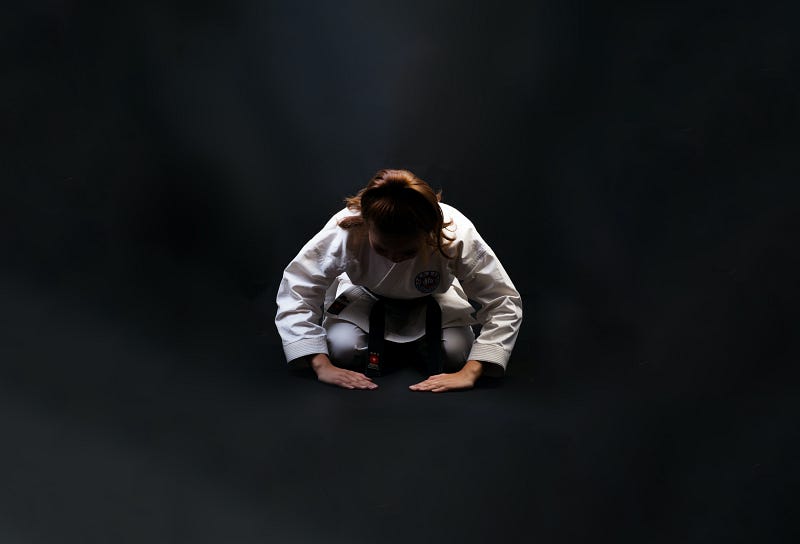
Seven years after walking in the door, I kneel on the now-familiar chipped asbestos-tile checkered floor. Thanks to this floor, I’ve learned to fall uninjured on asphalt at a full run. Thanks to hours of repeating forms and defenses, taping my feet to prevent blisters is second nature. I’ve mopped every smelly, grimy corner dozens of times. I love this floor.
I stare at the checkered pattern as sweat pours down my back and adrenaline sings in sweet exhaustion. I have a broken toe, but I don’t feel it yet. Red-painted two-by-fours flank me, each holding seven candles. A place of honor.
Today, I earned my first-degree black belt.
Go toward what scares you.
The most important lesson I learned in my fifteen years of training — was to move toward the things that scare you.
Kung-Fu is an inside art, a soft-style art. A great equalizer for someone my size. Imagine me: Five-foot-three and one-hundred forty pounds and unarmed, facing my future husband at six-foot-three, two-hundred-sixty pounds, with a baseball bat.
Ah, romance.
With an inside art, when someone swings at you, you step inside, ride their momentum down and use it to pin them to the floor. If someone pulls you toward them, step in, off-balance them, poke their tender bits, and slap them silly.
Somehow, all the physical lessons translated into psychological habits. I trained my terrified feet and got them to step INTO the swing.
I learned to choose my fear response. Because your brain can only focus on one thing at a time, action reduces fear. When I step toward a scary situation, I suddenly have more control.
If you step backward under attack, it is easy to trip.
Stepping back to avoid things that scare us will increase our sense of failure and actually increase anxiety. Conversely, confronting fear gives us a sense of accomplishment and teaches us to control our response to fear.
It turns out that facing fear takes advantage of the brain’s neuroplasticity and carves new pathways each time we survive a scary situation.
In other words, walking through that door in my late twenties gave me the tools to keep walking through scary doors.
Finishing my seven-year “degree” in self-defense gave me the skills to finish a B.S. and an M.S. in my forties.
Training myself to confront fear allowed me to audition for and complete British drama school in my fifties.
Our life’s most valued treasures hide behind scary doors.
Having kids? Terrifying.
Defending a thesis before a panel of Ph.D.’s? Stomach-churning.
Auditioning on the West End? Pulse-freezing.
I’ve done all of them, and every experience is precious. Every single one of them petrified me.
Seth Godin says:
What’s the smallest, tiniest thing that I can master and what’s the scariest thing I can do in front of the smallest number of people that can teach me how to dance with the fear?
Get moving and take small steps. Learn to step in and dance with fear, rather than run from it.
Going toward things that scare you is a practical skill that you can learn. The key isn’t being unafraid; it is choosing your reaction to fear. Practicing it makes it second nature. Your feet will learn.
Just keep going through scary doors.
Here’s a handy reference to help practice tough emotions.
Diana Carson-Walker is a writer, actor, ever-curious nerd. You can read more about her journey away from the mainstream on her blog, or connect on Twitter @carson_walker and Facebook @CarsonWalkerSideways.