Growing Wisdom
The Goal of People Talent Professionals
Strategic failures abounded over the past 2 decades: corporate goliaths fell; “body-less” cyber companies become profitable and popular; conventional corporate strategies turned on their heads; legacy core strengths transforms overnight into weaknesses; intense “red ocean” competitions turns bloody; “blue oceans” quickly turns pinkish, becomes bruised purple before turning red ….. Exactly, what went wrong?
The Simple Answer: the absence of wisdom.
Knowing what we now understand to be continuous uncertainties and ambiguities in the operational space between the present here and distant there in the future, and where the only viable strategic responses are agility and flexibility, the most effective talent management response is human wisdom, referring to that boundless synergy of human cognitive, reflective and affective abilities.
The knowledge economy today replaces hitherto robot-like manufacturing workers with relationship workers in the fast-growing service industries. Leaders, managers, and workers alike are expected to anticipate and deliver consistently excellent services within a narrow 6-sigma band. Globally, technological innovation in mobility and communications also rapidly accelerates the tsunamic digital transformation of the marketplace and workplace, empowering the multiplication of social networks between peers, between strangers, and between business2consumers/businesses.
Engaging the confluence of timing, context, and capability to occupy strategic space requires wisdom. Even as learning and development (L&D) professionals have kept pace with new programs to parch organisational and talent needs of the emergent globally networked knowledge economy, the proliferation of L&D professionals, training literature, strategy consultants and strategy formulation tools have not prepared companies for the onslaught of change.
And as human talents are laid off by the thousands in traditional responses to economic downturns, it aggravates a looming talent management crisis through the associated loss of wisdom, which is a core tacit knowledge resident in the human talent within the organization. Replacing this lost wisdom is most difficult and well nigh impossible.
The failure to grow wisdom in talents and in organizations is squarely on L&D professionals. The L&D profession is responsible for the increasing fragmentation and specialization of knowledge and L&D programs in recent decades, even as the world becomes more disorderly, inter-connected, networked, and globalised in such a manner that it no longer could be perceived, managed, or engaged by a silo-mentality L&D approach to knowledge and experience.
There is also a deep-seated but wrongful belief in L&D professionals that wisdom cannot be taught, but can only be developed within the individual, and that wisdom comes from a combination of insight and intuition based on knowledge and experience.
WHAT IS WISDOM?
There is no one precise definition of wisdom. It is a multi-dimensional construct around the idea of goodness, cognitive diagnosis, strategic insight, intellectual development, competency excellence, management foresight, and experience.
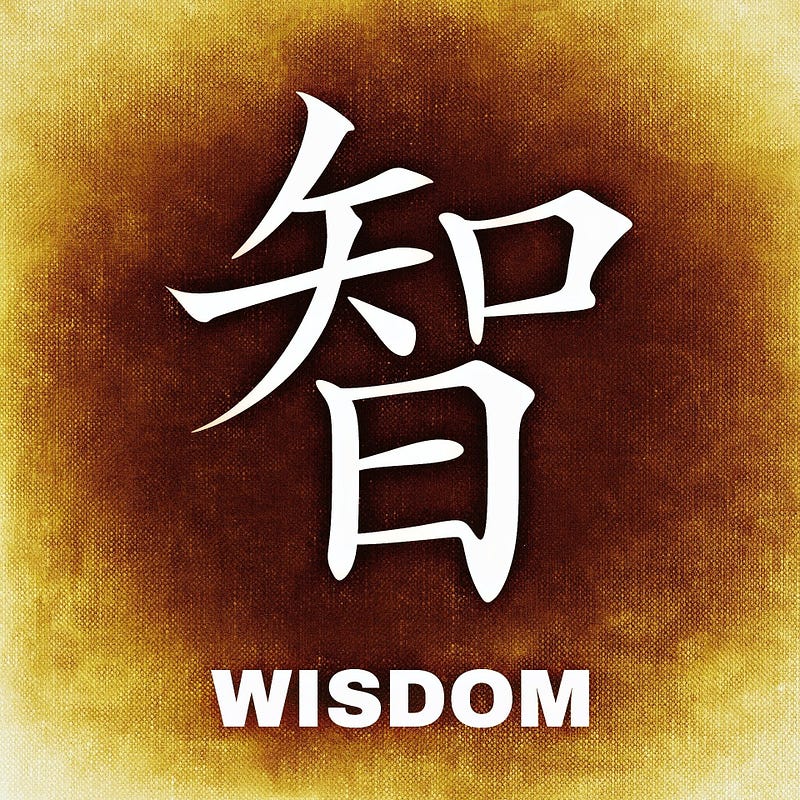
The Chinese word for wisdom is 智(zhi). The title pictograph depicts the word “knowledge” 知 (also pronounced as ‘zhi’) on top of the word “daily” 日 (ri) — together, their combination carries the meaning “heavenly insight or knowledge over daily life affairs”.
Wisdom is a personal social-psychological quality that integrates both intelligence and moral virtue which are acquired or developed through experience and practice according to personal intelligence and knowledge.
In its essence, wisdom moderates the interaction between the individual and his/her social environment to achieve mental well-being and social order through the prudent exercise of good judgment, foresight, discretion, and rational decisions in actions.
A “wise choice” refers to the pursuit of truth for active contribution to the social, economic, and political goodness and well-being of human society. Wisdom overcomes and transcends physical and psychological “limitations” beyond the dictates of human emotions while embracing uncertainty amidst chaotic turbulence through insightful knowledge, innovative thinking, and creative problem-solving.
Wisdom is a uniquely human talent process. It can be regarded as a concurrent series of processes which overlap understandings to forge an awesomely indescribable alchemy of human action in accordance with underlying principles that earn eternal admiration by peers and generations to be the gold standard of a desired completely satisfying human existence. It is not, and should not be confused with a human capability.
The dimensions of wisdom from the relevant literature include being practical, reflective, experiential, ethical sensitivity, respectful of diversity, socially interactive, boldness, unconventional, a readiness to learn from uncertainty, and being comfortable with ambiguity.
To HR professionals, the key L&D question: is it possible to define “wisdom” sufficiently and to operationalise it adequately for the universal purpose of integrated L&D designs?
The answer is “Yes”.
Learning and growing wisdom is essentially a sense-making process. The learning outcome of wisdom in T&D is action — powerful, wise and impactful action. Wisdom curriculum development is designed as the pathways to learning and thinking as the prelude to impactful action that is sustainable and socially responsible.
Wisdom develops as we make sense of life after participating in an event or situation. Through discussion with others and subsequent explanations, we then construct the meanings of our experiences. Sense-making thereby creates “new” realities in a better understanding, and for “better” wisdom.
Wisdom is sense-making in action. Great judgment, best competent decisions, and creative problem-solving are the results of the interplay of thinking, learning and development which shape cognition and the cognitive development of wisdom. L&D professionals already know that participants learn best through their own activity; that sensory experience is basic to learning; and that effective learning is holistic, interdisciplinary, and specific.
Learning wisdom is fundamentally a social activity. People construct their knowledge, not merely from direct personal experience, but also from feedback or being told by others and by being shaped through social experience and interaction. The construction of wisdom is therefore not effected in social isolation but is co-constructivist in essence within the reality of the social and cultural space.
The development of wisdom begins with experience. Learning is essentially the determination of meaning out of an experiential encounter with real situations. The meaning derived would be the result of the interplay between what the person brings to the experiential situation and what actually happens there. The person works on every new experience to “make sense” of it. He uses the knowledge or meaning derived from previous experience to work on the new experience so as to make sense of it.
Experience by itself is however not learning. Wisdom learning requires reflections and “making sense” in relation to some referents. The basic idea of sensemaking is that reality is constructed through an ongoing accomplishment that emerges from efforts to create order and make retrospective sense of what occurs. Sensemaking is simply “how people make sense out of their experience in the world” (Duffy, 1995). The most important lesson in cultivating wisdom from experience is not what has happened, but what the happening means for the happiness of others and oneself.
Incorporating sensemaking in a T&D wisdom curriculum involves everything from creativity, comprehension, curiosity, mental modeling, explanation, and situational awareness in a motivated, continuous effort of coaching and mentoring to empower understanding and connections of the dots in the uncertainty and complexity space, in order to anticipate the nature and direction of consequences so as to pro-act or react effectively. Wisdom can be grown in organisations because it can be designed, and its learning outcomes in the form of changed behaviors can also be observed and evaluated.
Wisdom frames its own question and brings sense-making to bear for the final answers. Through thinking the unthinkable, predicting the improbable, anticipating the impossible, visioning the unimaginable, wisdom then asks the impossible question(s); and wisdom answers its own questions that we do not yet know how to ask, concerning objects or issues that we have not yet envisaged.
Here’s an example: The goal of a typical T&D Curriculum to empower agility and flexibility in strategic response to the environmental uncertainties in the marketplace has the following objectives:
[1] Develop a personal growth process to apply knowledge and skills with a conducive and insightful mindset informed by conscious experience on a specific situation defined by the sustainable community interests of stakeholders.
[2] Empower an intuitive sense-making deployment of capability and capacity to achieve desired sustainable impact in a specific situational context with the right decisions and timings.
The quality of wisdom is more than just a skill-set, knowledge domain or attitude. It is tempered by experience, burnished by age, dignified by virtue, empowered by instinct and unified by deliberate action from the consilience of empirical and deductive processes in life’s rich mixture of successes and failures, of blessings and disappointments, of pain and suffering, of benefits and losses, of love and rejection, of victories and defeats, of truth and hypocrisy, of lies and half-truths, of reality and surrealism, of chance and design; and of ultimate good vs evil.
The beginning of wisdom in T&D is to unlearn and debunk the legacy mental firewall that wisdom cannot be trained or developed. Growing wisdom is the next challenge of T&D professionals for a world where change is the only constant. If not us, who? If not now, when? Be wise, and act.
Please enjoy my recent Articles.
You can also subscribe to my stories and social media posts via your email.
Enjoy more interesting Articles by signing up to Medium here: https://thefuturistoracle.medium.com/membership