
Grow Your Startup and Communicate More Effectively with Actionable Takeaways from These 19 Books
Your brain is “running” in a conscious state for 16 hours a day, 365 days a year, for your entire life. If you can “improve your form” and make it run more effectively, then you’ll get habitualized, compounding returns on your professional and personal life. That’s what this article is about. Operating more effectively. Charlie Munger, the Vice Chairman of Berkshire Hathaway (and a damn good thinker) calls it “building a latticework of mental models”.
Unlike other articles on mental models, we’ll primarily focus around the professional work environment (Lean, Agile, Organizational Design). These takeaways will be applicable to any situation where you’re dealing with “Human Systems”—with a company, a community, a 1:1 conversation, or with yourself. We’ll give takeaways from 19 books, specifically focusing on the following goals:
- Prioritizing your team’s work
- Iterating to Product-Market Fit
- Designing products with behavioral psychology
- Creating an effective organizational structure
- Clarifying thinking with communication patterns
- Mental models to use yourself!
This is both an article and a podcast. You can listen to the podcast and follow along with the article (maybe diving into links later). For reference, this is part of my podcast Series B: Human Systems, which is part of my macro vision—Creating a Humanist Blockchain Future (iTunes, Soundcloud, Youtube). I will interview experts (like the authors of these books) in future episodes. Finally, if you’re interested in consulting or working with me, please reach out over email. Thanks!
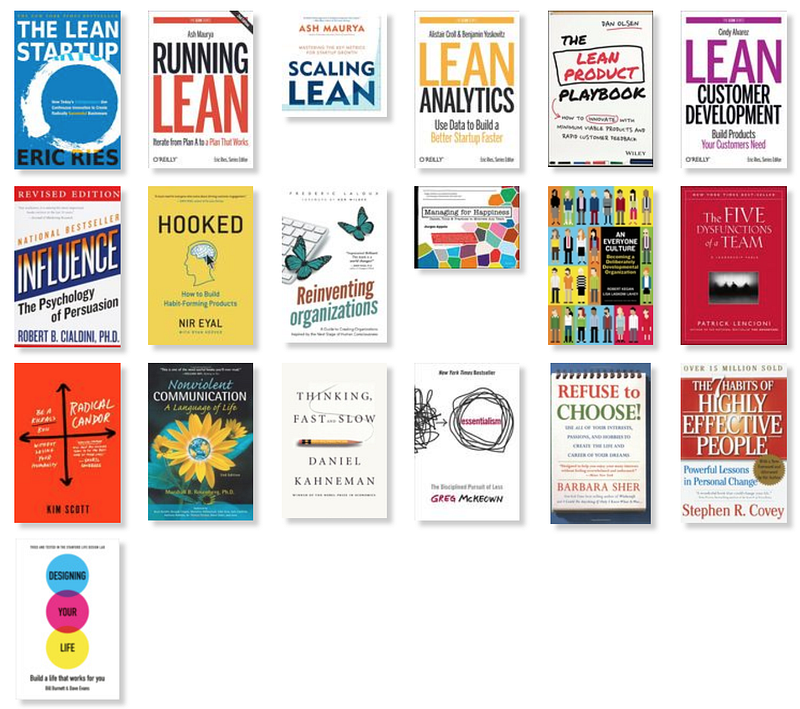
PRIORITIZATION: The Lean Startup, Running Lean, Scaling Lean, Lean Analytics
These books are all about high-level prioritization of work within a startup. What learning should you focus on? How do you communicate those learnings? How do you decrease waste and optimize for growth?
The Lean Startup
This is the “classic” book that started the Lean movement. Honestly, I feel like the book isn’t that actionable, but I do use three sub-frameworks from it:
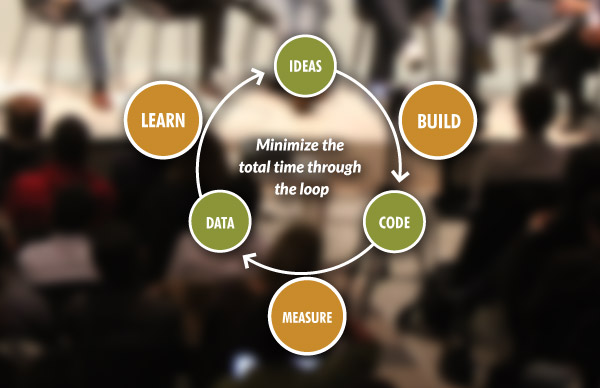
- The Build-Measure-Learn loop. This iterative feedback loop is the foundation of all Lean. It states: build things, measure how customers respond, learn and update your hypothesis, then start the loop again by building. The goal is to minimize total time in the loop. I like to ask myself/my team the question: “What is our vector of learning?” i.e. What are we trying to learn? (Direction) And how fast are we learning about it? (Rate)
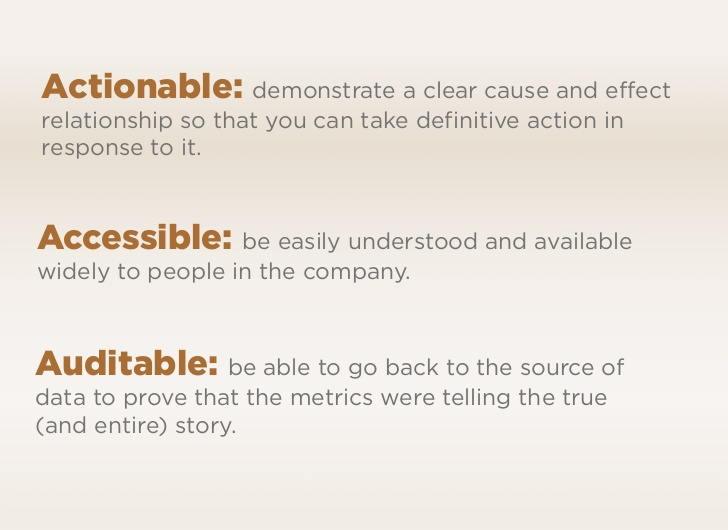
2. The 3 A’s of data. Data need to be actionable, accessible, and auditable (see below). Without any of these 3, you cannot have a data-driven organization.
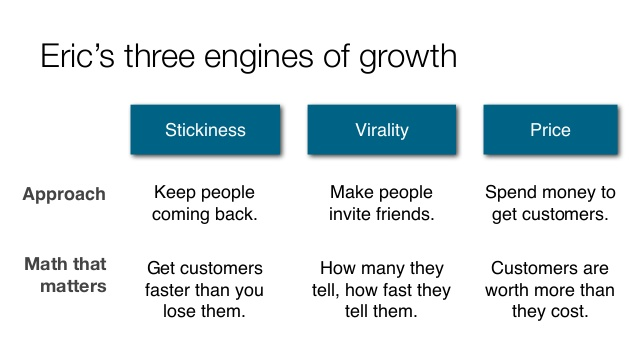
3. Three Engines of Growth. These are three ways to grow of your company. These map well onto 3 of 5 of Dave McClure’s pirate metrics (AARRR). They are: stickiness (retention), virality (referral), and price/paid (acquisition).
Running Lean
- This is an actionable, condensed version of the Lean Startup. We should think of a business as a series of risks and answer the question “How do we minimize waste?”
- The crucial concept is to document your assumptions, up-prioritize the riskiest ones, test them, and repeat. With Running Lean, you document and share learning through the Lean Canvas (which is like a modified Business Model Canvas).
- In testing your assumptions, you should be hyper aware of two human biases: Solution Bias and Validation Bias. Solution Bias states that we are biased to love our solution from our worldview, not necessarily to solve a problem from the customer’s worldview. (As the author says “Love the Problem, not your Solution.” And “your solution is not your product. Your business model is your product.”) Validation Bias states that we (and our customers that we interview) are biased to want confirming data. So we ask leading questions that our customers then agree with because they don’t want to be socially awkward.
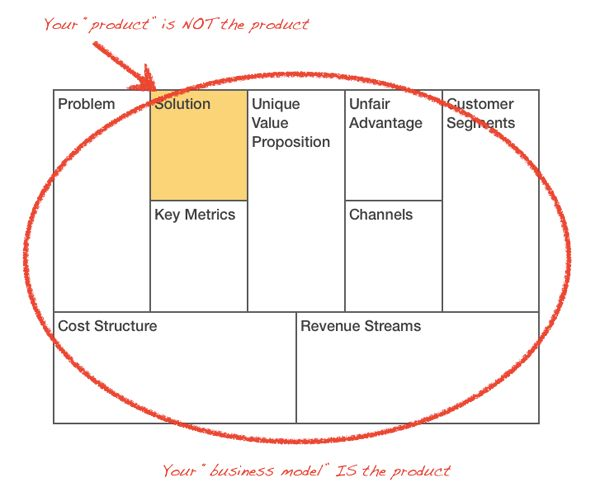
- With those two biases in mind, we should first go through Gate 1: Problem-Solution Fit. In this process you run parallel Lean Canvases with different customer segments and problem sets. You start with divergent problem interviews and then do convergent problem interviews as you find patterns. Then you can test a prototype version of your solution by creating a Unique Value Proposition (UVP) story/promise about how their life will change after your product. (e.g. “Before your problems were x, y, z, but we’ll solve them with a, b, c. Thoughts?”) The KPI at this stage is “# of aligned early adopters who are paying for your promise.” The promise part is awkward but powerful. You want to minimize waste by not building anything before you need to. So, you ask your potential early adopters: “would you pay for this promise to solve your problems?” You know you have great early adopters if they are paying for your promise, before you’ve even built it.
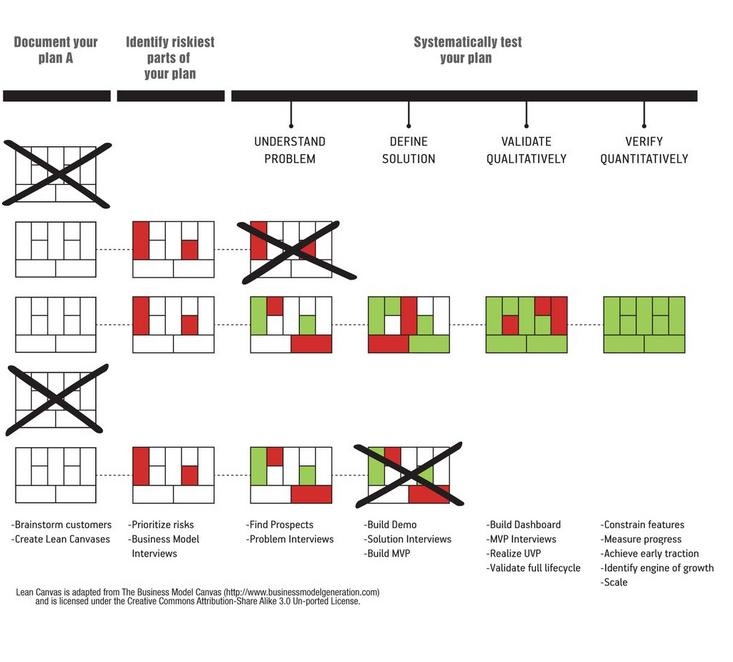
- After going through Gate 1: Problem-Solution Fit, you enter Gate 2: Product-Market Fit. There are lots of definitions of Product-Market Fit (see this overview by Tren Griffin), but I like how Ash Maurya approaches it. The “meta” idea is that you want to derisk your assumptions by first validating qualitatively (with interviews, etc.) then verify quantitatively (with metrics, cohort-testing, etc.). I like to think of Problem-Solution Fit as qualitative validation of your key hypotheses, while Product-Market Fit is quantitative verification of those hypothesis.
Scaling Lean
- This is another book by Ash Maurya that bookends Running Lean. It covers before starting your interviews (before looking to validate Problem-Solution Fit) and after growth (after quantitative verification of Product-Market Fit).
- There are a couple key things to do before embarking on your startup journey. First, create your “definitions of success”. What does your company need to look like in 3 years in order for you to feel successful? Part of this is allowing yourself to think in a 10x way (where by year 1 you might have 100 customers, but you’ll have 10,000 by year 3). The other key idea is founder-market fit, where you as a founder check to make sure that you’re aligned with the problem/market that you’re facing. Ash doesn’t go to deep into this, but I like to think of it as a vector. A) Are you aligned with the direction of the vector (the market, the customers, etc.)? B) Are you aligned with the line of the vector (your day-to-day tasks, your daily actions, etc.)?
- After growth, Ash gives us a framework to think about growth , which he calls the Customer Factory. It’s quite similar to AARRR, though goes a bit deeper by defining traction as customer throughput. i.e “How quickly do you turn unaware people into happy customers?”
Lean Analytics
- The One Metric That Matters (OMTM) is like KPIs (Key Performance Indicators), but focused on a specific metric for a specific period of time (a gate). Use this to define your crucial metric for everyone on the team to focus around.
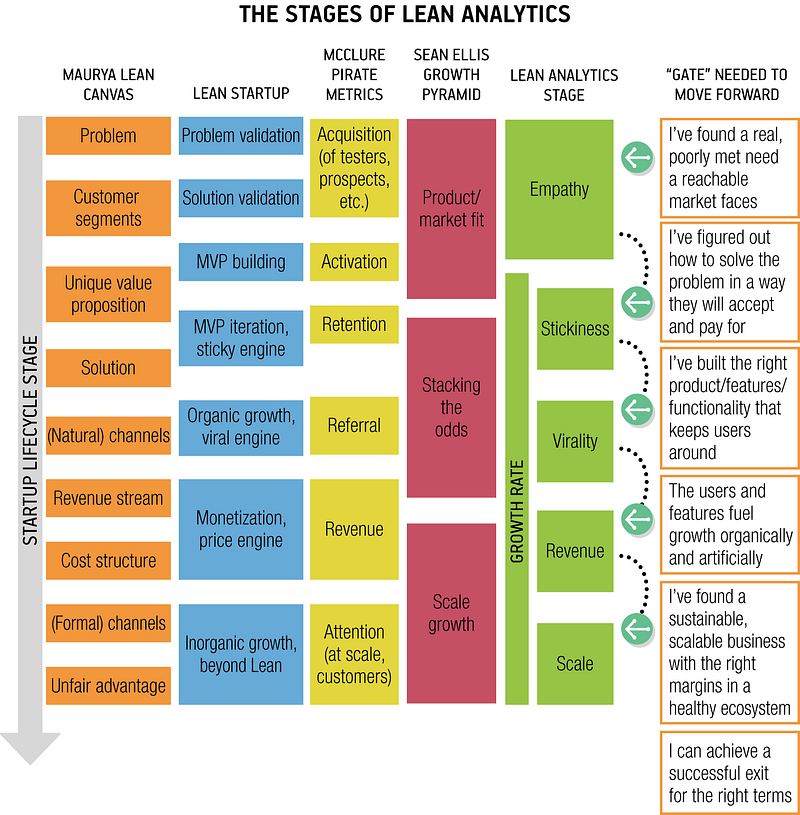
- Lean Analytics does a great job of synthesizing past frameworks into a “meta framework” (see image below). Essentially, you can imagine many of the Lean frameworks as a different way to break down the stages of a startup into “gates”.
PRODUCT-MARKET FIT: Lean Product Playbook, Lean Customer Development
The books above are about the macro prioritization of a startup and the gates in a startup’s lifecycle. These books are about how to iterate to product-market fit: how do you understand and solve your customer’s problems/needs?
Lean Product Playbook
- This book incorporates the Jobs-to-be-Done (JTBD) Framework by Clayton Christensen. The JTBD is a new way to understand customer segments and behavior through asking “why” questions instead of “who” questions. Usually people define a customer segment using demographic correlators like age, gender, etc. But knowing that someone is a 25-year-old female doesn’t tell us why she purchased the bookshelf. Instead, we should understand why she purchased the bookshelf, which is equivalent to understanding what job the bookshelf is doing for her (to hold books!). See more: 5min video from Christensen, Intercom blog on JTBD, using JTBD stories instead of user stories.
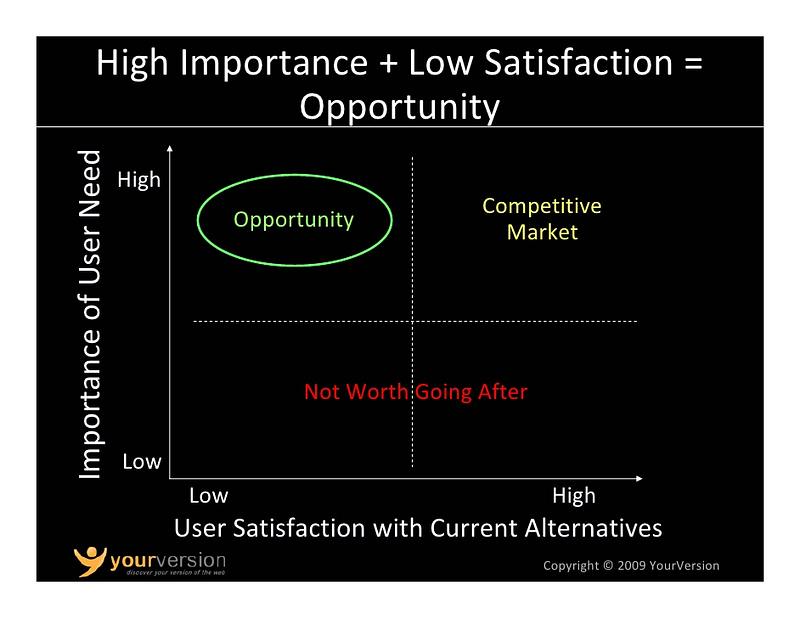
- Another crucial framework outlined in this book is the “Importance and Satisfaction” framework. You ask a customer—“How important is your need or JTBD?” Then you ask “And how satisfied are you with your existing alternatives?” If they have an important JTBD that’s not satisfied, then that’s a great opportunity for your product. One note here: trust their actions, not their words. I love to use the words “existing” and already” here. i.e. What are the existing alternatives that they have already tried? If they are claiming a high importance need/JTBD but haven’t already tried to address it with existing alternatives, it’s probably not that important to them.
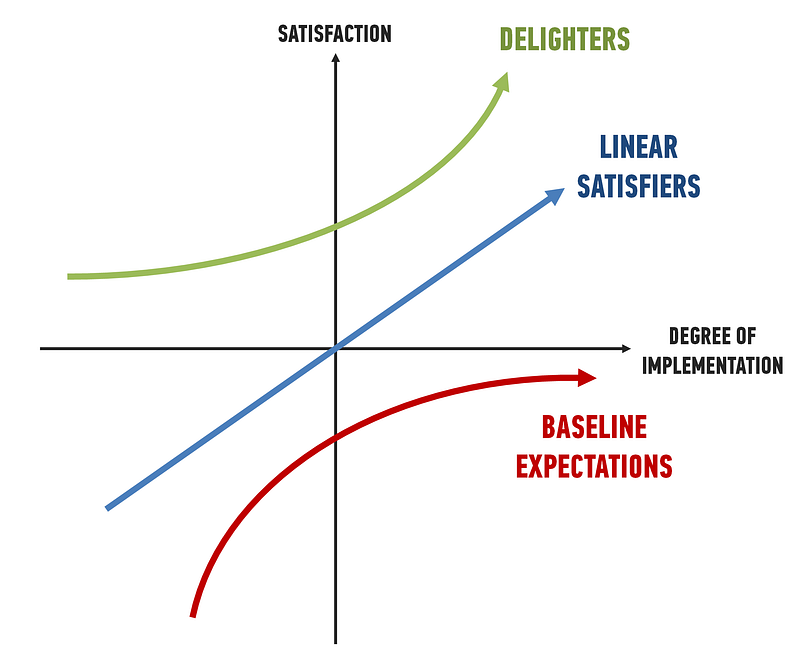
- Building on the Importance-Satisfaction framework, there’s a framework to understand the different types of features called the Kano Model. With the Kano Model, you think about a given feature/need over time. For certain features (called Delighters), customers are not dissatisfied if you don’t have the feature, but love it when you make it. For other features (called Baseline Expectations or Must-Haves), customers are very dissatisfied if you don’t have the feature, but don’t get more satisfied if you make it better and better. It just needs to “be there”. The final kind of feature (called Linear Satisfiers or Performance Features), is in the middle: increasing the quality of the feature increases the customer satisfaction in a linear fashion.
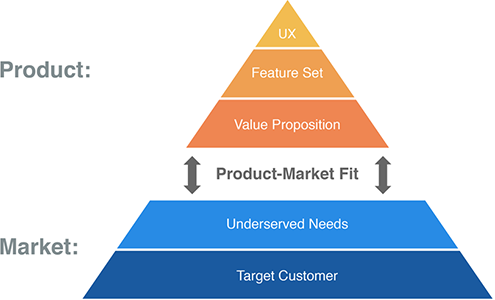
- Finally, Lean Product Playbook does a great job of breaking down the differences between market (the problem space or the what) vs. the product (the solution space or the how). I’ve found their phrase “a textured problem space” especially helpful. You can ask other team members—how richly textured is our understanding of the customer’s problem space? (i.e. How much empathy do we have?) They also provide a gated way to understand product-market fit, similar to Lean Analytics, etc. above. You can see this in the pyramid below.
Lean Customer Development
- This is a great book to dive more deeply into best practices for conducting customer development (sometimes called “problem empathy interviews”).
- One great customer development question that I learned from this book is: “Forget about what’s possible. If you could wave a magic wand and solve anything, what would you do?” This question always provides useful answers because it allows the customer to break out of their social constraints of the situation and say “you know, if magic was possible, I’d love X”. It’s a great way to understand what would make the product magical for them.
- The other mini-takeaway from this book answers the question that I get a lot, “How many interviews should I do?” The first gate is “until you’re no longer surprised (and can guess their answers).” This is a great feeling in customer development where you’ve done your nth interview and you’re like, “wow, we didn’t really need to do that interview because it aligns so well with the other interviews and there was no new information.” It’s almost like you could’ve done the interview for them. If you want to push further (to a second gate), you can try to invalidate their expected answers. You do this by taking the “truth” you’ve heard (about needs, JTBD, etc.) and stating the opposite of that and seeing if they’ll push back. You say “well we’ve heard from everyone else that [the opposite of X] is true”, and you hope they say “no no no! I don’t know who else you’ve been talking to, but they’re crazy!”
Measuring Love Customers:
- When you start iterating towards product-market fit, a great sign of progress is once you start getting “love customers” (customers that love your product). The classic saying is: “It’s better to have 100 customers who love you than 1,000 customers who like you.” You can “measure love” in a couple different ways, outlined below:
- Classic Net Promoter Score. “How likely is it (1–10) that you would recommend [brand] to a friend or colleague?” (Link)
- Sean Ellis — 40% of your customers would be “Very Disappointed” if you discontinued the product
- Sam Altman — “Do any customers love our product so much they spontaneously tell other people to use it?”
- Kathy Sierra defines it as “Badass Customers”, where you make your customers feel badass.
- All of these are a variant on the retention and referral stages from AARRR. Do users stay around because they love the product (retention) and do they love it so much they refer others to use it (referral)?
BEHAVIORAL PSYCHOLOGY — Influence, Hooked
These books discuss how to use behavioral psychology for product development—to get your customers to buy (Influence) and then keep them around (Hooked).
Influence
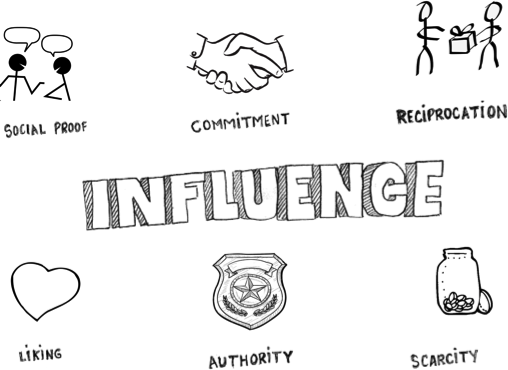
This book breaks down how to get customers (and people in general) to “say yes” to things. Note that these can be used for digital products as well as in-person interactions (like being a salesperson). From a digital perspective, I think about it as the behavioral psychology tactics you can use at the beginning of the customer lifecycle (acquisition). i.e. How do you get your customers to download your app in the first place? There are six ways to do so, and I break them up into three categories: people-based, time-based, and object-based. Let’s look at them!
People-Based Influence:
- Social proof: If lots of people are “doing X”, then you will do it. Whenever you see “10k people did this!”, that’s social proof at work (10k downloaded, 100k subscribers, etc.). This can be more powerful if you make the social connection stronger through “closeness to you”, e.g. friends. (This is used in dating apps, where they say “you and this person have 27 mutual friends!”)
- Authority: If social proof is for large numbers of people, then authority is for small numbers of “trusted” people. Whenever you see a synonym of the word “expert”, you know authority is being used. So this would be something like “3 top smart experts say to buy this thing!”
- Liking: Social proof and authority are about persuading people by using others. Liking is about persuading people through just yourself. So if the other person likes you, they’re more likely to do what you want (buy, download, etc.).
Time-Based Influence
- Commitment: Commitment is usually paired with the word “consistency” and is the idea that if you get someone to “be like X” or “commit to X” in the past, they are much more likely to “do something like X” in the future. This is primarily used as a “foot-in-the-door” technique where you get someone to do a “small ask” (like answer a question) in preparation for a bigger and related ask (like paying money). This is “time-based” because it uses a past action to influence a future action.
- Reciprocation: The idea here is that you give someone something beforehand. Then later you ask for something and they are more likely to do it (because they feel obligated to reciprocate the action). This is often used as “please take this free thing on us!” as a setup for a later ask.
Object-Based Influence:
- Scarcity: While the first 5 tactics are more about the interaction between the customer and buyer, scarcity is about the product itself. Essentially, we believe that if something is scarce, it’s more valuable. So if you want someone to buy something, claim that there’s not much of it or that it’s only available for a little bit of time. Amazon is my favorite example of this. When you’re on their product purchase page and see “only 1 left in stock”. “What do you mean there’s only 1 left in stock? I know you have a warehouse full of this stuff.” :)
Hooked
This book outlines a framework to understand how to create user habits (i.e. retain users). The model is outlined below (with notes under the images):
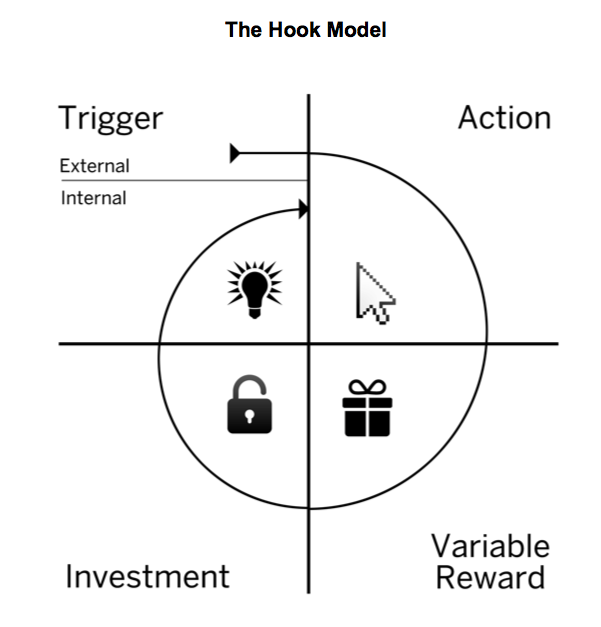
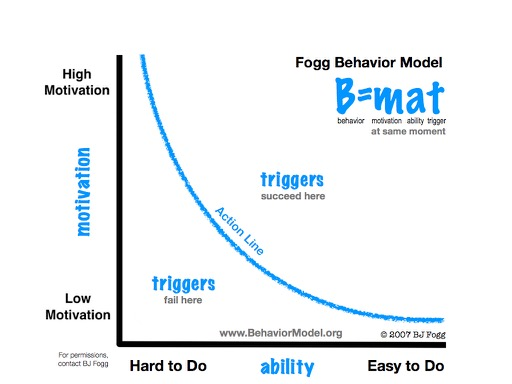
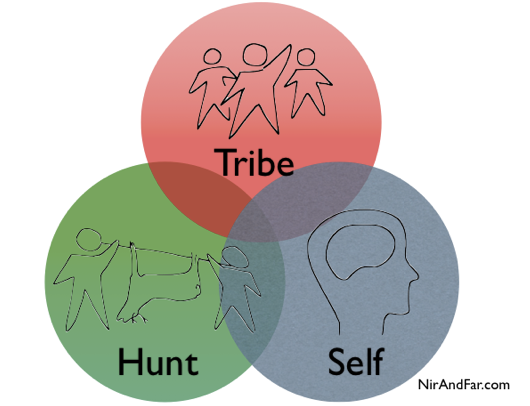
4. Have people invest by taking a small action (commitment) that their future self will want to be consistent with.
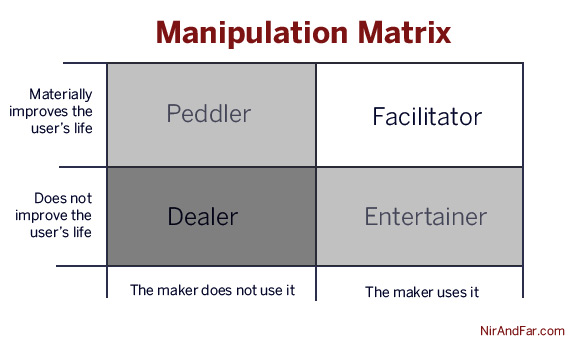
This model is very powerful and we can see the negative externalities of it with people being “too addicted” to Facebook, etc. The author tries to remedy this with the Manipulation Matrix below which breaks down when a company should these habit building tactics:
ORGANIZATION DESIGN: Reinventing Organizations, Managing for Happiness
Thus far, we’ve been primarily externally customer-facing, focused around product-market fit. How can we prioritize our work to empathize with customers, understand their problems, and build products to solve them? Now, we’ll concentrate on the internals of an organization.
This section is on Organization Design, i.e. how should information/capital flow and decisions be made within a company?
Reinventing Organizations
Reinventing Organizations is a book about a new kind of organizational design for our fast-moving world. The thesis is that the way our organizations have been structured is changing over time. We used to think of ourselves as an army, then as a machine, then as a family, and now as a living organism. (See image below with their accompanying colors.) When we think of the organization as a bottom-up living organism (as the color Teal), we can move more quickly to adapt to changing circumstances, competition, etc. Various companies have tried variations on this, the most famous of which is Zappos and their holacracy (without managers). This kind of design is especially powerful in blockchain-based organizations because both Teal and blockchain are based in peer-to-peer relationships and we can have the blockchain P2P code structure match the organization P2P human structure. (See Conway’s Law.)
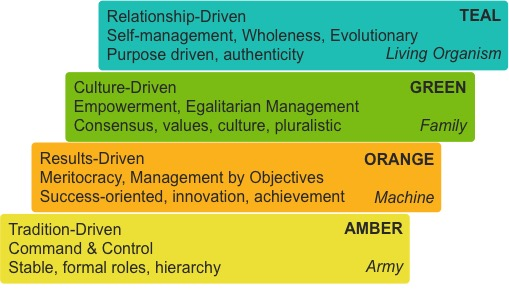
Here are the keys to making a Teal organization:
- Define Overarching Assumptions and Values. e.g. People are systematically considered to be good (reliable, self-motivated, trustworthy, intelligent).
- Self-Management. Advice Process: Anyone can make a decision, but needs to check with those affected + domain experts. Conflict-Resolution Mechanism: First try to resolve the conflict with the other person (P2P). If the conflict isn’t resolved, add a 3rd party moderator (P2P+1). If the conflict still isn’t resolved, add a panel (P2P + n).
- Wholeness. Come to work as your full self. Create meeting practices of silence, gratitude, etc. Design physical space to jolt people out of a “classic” office mindset (no cubicles, etc.).
- Evolutionary Purpose. Team members should be working to further the organization’s “evolutionary purpose”. Hiring: Deeply check for “purpose alignment”. Physical Representation: When asking the organization about its evolutionary purpose, represent the company in physical form. This can be an empty chair or a physical object.
Managing for Happiness
This book details various strategies for managing a company based on a mindset heavily informed by Teal and systems thinking. There are 11 specific “how to” chapters, but I found the most powerful to be the 7 levels of delegation in making a decision. Especially in decentralized organizations, coming to consensus on decision making is hard and it can sometimes feel like a binary (either everyone agrees or a single person makes the decision). Check out the 7 levels of delegation below:
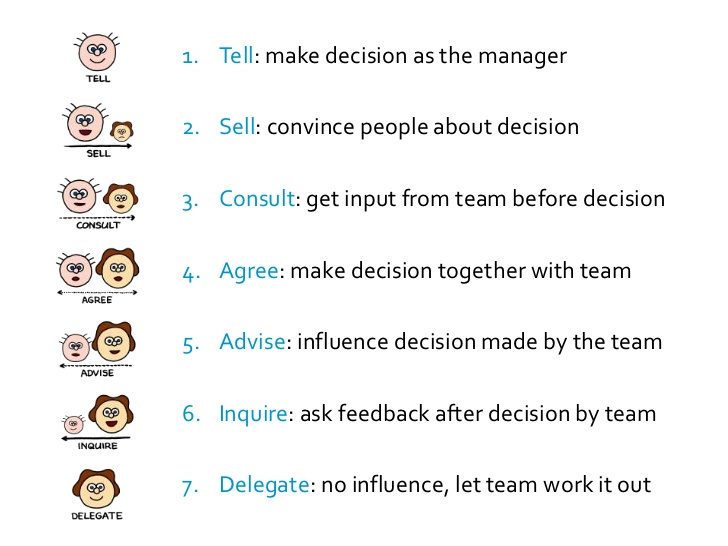
If you want to dive deeper on the philosophical origination of Teal, I’d recommend reading Spiral Dynamics (written in 1995!). Also, I’d recommend checking out Sociocracy 3.0 for a meta implementation.
TEAM COMMUNICATION: An Everyone Culture, 5 Dysfunctions of a Team, Nonviolent Communication, Radical Candor
Now once we’ve thought of the organization from a system level (as a Teal organization), we can look at the individual P2P relationships and how to communicate well.
An Everyone Culture
- This is a more science-heavy book around creating cultures of self-improvement. (What they call a “Developmentally Driven Organization”)
- There are three key parts of a DDO: Groove, Edge, Home.

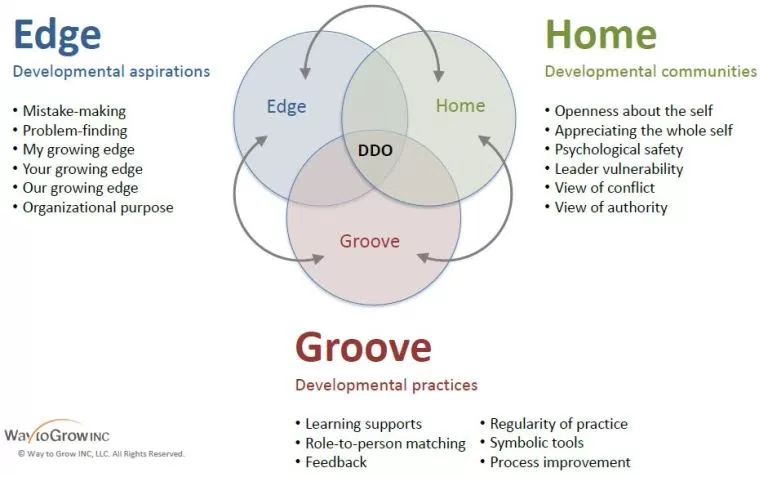
- This book also has a great Immunity to Change map for helping people change deeper held behaviors. Essentially, you ask yourself why questions until you find some ridiculous “big assumptions” that you hold about the world that do nothing but help your own self to rationalize negative commitments.
- I love this book’s claim for the KPI of a DDO — the Frankness Score. From 1–10, how frank are you with each other on matters of importance to how the business is run? Essentially, how often do you hide things?
5 Dysfunctions of a Team:
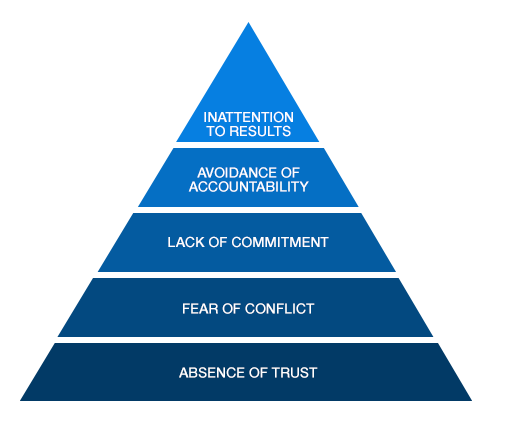
- Like NVC, this book outlines a framework for the organization. NVC is a framework for communication, 5 Dysfunctions of a Team is a framework for company decision making. You need each lower layer to achieve the next.
- Trust — By showing your weaknesses and vulnerabilities as a leader, you build vulnerability-based trust.
- Disagree — This trust allows people to disagree about business matters without feeling personally attacked by the disagreements. (The trust helps people overcome their avoidance of conflict.)
- Commit — By having an environment of lively debate and disagreement, you allow for people to real express their concerns, which allows them to commit to the decision, whether they made it or not. This is the classic term “disagree and commit”. (The bad version of this is where people don’t speak up and then don’t commit to a decision.)
- Accountability — By committing to a decision and working hard on it, people then can hold each other accountable for their results. (Instead of the opposite where they say “well I never liked that decision, so I take no accountability for the failure”.)
- Results—If you’re doing rungs 1–4 in the pyramid, you’re probably doing great. But sometimes even when you have 1–4, team members are attached to personal results rather than team results. Focus on collective results!
Nonviolent Communication
- This book that goes into detail on a simple but powerful framework for communicating emotions. It’s a 4-part framework that involves stating observations, feelings, needs, and requests (in “I” language), then to have the other person reflect back those statements (reflective listening). It can take heated emotional conversations (which are complex and abstract!), break them down into the sub-concepts (observations, feelings, needs, and requests), and get clarity around those concepts (through reflective listening). Here’s the framework: alignment, wholeness
- When I _____, I feel _____, Because I need _____, I request _____
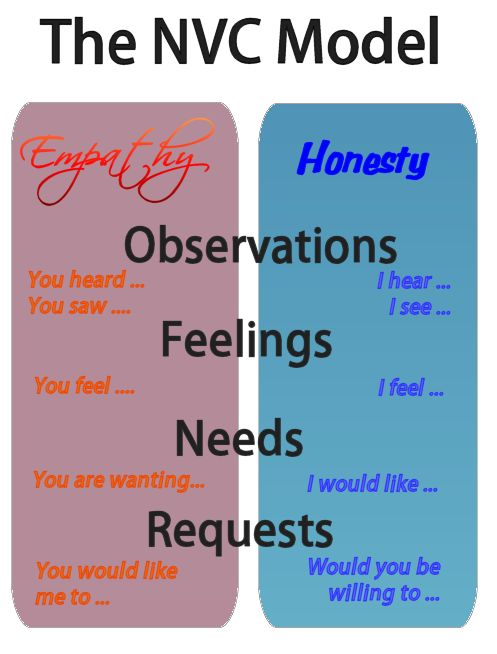
- The reflective listening piece reminds me of one of Covey’s 7 Habits of Highly Effective People (see bottom of this article) — “seek first to understand, then to be understood”. Also similar to Khalil Gibran’s quote “Between what is said and not meant, and what is meant and not said, most of love is lost.” (I like to think of this as the “meant/said/heard” differential.)
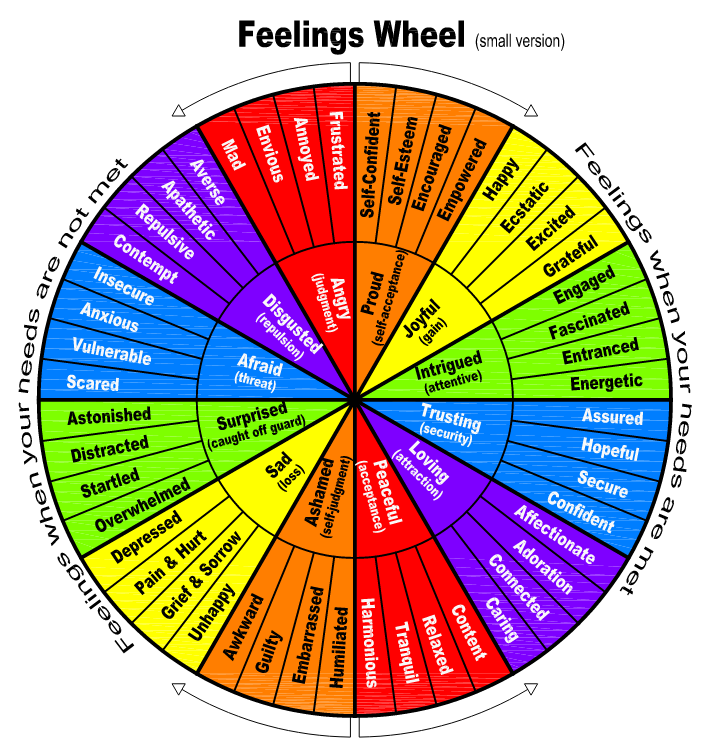
- Also, here’s my favorite NVC feelings wheel. 6 positive, 6 negative emotions, each of which is the reverse of another. Loss vs. gain, repulsed vs. attracted, etc.
Radical Candor
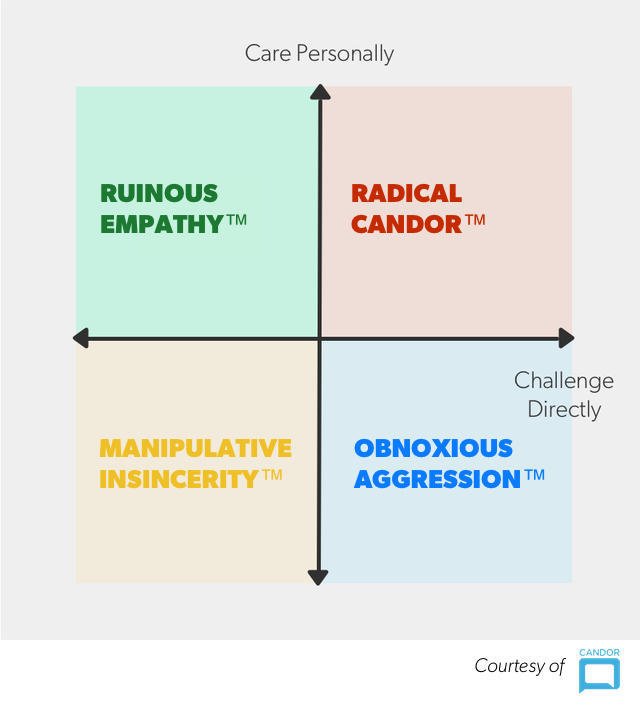
- This is a simple framework for communication that says “Radical Candor is caring personally and challenging directly. It creates much more positive work environments.” (Essentially by creating frankness.)
Framework Overlap:
- The cool thing with these 3 books is that they overlap in a cool way:
- The “layer of trust to disagree and commit” (from 5 Dysfunctions of a Team) is essentially equal to the DDO KPI (from An Everyone Culture) of “how frank are you”. (You aren’t frank if you don’t have the trust to disagree.)
- Radical Candor expresses a very similar thing — you should build trust by caring personally and disagree/commit by challenging directly.
- NVC gives you the communication framework for being truly frank about your emotional vulnerabilities — to speak in “I” language about feelings and needs you have.
- I like a team-facing KPI that combines multiple of these frameworks—On matters of importance to the business, from 1–10, how often do you: Speak frankly and vulnerably. Listen curiously and empathetically.
MENTAL MODELS FOR SELF: Thinking Fast and Slow, Essentialism, Refuse to Choose, 7 Habits of Highly Effective People, Designing Your Life
So we’ve moved from externally-facing product-market fit to internally-facing organization design and communication. Now to just yourself! What are some good frameworks/mental models that you can use in isolation of others.
Thinking Fast and Slow
- This book primarily outlines various cognitive biases through the mental abstraction of System 1(your quick and intuitive brain) vs. System 2 (your slower and more rational brain). You can break all cognitive processing down into System 1 or System 2. A helpful question to ask is “did that answer/decision come from System 1 or System 2 thinking?”
Cognitive Biases
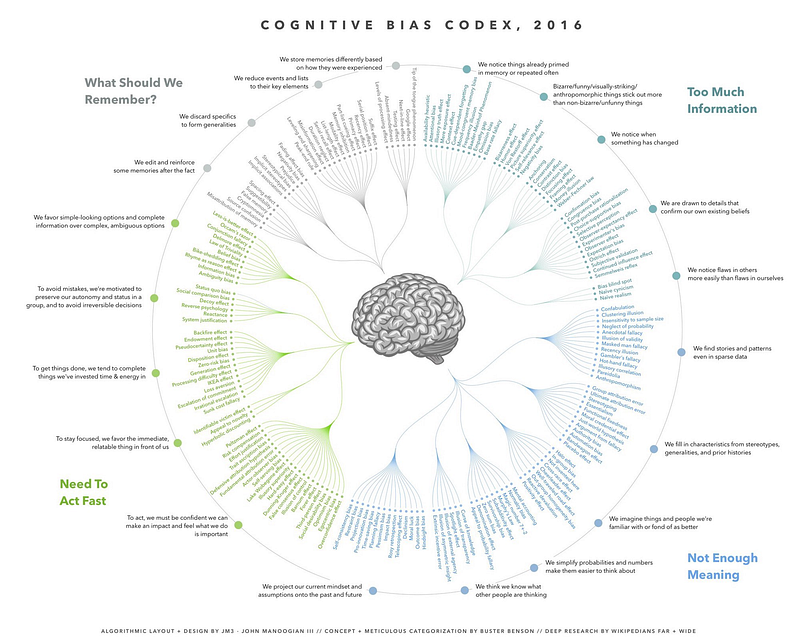
- Buster Benson (a product lead at Slack) does a great job of breaking down the 200-ish cognitive biases into 4 primary groups. Understand these 4 groups instead of individual biases!
- Information overload sucks, so we aggressively filter. . . . [But] some of the information we filter out is actually useful and important.
- Lack of meaning is confusing, so we fill in the gaps. . . . [But] our search for meaning can conjure illusions. We sometimes imagine details that were filled in by our assumptions, and construct meaning and stories that aren’t really there.
- [ We] need to act fast lest we lose our chance, so we jump to conclusions. . . . [But] quick decisions can be seriously flawed. Some of the quick reactions and decisions we jump to are unfair, self-serving, and counter-productive.
- This isn’t getting easier, so we try to remember the important bits. . . . [But] our memory reinforces errors. Some of the stuff we remember for later just makes all of the above systems more biased, and more damaging to our thought processes.
Bayesian Reasoning and Base Rates
- The other top mental model that I’ll pull from Thinking, Fast and Slow is the idea of “base rates and bayesian reasoning”. This mental model is also extensively used in rationalist communities. It’s used in determining the likelihood of a given outcome (whenever you’re thinking about probabilities). Essentially, this mental model states that we need to be super aware of the likelihood of a given outcome before we get the evidence. This is sometimes called a “base rate” or a “prior” (because determined before the evidence). There are a couple classic examples of this (outlined here by Spencer Greenberg), but here’s my favorite:
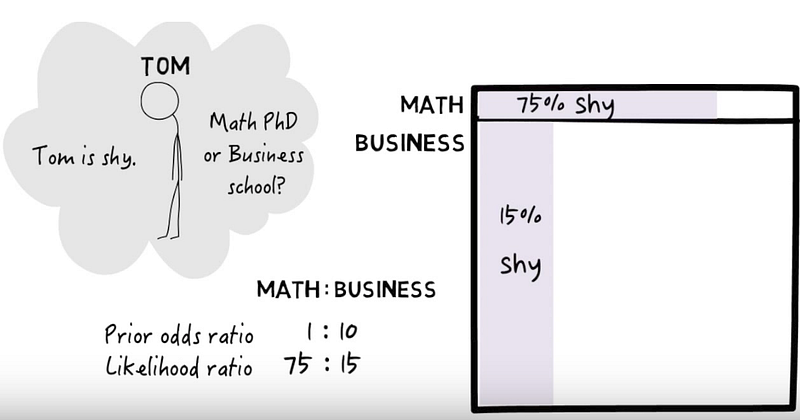
- You see someone walking on a college campus (Tom) who looks shy. Is Tom more likely to be a Math PhD or in business school? Your initial instinct may be to say that he’s more likely to be a Math PhD. But let’s look at some hypothesized base rates. What if Math PhDs comprise 1% of the school and business students comprise 10% of the school? (1% and 10% are base rates). Now we take into account the shyness — 75% of Math PhDs are shy and 15% of business students are shy. Now compare the likelihoods, including base rate. Likelihood that Tom is a Math PhD = .01 * .75 = .0075 or .75%. Likelihood that Tom is a business student = .1 * .15 = .015 or 1.5%. Tom is 2x more likely to be in business school than a Math PhD!
Related: If you haven’t seen Farnam Street’s incredible list of 113 mental models, check it out here. Also, there’s a section at the bottom of this article specifically around “Mental Models for Self”.
Essentialism
- The key idea in this book is that there’s both: a) A power law on things that provide you with happiness and b) A human instinct to say yes, especially in social situations. So, we should actively counteract (b) in pursuit of the power law returns in (a) by actively “saying no” to anything that’s not a “hell yes”.
- To do this, start with a breadth-first search and look at all your possibilities at a surface level. Then once you know what you have a “hell yes” response to, #SayNo to nearly everything else!
- This book also outlines a toolset for gracefully saying no to others, primarily by noting the things you are passionate about, giving them a time later to reach out, and saying that you do care about them.
Refuse to Choose
- This is a less well-known book about two personality types: Scanners (intensely curious, jumps around) and Divers (focuses on a speciality). It was especially helpful for me to read (as a Scanner). I think it’s also helpful for Divers to read (to understand Scanners better).
- Society has traditionally looked down on Scanners. But Scanners just need to place themselves in situations where they can continuously learn/scan.
- Here is the optimal Scanner progression, the LTTL Loop: Learn, Try, Teach, Leave. A Scanner comes into an organization, learns for a short period of time, tries out various solutions, teaches new people how to do them too, then leaves.
- Here are some other top quotes:
- Some Scanners even think that being an expert would be limiting and boring .
- When it comes to commitment, many Scanners draw the line. The horror of wasting their lives looms in front of them, and avoiding commitment itself is often the only thing a Scanner will commit to.
7 Habits of Highly Effective People
- This book has 7 frameworks that “highly effective” people use. Here are my top 3:
- Begin with the end in mind. What is the goal and how will you measure success? This is true both in business and in conversations. Always “go to the meta level” and check to make sure everyone has clarity around the goal.
- If possible, make your Circle of Concern (what you care about and spend attention on) equal to your Circle of Influence (what you can affect). Don’t spend too much time on things outside of your control! This is similar to the first thing I do when I feel overwhelmed/stressed. Bucket things into the [Things I Can Control] and the [Things I Can’t Control].
- Be effective with people and efficient with tasks.
Designing Your Life
- Finally, this book is about “life planning” and is about using design thinking to “iterate” through life. The key concepts for me were:
- Instead of being stuck in a job/PhD program you don’t like, you can prototype jobs/experiences in low cost ways. One of those ways is with “Life Interviews”, where you ask someone about the pros/cons of your hypothesized dream job.
- The book uses “question reframes” often. The reframe for the question “What do you want to be when you grow up?” is this: “Who or what do you want to grow into?” Life is all about growth and change. It’s not static. It’s not about some destination.
Thanks for reading! If you’re interested in upcoming interviews with experts in this field (including some authors from the books above), sign up below, or support me on Patreon! If you’re interested in consulting or working with me, please reach out over email. Thanks!
Thanks to Keith Klundt, Mike Goldin, John Desmond, Colin Wielga, Harry Lindmark, Joe Urgo, John Lindmark, Daniel Segal, Jacob Zax, Katie Powell, Jonathan Isaac, Brady McKenna, Jeff Snyder, Ryan X Charles, Chris Edmonds, Ramsay Devereux, Ned Mills, Kenji Williams, Scott Levi, Peter Rodgers, Kenzie Jacobs, Jon Frechin, Nathan Schneider, and Kash Dhanda for supporting me on Patreon!
Thanks to Shapeshift for sponsoring the show!
About Me: My name is Rhys Lindmark and I’m a social entrepreneur. I’m creating a humanist blockchain future by hosting a daily systems podcast with experts. I’m an alumnus of Techstars Boulder 2015 (Edify). Please reach out if you’d like to connect or have feedback! I’m curious about what you’re working on. You can support me on Patreon, follow me on Twitter, or connect on LinkedIn. My email is rhyslindmark [at] gmail [dot] com.
Disclaimer: I own less than $100 of any given cryptocurrency, so my monetary incentive is not directly aligned with Bitcoin, Ethereum, etc.