
Grigor Perelman (4th Most Intelligent Person in the World) Outlines His Counter-Intuitive Secrets to Lasting Happiness
And you don't need a monster I.Q or be a productivity freak to do them
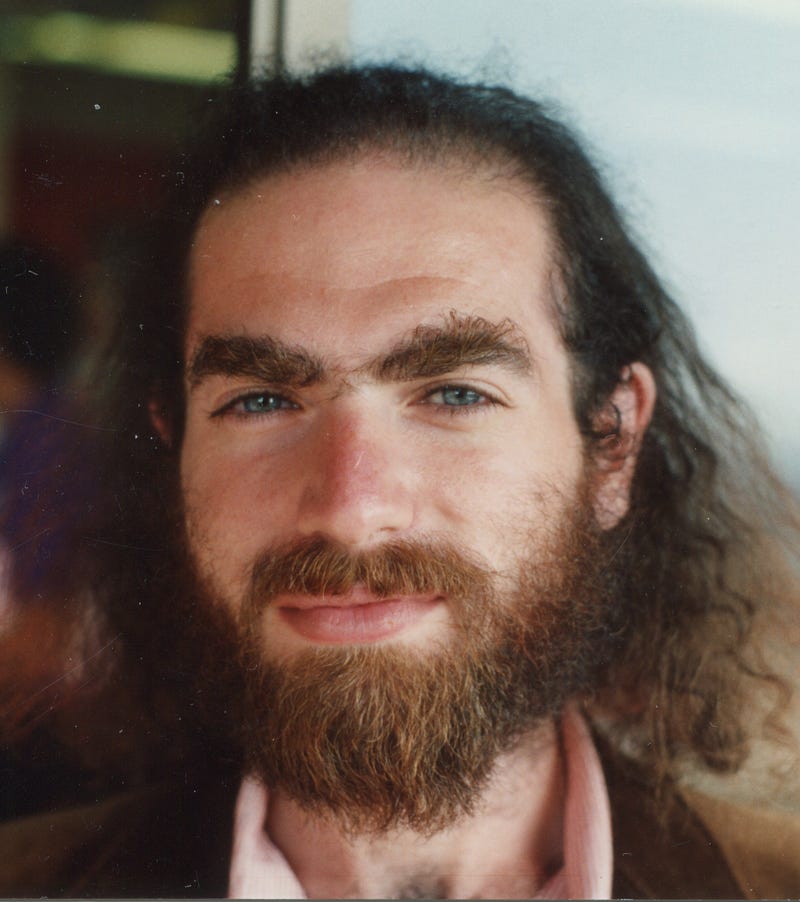
Girgori Yakovlevish Perelman, the 4th smartest person alive, spends his time in a field picking mushrooms. When he could be a high-paid professor at Harvard or Cambridge (he did have his choice.)
He lives a secluded life on the outskirts of Saint Petersburg, Russia, looking after his elderly mother.
He is a mathematical genius. And knows the one ingredient to happiness.
Perelman in 2006 quit professional mathematics. In so doing, he walked through the gateway to freedom and happiness.
Perelman was born on 13 June 1966, in Saint Petersburg, Russia, to Jewish parents. Lyubov, his mother, gave up her job to foster Grigori when his mathematical talents were identified at 10 years old.
He quickly accelerated through advanced mathematics and physics programs through high school and university.
After working at various American universities, including Berkeley, he returned to Russia. In 1994, he took a lesser research position at Steklov Institute in Saint Petersburg.
While those in the mathematics field saw this as a backward step in his career. He didn’t.
Over the coming years, he rejected the major international mathematical awards: the EMS prize (1996), Fields Medal (2006), and Millennium Prize (2010.)
But through giving up, he gained everything.
My way or the highway
“‘I’m not interested in money or fame. I don’t want to be on display like an animal in a zoo.”
— Grigori Perelman
They awarded Grigori the Fields Medal for his work on the Ricci flow.
But rejected the reward outright.
This came after 10 hours of conversation over 2 days between him and Sir John Ball, president of the International Mathematical Union.
“He proposed to me three alternatives: accept and come; accept and don’t come, and we will send you the medal later; third, I don’t accept the prize. From the very beginning, I told him I had chosen the third one … [the prize] was completely irrelevant for me. Everybody understood that if the proof is correct, then no other recognition is needed.”
Grigori lived his life with no requirement for external validation.
When you live your life on your terms, you are then not at the mercy of other opinions and demands.
Rejects $1 million prize
On 18 March 2010, they awarded Perelman the Millennium Prize. He didn’t accept the award or the $1,000,000 cash prize.
He rejected the award because they did not share it with a fellow mathematician who contributed equally to mathematics.
Upon not accepting the award Grigori said,
“the main reason is my disagreement with the organized mathematical community. I don’t like their decisions, I consider them unjust.”
— Grigori Perelman
His personal and professional values were aligned at all times. When your values are aligned in all areas of your life, there is no internal conflict. Allowing for freedom of choice.
How he did it, was by being clear on what and who he stood for as a person
Given up trying to control that which cannot be controlled
Grigori controlled what was in his means. And let go of what was out of his control.
He understood the mathematical community and education industry functioned in a certain way. To think his actions were born out of rebellion would be a mistake.
Grigori knew the value of allowing the world to be as it is. Coupled with a trust in himself to deal with life would throw at him.
Self-trust arises after the fact. He acted first based on what he knew to be true, then was responsible for the outcomes.
In the light of self-trust, he could stare down fear.
Feel the fear and act anyway
The greatest quality of Grigori was his absence of fear.
While other mathematicians were clamoring for awards, promotions, and recognition, he rejected it. Not for rejection’s sake, but because he wanted to live his life on his terms.
The problem that comes with a man living a life on his terms is that it will always be outside of the parameters of what society considers normal. Therefore he was considered, even in his own country, to be wacko.
Grigori had no fear of being himself in the face of unpopular opinion. This is a sign of genius.
That he had conquered the need to be liked, ensured he didn’t endure the pains of internal anguish of shame.
While most are clamoring for productivity tips as a key to freedom. Grigori leads a happiness because of what he gave up.
- Awards
- Work promotions
- Fame
- Money
Grigori found the key to keys to be renouncing those things that you are not aligned with your inner truth. This allows you to focus on that which you intuitively need to be important.
Don’t chase sparkly phantoms. Follow and invest your time and energy in those things that serve your highest interest.
And lastly, he gave up media interviews.
A reporter who had called him was told: “You are disturbing me. I am picking mushrooms.”
Join my email list of +1,000 people and receive your FREE intelligence checklist.


