
Green Hat Explained: The Six Thinking Hats [Book Summary 6/7]
This is the 6th part of the book summary series on the Six Thinking Hats.

The Green Hat is the creative Hat. Moreover, it’s the provocative Hat. The green color stands for plants 🌱growing, new opportunities.
Wearing the Green Hat we make a conscious effort to come up with new ideas. These are ideas that are non-obvious. The more obvious solutions (that may be just as good) can already be brought forward with the Yellow Hat.
“We are bogged down. We keep going over the same old ideas. We need something new. Let’s put on our Green Hats and see what we can come up with.”
It’s probably the hardest Hat to really wrap your head around. De Bono has invented quite a few tactics to provoke new ideas that may seem new. This blog post can not do justice to his techniques. He wrote an entire book about this called Lateral Thinking.
Main Benefits of the Green Hat
Generate more ideas. By wearing the Green Hat, we make a deliberate effort to actually look for new ways of doing things. We signal to others and our brains that now is the time to be creative. There is a correlation between the amount of time we spend looking for new ideas and the number of new ideas we can come up with.
Provoke new ideas. We have a low output pressure with the Green Hat. It’s totally under the protection of the Green Hat to say things that are impractical, stupid or provocative. They can serve as stepping stones to very practical solutions.
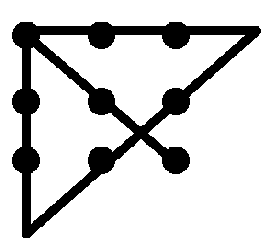
How can you connect all nine dots with just four connected, straight lines?
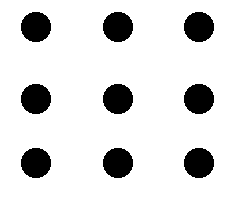
The task is impossible. Unless of course, you consider that you can also go outside the box.
Much of the time, our brain trains to pattern-match and throw out things that don’t fit the pattern. When picking fruits at the supermarket, we’re quite good at finding out the ones that are not good and dismiss them. Many thinkers like to be secure and behave in the same ways with unusual ideas.
Creativity requires exploration, risk-taking, and provocation. Unless we specifically wear the Green Hat and run the experiment, we will never know where we land.
“Remember, I’m wearing the Green Hat. So I’m allowed to say things like that.”
Humor and Creativity
Great humor-writers understand what makes a good joke. There is always a provocative, unexpected element in a good joke.
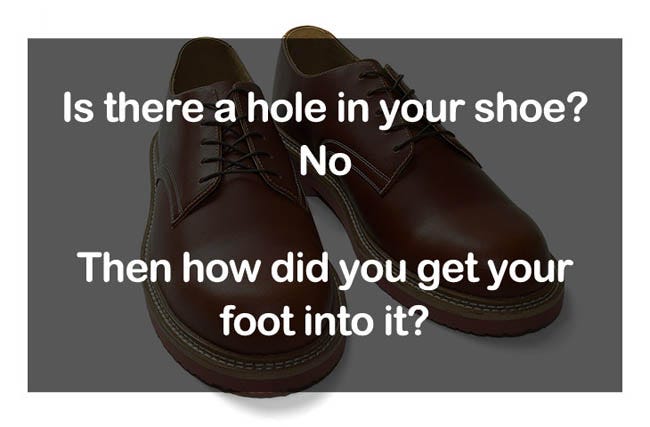
Here we break out of the pattern of thinking “Holes are unwanted; they are signs of worn out shoes.” and find a new pattern that considers the whole of the shoe.
How to Use the Green Hat: Lateral Thinking
The core concept of the Green Hat in de Bono’s book is something he calls Lateral Thinking.
The idea is to provoke new answers using intermediate steps that are not realizable.
We want to show a new thought pattern that is outside of the existing thought patterns.
Provocation
My favorite example of how provocation was used to generate a useful solution is the following.
“We need new ideas on how to fight crime in our neighborhoods. Let’s put on our Green Hats and see what we can find.”
“Under the protection of the Green Hat, I will provoke a new way of thinking. What if everyone was a police officer?”
We can see how this solution is unrealistic. But it can prompt a new way of looking at things.
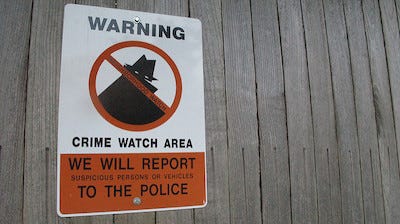
With this provocation, de Bono says the responsible parties came up with the concept of Neighborhood Watch (couldn’t verify this story personally, but it makes for a good story), which is in place in many neighborhoods around the US today.
“What if paid prisoners a pension at the end of their sentence? Maybe they could integrate into society better and would be less likely to fall back into criminality. Tell me what you see with that provocation.”
Generate Alternatives
In decision making, the quality of the decision will depend on both the quality of the alternatives available and as well as the selection process. So one simple way to increase the likelihood of good decision-making is to increase the number of alternatives.
“We can either increase the price, leave it the same or decrease it.”
Now while generally anything we decide will fall into one of the three buckets, there are many variations we can do here.
“We could increase prices later. We could create a new, more expensive version and lower the prices of the existing option. We could offer coupons valid for one month to boost sales now.”
There are many more options still. The point is to get our minds out of the ingrained thought patterns and find new ways of looking at things.
Po
“Po” is a word invented by de Bono. The goal is to have a playful way to say unusual and provocative things.
“Po Drugs Po Gardening. Give me your thinking on what you see there.”
“Po executives should determine their own salaries.”
“Po kids should their own classes.”
Levels
Sometimes it’s appropriate to break out of the current level of thinking.
“You’ve asked me to come up with new solutions to have people commute to their offices. With the Green Hat, I think we should look at solutions that involve commuting at all. What if everyone could be done from their homes?”
“Wearing the Green Hat, I think we should reconsider spending our advertising budget on PR instead.”
Shaping Ideas into Something Usable
After we’ve created new ideas with the use of the Green Hat, we still need to shape them into something useful. This is where we subject the idea to the real-world constraints prevalent.
This is where could use a sequence of other hats. For example, a Yellow Hat can find all the benefits of the idea. Then the Black Hat can point out the risks. The Yellow Hat can be used again to show solutions to solve problems surfaced under the Black Hat. In a tandem move, the Black and Yellow Hats help refine the idea into something we can implement.
“How would we make sure that Neighbors don’t start spying into each other's homes?”
“We could have simple training done for all of the volunteers when they first sign up. There they could learn about how to behave so to minimize crime and make their neighbors feel safe and not spied upon.”
Summary of the Green Hat
The Green Hat
- allows us to have deliberate time and effort to be creative
- motivates us to come up with ideas that break the current pattern of thought
- has low pressure on output but simply asks us to make an effort.
- can use Lateral Thinking techniques such as provocation, where we say something silly to find something useful that is new.
- may make use of ‘po’ to signal thought-provoking statements.
- wants us to further shape our ideas with the other hats to make them usable.
Your Turn
Training
- When can you apply the Green Hat next?
- Whom can you ask to wear the Green Hat to switch them out of their Black Hat thinking?
- Get the Lateral Thinking Book
Next time we’ll dig into the Blue Hat.
Subscribe below to get the article straight to your inbox.
Overview of the Six Thinking Hats
Flavio Rump is an entrepreneur and investor. He shares decision-making models from the world’s best decision makers. You can read his articles, watch his YouTube Videos or join his free newsletter to learn how to make better decisions.


