
Great Women of History: Joan of Arc
The virgin who was destined to save France.
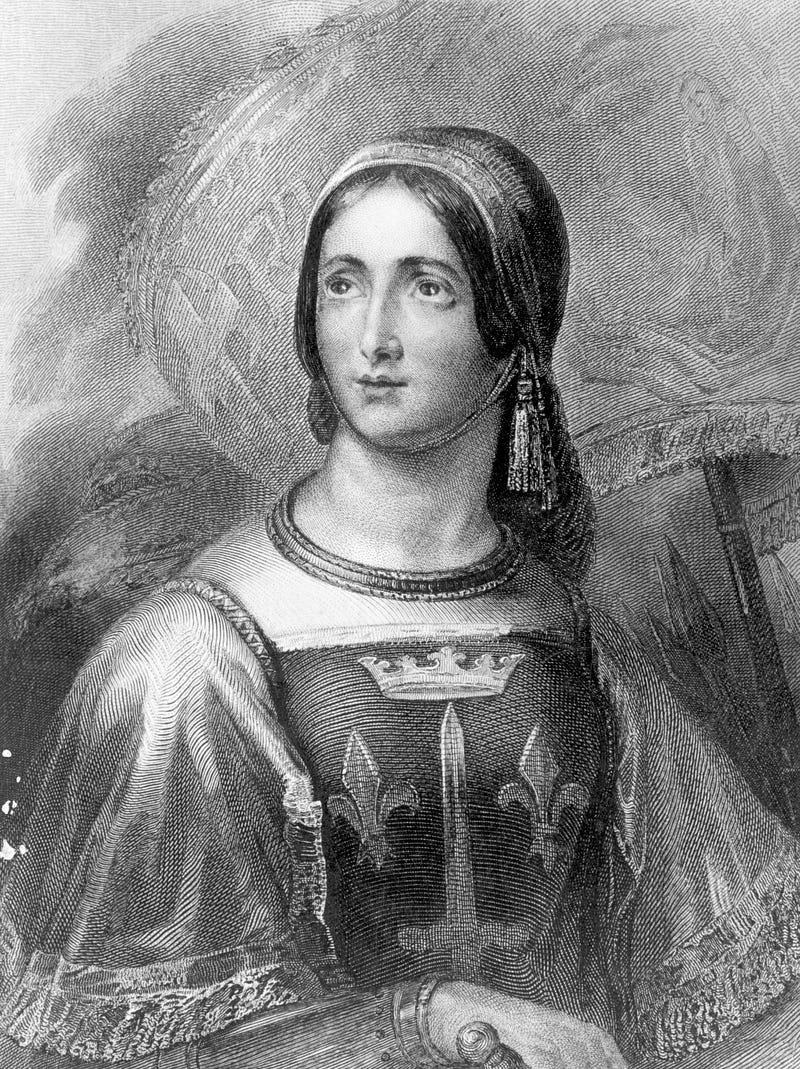
In 1412, Jeanne d’Arc (Joan of Arc in English) was born in a small French village to a tenant farmer. She was not taught to read or write, but a love for the Catholic church was instilled in her by her mother.
You gotta understand what exactly is going on during this time. So I’ll give you a brief rundown of the situation. France and England had been in a bitter feud famously known as the Hundred Years War for a little bit now. England eventually gained the upper hand and a peace treaty was struck in 1420 which basically got rid of the current king of France, Charles of Valois. Henry V was then made king of both England and France. His son, Henry VI, would succeed him in 1422.
But, what does this mean for Joan of Arc?
Because of the current situation with England now ruling over France, Joan and her family had to flee their little village for fear of an invasion of the English.
But here’s where things get strange..
At the age of 13, Joan started hearing voices in her head. She claimed these voices were from God directing her to save France from its enemy and restore Charles back to the throne. She accepted her mission and took up a vow of chastity.
In 1428, she made her way to a stronghold that was occupied by those loyal to Charles called Vaucouleurs. Joan was rejected by the local magistrate when she made the attempt to meet with Charles in person. After gaining a following of people who believed her to be the virgin that would save France, she cut her hair, dressed in men’s clothing, and started her 11-day journey to Charles.
When she finally met with Charles, she told him that she would make sure that he was crowned King at Reims. The only thing she asked for was an army that she could lead to Orleans. Charles granted her permission and an army. In 1429, she led her army to Orleans on a white horse while wearing white armor. She would eventually force the Angloburgundians out of Orleans.
News of her victory spread throughout France. She was creating quite the reputation for herself amongst the French forces. With this reputation, she escorted Charles across the enemy territory of Reims. On their way through the area, she took any town/village that resisted. He was crowned King Charles VII in Reims in 1429.
Unfortunately, Joan of Arc would be captured in the Spring of 1430 while defending a town. The Angloburgundians would hold her captive and charge her with around 70 offenses that included heresy, witchcraft, and dressing like a man.
The King refused to negotiate on Joan’s release because of the accusation of witchcraft and heresy hanging over her head. After a year of captivity, she finally signed a confession that relinquished any divine guidance she had claimed before. On the morning of May 30, 1431, Joan of Arc was burned at the stake.
You’re probably wondering how she gained her celebrity stature in History. 20 years after her death, a new trial ordered by Charles VII cleared her name. She became a person of legend. She was celebrated across France and they made her their patron saint.
Regardless of your opinions on the voices that she heard in her head, she saved France. She did whatever she had to do to save her country. She dressed as a man and rode into battle to drive the enemy out. She did what no other person was willing to do during this time. Where would the country of France be today without her? Would there be a France? Who knows.
What I do know is that Joan of Arc is not only a hero but a badass.


