Grasshoppers, Crickets, Katydids and Locusts
It all started with crickets . . .
Sitting on the deck at dusk a few days ago, I was enjoying the sound of insects. I’m in Bali for the first time, so I’m not familiar with anything here. The sound wasn’t the deeper buzz of grasshoppers I was used to from where I grew up in California, but it had that same soothing summer-time feel to it. I thought they might be crickets or katydids, but I don’t really know them either, just a wild guess. I remembered watching Disney cartoons about Jiminy Cricket, singing, “I’m no fool, no sir-ee, I’m gonna live to be 103.”
The next day, in total contrast to my good mood of the evening before, the news was all about the locusts in Africa, and how they were ravaging crops for hundreds of miles around.
I started wondering what the differences are between grasshoppers, crickets, katydids and locusts, and why we like some of them and hate one of them.
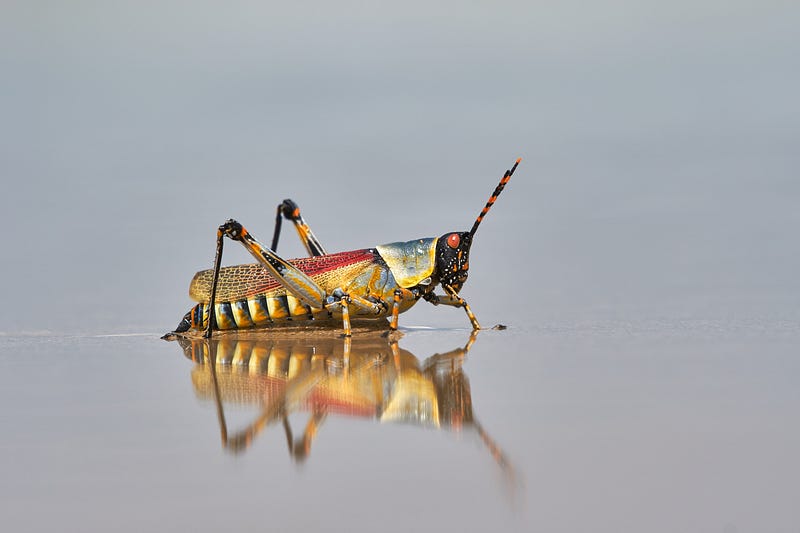
It turns out that grasshoppers and locusts are almost the same thing, except locusts have two phases. In their solitary phase, locusts are just like grasshoppers, hopping around, minding their own business, eating grass when the land is lush. But in drought conditions, there’s a change to density-dependent behavior, or the gregarious phase, commonly known as swarming. It’s triggered by touch, so as good forage dwindles and there get to be more and more locusts in one place, each touch produces serotonin in the locusts, until they reach some kind of critical mass and take off flying together.
When they’re swarming, there can be as many as 150 million of them per square kilometer. They eat everything that grows, and one square kilometer of locusts can eat, in one day, as much as 35,000 people can eat.
The only good thing about locusts is that they are very high in protein. I remember watching Viggo Mortensen eating locusts in that desert horse race movie, Hidalgo. (Ick. You can have my share. But, to be fair, I’d be willing to try something cooked with locust flour if it was already ground and totally unrecognizable.)
Although it’s rare, grasshoppers sometimes swarm, too, as occurred last year when they invaded Las Vegas. They can do damage to crops, but they are a very important part of the food chain, being a main source of food for many types of birds and lizards.
“The grasshopper flies about, but the kingfisher watches him.” — Samoan proverb
Luckily, other insects in the same order are not so destructive. In a different sub-order than grasshoppers and locusts, which are diurnal (awake in the day), crickets and katydids are nocturnal (awake at night), and never swarm. They eat aphids and ants, as well as some plants, and are considered to be completely harmless to us.
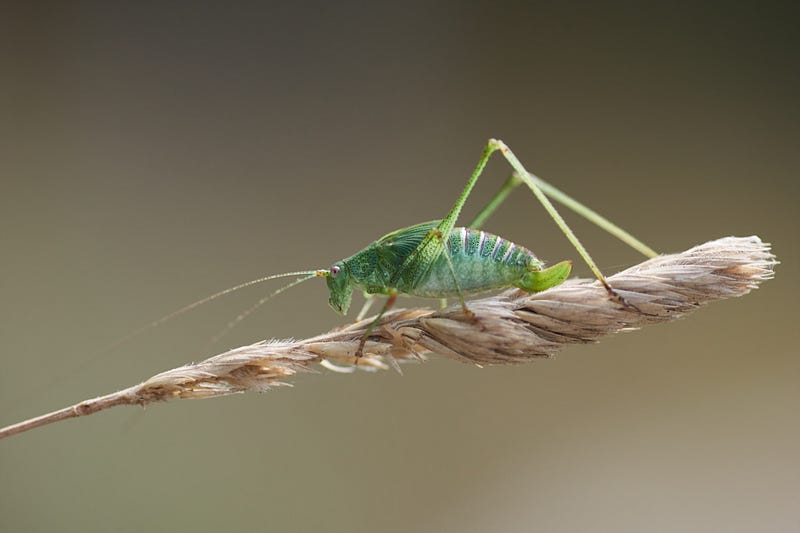
Katydids sort of look like leaves standing on edge, with legs. They are known for two things: first, their chirp (made the same way as the grasshopper, back leg against leathery front wing); second, their occasional wild colors. Along with the standard spring green, they come in tan, yellow, orange and pink.
Crickets are the royalty of this insect order, considered to bring good luck and prosperity by many cultures (Japanese, Chinese, and some Native Americans), and were kept as pets in little bamboo cages in China, and also were kept as pets in Europe on the Iberian peninsula. Their song is made by their two front leathery wings rubbing together and is considered to be soothing and pure.
So, returning to the deck after looking at the images on Google and listening to the various insect sounds on YouTube, I’ve decided that the insects I can hear from the deck are crickets. Yay! Good luck!
Here’s a haiku, from Issa, one of the original Japanese haiku masters (translated by Jane Hirshfield):
On a branch
floating downriver
a cricket, singing.
May you have good luck, and maybe even live to be 103, like Jiminy Cricket.