
A new blueprint for learning on graphs
Graph Neural Networks beyond Weisfeiler-Lehman and vanilla Message Passing
Physics-inspired continuous learning models on graphs allow to overcome the limitations of traditional GNNs
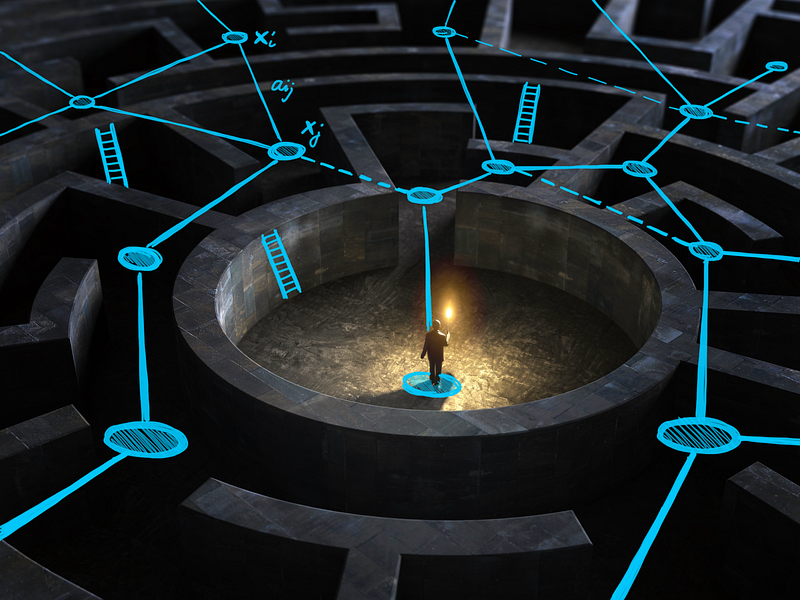
The message-passing paradigm has been the “battle horse” of deep learning on graphs for several years, making graph neural networks a big success in a wide range of applications, from particle physics to protein design. From a theoretical viewpoint, it established the link to the Weisfeiler-Lehman hierarchy, allowing to analyse the expressive power of GNNs. I argue that the “node and edge-centric” mindset of current graph deep learning schemes imposes insurmountable limitations that obstruct future progress in the field. As an alternative, I propose physics-inspired “continuous” learning models that open up a new trove of tools from the fields of differential geometry, algebraic topology, and differential equations so far largely unexplored in graph ML.
This post is based on recent works with Cristian Bodnar, Xiaowen Dong, Ben Chamberlain, Davide Eynard, Fabrizio Frasca, Francesco Di Giovanni, Maria Gorinova, Pietro Liò, Giulia Luise, Sid Mishra, Guido Montúfar, Emanuele Rossi, Konstantin Rusch, Nina Otter, James Rowbottom, Jake Topping, Yu Guang Wang, and Stefan Webb. See also my previous post on Graph Neural Networks through the lens of Differential Geometry and Algebraic Topology.
Graphs are a convenient way to abstract complex systems of relations and interactions. The increasing prominence of graph-structured data from social networks to high-energy physics to chemistry (all of these deal with objects that interact with each other, whether people, particles, or atoms), a series of initial successes in these applications, and industrial adoption have made deep learning on graphs one of the hottest topics in machine learning research [1]. Graph Neural Networks (GNNs) are by far the most common among graph ML methods and, at the time of writing, among the most popular neural network architectures overall [2].
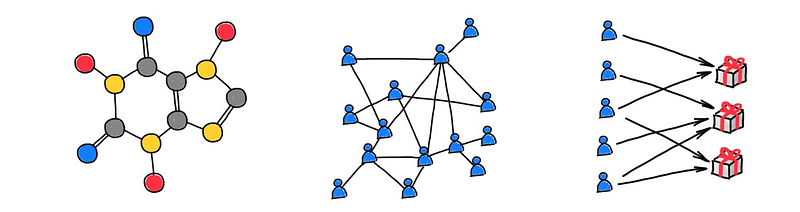
How do GNNs work? Graph neural networks take as input a graph with node and edge features and compute a function that depends both on the features and the graph structure. Message-passing type GNNs (also called MPNN [3]) operate by propagating the features on the graph by exchanging information between adjacent nodes. A typical MPNN architecture comprises several propagation layers, where each node is updated based on the aggregation of its neighbour features. Different forms of the aggregation function (which are parametric and whose parameters are learned during training) give rise to three different “flavours” of graph neural networks: convolutional (linear combination of neighbour features with weights dependent only on the structure of the graph), attentional (linear combination, where the weights also depend on the features), and message passing (general non-linear function) [4]. Of these three flavours, the latter is the most general and the former can be seen as special cases of message passing.
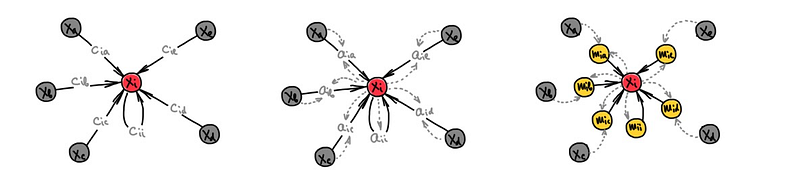
The propagation layers are made with parameters that are learned based on the downstream tasks. Typical use cases include node embedding (representing each node as a point in a vector space in such a way that the proximity of these points recovers the connectivity of the original graph, a task known as “link prediction”), node-wise classification or regression (e.g. inferring attributes of social network users), or graph-wise prediction by further aggregation of the node-wise features (e.g. predicting chemical properties of molecular graphs).
What’s wrong with message passing GNNs?
Despite the impressive success of GNNs across the board and the remarkable breadth and depth of recent research, it is fair to say that the predominant model underlying current graph deep learning schemes is to take a graph and propagate node information along its edges by means of message passing. I believe it is this very “node-and-edge-centric” mindset that imposes major roadblocks that will hinder future progress in the field. I outline below some of the prominent limitations of today’s run-of-the-mill GNNs:
The Weisfeiler-Lehman analogy is limiting. An appropriate choice of the local aggregation function like summation [5] makes message passing equivalent to the Weisfeiler-Lehman graph isomorphism test [6], allowing graph neural networks to discover some structure of the graph from the way information propagates on it. This important link to graph theory [7] has produced multiple theoretical results on the expressive power of GNNs, determining whether certain functions on a graph can be computed by means of message passing or not [8]. However, this type of result does not generally tell how efficient such a representation is (i.e., how many layers are required to compute a function) [9], nor about the generalisation capabilities of GNNs.
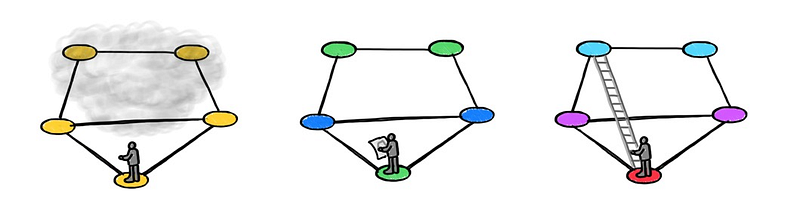
The inability of the Weisfeiler-Lehman algorithm to detect even simple graph structures such as triangles is astonishingly disappointing for practitioners trying to use message passing neural networks for molecular graphs: in organic chemistry, for example, structures such as rings are abundant and play an important role in the way molecules behave (e.g., aromatic rings bear this name due to their prominence in compounds with strong odour such as naphthalene).

Several approaches for more expressive GNN models have been proposed in the past few years. These include higher-dimensional isomorphism tests in the Weisfeiler-Lehman hierarchy [10] (which come at the expense of higher computational and memory complexity and lack of locality), applying the Wesifeiler-Lehman test to a collection of subgraphs [11], or positional- or structural encoding [12] that “colours” the nodes of the graph helping this way to break the regularities that “confuse” the Weisfeiler-Lehman algorithm. Positional encoding is by far the most common technique made popular in Transformers [13] and now ubiquitous in GNNs. While multiple positional encodings exist, it is fair to say that a particular choice is application-dependent and rather empirical.
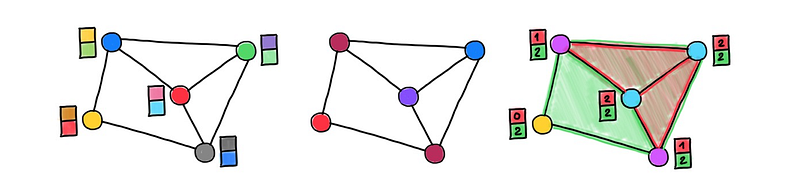
Graph rewiring breaks the theoretical foundations of GNNs. One important and somewhat subtle difference between GNNs and let’s say CNNs is that the graph is both part of the input as well as the computational structure. Traditional GNNs use the input graph to propagate information, obtaining this way a representation that reflects both the structure of the graph and the features on it. However, some graphs turn out less friendly for information propagation due to certain structural characteristics (“bottlenecks”) that result in information from too many nodes to be “squeezed” into a single node representation — a phenomenon referred to as “oversquashing” [14].
Modern GNN implementations cope with this phenomenon by decoupling the input graph from the computational one (or refining it for computational purposes), a technique known as “graph rewiring”. Rewiring can take the form of neighbourhood sampling (as done in GraphSAGE [15], originally to deal with scalability), virtual nodes [16], connectivity diffusion [17] or evolution [18], or node- and edge-dropout mechanisms [19]. Transformers and attention-type GNNs such as GAT [20] effectively “learn” a new graph by assigning a different weight to each edge, which can also be understood as a form of “soft” rewiring. Finally, “latent graph learning” methods building a task-specific graph and updating it in every layer [21] (starting with some positional encoding, initial graph, or sometimes with no graph at all) can also be put in this category. Overall, it will probably be only slightly overstating the case to say that almost no modern GNN model propagates information on the original input graph.

This however is bad news for the theoretical analysis relying on the equivalence of message passing and the Weisfeiler-Lehman test, which obtains a description of the graph from the way information propagates on it. Rewiring breaks this theoretical link, putting us in a situation not uncommon in machine learning: models that can be analysed in theory are not the same as those used in practice.
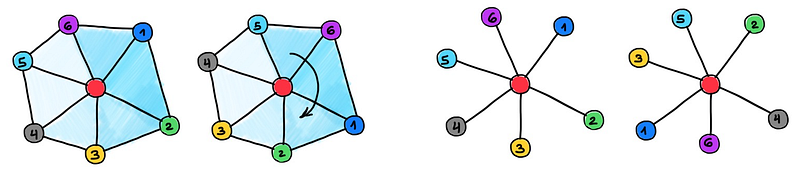
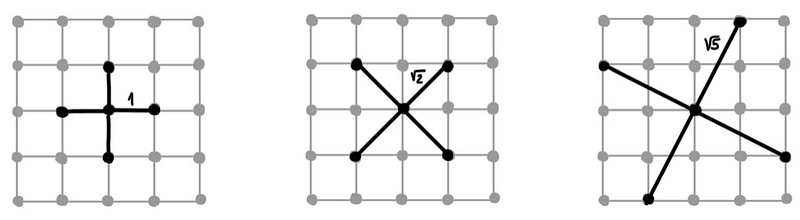
The “geometry” of graphs is too poor. Graph neural networks can be obtained as an instance of the “Geometric Deep Learning blueprint” [22], a group-theoretical framework allowing to derive deep learning architectures from the symmetry of the domain underlying the data. In the case of graphs, this symmetry is node permutation, as graphs do not have a canonical node ordering. Because of this structural characteristic, MPNNs operating locally on the graph must rely on permutation-invariant feature aggregation functions, implying that there is no notion of “direction” on graphs and that the propagation of information is isotropic [23]. This situation is strikingly different from learning on continuous domains, grids, or even meshes [24], and has been one of the early criticisms of GNNs arguing that isotropic filters are not very useful [25].
The “geometry” of graphs is too rich. The issue of “distance but not direction” is also somewhat related to the problems encountered when building node embeddings, where the distance between the representations of the nodes in some space is used to capture the connectivity of the graph (roughly, nodes that are close in the embedding space are expected to be connected by an edge in the graph). Typical use cases are recommender systems, where graph embeddings are used to create associations (edges) between entities represented by the nodes (e.g., whom to follow on Twitter).
The quality of graph embeddings and their ability to convey the structure of the graph crucially depends on the geometry of the embedding space and its compatibility with the “geometry” of the graph. Euclidean space, a true “battle horse” of representation learning and by far the simplest and most convenient object to work with, turns out to be a rather poor choice for many natural graphs: one of the reasons is that the volume growth of Euclidean metric balls is polynomial in the radius but exponential in the dimension [26], whereas many real-world graphs manifest exponential volume growth [27]. As a result, embeddings become “too crowded”, forcing to use spaces of high dimensions, which leads to a higher computational and space complexity.
A recently popular alternative is to use negatively-curved (hyperbolic) spaces [28] that have exponential volume growth more compatible with that of graphs [29]. The use of hyperbolic geometry typically leads to lower embedding dimensions, resulting in more compact node representations. Yet, graphs often tend to be heterogeneous (i.e., some parts may look like trees and others as cliques, with very different volume growth properties), whereas hyperbolic embedding spaces are homogeneous (every point has the same geometry).
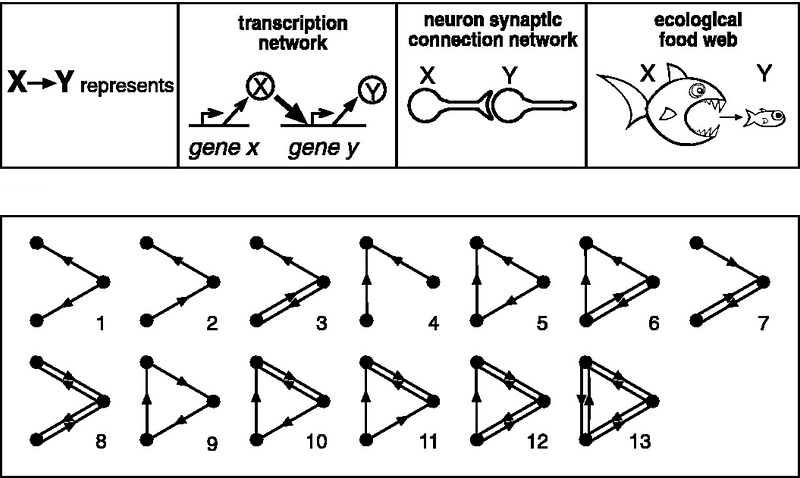
Furthermore, it is generally impossible to exactly represent the metric structure of a general graph in an embedding space [30], even if this space has a non-Euclidean geometry. Thus, graph embeddings are inevitably approximate. What is worse, however, is that since embeddings are constructed with “link prediction” criteria in mind, the distortion of higher-order structures (triangles, rectangles, etc.) can be uncontrollably large [31]. In some applications, including social and biological networks, such structures play an important role as they capture more complex non-pairwise interactions and motifs [32].
GNNs struggle when the structure of the data is not compatible with that of the underlying graph. Many graph learning datasets and benchmarks make a tacit assumption of data homophily (i.e., that the features or labels of adjacent nodes are similar, or, using signal processing terminology, “smooth”). In this setting, even simple low-pass filtering on the graph (e.g., taking the neighbour average) tends to work well. Early benchmarks, including the still ubiquitous Cora dataset, were on graphs with a high level of homophily, making the evaluation of GNNs “too easy”.
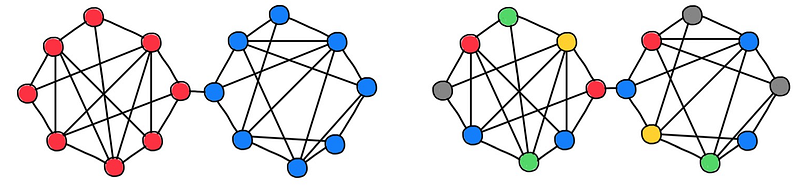
However, many models show disappointing results when dealing with heterophilic data, in which case more nuanced aggregation must be used [33]. Two typical phenomena observed in such cases is either avoiding the use of neighbour information altogether (thus GNNs essentially boil down to node-wise multilayer perceptrons) or “oversmoothing”, i.e., the phenomenon of the node representations become smoother with every layer of GNN, eventually collapsing into a single point [34]. The latter phenomenon also occurs in homophilic datasets and appears to be a more fundamental plight of some types of MPNNs, making it hard to implement deep graph learning models [35].
It is often hard to understand what GNNs learn. One of the criticisms of deep learning systems in general applies to GNNs in particular: these are “black boxes” that are hard to interpret. While interpretability is a somewhat vague category that is largely in the eyes of the beholder, we can honestly admit that in most cases we do not really understand what GNNs learn. Several recent works try to mitigate this drawback by providing “explanations” for GNN-based models in the form of a compact subgraph structure and a small subset of node features that have a crucial role in GNN’s prediction [36]. Graphs learned by latent graph learning architectures [21] can also be seen as a form of “explanation”.
Restricting generic message-passing functions helps rule out implausible outputs and ensure that what the GNN learns makes sense and is better understood in domain-specific applications. In particular, it is possible to endow message passing with additional “internal” data symmetries that better “understand” the underlying problem [37]. A perfect example is E(3)-equivariant message passing that correctly treats the atomic coordinates in molecular graphs and has recently contributed to the triumph of protein structure prediction architectures such as AlphaFold [38] and RosettaFold [39].
Another example is the work coauthored by Miles and Kyle Cranmer (no family relation) [40], in which message-passing functions learned on a multi-body dynamical system were replaced by symbolic formulae, allowing to “learn physical equations”. Finally, there are attempts to link GNNs to causal inference [41], in which case one tries to build a graph that explains the causal relations between different variables. Overall, this is still a research direction in its infancy.
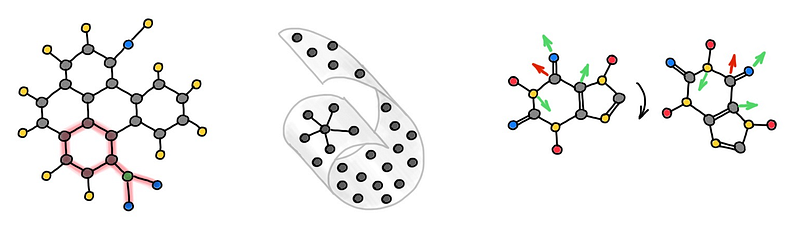
Most implementations of GNNs are hardware-agnostic. The majority of today’s GNNs rely on GPU implementation and tacitly assume that the data fits into memory. This is often wishful thinking when dealing with large graphs such as biological and social networks. In this case, understanding the limitations of the underlying hardware such as different bandwidth and latency of the memory hierarchy, and using it advantageously is of crucial importance. Roughly, there might be an order of magnitude difference in the cost of message passing (in terms of latency and power, for example) between two nodes in the same physical memory and two nodes on different chips. Making GNNs friendly to existing hardware is an important and frequently overlooked problem. Developing novel graph-centric hardware is an even bigger challenge, given the time and effort it takes to design a new chip, and the speed at which machine learning state-of-the-art moves.
“Continuous” models as a new blueprint for learning on graphs
An emerging and promising alternative to current “discrete” GNNs are “continuous” learning models that are inspired by physical systems and open up a new trove of tools from the fields of differential geometry, algebraic topology, and differential equations so far largely unexplored in graph ML.
Reimagine GNNs as continuous physical processes. Instead of several layers of message passing on a graph, we can consider a physical process that happens on some domain (that can also be continuous, e.g., a manifold, and discretised as a graph) in continuous time (that replaces the discrete layers). The state of the process at some point in space and time replaces the latent features of a node of the graph produced by a layer of GNN. The process is controlled by a set of parameters (representing the properties of the underlying physical system) that replace the learnable weights of message passing layers.
A plethora of different physically-inspired processes can be constructed, drawn from both classical and quantum systems. In a series of papers [42–44], we have shown that many existing GNNs can be related to diffusion processes, which are probably the most “natural” way of propagating information, but other more exotic ways, such as systems of coupled oscillators [45] are also possible and may offer certain advantages.
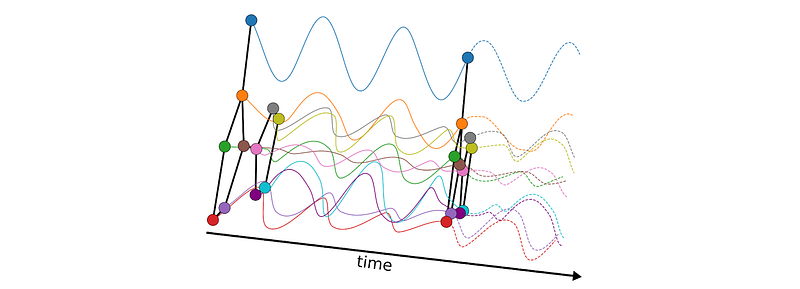
A continuous system can be discretised both in time and space. The spatial discretisation, in the form of a graph connecting nearby points on the continuous domain, and can change throughout time and space. Such a learning paradigm is a radical departure from the traditional Weisfeiler-Lehman scheme that is rigidly bound by the assumption of the underlying input graph. More importantly, it brings a new set of tools allowing, at least in principle, to address important questions that are at present out of reach of the existing graph-theoretical techniques.
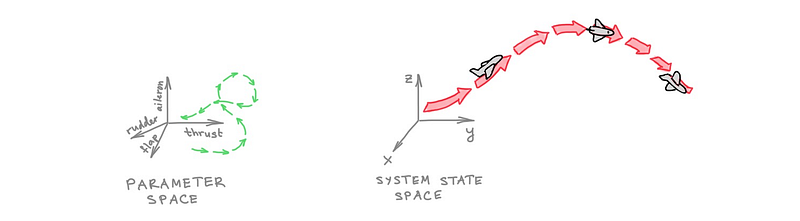
Learning as an optimal control problem. The space of all the possible states of the process at a given time can be regarded as a “hypothesis class” of functions that can be represented. Learning this way is posed as an optimal control problem [46], i.e., whether one can control the process (by choosing a trajectory in the parameter space) in order for it to reach a certain desirable state. Expressive power can be formulated as whether a given function can be reached by an appropriate choice of a trajectory in the parameter space controlling the process (“reachability” using the jargon of optimal control theory); efficiency is related to how long does it take to reach a certain state; and generalisation is related to the stability of this process.
GNNs can be derived from discretised differential equations. The behaviour of physical systems is typically governed by differential equations whose solutions produce the state of the system. In some cases, such solutions can be derived in a closed form [47], but more generally, one has to resort to numerical solutions based on appropriate discretisations. The wealth of different iterative solvers accumulated in the numerical analysis literature after over a century of research offers potentially completely new architectures for deep learning on graphs.
For example, we showed in [42] that attentional flavours of GNNs can be interpreted as discretised diffusion PDEs with learnable diffusivity solved using explicit numerical schemes. In this case, each iteration of the solver (discrete steps in time) corresponds to a layer of a GNN. More sophisticated solvers e.g. using adaptive step size or multi-step schemes do not currently have an immediate analogy in the “zoo” of GNN architectures, and could lead to future architectural insights. Implicit schemes, requiring the solution of a linear system at each iteration, can be interpreted as “multi-hop” filters [48]. Furthermore, numerical schemes come with stability and convergence guarantees, providing conditions when they work and an understanding when they fail [49].
Numerical solvers can be hardware-friendly. Iterative solvers are older than digital computers, and from the very birth of the latter had to be aware of the underlying hardware and make efficient use of it. Large-scale problems in scientific computing often have to be solved on clusters of computers, where such issues are of crucial importance.
The “continuous” approach to deep learning on graphs allows discretising the underlying differential equations in ways that are compatible with hardware on which they are simulated, potentially leveraging vast literature from the supercomputing community such as domain decomposition techniques [50]. In particular, graph rewiring and adaptive iterative solvers can be made aware of the memory hierarchy, e.g. performing few infrequent steps of information transfer across nodes in different physical locations and more frequent steps across nodes in the same physical memory.
Interpreting evolution equations as gradient flows of energy functionals associated with the physical system provides insights into the learning model. Many physical systems have an associated energy functional (sometimes also incorporating certain symmetries or conservation laws), of which the differential equation governing the dynamics of the system is a minimising gradient flow [51]. For example, the diffusion equation minimises the Dirichlet energy [42] and its non-Euclidean version (Beltrami flow) minimises the Polyakov functional [43], giving an intuitive grasp on what the learning model is doing. Using the principle of least action w.r.t. certain energy functionals leads to hyperbolic equations, such as the wave equation. The solutions of such equations are “wave-like” (oscillatory) and dramatically different from the typical dynamics of GNNs.
Analysing the limit cases of such flows is a standard exercise that provides deep insight on the behaviour of the model that would be difficult to gain otherwise. For example, in our recent paper [44] we showed that traditional GNNs (analogous to isotropic diffusion equations) necessarily lead to oversmoothing and have separation power only under the assumption of homophily; better separation power can be achieved by using additional structure on the graph (a cellular sheaf) [52]. In another recent paper [45], we showed that an oscillatory system avoids oversmoothing in the limit. Such results can explain why certain undesirable phenomena occur in some GNN architectures, and how to design architectures to avoid them. Furthermore, linking the limit case of the flow to separation reveals bounds on the expressive power of the model.
Graphs can be endowed with richer structures. We already mentioned that graphs may be “too poor” (i.e., fail to capture more complex phenomena like non-pairwise relations) and “too rich” (i.e., hard to be represented in a homogeneous space) at the same time. A way to deal with the former problem is to “enrich” the graph with additional structures. A good example is the aforementioned molecular graphs, containing rings (cycles in graph terminology) that chemists regard as single entities rather than just a collection of atoms and bonds (nodes and edges).
In a series of works [53–54] we showed that graphs can be “lifted” to higher-dimensional topological structures called simplicial- and cellular complexes, on which one can design a more complex message passing scheme allowing to propagate information not only between nodes like in traditional GNNs, but also between structures like rings (“cells”). Appropriate construction of the “lifting” operation makes such models more expressive than the traditional Weisfeiler-Lehman test [55].
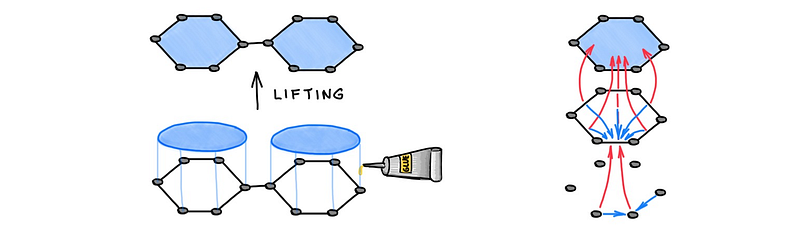
In another recent paper [44], we showed that graphs can be equipped with an additional “geometric” structure called a cellular sheaf by assigning vector spaces and linear maps to nodes and edges. Traditional GNNs implicitly assume a graph with a trivial underlying sheaf, which is reflected in the properties of the associated diffusion equation and the structure of the graph Laplacian operator. Making the sheaf non-trivial (and learnable from the data) produces richer diffusion processes and gives greater control over their asymptotic behaviour compared to traditional GNNs. For example, diffusion equations on an appropriately selected sheaf structure can separate in the limit multiple classes even in heterophilic settings [52].
From the geometric standpoint, the sheaf structure is analogous to a connection, a notion from differential geometry describing the parallel transport of vectors on manifolds [56]. In this sense, one can regard sheaf learning as a way of evolving the “geometric” structure of the graph depending on the downstream task. We show that interesting insights can be gained by restricting the structure group of the sheaf (“restriction maps” using the jargon of algebraic topology) e.g., to the special orthogonal group, allowing the node feature vectors to only rotate.
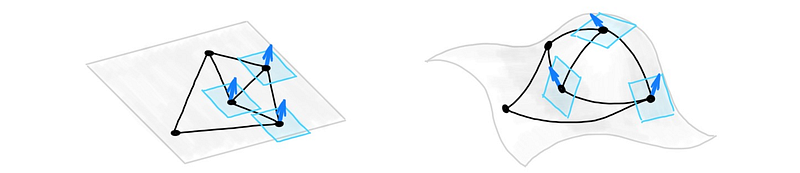
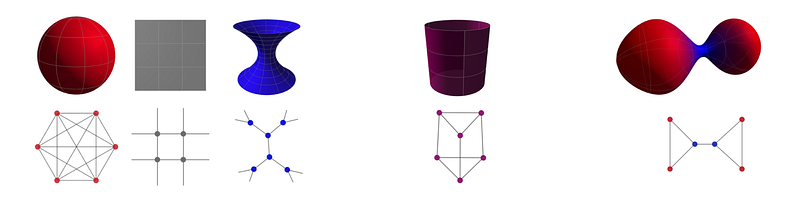
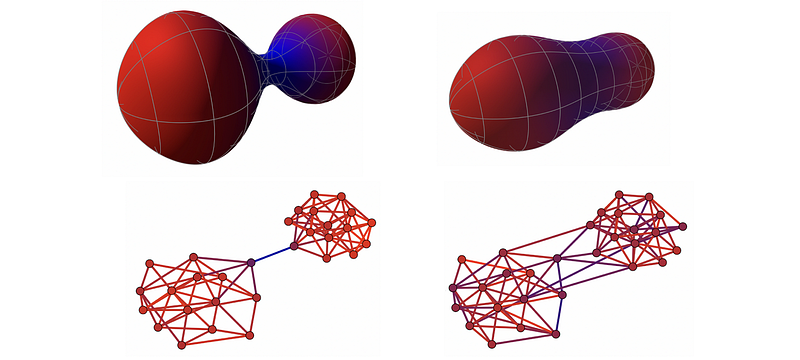
Another example of “geometric” structures on graphs are discrete analogues of curvature, a standard tool from the field of differential geometry to describe the local behaviour of manifolds. In [18], we showed that negative graph Ricci curvature produces “bottlenecks” tampering with information flow on the graph and resulting in the oversquashing phenomenon in GNNs [14]. Discrete Ricci curvature accounts for higher-order structures (triangles and rectangles) that are important in many applications. Such structures are “too rich” for traditional graph embeddings, since graphs are heterogeneous (have non-constant curvature), whereas the spaces commonly used for embeddings, even non-Euclidean ones, are homogeneous (constant curvature).
In another recent paper [57], we showed a construction of heterogeneous embedding spaces with controllable Ricci curvature that can be chosen to match that of the graph, allowing to better represent not only the neighbourhood (distance) structure but also the higher-order structures such as triangles and rectangles. Such spaces are constructed as products of homogeneous and rotationally-symmetric manifolds and allow for efficient optimisation using standard Riemannian gradient descent methods [58].
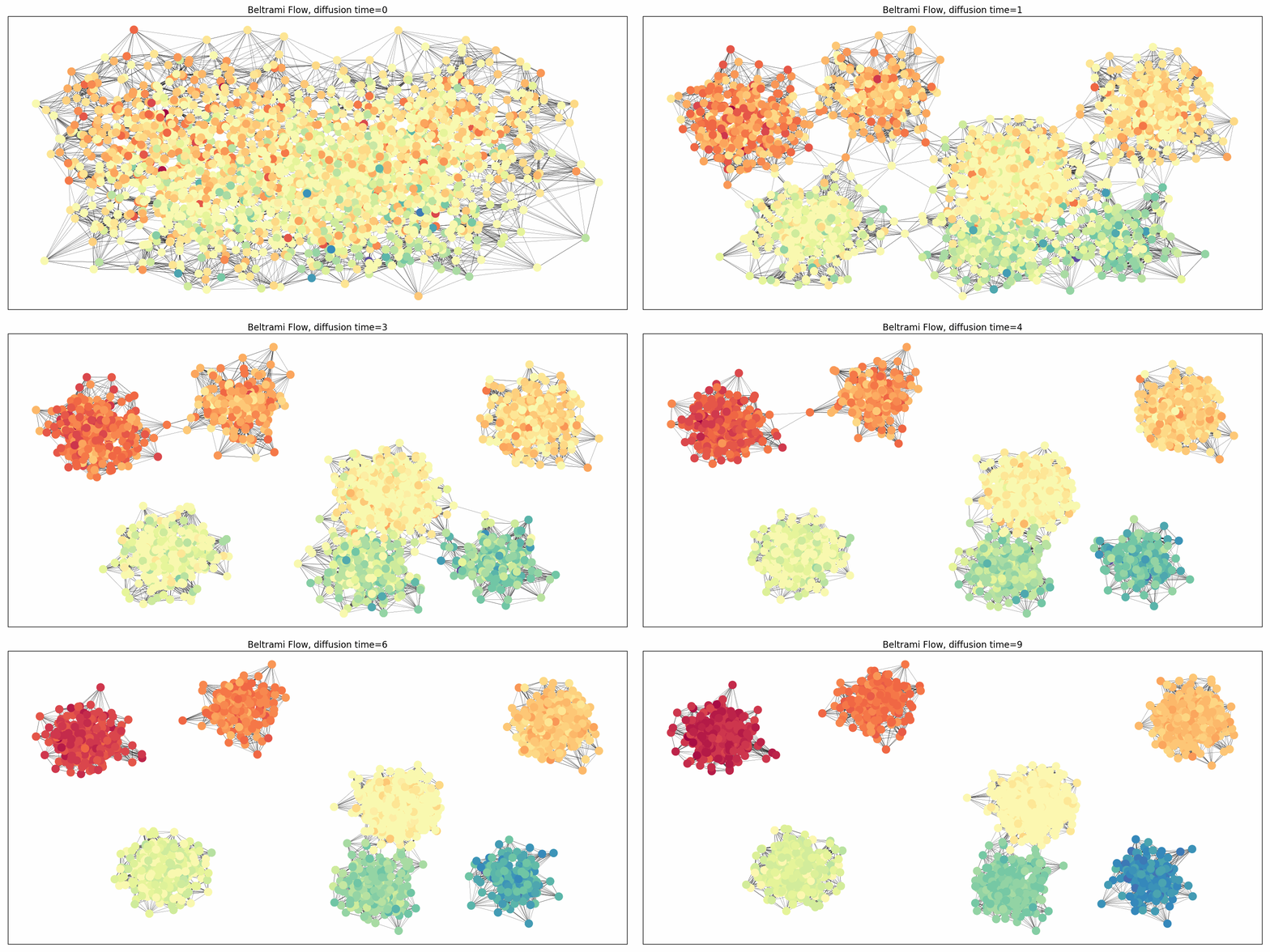
Positional encoding can be regarded as part of the domain. Thinking of a graph as a discretisation of a continuous manifold, one can consider the node positional and feature coordinates as different dimensions of the same space. The graph, in this case, can be used to represent a discrete analogue of a Riemannian metric induced by such an embedding, and the harmonic energy associated with the embedding is a non-Euclidean extension of the Dirichlet energy, known as the Polyakov functional in string theory [59]. The gradient flow of this energy is a diffusion-type equation that evolves both the positional and feature coordinates [43]. Building a graph upon the positions of the nodes is a form of task-specific graph rewiring, that also changes across the iterations (layers) of the diffusion.
Evolution of the domain replaces graph rewiring. Diffusion equations can also be applied to the connectivity of the graph as a pre-processing step aimed at improving information flow and avoiding oversquashing. Klicpera et al. [17] proposed one such algorithm based on Personalised Page Rank, a form of graph diffusion embedding. In [18], we analysed this process pointing to its problematic behaviour in heterogeneous settings and proposed an alternative graph rewiring scheme by a process inspired by the Ricci flow. Such a rewiring reduces the effect of negatively-curved edges responsible for graph bottlenecks. Ricci flows are geometric evolution equations for manifolds very roughly resembling the diffusion equations applied to the Riemannian metric, and are a popular and powerful technique in differential geometry, including the celebrated proof of the Poincaré conjecture. More generally, instead of performing graph rewiring as a pre-processing step, one can consider a coupled system of evolution processes: one evolving the features and another one evolving the domain (graph).
Concluding remarks
Is this really new? One of the traps we must avoid falling into is basing new models on fancy mathematical formalism “in name only,” with the underlying models still doing roughly what the previous generation of GNNs did. For example, one can argue that sheaf diffusion studied in [44] is a special case of message passing. The insightful theoretical results that were made possible with tools from differential geometry [18,43] and algebraic topology [44,53–54] make me believe that this is already unlikely. However, how far the new theoretical framework can take us and whether it will be able to address the currently unanswered questions in the field is still an open problem.
Will these methods be actually used in practice? For practitioners, a crucial question would be whether these methods will result in new better architectures, or remain a theoretical apparatus detached from real-world applications used merely to prove theorems. I believe that the field will be pragmatic, and theoretical insights obtained with topological and geometric tools will allow making better choices for existing GNN architectures — e.g. how to restrict the message passing functions and when to use such particular choices.
Have we moved beyond message passing? Finally, a question of a somewhat semantic nature is whether the described approaches can still be labelled as “message passing”. While opinions may vary from casting every form of GNN as message passing [60] to proclaiming the need to go beyond this paradigm [61], I am somewhat reluctant to use this term. Sensu amplo, any computation on a digital computer is a form of message passing. However, in the sensus strictus of GNNs, message passing is a computational concept implemented by sending information from one node to another, an inherently discrete process. On the other hand, the described physical models share information between nodes in a continuous manner (e.g., in a system of graph-coupled oscillators, the dynamics of one node depends on that of its neighbours at every point in time). When the differential equations describing such systems are discretised and solved numerically, the corresponding iterative schemes are indeed implemented through message passing.
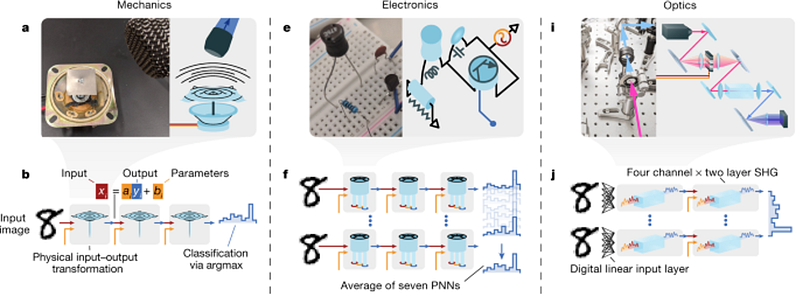
However, one can hypothetically use the actual realisation of such physical systems [62] or other computing paradigms such as analogue electronics or photonics [63]. Mathematically, the solution of the underlying differential equations may sometimes be given in a closed form: for example, the solution of the isotropic diffusion equation is a convolution with a Gaussian kernel. In this case, the influence of the “neighbours” is absorbed within the structure of the kernel and no actual “message passing” happens. Therefore, the continuous nature of this model calls for a more appropriate term–for example, “spatial coupling” or “information propagation” in the absence of better ideas at this time. As a computational primitive, message passing is and will likely remain useful, when applied synergistically with additional angles such as those presented here.
[1] See e.g. ICLR 2021 statistics.
[2] I am counting Transformers as an instance of GNNs.
[3] I use the term “GNN” to refer to an arbitrary graph neural network architecture and “MPNN” for architectures based on local message passing.
[4] Typical representatives of the convolutional flavour are “spectral” graph neural networks that emerged from the domain of graph signal processing such as M. Defferrard et al. Convolutional neural networks on graphs with fast localized spectral filtering (2016) NIPS and T. Kipf and M. Welling, Semi-supervised classification with graph convolutional networks (2017) ICLR. The attentional flavour was introduced by Petar Veličković in [16], though one can consider the Monet architecture developed by F. Monti et al., Geometric deep learning on graphs and manifolds using mixture model CNNs (2017) CVPR, as a form of attention on positional coordinates. A general form of message passing and the name MPNN were used by J. Gilmer et al., Neural message passing for quantum chemistry (2017) ICML.
The naming of the flavours, which we adopted in our “proto-book” M. M. Bronstein et al., Geometric Deep Learning: Grids, Groups, Graphs, Geodesics, and Gauges (2021) arXiv:2104.13478, is due to Petar Veličković. In my earlier versions of this dichotomy (such as the tutorial at MLSS Moscow 2019) I used the terms “linear” (where the feature computation has the form Y=AX with A typically being some form of the graph adjacency matrix), “linear feature dependent” (Y=A(X)X) and “nonlinear” (Y=𝒜(X)). This is less general than the notation adopted in the book, as it assumes sum-based aggregation.
[5] The local aggregation function must be injective. See K. Xu et al. How powerful are graph neural networks? (2019) ICLR.
[6] B. Weisfeiler and A. Lehman, The reduction of a graph to canonical form and the algebra which appears therein (1968). Nauchno-Technicheskaya Informatsia 2(9):12–16.
[7] See C. Morris et al., Weisfeiler and Leman go Machine Learning: The Story so far (2021) arXiv:2112.09992 for historic notes and an in-depth review.
[8] Z. Chen et al., On the equivalence between graph isomorphism testing and function approximation with GNNs (2019) NeurIPS, showed the equivalence between graph isomorphism testing and the approximation of permutation-invariant graph functions.
[9] For example, N. Dehmamy, A.-L. Barabási, R. Yu, Understanding the representation power of graph neural networks in learning graph topology (2019) NeurIPS shows that learning certain functions on graphs (graph moments of certain order) requires GNNs of certain minimum depth. See also F. Geerts and J. L. Reutter, Expressiveness and Approximation Properties of Graph Neural Networks (2022) ICLR.
[10] The hierarchy of so-called “k-WL tests” of strictly increasing power. László Babai credits the invention of the k-WL tests to himself with Rudolf Mathon and independently, Neil Immerman and Eric Lander. See L. Babai, Graph isomorphism in quasipolynomial time (2015), arXiv:1512.03547 p. 27.
[11] There have been several papers proposing to apply GNNs on a collection of subgraphs, including our own B. Bevilacqua et al., Equivariant Subgraph Aggregation Networks (2021) arXiv:2110.02910. See our post on this topic.
[12] Structural encoding by counting local substructures was proposed in the context of GNNs by G. Bouritsas, F. Frasca et al. Improving graph neural network expressivity via subgraph isomorphism counting (2020). arXiv:2006.09252. See also P. Barceló et al., Graph Neural Networks with Local Graph Parameters (2021) arXiv:2106.06707.
[13] A. Vaswani et al., Attention is all you need (2017) NIPS.
[14] The oversquashing phenomenon is not unique to GNNs and has been previously observed also in seq2seq models. However, it can become particularly acute in graphs with exponential volume growth. See U. Alon and E. Yahav, On the bottleneck of graph neural networks and its practical implications (2020). arXiv:2006.05205 and our paper [14] for the description and analysis of this phenomenon.
[15] W. Hamilton et al., Inductive representation learning on large graphs (2017) NIPS used neighbourhood sampling to cope with scalability.
[16] P. W. Battaglia et al., Relational inductive biases, deep learning, and graph networks (2018), arXiv:1806.01261.
[17] J. Klicpera et al., Diffusion improves graph learning (2019) NeurIPS used rewiring through personalised page rank embedding (a form of “connectivity diffusion”).
[18] J. Topping, F. Di Giovanni et al., Understanding over-squashing and bottlenecks on graphs via curvature (2022) ICLR.
[19] Dropout can be done on edges or nodes and also leads to better expressive power (for reasons similar to Subgraph GNNs), see e.g. Y. Rong et al., DropEdge: Towards deep graph convolutional networks on node classification (2020) ICLR and P. A. Papp et al., DropGNN: Random dropouts increase the expressiveness of Graph Neural Networks (2021) arXiv:2111.06283.
[20] P. Veličković et al., Graph Attention Networks (2018) ICLR.
[21] One of the first “latent graph learning” architectures was our work Y. Wang et al. Dynamic graph CNN for learning on point clouds (2019) ACM Trans. Graphics 38(5):146 on point clouds, where the initial “positional encoding” (xyz coordinates of the points) represent the geometry of the data, and the graph is used to propagate information between the relevant parts thereof. A more general case was considered by A. Kazi et al., Differentiable Graph Module (DGM) for graph convolutional networks (2020) arXiv:2002.04999, where there is no obvious data geometry and the appropriate “positional encoding” is learned for the task at hand. See also my blog post on the topic.
[22] More on this in my ICLR keynote talk.
[23] There have been several attempts to make “anisotropic” propagation in graphs, a recent one by D. Beaini et al., Directional Graph Networks (2020), arXiv:2010.02863 and an old one in our paper F. Monti, K. Otness, M. M. Bronstein, MotifNet: a motif-based Graph Convolutional Network for directed graphs (2018), arXiv:1802.01572. Some form of external information must be provided, e.g. gradients of the graph Laplacian eigenvectors in the case of DGNNs and some chosen substructures in the case of MotifGNNs.
[24] D. Boscaini et al., Learning shape correspondence with anisotropic convolutional neural networks (2016) NIPS.
[25] See for instance Ferenc Huszar’s blog post.
[26] Recall the classical formulae for 2- and 3-dimensional volumes, πr² and 4πr³/3: these are polynomials in r. The general formula for a 2n-dimensional ball is V=πⁿ r²ⁿ / n!, showing an exponential dependence on n.
[27] Real-world graphs such as social and biological networks exhibit hierarchical structure and a power-law degree distribution that is linked to negative curvature.
[28] Q. Liu, M. Nickel, D. Kiela, Hyperbolic Graph Neural Networks (2019) NeurIPS.
[29] See e.g. M. Boguñá et al., Network geometry (2021) Nature Reviews Physics 3:114–135.
[30] More formally, there is no isometric embedding, i.e. no way to represent the distance metric of a graph in that of the Euclidean space. A simple example is a graph built upon three points on the equator of a sphere and one on the pole, all with unit geodesic distance. Such a graph cannot be embedded into any finite-dimensional Euclidean space.
[31] C. Seshadhri et al., The impossibility of low-rank representations for triangle-rich complex networks (2020), PNAS 117(11):5631–5637.
[32] Classical evidence of higher-order structures in real-world networks is R. Milo et al., Network motifs: simple building blocks of complex networks (2002) Science 298 (5594): 824–827. For more recent results, see F. Battiston et al., Networks beyond pairwise interactions: structure and dynamics (2020) Physics Reports 874:1–92.
[33] J. Zhu et al., Beyond homophily in graph neural networks: Current limitations and effective designs (2020), NeurIPS.
[34] The oversmoothing phenomenon is studied in H. Nt and T. Maehara, Revisiting graph neural networks: all we have is low pass filters (2019) arXiv:1812.08434v4 and K. Oono and T. Suzuki, Graph neural networks exponentially lose expressive power for node classification (2020) ICLR.
[35] See my somewhat controversial previous post. Since then several very deep GNNs have been shown, but this, in general, appears to be much harder than in other deep learning architectures.
[36] R. Ying et al., GNNExplainer: Generating Explanations for Graph Neural Networks (2019), NeurIPS
[37] In physics, it is common to distinguish between external symmetries of the space and internal symmetries of the field. This is thoroughly explained in the PhD thesis of Taco Cohen.
[38] J. Jumper et al., Highly accurate protein structure prediction with AlphaFold, Nature 596:583–589, 2021.
[39] M. Baek et al., Accurate prediction of protein structures and interactions using a three-track neural network, Science 373:871–876, 2021.
[40] M. Cranmer et al., Discovering symbolic models from deep learning with inductive biases (2020) arXiv:2006.11287
[41] M. Zečević et al. Relating Graph Neural Networks to Structural Causal Models (2021) arXiv:2109.04173.
[42] B. Chamberlain, J. Rowbottom, et al., GRAND: Graph Neural Diffusion (2021) ICML.
[43] B. P. Chamberlain et al., Beltrami Flow and Neural Diffusion on Graphs (2021) NeurIPS.
[44] C. Bodnar, F. Di Giovanni, et al., Neural Sheaf Diffusion: A Topological Perspective on Heterophily and Oversmoothing in GNNs (2022) arXiv:2202.04579. See an accompanying blog post.
[45] T. K. Rusch et al. Graph-Coupled Oscillator Networks (2022) ICML.
[46] The view of deep learning problems as optimal control has been discussed e.g. by M. Benning et al., Deep learning as optimal control problems: models and numerical methods (2019) arXiv:1904.05657.
[47] The analytic solution of an isotropic diffusion equation on a Euclidean domain ℝⁿ is given as a convolution with the heat kernel (the “fundamental solution” of the heat equation for a delta initial condition), which is a Gaussian of the form h(x,y,t) = (4πt)ⁿᐟ² exp(−∥x−y∥²/4t). In the non-Euclidean case, the heat kernel can be expanded in the Laplacian eigenbasis and is position-dependent (i.e., h(x,y,t) cannot be written in the form h(x−y,t) as before). The heat kernel has been widely used in the computer graphics and geometry processing literature, including the famous heat kernel signatures by J. Sun, M. Ovsjanikov, and L. Guibas, A concise and provably informative multi‐scale signature based on heat diffusion (2009) Computer Graphics Forum 28(5):1383–1392. The group of Maks Ovsjanikov has recently used similar ideas in the context of deep learning on meshes, see N. Sharp et al., DiffusionNet: Discretization agnostic learning on surfaces (2020) arXiv:2012.00888.
[48] Frasca et al., SIGN: Scalable Inception Graph Neural Networks (2020) ICML Workshop on Graph Representation Learning and Beyond.
[49] There is a subtle but important difference between our framework and the typical setting in which the properties of numerical schemes are studied. In the latter case, one is interested in achieving an accurate numerical solution of a given PDE. In our case, we use the solutions of a PDE to parametrise a space of functions, rather than solving a specific equation.
[50] Domain decomposition methods split a large-scale problem into smaller subproblems that can be solved independently in parallel on a multiprocessor machine. The communication occurs only along the interface of the adjacent subdomains.
[51] A gradient flow can be seen as a continuous analogy of gradient descent in variational problems. It arises from the optimality conditions (known in the calculus of variations as Euler-Lagrange equations) of a functional.
[52] See Theorems 13, 14, 16, 18, 19, 21, and 23 in our paper [44] for results on separation power and Theorems 25–28 for results on oversmoothing.
[53] C. Bodnar, F. Frasca, et al., Weisfeiler and Lehman go topological: Message Passing Simplicial Networks (2021) ICML.
[54] C. Bodnar, F. Frasca, et al., Weisfeiler and Lehman go cellular: CW Networks (2021) NeurIPS. See an accompanying blog post.
[55] To some extent, higher-dimensional GNNs such as C. Morris et al. Weisfeiler and Leman go neural: Higher-order graph neural networks (2019) AAAI, and H. Maron et al. Invariant and equivariant graph networks (2019) ICLR, can also be put in this category.
[56] Connection is an object in differential geometry describing the relation between tangent spaces at two different points on a manifold. It is used for the parallel transport of vectors on a manifold. On graphs, a discrete version was studied by A. Singer and H.-T. Wu, Vector Diffusion Maps and the Connection Laplacian (2012) Communications on Pure and Applied Mathematics 65(8), who also used the term “connection Laplacian” (it is a particular setting of our cellular sheaf with orthogonal restriction maps). Graph neural networks with orthogonal message passing have been explored e.g. by K. Guo, Orthogonal Graph Neural Networks (2021) arXiv:2109.11338.
[57] F. Di Giovanni, G. Luise, and M. M. Bronstein, Heterogeneous manifolds for curvature-aware graph embedding (2022) arXiv:2202.01185.
[58] Riemannian optimisation is a class of constrained optimisation methods where the data points are assumed to be lying on a manifold. Riemannian optimisation performs gradient descent on the manifold by operating in the local tangent space, see an excellent reference by N. Boumal, An introduction to optimization on smooth manifolds (2022). In our construction of heterogeneous manifolds, the rotationally-symmetric factor has only one coordinate, see Section 4.1 in our paper [56].
[59] A. Polyakov, Quantum geometry of the bosonic string (1981) Physics Letters B 103:207.
[60] P. Veličković, Message passing all the way up (2022) arXiv:2202.11097.
[61] See our 2021 predictions.
[62] L. G. Wright et al., Deep physical neural networks trained with backpropagation (2022) Nature 601:549–555.
[63] R. Hamerly, The future of deep learning is photonic (2021) IEEE Spectrum.
I am grateful to Dominique Beaini, Cristian Bodnar, Giorgos Bouritsas, Ben Chamberlain, Xiaowen Dong, Francesco Di Giovanni, Nils Hammerla, Haggai Maron, Sid Mishra, Christopher Morris, James Rowbottom, and Petar Veličković for very fruitful discussions and comments, some of which were so substantial that amounted to “collective editing”. Needless to say, any remaining omissions or mistakes are my sole responsibility.
For additional articles about deep learning on graphs, see my other posts in Towards Data Science, subscribe to my posts and YouTube channel, get Medium membership, or follow me on Twitter.


