avatarHelen Cassidy Page

Free AI web copilot to create summaries, insights and extended knowledge, download it at here

4842

Abstract

than perhaps even she could have imagined.</p><div id="b730" class="link-block"> <a href="https://www.brooklynmuseum.org/opencollection/exhibitions/626"> <div> <div> <h2>Brooklyn Museum</h2> <div><h3>Patrick Kelly: A Retrospective, April 16, 2004 through September 5, 2004 (Image: DEC_E2004i001.jpg Brooklyn Museum…</h3></div> <div><p>www.brooklynmuseum.org</p></div> </div> <div> <div style="background-image: url(https://miro.readmedium.com/v2/resize:fit:320/0*W2qmP3dWjWdkgNfg)"></div> </div> </div> </a> </div><p id="0a5e">Kelly came into his own in the ’70s and ’80s with an original look that showed playful designs highlighting buttons, hearts, and images that shed light on his racist past. Jungians could have a field day talking about Kelly revealing the shadow of the racist south with his collection of racist memorabilia, but he was comfortable displaying this aspect of his history.</p><p id="9a58">Patrick Kelly’s career took off when the Warneco Corporation signed him to a contract in 1987. This tidbit thrilled me because my late brother Jack was named executive vice president of that corporation circa 1986 or 1987.</p><p id="32d0">I don’t know if Jack was instrumental in that negotiation, but given his seniority in the corporation and his closeness to the CEO, I’m sure he knew Kelly and approved of the deal.</p><p id="a58e">I like to think that during Jack’s tenure with Warneco before he died of lymphoma in 1988, our fashion-forward grandmother whispered to Kelly to make sure he found a “good black” for his signature tube dresses.</p><p id="4904">At the end of the exhibit, my daughter and I watched a film about Kelly’s life. In it, he mentioned again the love and support of his grandmother. It was her influence, giving him a sweater with mismatched buttons as a child, that inspired him throughout his short life, and no doubt the smile that made Kelly so beloved.</p><figure id="72fb"><img src="https://cdn-images-1.readmedium.com/v2/resize:fit:800/0*8JTzdjLYS_cpNotX"><figcaption>Photo by <a href="https://unsplash.com/@kellysikkema?utm_source=medium&amp;utm_medium=referral">Kelly Sikkema</a> on <a href="https://unsplash.com?utm_source=medium&amp;utm_medium=referral">Unsplash</a></figcaption></figure><p id="3a47">Kelly’s overall message, plastered on the front and backside of all of his gorgeous black models, was love in the shape of his iconic hearts. No doubt a homage, at least in part to his grandmother.</p><p id="861e">I left the museum knowing I wanted to write about the exhibit, but not clear what part and what message resonated most deeply.</p><p id="f4a3">And then I read Toni Greathouse’s beautiful piece about her grandmother.</p><div id="1deb" class="link-block"> <a href="https://readmedium.com/about-me-toni-greathouse-7202f69d1fe"> <div> <div> <h2>About Me — Toni Greathouse</h2> <div><h3>Entrepreneurial Evangelist/Community ARTivist</h3></div> <div><p>medium.com</p></div> </div> <div> <div style="background-image: url(https://miro.readmedium.com/v2/resize:fit:320/1*Z3WvhMeLPPHShBTd_nfznQ.png)"></div> </div> </div> </a> </div><p id="ffe9">Toni makes it clear that the direction her life eventually took was shaped by the years spent with her grandmother.</p><p id="4d28">She outlines the strong religious faith of her grandmother and what she has taken from it to craft her own moral and religious underpinnings.</p><p id="67bf">Her piece is a moving document, and I recommend you read it, whether or not you share Toni’s religious beliefs.</p><p id="600e">After the exhibit and reading of Toni’s grandmother, once again, as I have over the course of my life, I’ve thought of my own grandmothers and lamented I never knew them.</p><p id="3722">This month is my mother’s birthday. She was born 125 years ago, on April 23, 1897. Her mother, my maternal grandmother, envisioned a very different life for her infant daughter than the one fate had in store.</p><p id="c1f3">My maternal grandparents lived in the next village over from my father’s family in Country Mayo, Ireland. Life was hard in Ireland before its independence, so when the young Drurys, Mary and John, married, they moved to England in the 1890s. My grandfather had dreams of starting a greengrocers and giving his future children a musical education.</p><p id="1657">However, my mother recalled, as a five-year-old, seeing her father in a wheelchair and a complicated contraption involving pulleys and chains that helped him navigate after he suffered a severe illness

Options

from blood poisoning, supposedly from a splinter.</p><p id="d8e4">He died soon after and left seven children. With no means of support, my grandmother had to split up her family. She cleaned schools to support them and sent my mother to live with an aunt who was it turned out, cruel to her. Only the babies stayed with my grandmother.</p><p id="dbb6">Every story I’ve heard is that she was the soul of kindness and sweetness. The family lived for their Sunday dinners when they would gather with each other and see their mother.</p><figure id="33d6"><img src="https://cdn-images-1.readmedium.com/v2/resize:fit:800/1*NbZFv4qBAuGcQdORMFQDNA.jpeg"><figcaption>My grandmother, Mary Gavagan Drury, photo from the author’s collection.</figcaption></figure><p id="7f14">I don’t know if she ever owned a dress that was a good black. I think she might have dandled her children on her knee. I think both women loved their families with a deep passion and great heart but found different ways to keep their children safe in a harsh world.</p><p id="9e82">The love of fashion and family runs deep in our veins, the descendants of Mary and Mariah.</p><p id="7d10">We’ve never had to struggle in quite the same way, but I’ve no doubt, if put to the test, we’d make them proud, the 100-plus of us now, counting the grands and great-grandchildren of all who share their DNA and spirit. We’re spread all over the globe.</p><p id="725a">I’ve always missed growing up without knowing my grandparents. When I hear stories like Kelly’s and Toni’s, I think about the strong women we’ve been lucky to have guided us, nonetheless, even if it’s only by virtue of receiving their DNA.</p><p id="6114">Somehow, they’ve come through us, whispering about good blacks, loving our children, bonding with family no matter what, honoring our ancestors.</p><p id="edc9">Before you go…</p><div id="e134" class="link-block"> <a href="https://bulkarn.medium.com/membership"> <div> <div> <h2>Join Medium with my referral link - Helen Cassidy Page</h2> <div><h3>As a Medium member, a portion of your membership fee goes to writers you read, and you get full access to every story…</h3></div> <div><p>bulkarn.medium.com</p></div> </div> <div> <div style="background-image: url(https://miro.readmedium.com/v2/resize:fit:320/0*YqR3Go7Vw5Z9J10_)"></div> </div> </div> </a> </div><p id="26d1">Some other stories you might like.</p><div id="0c6b" class="link-block"> <a href="https://readmedium.com/can-a-little-old-lady-make-money-on-medium-52861b2fc99b"> <div> <div> <h2>Can A Little Old Lady Make Money On Medium?</h2> <div><h3>Depends on how little, how old, and how much money?</h3></div> <div><p>medium.com</p></div> </div> <div> <div style="background-image: url(https://miro.readmedium.com/v2/resize:fit:320/0*XfInNyqsTYSebGME)"></div> </div> </div> </a> </div><div id="aefb" class="link-block"> <a href="https://readmedium.com/helen-cassidy-page-biography-e7897ba0dca5"> <div> <div> <h2>Helen Cassidy Page: Biography</h2> <div><h3>For anyone interested in badass little old ladies.</h3></div> <div><p>medium.com</p></div> </div> <div> <div style="background-image: url(https://miro.readmedium.com/v2/resize:fit:320/0*Ex9pVW7Co8liyhbX)"></div> </div> </div> </a> </div><div id="3cc1" class="link-block"> <a href="https://readmedium.com/thank-you-putin-for-the-life-lesson-92c73ab84392"> <div> <div> <h2>Thank You, Putin, For The Life Lesson</h2> <div><h3>Reminding me it’s okay to judge.</h3></div> <div><p>medium.com</p></div> </div> <div> <div style="background-image: url(https://miro.readmedium.com/v2/resize:fit:320/0*bPY0rOGxkuhKo1A8)"></div> </div> </div> </a> </div><p id="501c">I’m a writer and freelance editor Medium with Top Writer status. I’ve published 55 titles on Amazon. I edit fiction and non-fiction for private clients. If you’d like to hire me as your editor for fiction, non-fiction, or business writing, please contact me <a href="https://dailywritingcoach.weebly.com">here</a>. If you’d like to read more of my work on Medium, click here to sign up for my <a href="https://upscri.be/vplxec">newsletter</a>. Thank you for reading, and stay safe.</p></article></body>

Grandmothers

You don’t have to know them to feel their influence.
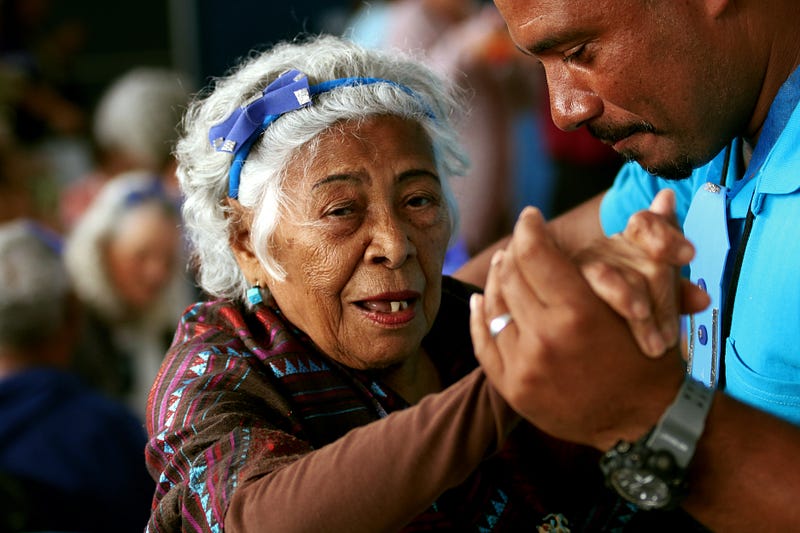
Photo by Vladimir Soares on Unsplash

I never knew my grandmothers, but I would not be here without them. I was a young girl when my grandmothers passed away. I recall sitting at the dining room table when my mother read one of the thin airmail letters to my father, the flimsy blue paper that signaled news from Ireland.

In the time before e-mail, texts, even phones, he had no way of knowing this letter would not bring news of the haying and milking, the newest baby in the family. Whether the thatch would hold up for another year or if it was time to spring for a slate roof for the farmhouse that had been on the land before the famine.

I recall my father shuddering as my mother gave him the news, the letter most likely from one of his sisters telling him that their mother had passed away. Or it might have been the letter about his father. I witnessed my father receive both blows but they have melded into that same awful moment.

My mother got her terrible blow about her beloved mother as she read her letter hanging from a strap on a crowded bus to the subway into Manhattan. She said she held onto the strap for fear of collapsing onto the floor with grief.

My father left Ireland for good in 1920 or so. My mother told me of his mother’s sorrow when she waved goodbye to each of the seven children who took off for America, not knowing if she’d ever see them again.

Half of her bairns left for New York, and half remained in Ireland. I imagined, having heard the stories of her iron will and sharp tongue as an overburdened mother, that she kept her heartache to herself when she sent them off.

Growing up and hearing of her harsh ways with my father, I imagined Mariah as an unfeeling mother. What did I know of saying a forever goodbye to your children when my whole world revolved around a new pair of roller skates as an eight-year-old?

But then I heard a different side of her from my cousin when I visited her in Galway as an adult. Grandma was a stoic, as my cousin described her. She had big strapping boys to raise while her husband was away in the mines in England, pounding rock to send money home to feed all those hungry mouths. If she gave her sons an inch, they’d run roughshod over her. It was not about love but testosterone.

As she told my mother about her parenting style, cooking for fourteen children on a turf-burning stove and with extra hands to feed during haying season, “There was no time for dandlin’ the babies on me knee.”

But she kept them all clean and groomed. My father had to wash the laundry within an inch of its life, and my grandmother would tie my father’s good suit in a tree so he wouldn’t sneak out early to the church dance on Saturday night. Imagine his shock when the collars and linens weren’t up to snuff and she dumped the whole lot in the mud. “Wash them again,” she said. No jigs and reels for him.

But ever style-conscious, she had her photo taken in a hat that I once memorialized in a story.
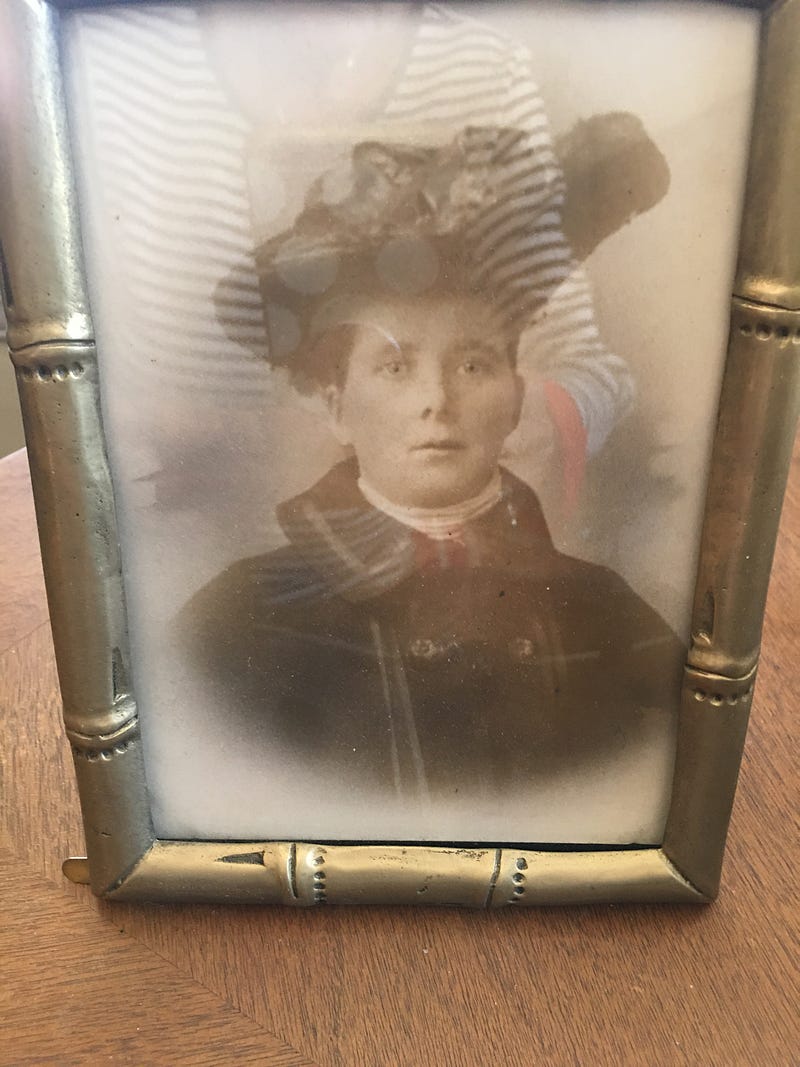
Photo of author’s grandmother, Mariah (Mary) Gallagher Cassidy, by author.

She memorably advised her daughters always to have a black skirt on hand, but “Make sure it’s a good black.”

Yesterday, I attended the Patrick Kelly: Runway of Love exhibit at the de Young museum in San Francisco with my daughter, a fashion professional herself. Tributes by the late, gifted designer to his own grandmother abound throughout the show. Kelly died of AIDS in 1990.

We learn that, in the fifties, his grandmother showed him copies of Vogue and other fashion magazines given to her by the white women whose homes she cleaned.

Patrick soaked up the fashion designs but wondered why the mags didn’t feature black women. Imagine the vision it took for this black, pre-adolescent, raised in 1950s blatantly racist Mississippi, home to the KKK, to vow to change all that.

His grandmother nourished his dreams of creating clothes like the French couturiers and showcasing the beauty of black women. He succeeded more than perhaps even she could have imagined.

Kelly came into his own in the ’70s and ’80s with an original look that showed playful designs highlighting buttons, hearts, and images that shed light on his racist past. Jungians could have a field day talking about Kelly revealing the shadow of the racist south with his collection of racist memorabilia, but he was comfortable displaying this aspect of his history.

Patrick Kelly’s career took off when the Warneco Corporation signed him to a contract in 1987. This tidbit thrilled me because my late brother Jack was named executive vice president of that corporation circa 1986 or 1987.

I don’t know if Jack was instrumental in that negotiation, but given his seniority in the corporation and his closeness to the CEO, I’m sure he knew Kelly and approved of the deal.

I like to think that during Jack’s tenure with Warneco before he died of lymphoma in 1988, our fashion-forward grandmother whispered to Kelly to make sure he found a “good black” for his signature tube dresses.

At the end of the exhibit, my daughter and I watched a film about Kelly’s life. In it, he mentioned again the love and support of his grandmother. It was her influence, giving him a sweater with mismatched buttons as a child, that inspired him throughout his short life, and no doubt the smile that made Kelly so beloved.

Photo by Kelly Sikkema on Unsplash

Kelly’s overall message, plastered on the front and backside of all of his gorgeous black models, was love in the shape of his iconic hearts. No doubt a homage, at least in part to his grandmother.

I left the museum knowing I wanted to write about the exhibit, but not clear what part and what message resonated most deeply.

And then I read Toni Greathouse’s beautiful piece about her grandmother.

Toni makes it clear that the direction her life eventually took was shaped by the years spent with her grandmother.

She outlines the strong religious faith of her grandmother and what she has taken from it to craft her own moral and religious underpinnings.

Her piece is a moving document, and I recommend you read it, whether or not you share Toni’s religious beliefs.

After the exhibit and reading of Toni’s grandmother, once again, as I have over the course of my life, I’ve thought of my own grandmothers and lamented I never knew them.

This month is my mother’s birthday. She was born 125 years ago, on April 23, 1897. Her mother, my maternal grandmother, envisioned a very different life for her infant daughter than the one fate had in store.

My maternal grandparents lived in the next village over from my father’s family in Country Mayo, Ireland. Life was hard in Ireland before its independence, so when the young Drurys, Mary and John, married, they moved to England in the 1890s. My grandfather had dreams of starting a greengrocers and giving his future children a musical education.

However, my mother recalled, as a five-year-old, seeing her father in a wheelchair and a complicated contraption involving pulleys and chains that helped him navigate after he suffered a severe illness from blood poisoning, supposedly from a splinter.

He died soon after and left seven children. With no means of support, my grandmother had to split up her family. She cleaned schools to support them and sent my mother to live with an aunt who was it turned out, cruel to her. Only the babies stayed with my grandmother.

Every story I’ve heard is that she was the soul of kindness and sweetness. The family lived for their Sunday dinners when they would gather with each other and see their mother.
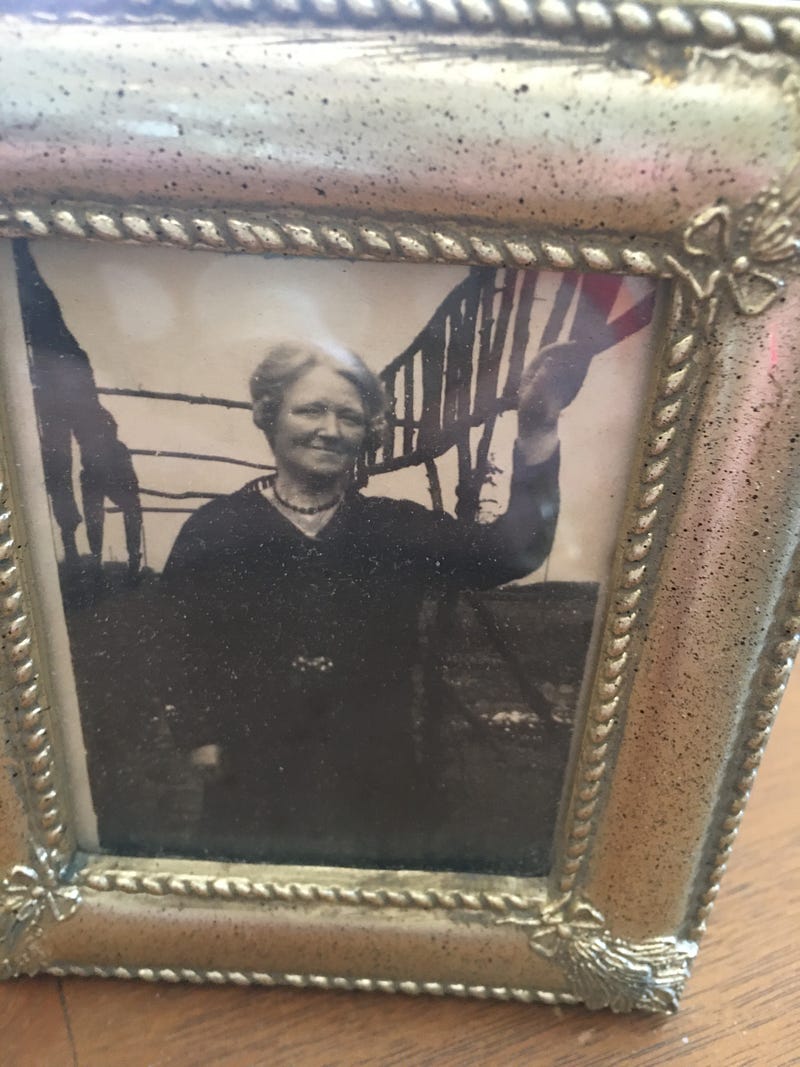
My grandmother, Mary Gavagan Drury, photo from the author’s collection.

I don’t know if she ever owned a dress that was a good black. I think she might have dandled her children on her knee. I think both women loved their families with a deep passion and great heart but found different ways to keep their children safe in a harsh world.

The love of fashion and family runs deep in our veins, the descendants of Mary and Mariah.

We’ve never had to struggle in quite the same way, but I’ve no doubt, if put to the test, we’d make them proud, the 100-plus of us now, counting the grands and great-grandchildren of all who share their DNA and spirit. We’re spread all over the globe.

I’ve always missed growing up without knowing my grandparents. When I hear stories like Kelly’s and Toni’s, I think about the strong women we’ve been lucky to have guided us, nonetheless, even if it’s only by virtue of receiving their DNA.

Somehow, they’ve come through us, whispering about good blacks, loving our children, bonding with family no matter what, honoring our ancestors.

Before you go…

Some other stories you might like.

I’m a writer and freelance editor Medium with Top Writer status. I’ve published 55 titles on Amazon. I edit fiction and non-fiction for private clients. If you’d like to hire me as your editor for fiction, non-fiction, or business writing, please contact me here. If you’d like to read more of my work on Medium, click here to sign up for my newsletter. Thank you for reading, and stay safe.

Family
Relationships
Grandmother
Children
This Happened To Me
Recommended from ReadMedium