
Granada, Te Amo
A short story
“Understand one single day fully, so you can love every night.”
— Federico Garcia Lorca
A woman sits alone in a café in Granada. It is not her first time in the city. She is a tourist here, on a three-day break with a girlfriend — but her friend is not here. She sits on a tall wooden stool at a small, high table-for-one, facing out over a cobblestone courtyard where grapevines spill from first-floor windowsills.
The café is popular. Since the woman arrived half an hour or so ago, a queue has formed on the opposite side of the courtyard. Families, couples, a mixture of locals and visitors, stand and wait for tables in the morning sun.
Apart from a pair of older women with Australian accents, no-one seems impatient or in a hurry to get a table. There is no particular order to the queue, yet everyone knows their place in it. The city does not rush. The people simply stand and talk and wait, some looking at their phones, some leaning against the white stone walls, as the occupants of the few tables outside eat tostadas and drink coffee and smoke cigarettes while light jazz music drifts from speakers behind the bar.
The woman finishes her breakfast and orders a second cup of tea. The tea is served in tall glasses which are too hot to touch for several minutes after they arrive. She reads a novel intermittently, looking up every now and again and noticing the people in the queue, who watch her, unintrusively, as she watches them, giving the whole scene an air of theatre. When the tea comes, the woman empties an entire sachet of white sugar into the glass, stirs it with a tall spoon, and takes out her notebook to write.
She surmises things about the people in the queue. There’s a young couple, a little ill at ease with each other. Did they spend last night together, maybe, and are they now going for breakfast rather than saying an awkward goodbye? It would not be outlandish to think so. The Australians are tourists, surely, wanting to tick the café off their bucket lists and rush on to the next thing. There are a few Spanish students wearing clothes like they’ve just come from the gym, and a couple with a baby, making parenthood look easy.
What, if anything, do these people make of her, she wonders? Is there something in the look of her which gives her away as an English tourist, a married mother-of-two on a weekend break? Or could she be someone else here— alone, childless, an immigrant resident of the city, stopping for morning tea at her favourite bar?
“To be writer, one has first got to be what he is,” says William Faulkner. But what is she? What is left of her, when the roles of wife, mother, writer are stripped away? Sometimes she is struck by an odd feeling of being a tourist in her own life — although she’s not sure where she might have come from before that. She’s not even sure that we really choose our own paths at all; more often than not they seem just as much to choose us. Perhaps our lives are just tapestries of privilege and chance, she thinks, and the exercise of free will simply adds colour.
The last time she visited the city she was twenty-five: younger, wilder, already in love with the man who would become her husband. She ponders the idea that, had she chosen a different path —if she had remained single, for example, and child-free— that in some mysterious and yet quite obvious way, the two threads of these opposing lives would almost certainly, perhaps even doubtlessly, cross over each another here, exactly at this moment, with both of the two women sitting with their backs to each other, here in this café in Granada on a Saturday morning in September.
She allows her mind to contemplate what this other life might have been. Would she have spent years meditating on a mountainside in India? Would she be working as a freelancer, traveling the world with a laptop? Would she be stuck in a dull job and going on endless unsatisfying tinder dates in an attempt to find someone to settle down with?
Her life, or at least this version of it, has been blessed with love and children, and she is grateful. Still, she can’t help but wonder about this mysterious other woman, the ghost of her unlived life, who sits at the bar inside, scribbling away in a notebook, wondering what her other life could be.
“I’ve often lost myself, in order to find the burn that keeps everything awake.”
— Federico Garcia Lorca
The woman spends the afternoon indulging in the simple pleasure of wandering the city streets alone, getting lost along the cobbled streets and alleyways. She drinks white wine and eats tapas and takes photographs, impulsively posting one of the photographs on Instagram with the caption Granada te amo.
She passes shops selling brightly coloured glass lanterns, trinkets and incense and then stumbles out into wide stone plazas where, at outdoor tables, people drink beer in stemmed glasses in the shade of grand colonial buildings. On benches, lovers kiss, a pair of young men smoke a joint, an old man eats an ice cream as he tries to decipher a map. It seems the whole city is outside, enjoying life. She takes off her sandals to enjoy the cool sensation of the stone floor, worn smooth as glass by centuries of feet.
She enjoys the feeling of unhurried disorientation. Often, her life at home feels ludicrously ordered and structured, dominated by the routines and demands of life and motherhood in a patriarchal, money-centric world. But here, if just for today, she can wander. She meanders through the city with no agenda or itinerary, and no real idea where she is going. She loses track of time and of herself, and finds her way back again. It is a lovely revolt.
“I know there is no straight road No straight road in this world Only a giant labyrinth Of intersecting crossroads”
— Federico Garcia Lorca
She arrives at an opening outside an enormous domed church, where, from the clothes of the people gathered outside and the air of celebration, it is obvious that a wedding has just taken place. She watches, smiling, as the bride and groom emerge from the church doors to applause. The newlyweds kiss, the crowd cheers. A Mariachi band breaks into song, a huge explosion of white ticker tape goes off — Bang! — and the people dance and sing as little strips of paper flutter and float around in the air for a long time, before settling on the streets and in the treetops and in people’s hair, like snow.
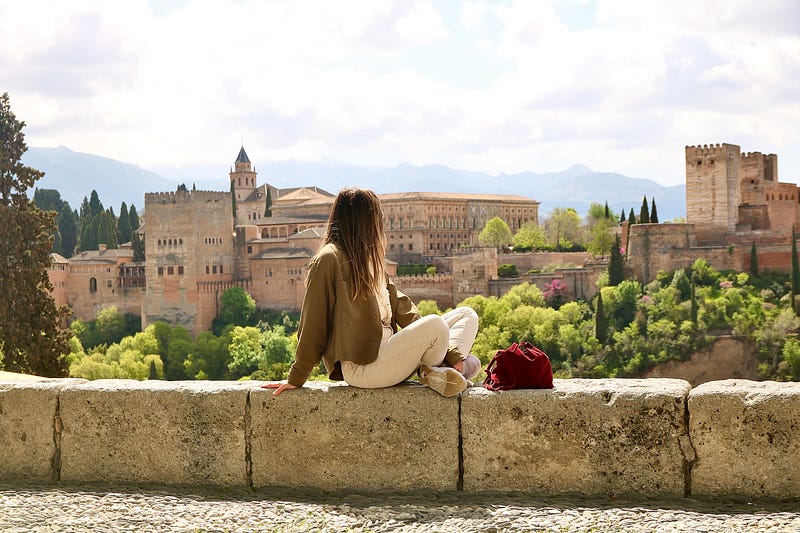
The city carries her to a stone bridge at the foot of the Alhambra. She listens to a woman busking on a cello as birds flit about along the river below: an ancient, sacred river, the source of all this beauty and life. She ducks away from the tourist hubbub and finds a steep, secluded trackway which leads down to the water itself.
Here, she is alone once more. Tired from hours of walking, she takes off her sandals and slips her toes into the shallows, finding a rock on which to sit and rest her legs, where she lets the cool, clear water wash over her feet.
She is forty years old now, embarking on a new decade of life. She reflects on the previous decade, her thirties — such a full time in life, overflowing like summer, with all its joy, and not without its storms:
Motherhood. Marriage. A global pandemic. The deepening climate crisis. A recent grief which has shaken her right to the foundations. And the writing: the thread which weaves through.
She notices a tall conifer tree beside her, and something glistens in the corner of her eye. She looks closer and sees that the tree bark is speckled with drops of sparkling amber: sap or resin, the joy and despair of the world crystallised in the slow tears of a tree.
For the first time in a long time, here with her feet in a river beneath the ramparts of a beautiful Moorish palace, she feels it all beginning to unweave, to settle, filtering down in tendrils of sunlight through the leaves, landing like silt on the riverbed and coming to rest in her bones.
“The important thing in life is to let the years carry us along.”
— Federico Garcia Lorca
Later, she meets Spanish friends at a bar. They sit on stools around a tiny table and drink red wine and eat tapas: miniature dishes of rissotto, bread with tomato paste and manchego cheese, jamon on round Rosca bread drizzled with good olive oil, fried patatas with garlicky aeoli.
They discuss, in English, how travel to and from the UK is more annoying since Brexit (the insane bureaucracy!); house prices which none of them can afford either in Granada or England, and how buying property in Southern Spain is probably a shit idea anyway, because it might all be desert pretty soon. It would be better to buy land in the North, they agree, in the mountains, with its own water source, as a matter of fact.
The waitress brings out a dish of paella with several teaspoons. The group shares the plateful and they joke good-naturedly about purchasing a bolthole in the mountains for ‘when things get bad,’ although they don’t elaborate specifically what that means.
As the conversation moves on, the woman looks around. She sees the trees and the fountains, the people walking and talking and sitting around in the early evening sun. She thinks of her children and of the wedding she saw earlier and she tries, for a moment, to imagine the scene in front of her turned to desert: the plants and the river and the centuries of art and culture, the loves and the lives and the human theatre of it all just vanished, extinguished, turned to dust.
“a sky and earth that darken by each hour…”
— from Stigmata of Love by Federico Garcia Lorca
The woman turns her attention back to the table and orders another glass of wine. The friends eat and talk and laugh until the sun disappears behind the tall buildings, the shade bringing with it a chill wind along the streets.
“Every song is the remains of love. Every light the remains of time.”
— Federico Garcia Lorca
It is evening. Back at her friend’s modern, third-floor apartment, the woman stands on a balcony and watches the stars come out over the city.
She sees the old tiled rooftops surrounding the cathedral. Bats darting about in the low dusky sky. Crickets chirping, cars humming past. In the distance, the city’s outer reaches twinkle blue, red and orange, the roads and industrial estates and hypermarkets a shimmering ocean of light.
Beyond the city limits, the dark peaks of the Sierra Nevada reach up into the twilight haze, carving a line in the sky as it fades into night.
Author’s Note: Federico Garcia Lorca was a poet, playwright and theatre director from Granada in Andalusia, Spain. If you feel the urge to get lost today, but can’t leave your desk, I’ll invite you to read a few of his poems here and allow your mind to wander, perhaps even be inspired.
Garcia Lorca was tragically executed by fascist forces at the beginning of the Spanish Civil War on 19 August 1936. His remains have never been found.
“Only mystery allows us to live, only mystery.”
— Federico Garcia Lorca, 1898–1936.
Thank you for reading 💙 Connect with me on facebook or on my website


