
Grab a Fire Extinguisher! Make a Positive Impact Before the World Goes Up in Flames
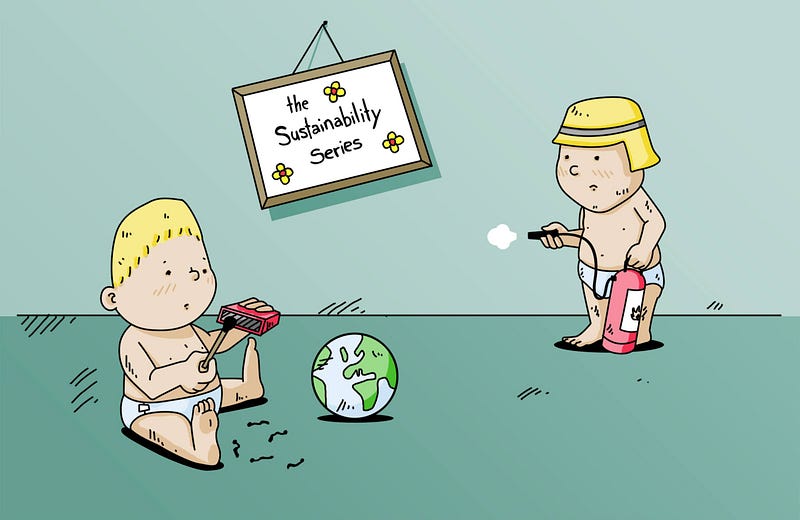
We need to talk about sustainability. We have some fires to extinguish before the earth literally goes up in flames. I am not talking about real fires; I mean rather economic, environmental and social issues we are facing (although, wildfires are increasing due to global warming in parts of South Europe, South America and the Western United States). In the economic sphere, too many businesses follow a short-term profit strategy rather than long-term profit strategy, at the cost of society, environment and long-term investors. In the 21th century the biggest challenge for societies will be around inequalities. Regarding the environment the main concern will continue to be global warming.
November 2017, the COP23 took place in Bonn, Germany. COP stands for Conference of the Parties, a gathering of smart people that are part of the United Nation Framework Convention on Climate Change, with the mission to find solutions to save humans from extinguishing itself, I mean reducing global warming — the 23 indicates that they tried it for the 23rd time. These are the same guys who wrote the Kyoto Protocol and the Paris Agreement. So how effective are they?
A short lesson in history
To understand global warming we need to differentiate between climate and weather. Let’s say this summer was warmer than last years, this indicates a change in weather. Next, assume that the coming 20 summers are becoming warmer and warmer, this indicates a change in climate. In short, climate is the long-term trend of weather. The biggest driver of global warming is carbon dioxide in the atmosphere (read here why). The figure below shows the amount of carbon dioxide over a period of 400,000 years.
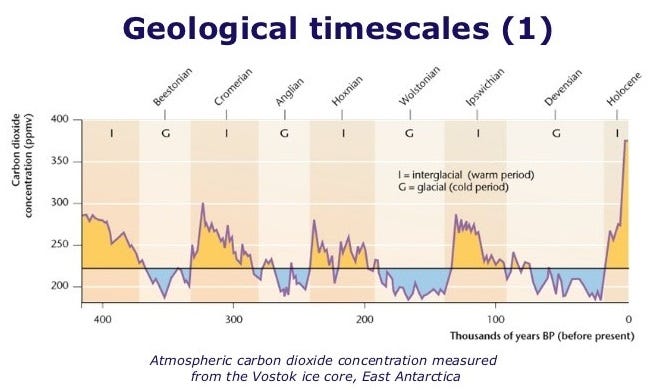
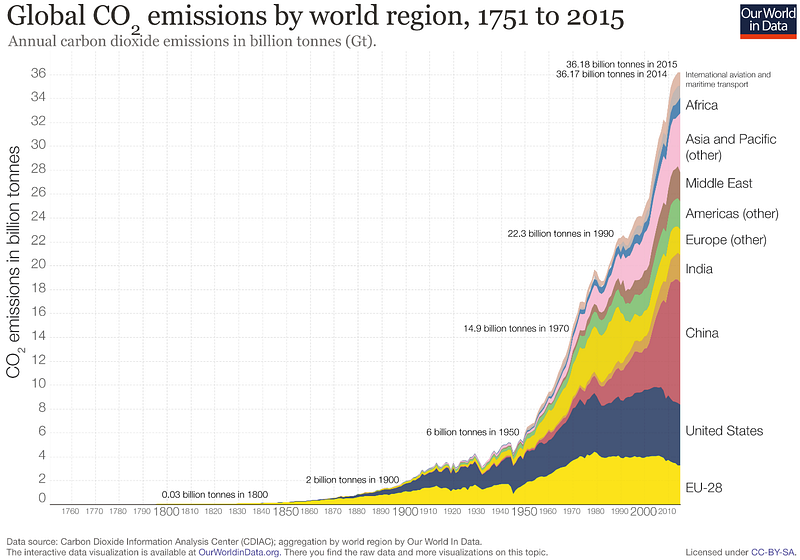
Why look at such a long period? It highlights the human impact on global warming. In warm periods (yellow) we have an optimal climate for humans. In cold periods (blue) we had ice ages. Currently, we are living in a period called the Holocene. Before 1850, the average atmospheric carbon dioxide amount in the Holocene period was similar to previous warm periods. Now, take a closer look at the next figure below. From 1850, the CO2 especially increased in Europe. What started in 1850? The industrial revolution. The expansion of the industrial revolution led to an exponential increase of carbon dioxide and ultimately resulted in an increase of the world temperature by about 0.8°Celsius (1.4° Fahrenheit). This is massive.
Dear reader, if you reached this far and believe that climate change is fake, then please take a second to close your browser. This will not be a debate if climate change is real nor if humans have an influence on it. Climate change is real and we have an influence on it. If you reached this far and believe that climate change is real, then stay with me to have a discussion on how we can have a positive impact.
Collaboration is a key for a positive impact
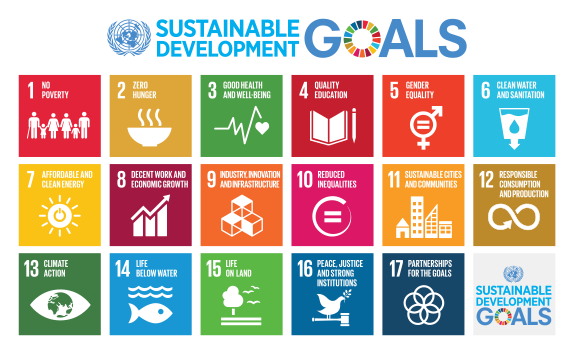
A positive impact is not just about climate change. It is about a sustainable development. That means that we satisfy our current needs without compromising the ability of future generation to meet their own needs. A milestone towards that agenda are the Sustainable Development Goals (SDGs). The SDGs are a set of seventeen goals to improve different social issues until 2030. They succeeded the Millennium Development Goals that were adopted in 2000 by the United Nations and ended in 2015. Take a look at the seventeen goals of the SDGs. These goals represent an immense task; one single country or business cannot solve them on its own. To have a positive impact it requires collaboration.
“ The 2030 Agenda for Sustainable Development and the Paris Agreement on climate change marked a turning point. And we can truly change the course of history when governments, companies, civil society and individuals everywhere carry out these global plans.” Ban Ki-Moon, Davos, 2016
Ban Ki-Moon described it perfectly; we can change the course of history if we collaborate. Every nation, organization or individual can contribute towards these goals. Take energy consumption as an example. The United Kingdom and Canada initiated the Powering Past Coal Alliance at the COP23. An alliance of more than 20 member countries that aims to reduce the amount of coal for energy use generation. Business also switches more towards sourcing renewable energies. Even individual households start to produce their own clean energy. The more people collaborate, the sooner we accomplish goal 13 — Climate Action. This is one of many examples of a positive impact.
What next … ?
My extinguisher is writing. I decided to write articles how organizations can become more sustainable. I will share my experiences from my graduate studies in sustainability; my work at Tesla and Oracle; and the endless discussion with sustainability professionals. The articles will explore how organizations can have a positive impact not just by only doing less bad but also by doing more good.
What is your extinguisher? Share it in the comments!