
Gorgeous Guilin
… a mingling of culture and nature.
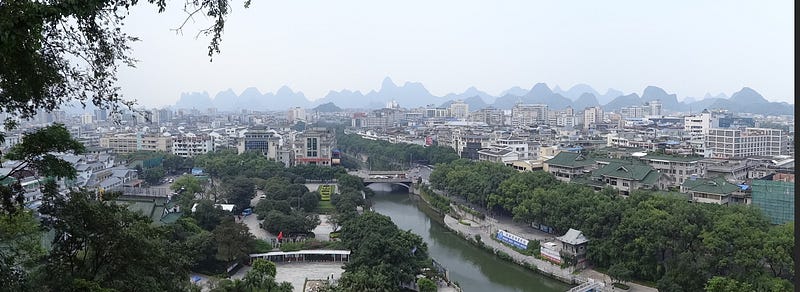
I can’t even remember how we decided to visit this city, back in 2013. I had never heard of the place before that and I wouldn’t be surprised if many of you don’t know it, either.
My wife and I had arranged a short holiday in China, tacked on to a stopover in Beijing en route to Mongolia. (I’ve recently written about our adventures on the Great Wall of China, during the same vacation.)
Beijing was interesting, but any country is not defined by its capital only, and we wanted to see something else. How we selected Guilin, is lost in my memory banks, but it was a very good decision!
That header image with all the apartment blocks and office buildings in different shades of grey, under an overcast sky may not look too appealing, not too “gorgeous”, at all. However, those impressive mountains in the background, and the river flowing through the city, promise that there is more.
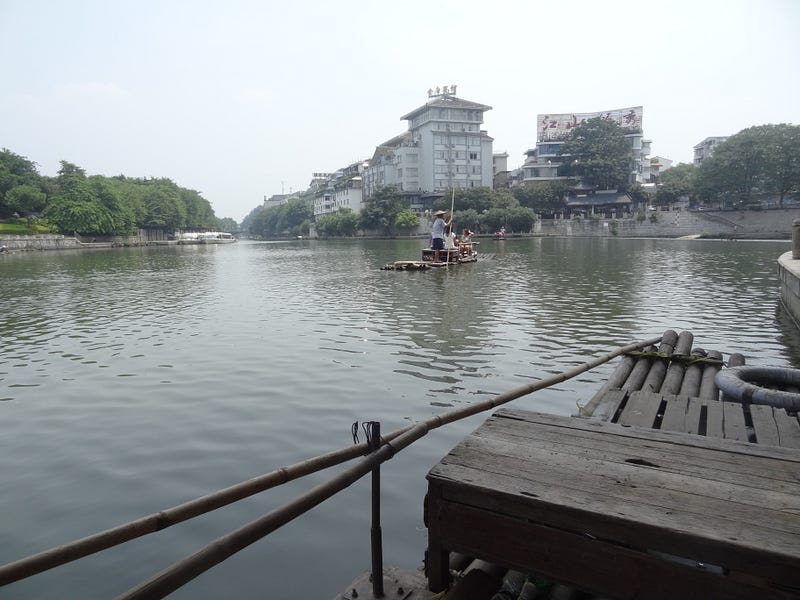
As the city straddles the Li Jiang (the Li River), it’s not surprising that quite a few views and activities are centred on or around water. Many years ago, on honeymoon, we’d taken a short gondola trip in Venice. Here in Guilin, some decades later, we took a trip on a bamboo raft, similar to the one in the image above. The views, mostly of the city seen from the bottom up, were not too impressive. At least not as impressive of the sights that were still to come!
One of the must-see sites is Elephant Trunk Hill, so named because from a certain angle, it looks somewhat like an enormous elephant drinking water from the river. Within the Elephant Hill Scenic Area, at the confluence of the Li and Taohua rivers, the hill has been a tourist destination for literally centuries.
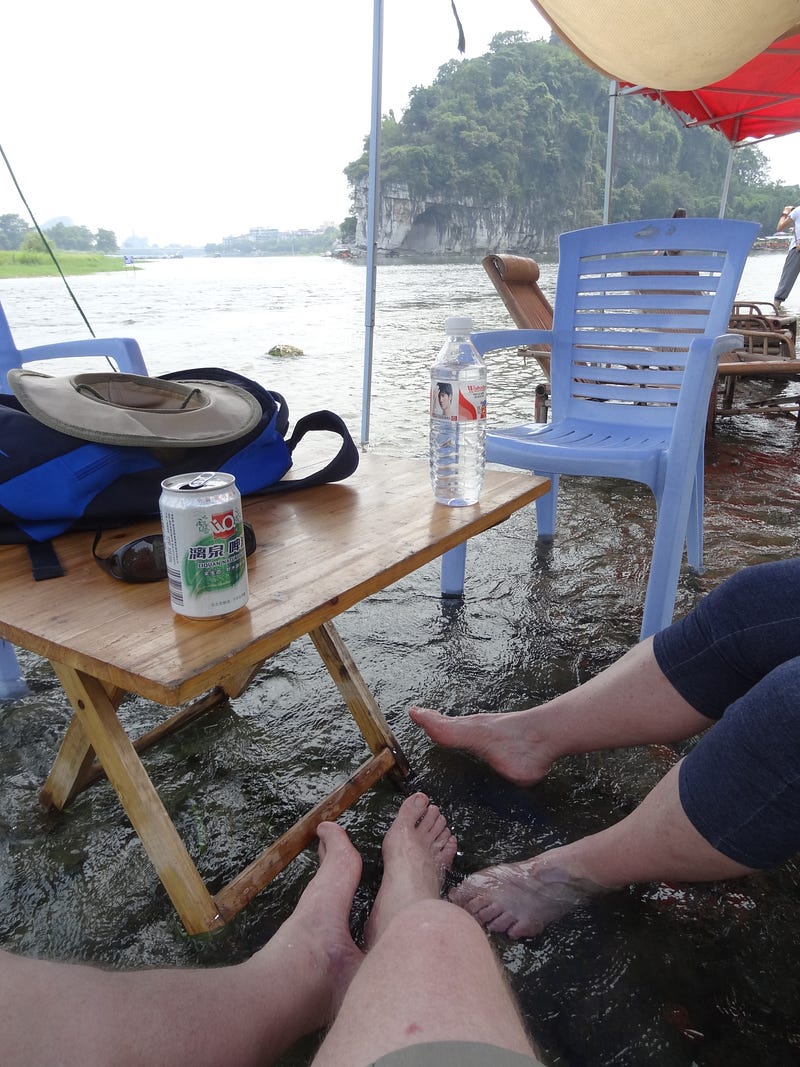
And in 2013, it was definitely a very well-developed tourist destination. From the people who sell you cold beer (and who provide a place to drink it while sitting in the river), to those who take you on bamboo raft trips, almost everybody was focused on providing a service to tourists.
Strangely, this bothered us less than we thought it would, perhaps because almost all those tourists were also Chinese. In a way, they also provided some of the scenery and the cultural context.
There’s a local legend that the hill is the embodiment of a God Elephant who used to be the mount of the Emperor of Heaven, that somehow got wounded and was stranded in Guilin, where local people tended to its wounds.
Now, local people and many, many non-local people visit the Elephant Hill Scenic Area and climb the hill itself. As did we, of course. I mean, what did you expect? That visit was also facilitated by well-built and maintained paths, leading up to the Puxian Pagoda on the top of the hill, and the Yungfeng Temple, on one of the slopes. All of these gave the area much more of a historical-cultural feeling, than a natural one.
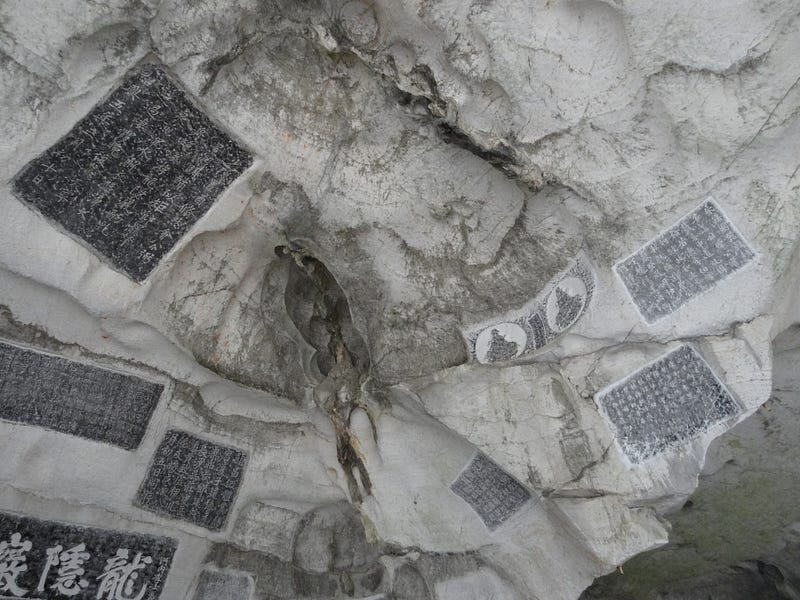
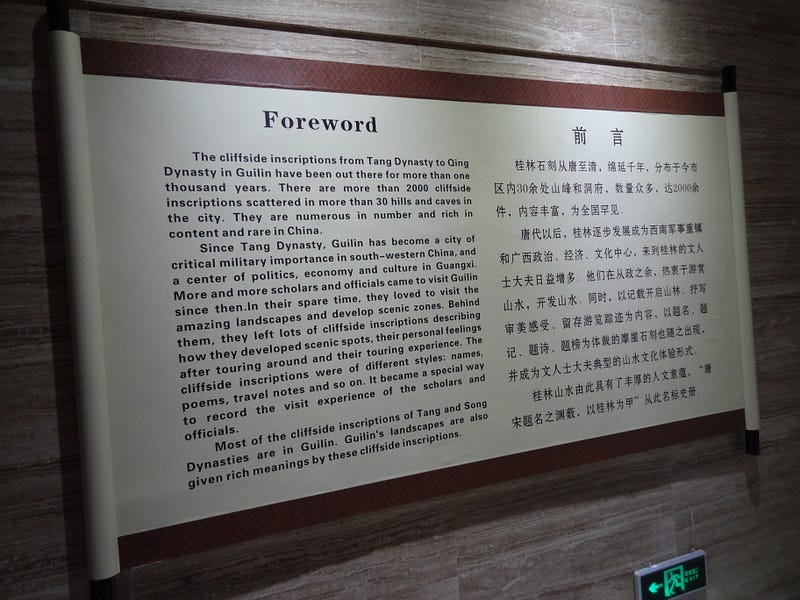
However, the lush green vegetation and the natural inhabitants of the hill blended in well with all the touristic stuff like pagodas and temples and concrete pathways and graffiti.
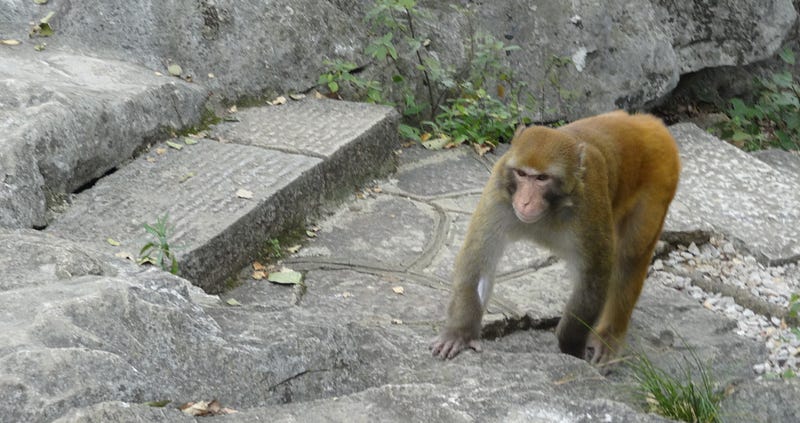
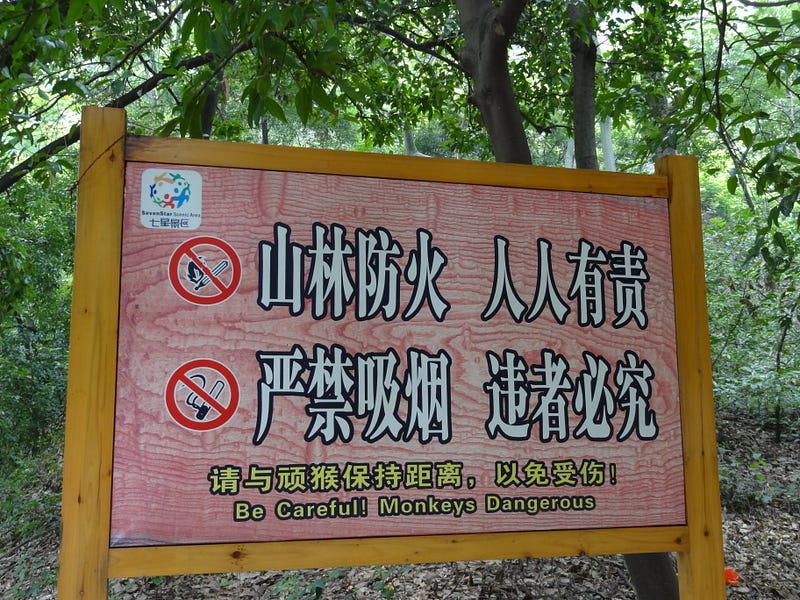
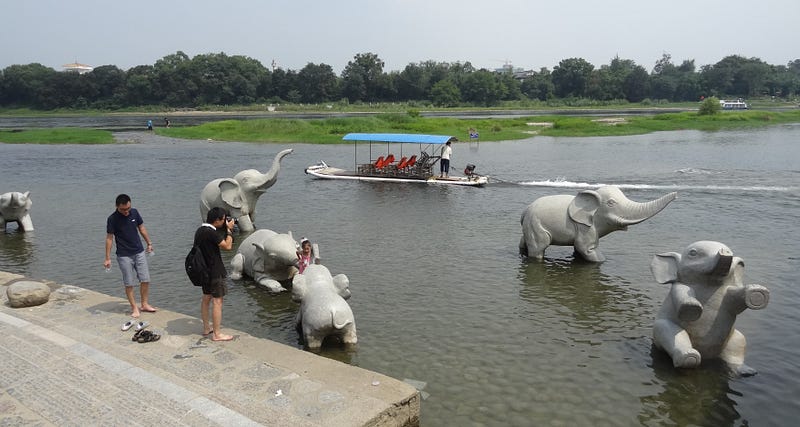
So far, you might be thinking that this is all very well, a limestone mountain that looks like an elephant (from a certain angle), inhabited by monkeys, some concrete elephants posing for touristic pictures, and a river flowing through it all, but the title promised “gorgeous” Guilin…?
Just wait until the sun sets.
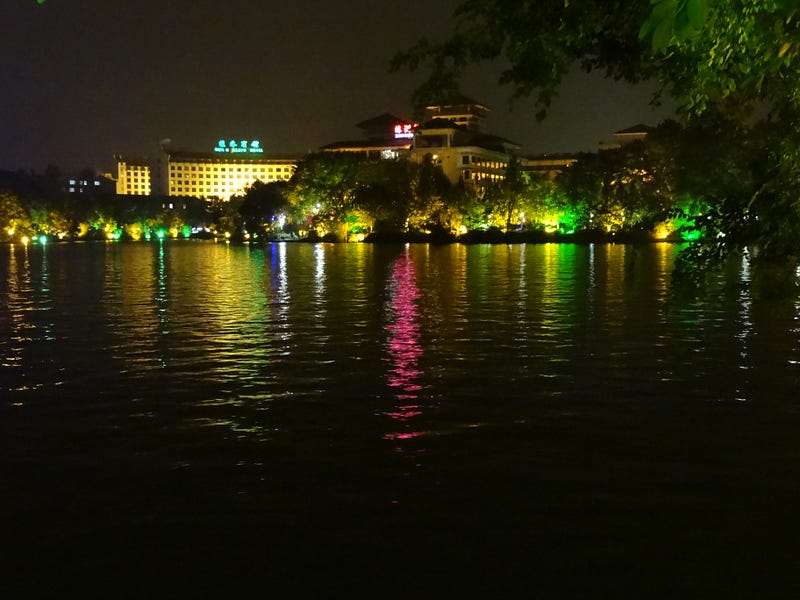
When darkness fell, lots of artificial light sources compensated, with colourful effects. Somewhat garish, yes, but this did provide very colourful reflections across the various parts of the river. In many places, there were covered promenades next to the water, where groups of people would sit and chat (or have a smoke) and at some of those locations, there were musicians, either in small groups or single. It all appeared to be quite spontaneous, with people just playing music (and listening) because they enjoyed it.
We appeared to be the only non-Chinese people around. (Actually, we did see two blond, Scandinavian-looking girls at one point, but that was it.)
One evening, while walking through the city streets, looking for a place to eat, we were approached by a little boy and his mother. He mentioned that he wanted to try out his schoolboy English and his mother (who spoke not a word of English) encouraged him to talk to us for a few minutes. We think that we are very experienced and wary travellers, so we did start wondering if some sort of scam was going to develop, but no, he just wanted to speak some English. After a few minutes, he politely greeted us, his mother smiled and waved, and off they went.
And off we went to find a cake shop. Because, yes, that seemed to be the trend there: Very lovely, very very tasty cakes and pastries in shops that looked like they should have been located in Paris or Vienna. Culturally out of place, but we love pastries, so we did eat quite a few while in Guilin.
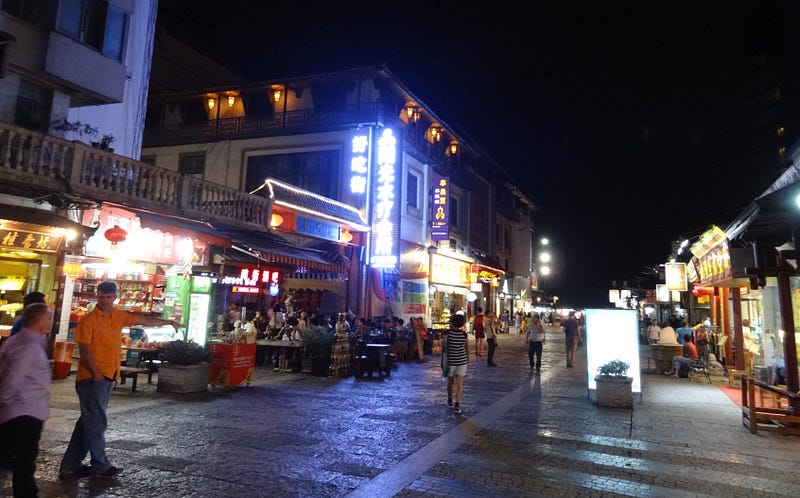
I could mention much more about Guilin, but let me conclude with one more evening experience: our visit to the twin Pagodas of the Sun and the Moon.
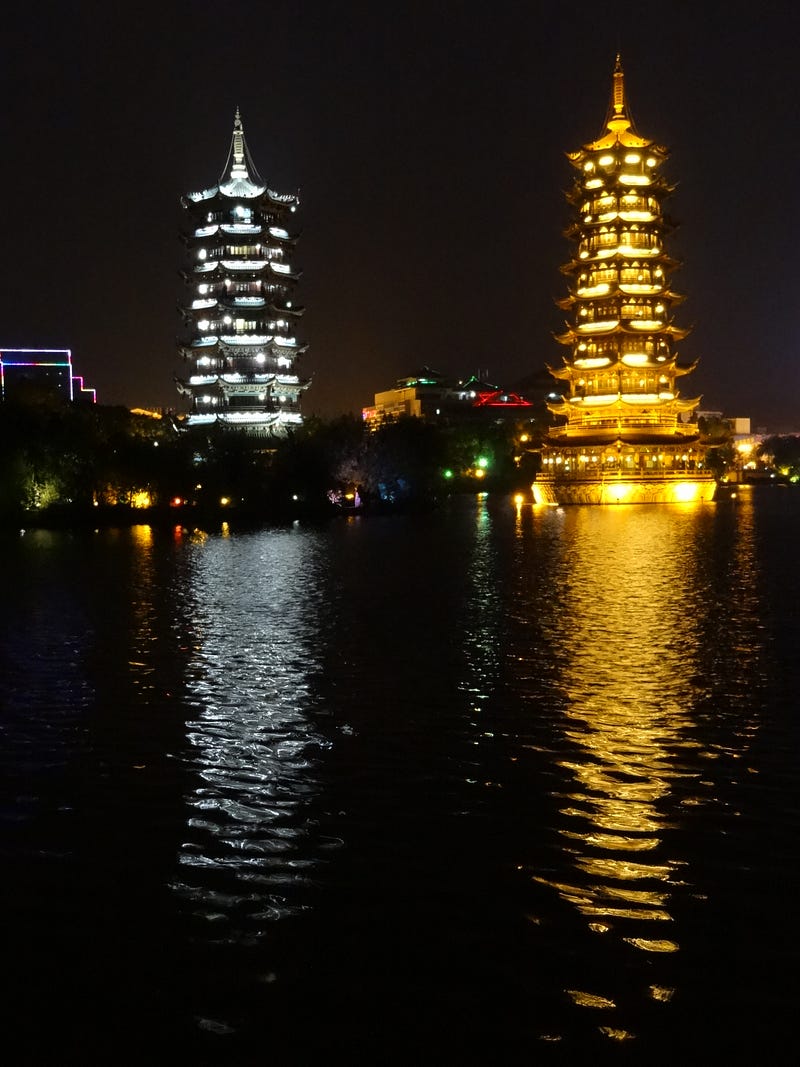
With so many neon city lights around, it was tricky to find one spot where the light from the two pagodas would not have to compete with various other green, red and blue lights. I almost succeeded. It was possible to enter the Pagoda of the Sun, and so we did that, in order to see the city from above.
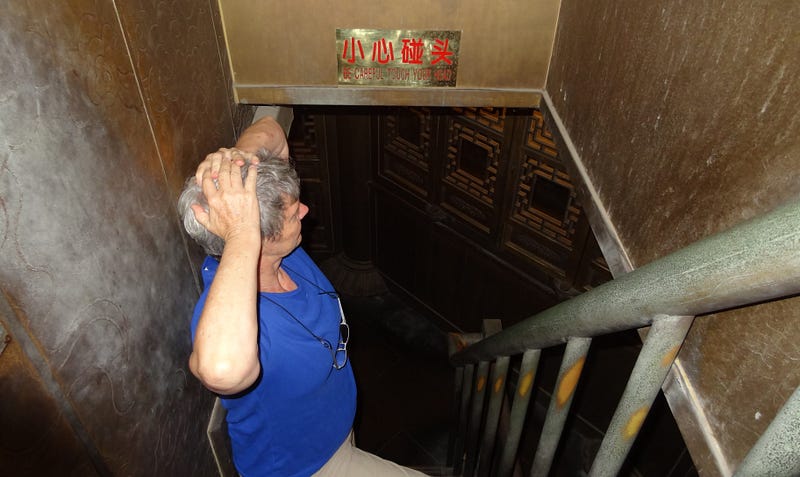
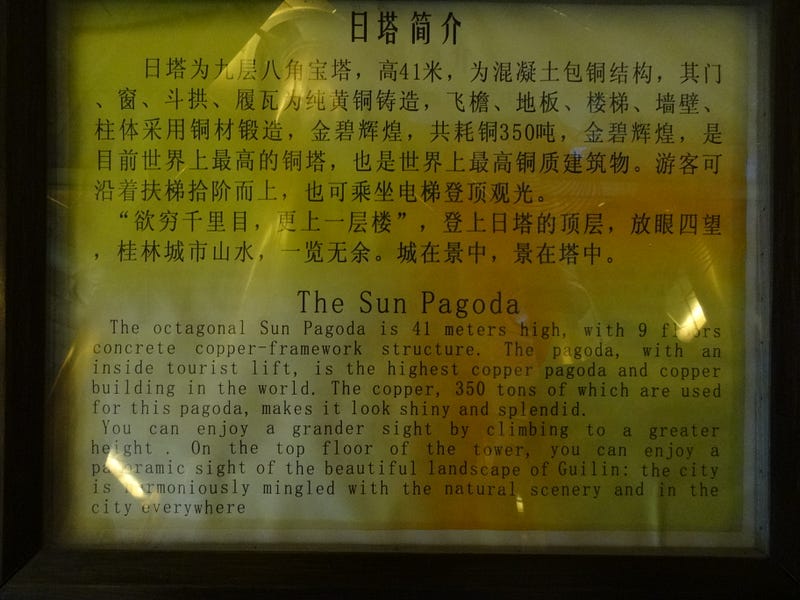
That last image, the sign mentioning the “harmonious mingling” of the city of Guilin with the natural scenery everywhere, seems an appropriate way to conclude this story.
In the next story, I will share some of our visits to a beautiful, more natural area nearby. Watch this space!