
Gordon Parks: An American Example of Brilliance in demonstrating Artistic Transcendence
A rare, non-snarky Essay (rather than one of my snarky Rants) about a brilliant American Master Artist that all who love and appreciate Art should be familiar with.
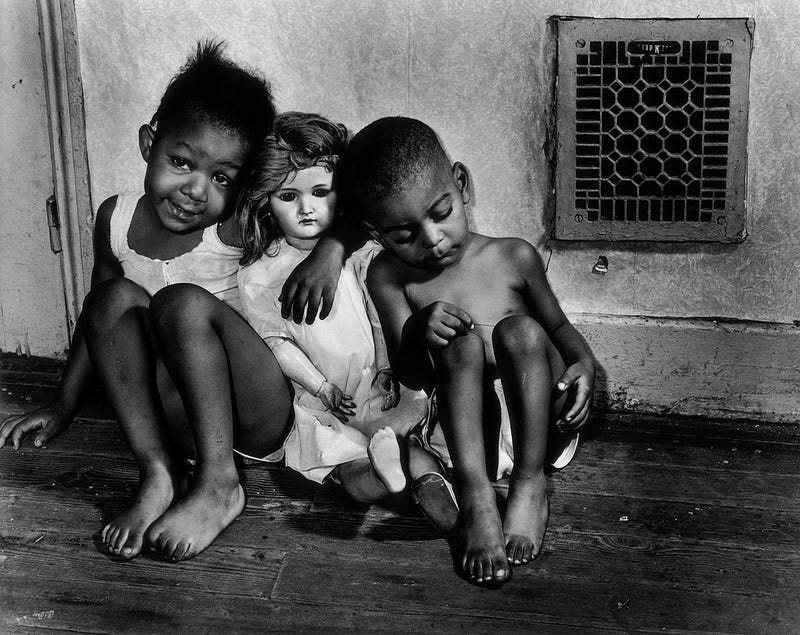
The body of work by Gordon Parks is an important part of American Social and Political History. His contributions to a better understanding of poverty, race and culture are well known, and nothing I say here as an aspiring Artist and Art Educator is meant to diminish or obscure that legacy. However, for those of us focused largely on recognizing his stature in World Art History, he was, first and foremost, an Epic Artist of the Highest Caliber. He was a Black American — the first Black American to be a Life Magazine staff photographer. But, as historically and socially significant as that is, it was not the primary attraction for an emerging Artist like myself — an older American Artist of mixed Anglo and African ancestry, with brown skin, caught in a multigenerational cyclone of frustration and anger about race. What is of overriding importance to an Artist like myself is that he was a Master Artist — a man whose artistic skill moved beyond the constant didactical rhetoric in an out-of-control nation to represent the highest goal of any Artist for the Ages: Transcendence.
In America, we rarely consider anything attributed to Black historical figures to be relevant outside of the contentious racially-centered social and political context that we have historically been trapped in. Racial passions are routinely being inflamed by a propaganda and controversy obsessed mass media. For a large chunk of the world’s population, politics and other pop culture fare are a daily addiction — often consumed to near overdose. However, when we hear pop culture discussions about the Photographic work of Andy Warhol, Ansel Adams, Edward Weston, Dorothea Lange, Vivian Meier, Diane Arbus, Man Ray, James Nachtwey, Margaret Bourke-White, Henri Cartier-Bresson, Richard Avedon, Annie Leibovitz, and countless others, we hear discussion in terms of their place in history as Master Photographers in the World of “High Art.” We hear some of these names relatively often in media and academic discussions about Art. Oddly, some are less frequently discussed. All are significant and knowledge of them is part of any functional definition of Art Literacy.
Though Parks is occasionally mentioned by those in the know in pop culture, his artistic legacy is not as widely known as beatified giants of Art like Warhol, Adams, or Lange. Ironically, Parks worked as a Photographer for the Farm Security Administration, as did Lange, but did not receive the same broad level of pop culture celebration. Gordon Parks created work every bit as vibrant, relevant, and artistically complex as any of our highly celebrated and often favored sons and daughters who are not Black. But, somehow Parks is viewed primarily, in the context of popular culture, as a Civil Rights Activist — as opposed to being recognized as a multifaceted creative genius who was also a World-Class Photographic Artist. Even in our current context, Lange is more frequently included in discussions of poverty and class in the context of photography, though both she and Parks produced numerous images of great importance to the understanding of the scope of poverty in America during that period.
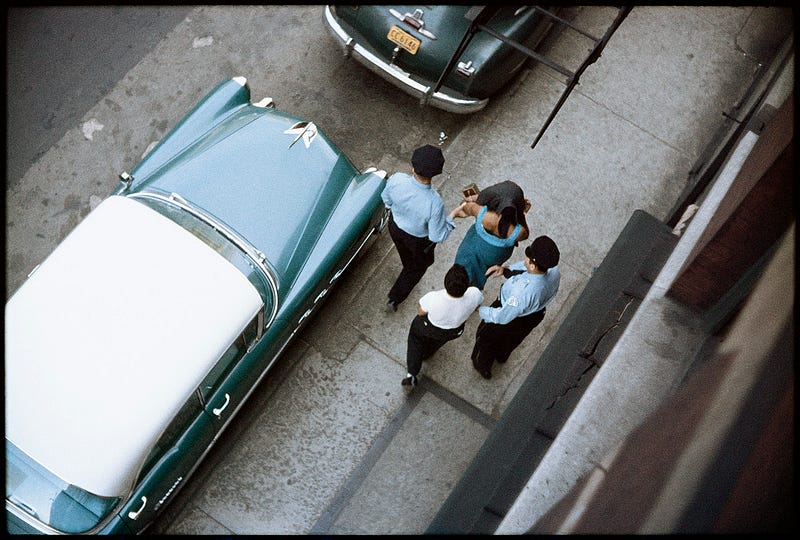
I discovered the works of Gordon Parks later in my life (I hesitate to say “late,” since that might imply being near to its end — which I hope is not the case at the relatively young age of sixty). I stumbled upon them by accident, as a fifty-nine year old disabled veteran and university student studying Fine Arts and Creative Writing at a public university in the American Southwest. As I perused the lists of significant American and World Photographers, in my quest for unique and moving inspirations, I found Parks, towards the end of a list of American photographers. Seeing him as one of few Black photographers represented, I was curious.
I located numerous articles on his role in advancing civil rights, his role in helping to create the Blaxploitation genre, and articles on his attaining a broad reputation as a Photojournalist of note. But, there relatively few articles to be found that focused on his importance as a major American Artist. And being completely honest, what I had been searching for were Artists I could analyze and learn from.
One of the first of his images that I found was the image of a Black man emerging from a manhole (the iconic Invisible Man series — images of American Novelist Ralph Ellison), employing a unique type of photographic composition, precisely employed Focal Vignettes, and a couple of oddly isolated Bokeh highlights. The image was bold and artistically on point. I was intrigued. I decided to research his work a bit more in depth.
As I continued my exploration, I found one image after another of profound Art of with subject matter that was familiar, but with an uncommon and unfamiliar depth of insight. I realized that I had found an Artist that I could immediately admire. The fact that he was Black didn’t go unnoticed, but it wasn’t what was compelling to me. What was compelling to me was that I had found an Artist whose work offered me new insights into the breadth of artistic expression. Some of the images brought me to tears of joy — not because I had finally found a Noted Black Photographic Artist, but because I had found a truly unique Art Master. To me, that is a find worth more than diamonds or gold.
I experienced similar sensations as I discovered each new Artist whose work I fell in love with. I fell in love with the work of scores of Artists from Ancient Western and Eastern Cultures. I fell in love with scores of works from Byzantine and Renaissance Artists. I developed a special affinity for the wonderful work of the German Expressionist and Neue Sachlichkeit Artists, and American Artists of color, along with other marginalized American Artists, who were all denounced by the Nazis as “Degenerate.” I found Artists from all times and places whose works I loved and cherished. The Artist’s ethnic background and/or national origin or specific exigent circumstances was rarely what first attracted me, outside of those factors which might have inspired the Art. What always struck me first and most profoundly was the strength of the works. And often, I was overwhelmed with emotion as I discovered each new treasure of Art.
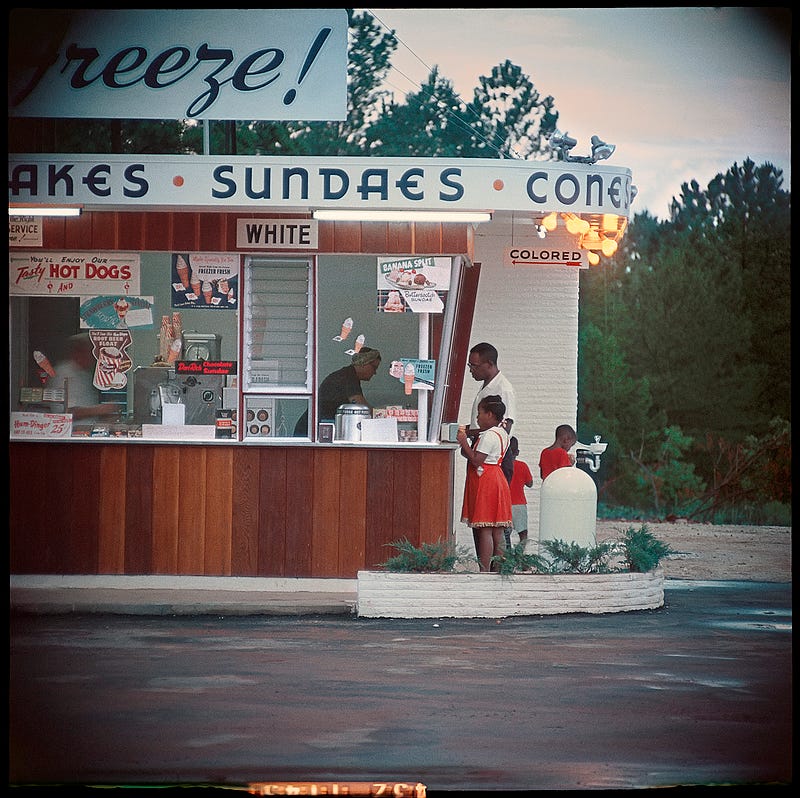
In learning about the work of Gordon Parks, I found another artistic vault of treasure. The image from Shady Grover, Alabama, from 1956, was one of the most profoundly moving of the images I found in my deeper explorations of Parks. Contrary to the current mood of our times, the image of a Black family being served ice cream next to a trash bin in the segregated South didn’t inspire immediate indignation or offense for me. It inspired a type of glee in seeing an image that is — to my modest skills of opining and even more modest, but evolving, credentials in Art History — Perfect Art. I saw technique and artistic vision at its most accomplished level. I felt like this man, whose image conceptually and artistically encapsulated that moment in time, beyond the ugly reality of the racist legacy it represented, had sent me a timeless gift of inspiration and instruction. As an Artist, and I acknowledge that we can sometimes be highly emotional creatures, I genuinely wanted to span the boundary between the living and dead to thank him. More importantly, I wanted to work as hard as possible become an Artist who is as profoundly gifted as Gordon Parks. I remember telling my wife as I stared, tears welling up in my eyes, at the image, “That photographer is a Master.” Not everyone might understand, but the joy of seeing such skill and passion outweighed the sense of gloom that situation represents. It gave me hope as an Artist, and as a person who loves the Transcendence of Art.
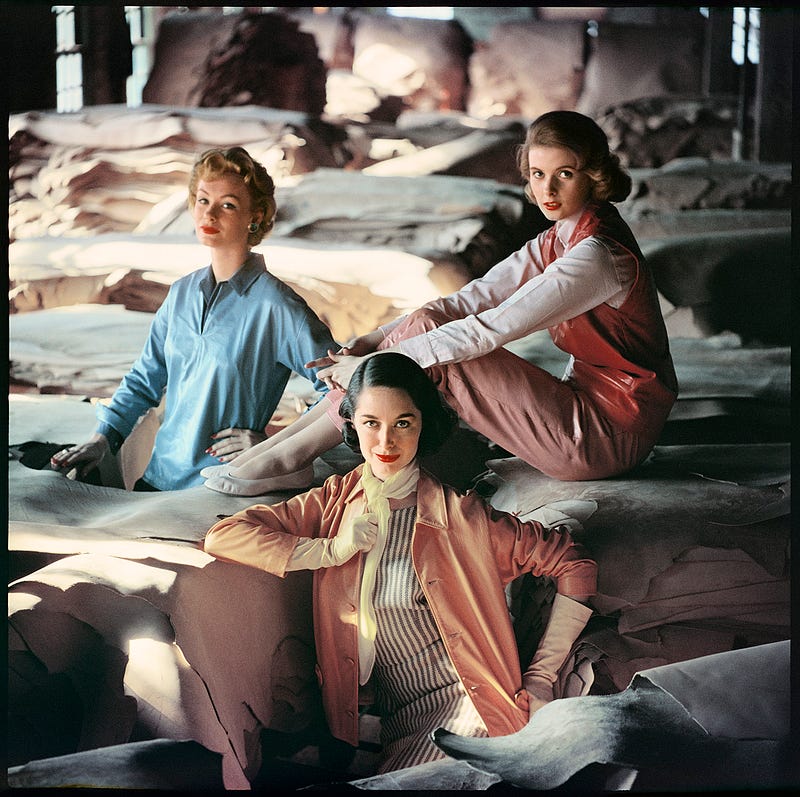
The beauty of the Transcendence of Art is that is really doesn’t matter who, where, or what you are when you experience it. It only matters what the Art inspires inside you. There is only Art, and one’s Reaction to the Art. The Art may focus on race, class, gender, beauty, love, religion, or whatever, as its subject. But, the Magic of the Art arises from the skill of the Artist in bringing into being the sublime and complex impulses that possessed the Artist to want to create it. If Art succeeds at inspiring change in the social and political realm, that Transformative Power arises out of the skill and insights of the Artist to employ creative Magic. Each Artist captures a tiny piece of Divinity in the process, and establishes a kind of immortality for both the Artist and the Artist’s subject in the process. That is real Power that only the soulless among us could resist.
Though Gordon Parks is known for many other creative endeavors beyond his Photography, as a student of Photography (and a fellow Nikon shooter — as Gordon Parks used Nikon later in his career), among a couple of other specialties, I am most drawn to the numerous images he created. They reach me. In them I find solace in seeing not only someone who is clearly sympathetic and compassionate towards the subjects of his works who are most in need, but who also has the skills, spirit, and the drive of a World-Class Master Artist.
His unique composition, especially in his color images, along with his choice of diverse subject photographic subject matter, made for distinctively interesting and emotional images. The centrality in frame of some subjects, sometimes employed outside of the Rule of Thirds concept, make for images that create a feeling of sympathetic and compassionate Humanistic Observations. His use of enhanced contrast in his black and white images is always point on, and not overdone. The tonal choices in his color images, along with the highlight colors he seeks out, make the images feel simultaneously both dreamy and hyperreal. Each image creates a masterful narrative that challenges the viewer’s emotional sensibilities. When I wasn’t tearing up, I was gazing at his artistry with my mouth open — aching to ask him a million questions about his artistic choices. While that may not be a rare occurrence for me, it is part of the Magic that makes me perpetually excited and grateful to be an Artist.
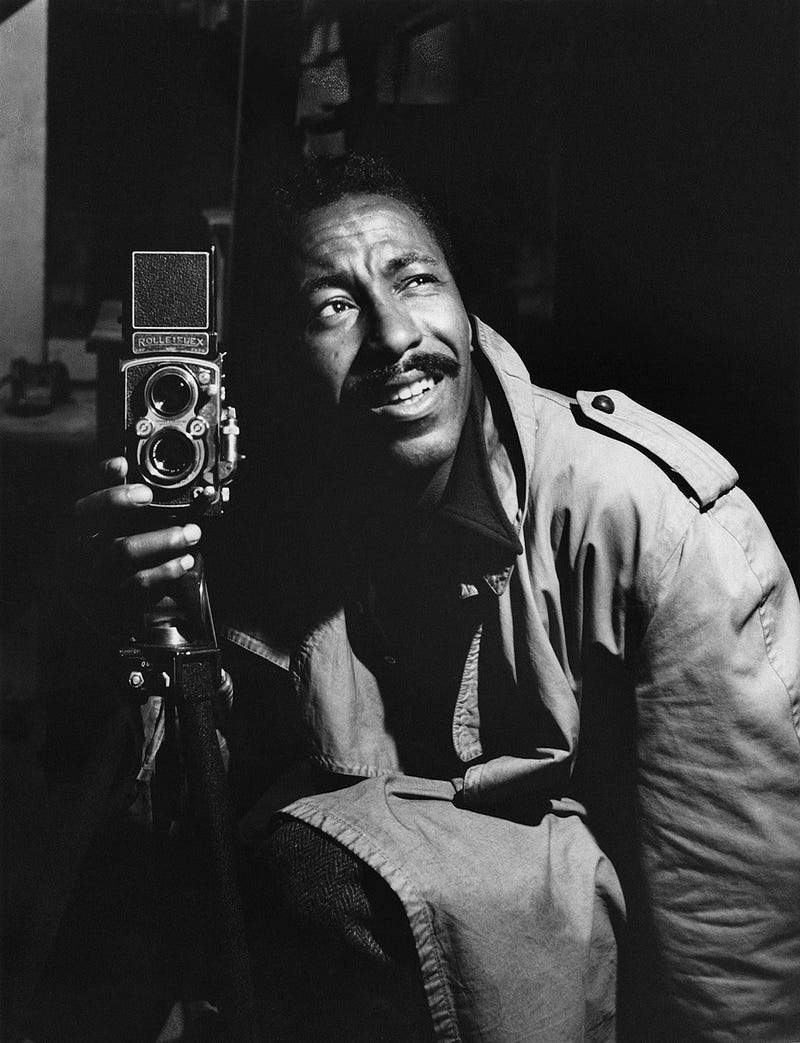
Though he is largely known in popular culture as an Activist, Writer, Filmmaker, Composer, and though he traveled many other creative paths, it was his skill as a Master Art Photographer and Photojournalist that deeply captured and nurtured my imagination. His images transcend time, space, race, nation of origin, economics, political affiliations, and other mundane aspects of everyday life to capture the Magic of Art. In a world sorely missing many examples of Magic, every person who loves Art, across the world, should take the time to sample the Magic that Gordon Parks has left us.*
All images used in this essay are copyrighted, and were used with the written consent of the Gordon Parks Foundation. Their reproduction, use, or promotion without the permission of the Gordon Parks Foundation, is prohibited. Copies of the agreement are on file with both the Foundation and the Author.
I offer my personal thanks to the Gordon Parks Foundation for generously allowing me use of the images, their tolerance of my novice understanding of the image licensing process, as well as my unnecessarily anxious and unreasonable requests for assistance in maintaining accuracy. Most importantly, I want to express my gratitude for their efforts at preserving the legacy of this amazing Master Artist. I am grateful for the honor of having been able to briefly discuss my personal perspective of Gordon Parks as an inspirational Artist, champion of human dignity, and compassionate human being.
To learn more about Gordon Parks and his work, visit the Gordon Parks Foundation Website. While you’re there, please consider supporting the foundation and their important work.
*My unorthodox use of capitalization, italicization, and nonstandard punctuation in my writing is a stylistic choice. I am a Visual Artist, as well as a Writer, so how words appear on the page transcends my devotion to formal conventions of writing, at times.


