
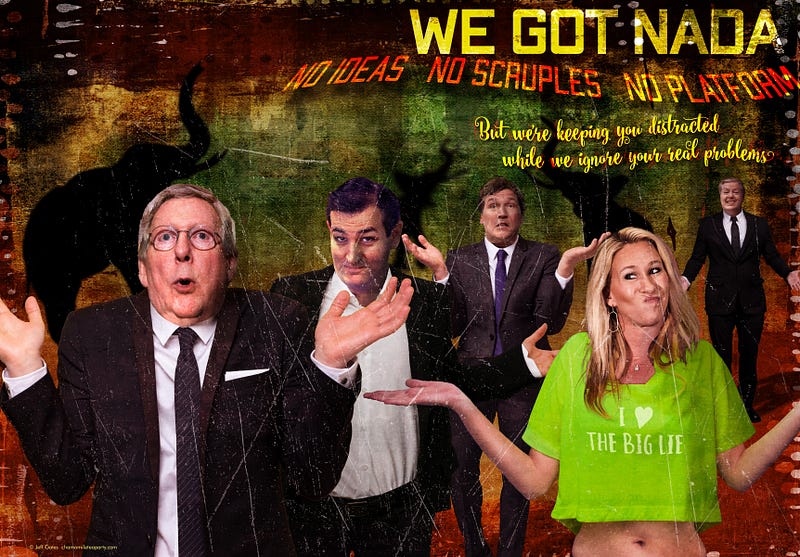
GOP: We Got Nada. No Ideas. No Scruples. No Platform.
But we’re keeping you distracted while we ignore your real problems
As we enter a new election cycle, every voter should be asking themselves, what is the Republican platform, not just for the midterms, but for 2024? What exactly does the GOP stand for, and what programs would they like to enact should they carry Congress and even the Presidency?
So far, all we’ve learned is what they don’t want. They don’t want people of color voting. As demographics shift to a more racially and ethnically diverse population, the party’s base is dwindling. So, legislatures in conservative states are passing a record number of voter suppression laws. They don’t want to make it easy to vote for anyone but them.
Vladimir Putin’s invasion of Ukraine presents an interesting parallel to the political and social upheavals in the United States. Both represent existential threats to our countries’ futures. Yet, unlike the united opposition Ukrainians have displayed against Russian aggression, Americans stand more divided than ever before.
The Republicans’ platform lacks any coherent substance to better people’s lives, but they are in lockstep unison with their messaging. In contrast, Democrats are committed to reducing income inequality and ending racial and gender discrimination. But they lack a coherent and united message. We are at an untenable impasse.
President Biden’s State of the Union got several bipartisan standing ovations when speaking out against Putin. The enemy of my enemy is my friend (well, temporarily).
The applause continued when Biden declared the police would not be defunded. But as The Nation’s justice correspondent, Elie Mystral, remarked on The View, the President failed to give his words any context. “Defund the police” was a confusing phrase that didn’t mean what it stated. The backlash was huge and unnecessary. And it didn’t get to the heart of the issue.
It was a call to restructure police departments so that social workers and psychologists, not police patrolling neighborhoods, handled marital disputes, the homeless, and those in psychological distress. These people were being jailed and killed at alarming rates when we should have been treating them for their mental health problems. And, when put that way, the police welcomed that change. Biden’s comment garnered rapturous applause from both sides of the aisle. Yet his message lacked any substance. It was a missed opportunity.
Was this another of his attempts to find common ground with Republicans, something to build on? Or was this a temporary Kumbaya moment? Bipartisanship is far from reality given the Republican’s response to the President’s State of the Union by Iowa Governor Kim Reynolds. Being an election year, using overly simplistic talking points makes it easier for the electorate to make choices. “On the economy, the contrast couldn’t be starker,” Reynolds said. “While Democrats in DC are spending trillions, sending inflation soaring, Republican leaders around the country are balancing budgets and cutting taxes.”
In reality, both GOP and Democrat governors are cutting taxes. A booming economy and COVID relief have built huge tax surpluses across the country. However, there are fundamental differences between each party’s strategy for distributing those surpluses to its citizens. Republicans want to create tax cuts that benefit the rich, believing the already discredited “trickle-down economics” theory creates more jobs. Democrat-led states want to tailor amounts more to the middle class. In Iowa, Reynolds wants to do away with the state’s nine-tiered tax rate. She wants to replace it with a flat rate of 4%. That would put a more significant tax burden on the middle class and poor.
While politicians like Governor Reynolds would like voters to think Democrats are to blame, inflation is soaring for many reasons. The prolonged pandemic changed our lives virtually overnight. We stayed home. We didn’t eat out, go to the movies, or use our cars. Instead of spending, we saved. And the federal government helped millions in need with financial assistance. Oil prices plummeted, and OPEC reduced output to compensate. And, now that the pandemic might be easing up, we’re ready to spend that cash. We’re driving again, and with the greater demand for gas, oil production has yet to match our increased needs (and with higher profits, OPEC is taking its time). That’s one of the main reasons for the high cost of gas. Russia’s invasion of Ukraine has only added to this volatility. Chaos breeds unpredictability. Not surprisingly, the Governor failed to mention this.
COVID caused a lot of supply chain issues. Not only did sick and absent workers slow the production of many goods, but, like oil, the demand outstripped inventory. And let’s not forget the price-gouging shipping companies. The cost of shipping a cargo container from Shanghai to Rotterdam rose 547% compared to the seasonal high during the previous five years! So there are many reasons we’re encountering inflation right now. It’s a problem, but not a partisan one.
We are experiencing one of the most turbulent times since World War II. Neither the Democrats nor the Republicans have all the answers. Nor can either party fix it all. Unlike Ukrainians, we are far from united in our efforts to save our country. This stalemate will be the death of us.
Build Me a Wedge Issue
Without actual plans to help struggling Americans, Republicans create cultural wedge issues to ignite their base and bring out the vote. Not only did Donald Trump’s disdain for taking commonsense health precautions prolong the pandemic, but it also turned us against each other. That’s the Republicans’ plan right now.
We don’t teach critical race theory (CRT) in our children’s schools. So why are GOP-led states trying to ban it in K-12? Why are parents so whipped up about it, attacking school boards and threatening their members? Because anger brings out voters. Republicans accuse liberals of blaming Whites today for the sins of the past, and it’s incendiary. But that isn’t happening. Only current bigots are called to task. This is just one example of a bogus Republican ploy to divide us.
Teaching age-appropriate social-emotional skills in K-12, such as cooperation and empathy, can lead to more specific discussions about our history as children grow into adults. But if we continue to politicize everything, how will we learn to live together — how will we teach our children to live together? Parents have a right to know what their children are learning and why. But conservative attempts to embrace discord at school board meetings, install cameras in classrooms, and ban books are symbolic of Republicans’ desire to stir outrage, not embrace common goals. How can we acknowledge the past while making opportunities for all Americans in the present?
Politicians like Florida Governor Ron DeSantis (who chastised high school students for wearing masks) and Texas Attorney General Ken Paxton (who recently issued a legal opinion defining gender-affirming health care for transgender kids as “child abuse”) are just two examples of Republican attempts to create theatrics for political gain.
These actions also have a dangerous side. Whitewashing our country’s history when our children are supposed to be learning critical thinking leads to ignorance. And laws like Florida’s “Don’t Say Gay” bill, just passed by the Florida House, would ban lessons on gender identity and sexual orientation from kindergarten through third grade. It would also allow parents to sue teachers and schools who teach it. But are there any teachers who actually teach these subjects to young children? This is another example of laws enacted for problems that don’t exist. But it sends a message to already at-risk LGBTQ youth that these subjects are taboo and their lives are marginalized. Again, it is divisive rather than unifying.
Forging a More Unified Nation
If the GOP is unwilling to work with Democrats to address these economic and social issues, the Democrats must go it alone. (In a recent essay, I outlined The Washington Post’s Perry Bacon, Jr.’s three suggestions on how Biden can do this.) Georgetown University history professor Michael Kazin also has some ideas. In his recent New York Times essay, he says the Democrats’ problem is that they lack a social movement that can turn much of the working class into active supporters of sustainable social change. We need to create a powerful message that is class rather than racially based. Political elites, Kazin states, have never initiated essential policy changes on their own.
Looking at America’s past successes to create significant policy shifts, Kazin sees two lessons we can use now. First, a social movement must be large and powerful enough to force Democrat leaders to listen and grant some of our demands. Second, progressive programs that were successful and long-lasting, like social security, helped Americans no matter their race. And most importantly, they were perceived as helping everyone. During the New Deal, the Congress of Industrial Organizations welcomed African Americans as equals and pushed the Democrats to focus on civil rights. A movement based on the working class would be inclusive, with Whites and people of color united for common causes.
The pandemic has forced major social shifts in our society, something Democrats can take advantage of. There is a resurgent interest in unions — people cooperating to forge change at their workplaces. With “The Great Resignation,” people are quitting their jobs en masse to look for better pay, working conditions, and more balanced life. Small businesses and large companies can’t find enough workers and offer signing bonuses, even for fast-food jobs. Suddenly, it’s a seller’s market we haven’t seen for decades. From Starbucks to Google and Apple, workers are looking for a more democratic workplace by unionizing for the greater good. The results could reduce economic inequality and racial animus.
Historically, it’s been workers’ rights and working conditions versus corporate interests. One crucial difference now is that some corporate and financial leaders realize the danger of income inequality. Billionaire and hedge fund manager Ray Dalio has said, “The most intolerable situation is how our system fails to take good care of so many of our children. Low incomes, poorly funded schools, and weak family support for children lead to poor academic achievement, which leads to low productivity and low incomes of people who become economic burdens on the society.” This cements the poor in their place for generations. Another billionaire, Mark Cuban, has just launched CostPlus Drug Company, a low-cost pharmacy to make medications more affordable to Americans (something the federal government has failed to do).
While corporations reward their CEOs and stockholders for profitable quarters, companies should also reward their workers for companies’ successes. A large class-based movement can accelerate this change. JPMorgan Chase Chairman and CEO Jamie Dimon have said, “Capitalism enables competition, innovation, and choice. This is not to say that capitalism does not have flaws, that it isn’t leaving people behind, and that it shouldn’t be improved.”
Dr. Kazin points out that progressive politicians in red states can win elections. He points to Ohio’s Senator Sherrod Brown and Montana’s Senator Jon Tester, who speak about class inequality. Brown talks about the “dignity of work,” and Tester has proposed a bill to bar corporations who lock out their employees during labor disputes from receiving tax breaks and deductions.
Like Bacon, Kazin suggests paths President Biden can take to build this coalition of working people. Talk often and forcibly about how legislation in his Build Back Better program, like child credit and lower health care costs, could improve most Americans’ lives. Promote the Protect the Right to Organize Act, which the House passed a year ago, but the filibuster has stalled it in the Senate. In a poll, 80% of West Virginia’s working-class backs these programs, even Republicans. But the state’s Joe Manchin has continued to block their passage. Time to go around him. A large and vocal working-class movement could transcend party politics. The President’s messaging needs to emphasize this coalition strategy every single day.
Kazin states, “Last fall, a liberal polling firm conducted a survey in swing states and battleground districts to test how voters would react to a Democratic candidate who articulated such an aggressive pro-worker, anti-corporate message.” After hearing the pitch, support for Democrat candidates rose five points, enough to win elections in these contested districts.
It’s time to call out the GOP for its feckless We Got Nada strategy to win elections. When asked to reveal the Republican platform if they take back the Congress, Senate Minority Leader Mitch McConnell said, “That’s a very good question. And I’ll let you know when we take it back.” Their goal is to distract us with canards like Florida’s law outlawing mask mandates while they ignore our actual problems. Their politics are divisive and deaf to our critical needs. Democrats can effectively do an end-around this political standoff by honing their message: one that encourages massive support that transcends race and politics for programs that improve Americans’ lives.
We’re all mentally and physically exhausted by our hostile and suspicious neighbors. I’m sick of American politicians who revel in this discord. To sustain economic growth and political stability in the face of more turbulent times, we must create a fairer society. Let’s be more like Ukraine. They’re in a fight for their lives. So are we.
This image is part of a series of posters about the sorry state of American political discourse. Jeff Gates does these under the guise of the Chamomile Tea Party. Download a high-resolution copy of this poster for free. In fact, all Chamomile Tea Party posters are free to download under a Creative Commons license.
Follow the history of our country’s political intransigence from 2010–2020 through a seven-part exhibit of these posters on Google Arts & Culture.


