
Google’s Bard AI is Better Than ChatGPT
Large language models (LLMs) rose to the top of conversation and innovation late last year. ChatGPT blazed the trail and captured the market—becoming the Kleenex style brand moniker that represented the entire AI sector.
But, they are far from the only ones in the game. For the past month, I have been using Bard. I started with ChatGPT, but within the first week of using Bard—I was a convert.
In fairness, both models have their own strengths and weaknesses, but my experience with Bard has been far smoother, more accurate, and rewarding.
About Bard
Bard is an LLM developed by Google AI. It is trained on a massive dataset of text and code, including books, articles, code, and other forms of creative content. Bard is still under development, and you can only access it via a waitlist, but it is already capable of performing many kinds of tasks, including:
- Answering your questions in a comprehensive and informative way, even if they are open ended, challenging, or strange.
- Generating different creative text formats of text content, like poems, code, scripts, musical pieces, email, letters, etc.
- Translating languages
- Writing different kinds of creative content, like poems, code, scripts, musical pieces, email, letters, etc.
About ChatGPT
ChatGPT is an LLM developed by OpenAI. It is trained on a massive dataset of text only, including books, articles, and other forms of creative content. ChatGPT is capable of performing many of the same tasks as Bard, but it is not as good at them. For example, ChatGPT is more likely to generate text that is repetitive or nonsensical.
Why Bard Is Better IMO
My job is technology marketing. Which means I write a lot. I do a lot of graphics and photography. And I put together quite a few websites each year. I use LLM AIs to help me search answers faster; to generate a first draft of any style content—including blogs, articles, contracts, social media, eBooks, and emails; and to create graphics including prompt engineering. Basically, while I do not use it for complex programming, I use it for most all of its applications.
I then use the output as a first draft to edit—taking me to the end polishing part of my writing process immediately. I always rewrite content with my voice and spin — I believe my unique voice is imperative to be authentic and really add value.
When I first started working with technologies like ChatGPT, I spent copious time revising and grading my prompts. In every other case (Midjourney especially!), I have had a big learning curve.
With Bard, I did not. It just works. It works so well, my friends and family have started calling me to ask Bard things. It’s addictive.
To outline the benefits, I asked Bard to create a table of the capabilities between the two AIs:
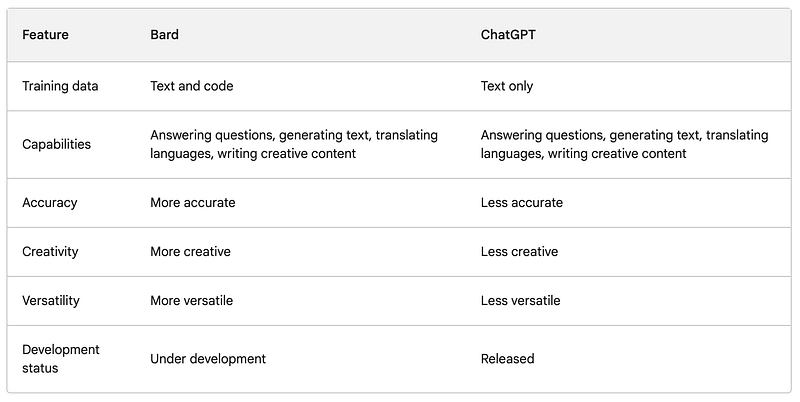
As Bard pointed out how well it does in this area, this table is very accurate. I think the accuracy feeds the creativity and versatility improvements, and to me—it is really what matters.
Examples of Bard’s Accuracy
Last fall, when I first started incorporating AI to my writing, I managed to cut my writing time by 20%. If an article took 5 hours to research, write, copy edit, post and promote—AI saved me about an hour.
Today, using Bard I can say that shift is more in the 60–80% time savings. Now normal articles take 1–2 hours. And that is because it is accurate—I usually get a right answer the first time, 95% of the time.
Bard is more likely to generate text that is factually accurate.
For example, if you ask Bard “What is the capital of France?”, Bard will correctly answer “Paris”. ChatGPT, on the other hand, is more likely to generate an incorrect answer, such as “London”.
Bard is more likely to generate text that is consistent with the context of the conversation.
For example, if you ask Bard “What is the meaning of life?”, Bard will give you a thoughtful and insightful answer. ChatGPT, on the other hand, is more likely to generate a nonsensical answer, such as “The meaning of life is 42”.
Bard is more likely to generate text that is relevant to the topic at hand.
For example, if you ask Bard “What is the history of the Roman Empire?”, Bard will give you a comprehensive and informative answer. ChatGPT, on the other hand, is more likely to generate an answer that is only tangentially related to the topic, such as “The Roman Empire was a powerful empire that lasted for centuries”.
The Road Ahead
Bard isn’t available to everyone—but the experiment is worth being part of now if you can get in. I assume both will continue to enrich their capabilities, and I fully expect to see a myriad of AIs that will be specific to areas. I am keen to see how Microsoft’s Jarvis will play here — it may be the AI to unite all AIs into a fabric that is truly useful and transformative. Time will tell, but right now—if you like ChatGPT, I think you’ll like Bard better.
That’s all for now — hope you enjoyed it!
If you did, please consider becoming a Medium member if you appreciate reading stories like this and want to help me as a writer. It costs $5 per month and gives you unlimited access to Medium content. I’ll get a little commission if you sign up via my link.