
Google vs. Microsoft: The battle of generative AI search has begun
Will ChatGPT take down the search giant?
Last year, I wrote about how Google Search is reinventing itself in 2022. The article highlighted the evolving digital landscape of search, and how the tech giant is incorporating exciting improvements to Search including advancements in Google Lens and surfacing different content mediums in search results.
But all of those developments have been overshadowed by OpenAI’s release of ChatGPT. The generative artificial intelligence (AI) chatbot has entirely transformed how people are accessing information and now with Microsoft’s investment, they’re using it to power the search engine that everyone has forgotten about, Bing.
ChatGPT and generative AI
Reaching over 100 million users within two months of launching, ChatGPT has become “the fastest-growing consumer internet app ever”. No wonder it’s such a hot topic in the tech industry right now.
Writers, developers, content creators, researchers, you name it. Everyone is using ChatGPT and for good reason. Its capabilities are pretty impressive when it comes to understanding meaning and context, and constructing fluent, grammatically-correct content.
Don’t believe it? Here’s an example of generative AI explaining generative AI:
Generative AI refers to a category of artificial intelligence (AI) algorithms that generate new outputs based on the data they have been trained on. Unlike traditional AI systems that are designed to recognize patterns and make predictions, generative AI creates new content in the form of images, text, audio, and more. (Source: Visual Capitalist)
Some of the many real-world applications of generative AI include:
- writing code for web development
- writing assistance in journalism
- creating visual advertisements based on existing ones
The common theme here is that generative AI makes things easier to do, boosting efficiency at a high-quality output.
So, how will big tech investments in generative AI search engines change the way people search for and discover information?
Google declares “Code Red”
For the past two decades, Google has dominated online search, owning about 84% of the entire market, while Microsoft only accounted for 9% of desktop searches in 2022. The search giant carries out over 8.5 billion search queries a day. That’s 99,000 searches every second. It makes a lot of sense why the term “Google” has become synonymous with searching for information.
But now Google is shaking at the knees. For the first time in a very long time, people are starting to think there may be an alternative to the world’s leading search engine.
“Google may be only a year or two away from total disruption. AI will eliminate the Search Engine Result Page, which is where they make most of their money.”
After Microsoft announced its plan to integrate ChatGPT into Bing, Google declared ‘Code Red’ as they recognized that the partnership could make or break their future.
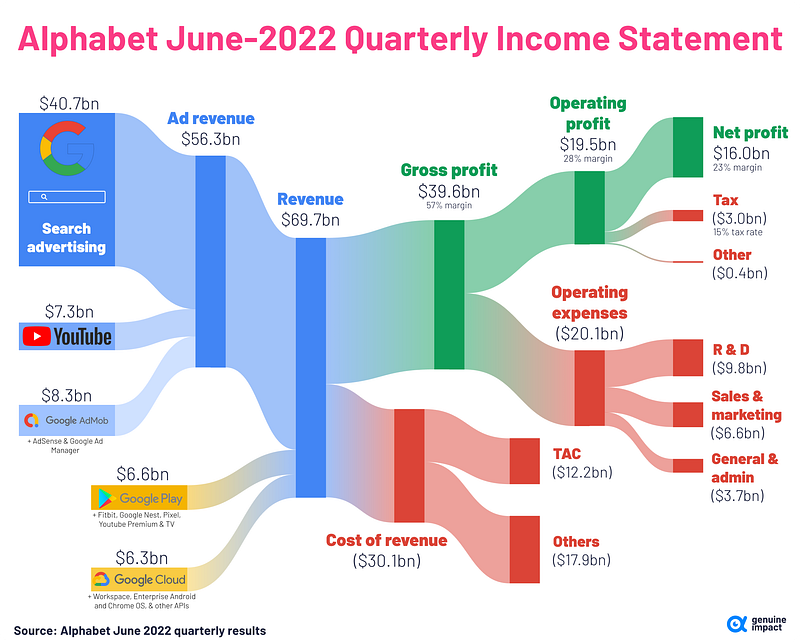
Google’s parent company Alphabet relies on the Search platform to bring in roughly 58% of its revenue from advertising, which amounted to around $40 billion per quarter in 2022.
So now, the ball is in Google’s court. Their response?
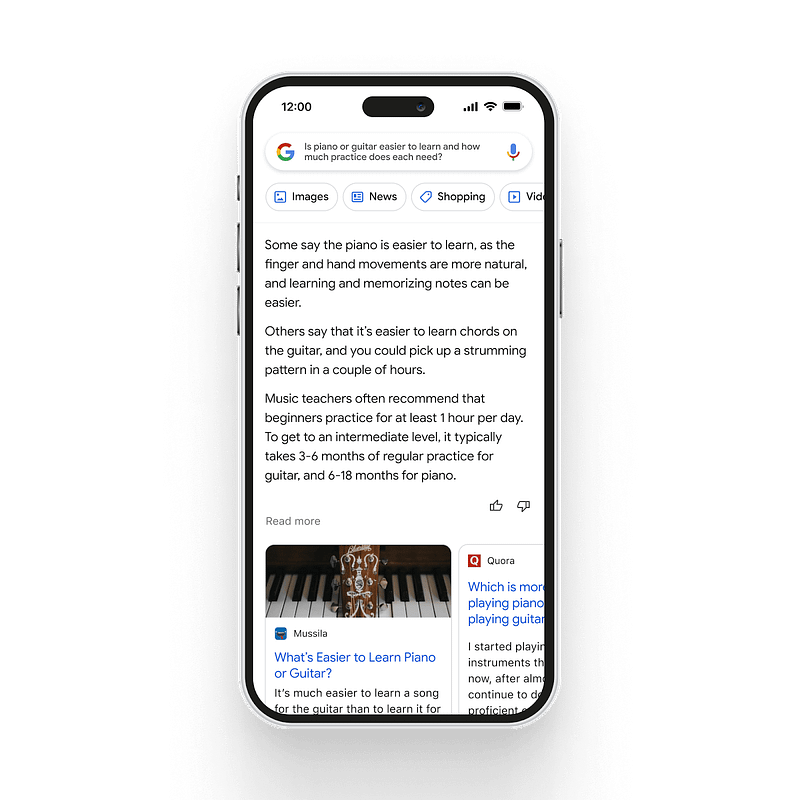
Google fired back by announcing the launch of Bard, an experimental conversational AI service that will beef up its existing search engine. They are currently testing the service with limited users, and similarly to ChatGPT, it appears that Bard will also be able to respond to queries using natural language.
Needless to say, the battle of generative AI search has begun.
Convenient access to information
With its Generative Pre-trained Transformer (GPT) language model, ChatGPT has the potential to change the way people interact with search engines. Unlike existing chatbots that just seem to get in the way of talking to a customer service agent, ChatGPT has been trained on a vast amount of data that results in it appearing to understand queries and generate responses that make sense.
Types of searches
People typically search for three reasons:
- Navigational — To find a particular website, such as ‘Medium’
- Informational — To learn about something, such as ‘the origins of Halloween’, or answer a question, such as ‘what’s a normal age to get grey hair?’
- Transactional — To make a purchase decision, which can be specific, such as ‘buy iPhone 14 Pro’, or broad, such as ‘book a flight’
After Google-ing your search query, you still have to sort through numerous links and guess which ones you think are the most relevant. Not a very efficient use of time. And if there’s one thing we know, it’s that people are all about convenience.
Think about services like Uber, DoorDash, or Instacart, each designed for convenience and to save people time, whether it’s transportation or having food delivered.
ChatGPT is no different. You can ask it questions and receive accurate, detailed answers without ever clicking on a link. Even more, you can ask it follow-up questions, much like a conversation, and it will respond while understanding the context of what you’re talking about. This is the future of convenient access to information.
Can generative AI really be trusted?
We can’t have a conversation about generative AI without mentioning the potential for misinformation, antitrust violations, and bias. AI systems can only provide information based on the data that they are trained with. Now that big tech companies are taking control of AI-powered search, there are concerns about how trustworthy the search results can be.
What’s stopping Google or Microsoft from building bias into their AI models, prioritizing certain information sources over others? You could argue that these tech companies are no strangers to antitrust lawsuits. But even then, I can only wonder how they will win over society’s trust.
Assuming that they actually play fair, there are still issues of generative AI providing inaccurate, and in some cases, inappropriate answers.
For example, ChatGPT often provides different answers to the same question, which highlights how untrustworthy it really is. But the bigger concern is how convincing it sounds to a person unknowing of the real answer. This can easily lead to the spreading of misinformation and people being falsely educated on incorrect data.
Not to mention, AI systems don’t have morals, as most people do. ChatGPT has been known to generate phishing emails that appear to come from a bank and write code that is ingrained with racist and sexist views.
These problems won’t be solved easily, but by being transparent about the data that’s being used to train the AI model, companies can try their best to appear honest in the face of consumers.
The new Bing: UX deep-dive
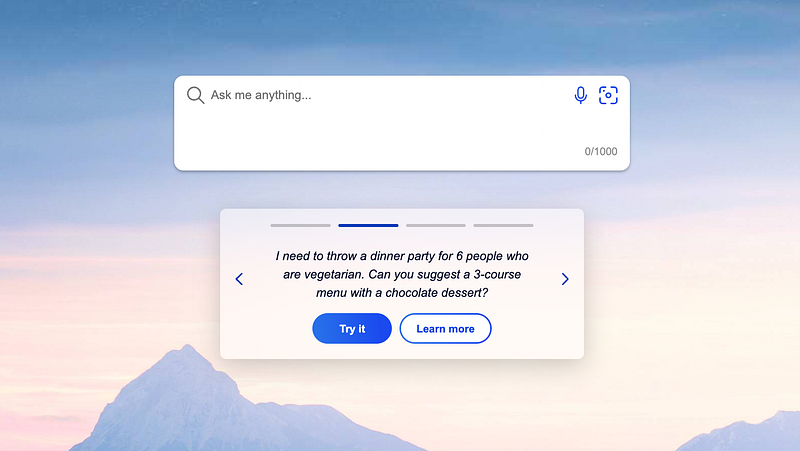
Microsoft just released its first version of the new AI-powered Bing search engine and it feels like the future is here. From a UX perspective, it’s similar to Google’s home page, featuring a text input field in the middle of the page that says “Ask me anything…”, which suggests a conversational approach to the search experience.
Bing also has voice and image search capabilities, providing alternative and accessible ways of searching.
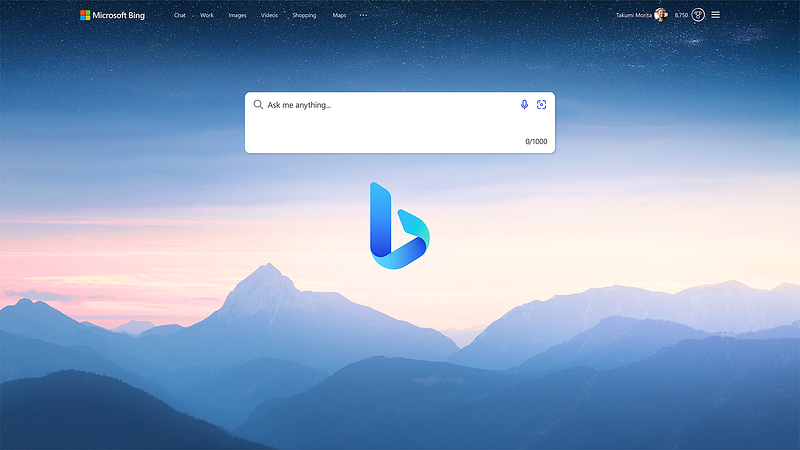
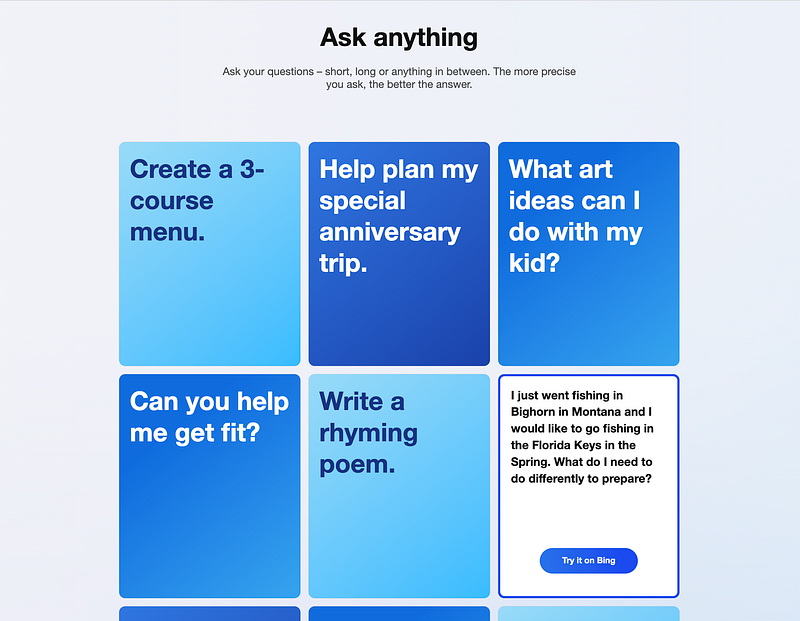
Below the search field is a carousel of suggested prompts to try out with a link to additional prompts. Many of them are catered towards seeking help in a certain activity, such as getting fit or planning for a trip.
In a way, it feels like Bing is more of a virtual assistant rather than a search engine. You ask it questions the way you would ask a human being. Provide it some context and it’ll instantly whip up an answer that’s relevant to what you’re looking for.
I tried one of the suggested prompts:
I just went fishing in Bighorn in Montana and I would like to go fishing in the Florida Keys in the Spring. What do I need to do differently to prepare?
Here’s how it responded:
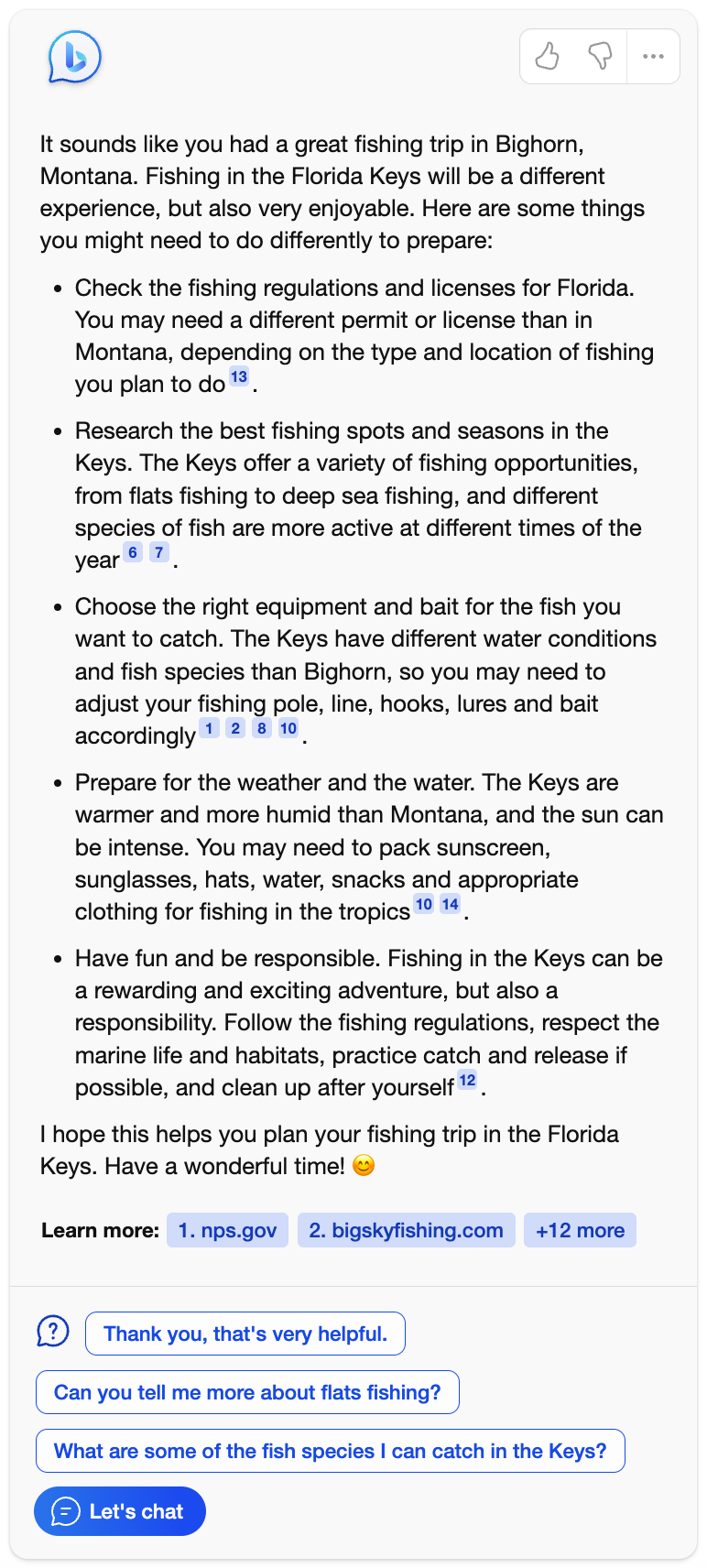
Let’s talk about some of the key aspects of Bing’s response.
1. Personality
Bing incorporates bits of personality in its response to appear more human-like. Its tone of voice is pleasant and doesn’t seem too robotic. For example, it shortened “the Florida Keys” to “the Keys” after the first mention, making it sound more natural.
ChatGPT doesn’t support emojis, so I was surprised when Bing included a smiley face at the end of its response. How thoughtful!
2. Understands context
Although I asked about fishing in the Florida Keys, Bing didn’t ignore the first part of the prompt that said “I just went fishing in Bighorn in Montana”.
It starts off by addressing my recent trip to Bighorn, which felt like a natural start to a conversation. It later compares the Keys and Montana on several factors, such as water conditions, fish species, and weather. Bing understood the full context of my question and incorporated it into its answer.
3. Cites its sources
As I mentioned earlier, the application of generative AI in products warrants the need for openness and transparency. People want to know where their information is coming from and how credible the AI really is.
Bing does this well by including footnotes and links to its sources. This helps to build people’s trust in the search engine, as the information isn’t just appearing out of thin air. It allows you to explore further into those sources and fact-check the information.
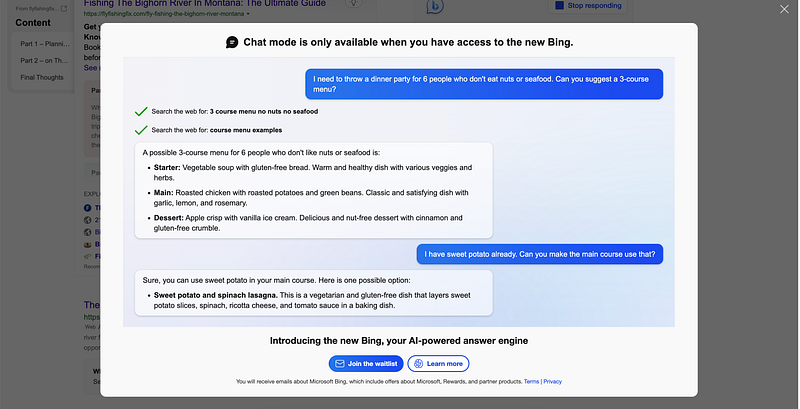
4. Chat mode
Finally, like any customer service chatbot, Bing provides a few follow-up prompts that enable Chat mode. This allows you to continue the conversation and learn more without leaving the page.
Although Chat mode is only available if you have access to the new Bing, I’m assuming this experience is similar to how you interact with ChatGPT today.
Final thoughts
So far, I’m pretty impressed with how Microsoft is rolling out its integration with ChatGPT into the new Bing. We’re still in the early stages, but I’m excited to see how the service develops throughout this year. Microsoft wasted no time in getting this functionality in front of users, as they finally have a real shot at taking down Google Search.
However, when Google finally launches Bard to the public, I can imagine that most users would stick with their preferred search engine. As long as the experience and performance of Google’s AI solution are just as good as Bing’s, then I don’t really see a threat to its Search business.
After all, throughout recent years, we’ve seen plenty of copycat products succeed, including Google’s very own YouTube Shorts. It will be interesting to see how people adjust to generative AI search down the line, but I think it’s safe to say that the way we search for information has changed forever.
Thanks for reading!
Be sure to SUBSCRIBE to never miss another article on UX design, career tips, life lessons, and more!
Here are a few more to read next:


