
Goodbye, Facebook
…and this time I mean it
“Jesse you’re such an upstanding man, I can’t believe some of your associates” — a family member
Somewhere deep in the cloud, stored in the data banks of a company like Palantir, there must be a record of how many posts I’ve made. But that number isn’t known to me. I haven’t got a clue. And that number is only the tip of the iceberg. I’m sure there are many pieces of information that the surveillance capitalists possess about me which I am totally blind to.
All I know is that every dumb, wrong, and embarrassing thing I’ve ever said along my slow path towards enlightenment is forever out there waiting to be mined by rivals who want to discredit me as an [insert pejorative label here].
For anyone like myself who refuses to retreat to an echo chamber bubble and instead attempts to engage in meaningful dialogue on Facebook, you will probably find it to be better described as the Namecalling Network.
People who disagree with a belief you may hold are highly inclined to attack your personhood rather than the idea you’re expressing. Not knowing you all that well, they immediately assume you could only ever represent the worst possible incarnation of the opposing tribe from the one they belong to.
I suspect this trend will reverse for a variety of reasons. One of them is because of the tireless efforts of good people like my friend and fellow author Fred Eder, who I met on Facebook.
Among younger audiences, there’s already a backlash against Facebook’s toxic culture on platforms like Tik Tok where positivity, fun, and whimsey are the pathway to views and likes.
But for now, Facebook is still more or less a place for strangers to introduce themselves to you by saying some form of “here’s why you’re stupid and everything that you believe in is wrong.”
Guilt by Association
Not that being told that I’m wrong is a problem for me. I like to discover that I’m wrong about something so that I can improve on that aspect.
The problem is that the Dunning-Kruger Effect runs so rampant on that platform that the people who “correct” me rarely have anything more insightful to offer than laugh emojis and insults, along with the talking points of the day from their side of the debate’s pundits.
Every argument I’ve wasted hours or even days on stands as an eternal monument to my poor time management. The enormity of the opportunity cost aside, there is also the cost hinted at by the opening quote by a family member: guilt by association.
Towards the end of 2019, when I was at the height of my optimism about Andrew Yang’s campaign, I friend requested about 1000 Yang Gang. There are some ways in which much of my growth in the past year is owed to the connections I made from this decision.
But on the downside, I’ve befriended lots of people over the last year on Facebook who I would not want to be associated with outside of argumentation and debate. I’ve had ongoing dialogues with everyone ranging from ultraconservative fundamentalist Christians to diehard antitheists. From far left anarchists and Communists to far-right fascists and antisemitic conspiracy theorists. From Black Lives Matter protesters who explicitly advocated for violence against police, to Conservatives who rejoice in the completion of the “Kenosha Mile” (Twitter is toxic too, there’s a lot of crossovers).
And everything in between.
By contrast, when that motley crew of ideologically diverse misfits that I’ve “friended” on Facebook chime in on my page to heckle my content, people seem to think their nonsense is a reflection of who I am or what I think.
Here’s the thing. There is a steep chasm of difference separating the experience of posting on Medium and posting on Facebook.
On this platform, I mostly get support and encouragement even though I’m sure not everyone agrees with me. Even when they don’t, even if I get strong pushback on a controversial post like this, it is generally helpful and about the content.
Most importantly, on Medium, no one is tempted to believe that I am actually good friends with my hecklers (few as they are).
By contrast, when that motley crew of ideologically diverse misfits that I’ve “friended” on Facebook chime in on my page to heckle my content, people seem to think that it is a reflection of who I am.
As an example, when I posted this upon learning that the president had COVID-19
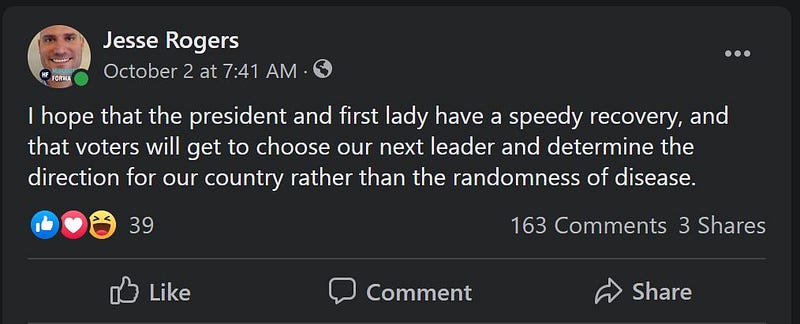
Some of the comments I got went like this
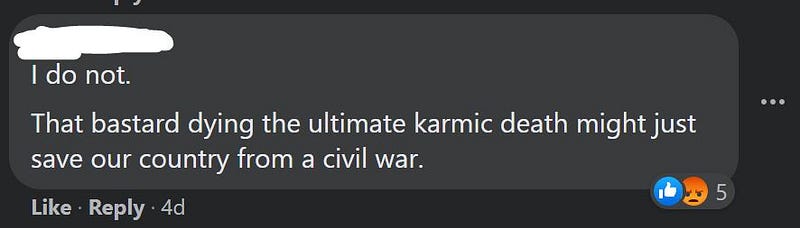
Or this
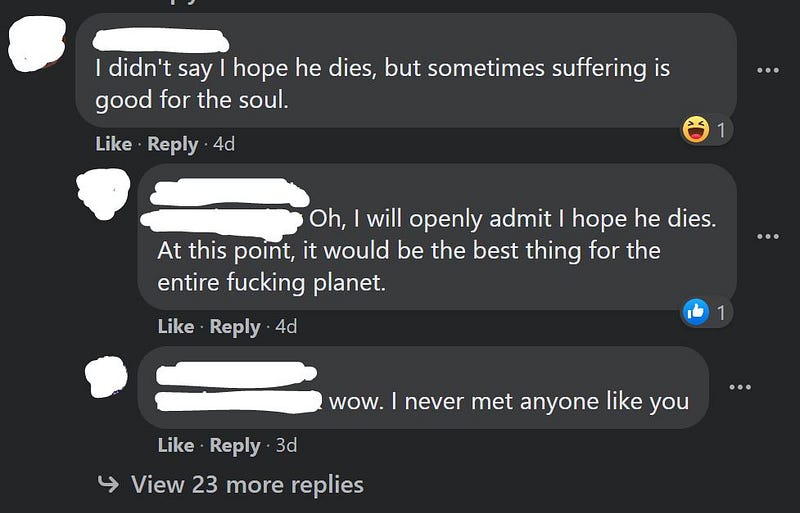
Again, if readers say offensive things in the comments section of this article, few will think I am in any way blameworthy for that.
But on Facebook, responsibility both for the inevitable dumpster fire of the comments section and for what’s said in the 409 member group that I created there seems to somehow fall on my shoulders?
On Facebook, I am not compensated at all for my work and efforts.
Here on Medium, I earn exponentially increasing money.
Facebook is lopsided into feeling like it’s all cost and no reward, so I sometimes wonder why I’m even still there. Should I just delete my account and be done with it?
The only reason I won’t is that in addition to my career as a writer I’ve also recently gotten my real estate license and I plan to run ads, make connections, and share listings on Facebook.
But as far as participating in the marketplace of ideas and the debates surrounding the issues of our time, all of that will now be done exclusively on Medium behind the paywall.
In Zoom calls, messenger, and podcasts, I’ll still talk with some of the friends that I’ve made from Resurgent.Us. But for the most part, count me as retired from the culture wars. I‘d rather catch people doing good and interesting things unrelated to politics, as I did here.


