
Good is the Enemy of Great
How to make the transition from good to great?
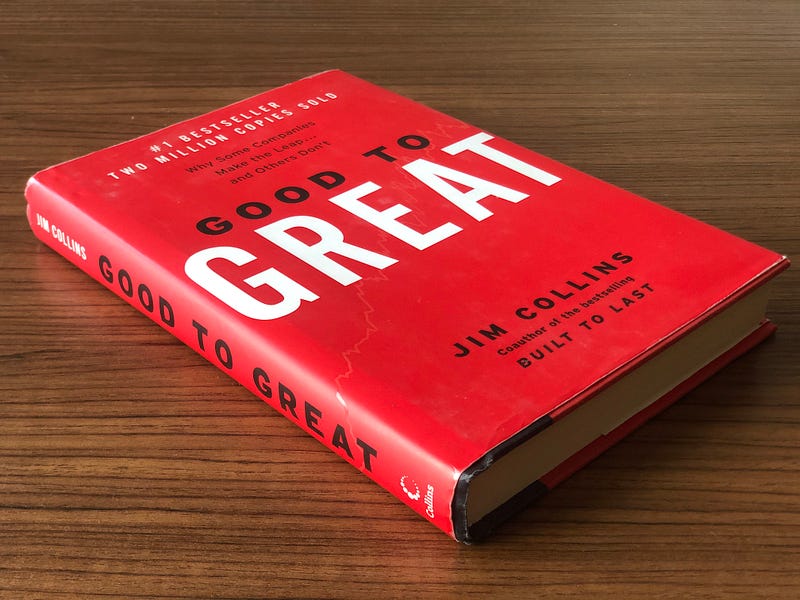
This book, “Good to Great: Why Some Companies Make the Leap… and Others Don’t” by Jim Collins — co-author of the book “Built to Last: Successful Habits of Visionary Companies” with Jerry I. Porras — was first published in 2001 and has sold millions of copies. It still sells more than 200,000 copies every year. It ranks #3 in Strategic Management and #7 in Business Systems & Planning categories of Amazon’s Book sales ranking.
Collins and his team focused on eleven companies, selected among 1,435 companies, including well-known ones such as Circuit City, Wells Fargo, and Gillette that were able to renovate themselves and make the transition from ‘good’ to ‘great’.
All these eleven companies showed the following basic pattern: Fifteen-year cumulative stock returns at or below the general stock market –where you cannot just be lucky for fifteen years- punctuated by a transition point, then cumulative returns at least three times the market over the next fifteen years.
To reach the key findings and way to greatness, Collins and his 21-person research team contributed 15,000 hours of work to the project, read and systematically coded nearly 6,000 articles, generated more than 2,000 pages of interview transcripts, and created 384 million bytes of computer data in a five-year project.
Most business books are analyzing the past successes or failures of the companies. How did these companies succeed? Where did they make the mistakes? These are some of the questions that the authors were trying to answer.
Jim Collins’ message is not solely for people who are in the business sector, but also to those who can apply what they learned from the book to their companies, social sector work, or at least to their own life. There is a focus on the values and principles which were helpful in the past and will be helpful in the future in Collins’s “Good to Great”.

The book consists of nine chapters that begin with “Good is the enemy of Great”. In this first chapter, the author explains how he decided to work on such a huge project with a research team of twenty-one people. Outlines of the project and previews of the key findings are also described in Chapter 1.
The process of transformation of the companies breaks down into three broad stages: disciplined people, disciplined thought, and disciplined action. There are also two key concepts within each of these three stages. These all six concepts are the essence of “Good to Great” and he assigns a chapter for each of them, which are Level 5 Leadership, First Who… Then What, Confront the Brutal Facts, The Hedgehog Concept, A Culture of Discipline, and Technology Accelerators.
Level 5 Leadership
In chapter 2, Jim Collins came up with a definition of Level 5 Leader — an individual who blends extreme personal humility with an intense professional will, and a definition of Level 5 Leadership — builds enduring greatness through a paradoxical blend of personal humility and professional will. According to Collins, HUMILITY + WILL = LEVEL 5 (page 22) and this formula is acceptable if we think humility as part of Personal Humility and will as part of “Professional Will.”
He should include the characteristics of the people in the formula; however, he might have thought that humility and will are results of people’s characteristics not to write the same thing again and again. Ambition (passion and energy should be a part of it) will drive a leader to do whatever it takes to achieve his or her goals and get things done successfully. Loyalty is the faith that leads level 5 leaders to stay with problems and get them fixed, instead of remaining blind to troubles.
Experience is another important factor of being a level 5 leader. It takes time for people to practice and learn from their mistakes and it takes years for CEOs to cultivate their mind and wisdom, to accumulate experiences, and to learn right from wrong. Therefore, no one is born to be a level 5 leader without experiences.
In chapter 3, Collins clearly defines that during the transition from good to great, companies should first have the right people on the bus (and the wrong people off the bus) and then try to figure out where to drive it. Actually, this was not what they expected before the project.
They thought that the first step would be to set up a new direction, strategy, and vision for the company. The truth is that if you get the right people on the bus, the right people in the right seats, and the wrong people off the bus, they will drive the company somewhere great.
“There is no worse mistake in public leadership than to hold out false hopes soon to be swept away.”
Winston S. Churchill
Disciplined Thought
Chapter 4 and Chapter 5 are about the second stage which is called “disciplined thought” (confront the brutal facts and the hedgehog concept). The breakthrough between level 4 and level 5 leadership appears in this stage. It is important for Good to Great companies to face brutal facts because that is the way to make the first step towards achieving greatness. A cycle of good decisions is one of the key factors in the success of the great companies and the author and his research team made a clear clarification of its process.
The Hedgehog Concept differentiates between CEOs. Collins has very appropriately included Isaiah Berlin’s essay, “The Hedgehog and the Fox,” in which he refers to a Greek parable: “The fox knows many things, but the hedgehog knows one big thing.” According to the results of the huge project, the good-to-great companies were built by “hedgehogs” who were capable of focusing on one important thing that carried their companies to greatness.
There are three circles of the Hedgehog Concept — what you are deeply passionate about, what you can be the best in the world at, what drives your economic engine — and companies need all three circles in order to have a fully developed concept.
Disciplined Action
In the part of “disciplined action” which covers chapters 6 and 7 (A Culture of Discipline and Technology Accelerators), Collins makes a connection between the former chapters and these two chapters. The good-to-great companies built steady systems with clear restrictions, but they also gave people freedom and responsibility within the framework of a highly developed system.

This begins with the right people (chapter 3) who take disciplined action and are consistent with the three circles of the hedgehog concept. There are two types of individuals: those who see their job as a “responsibility” and those who see their job as a “job”. The first type of people would take the company to greatness as their responsibility.
They “engage in disciplined thoughts and take disciplined actions” (page 142) to work out any possibilities to help the company become the best in the world. Their own objectives and the company’s objectives are parallel, so they believe that if they spend time on the company’s objective, their own objective will become true automatically.
The second type of people would not pay attention much about responsibilities and disciplines. They just want to work to meet the basic requirements and only expect to get their paycheck on time. The technology issue is not one of the top factors in the transition, Collins’s study says. The good-to-great companies used technology as an accelerator of momentum, not a creator of it; therefore, technology by itself cannot be the main reason for either greatness or decline, and that’s why 80 percent of good-to-great executives didn’t even mention technology as a top factor.
No technology can make people a level 5 leader, or turn the wrong people into the right people. It is impossible for the technology itself to create a culture of discipline or displace the need for a deep understanding of the three circles and the translation of that understanding into a simple Hedgehog Concept.
What Jim Collins says for the very first sentence of the book is “Good is the enemy of great.” As a result of 5-years team project, Collins and his team accomplished a great work by presenting this book to the business world. The findings and the discovery of “Good to Great” would be helpful in every area of management in terms of strategy, mission, vision, and practice. I believe Good to Great is one of those books that supervisors, managers, CEOs, and CFOs will be reading for years.


